
Black Holes and Neutron Stars Dead Stars Copyright
Black Holes and Neutron Stars Dead Stars Copyright – A. Hobart 9 A
Goals • • • What are neutron stars and pulsars? What are black holes? What happens near a black hole? How do we see black holes? What happens when neutron stars and black holes are in binaries? 9 A
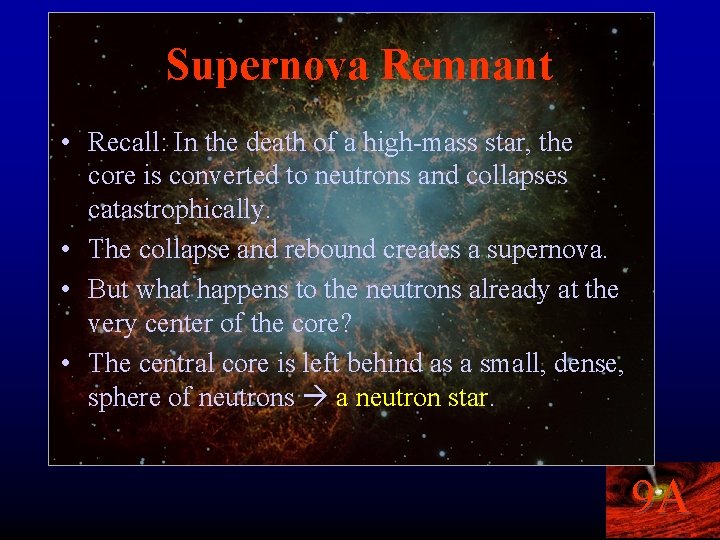
Supernova Remnant • Recall: In the death of a high-mass star, the core is converted to neutrons and collapses catastrophically. • The collapse and rebound creates a supernova. • But what happens to the neutrons already at the very center of the core? • The central core is left behind as a small, dense, sphere of neutrons a neutron star. 9 A
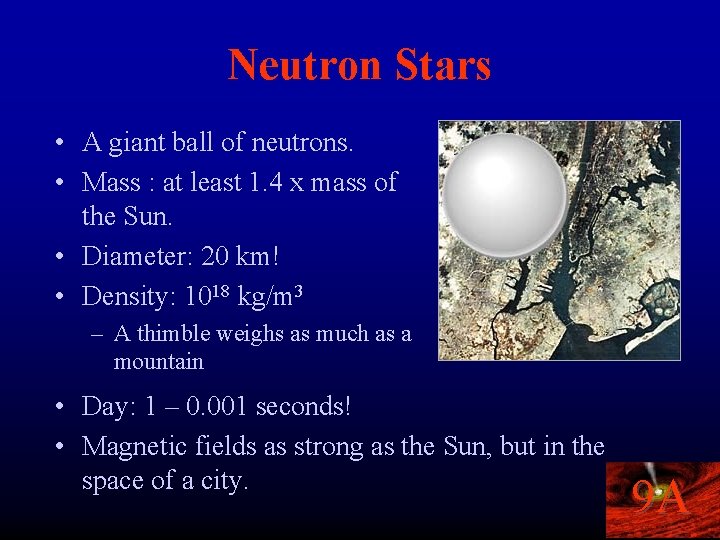
Neutron Stars • A giant ball of neutrons. • Mass : at least 1. 4 x mass of the Sun. • Diameter: 20 km! • Density: 1018 kg/m 3 – A thimble weighs as much as a mountain • Day: 1 – 0. 001 seconds! • Magnetic fields as strong as the Sun, but in the space of a city. 9 A

Pulsars • Interstellar Lighthouses. • See periodic bursts of radiation. • Perfect clocks. • While every pulsar is a neutron star, the opposite isn’t true. 9 A
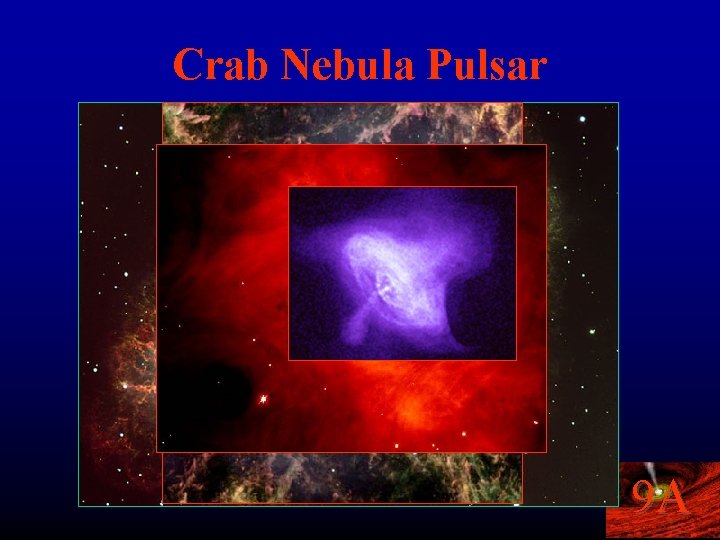
Crab Nebula Pulsar 9 A
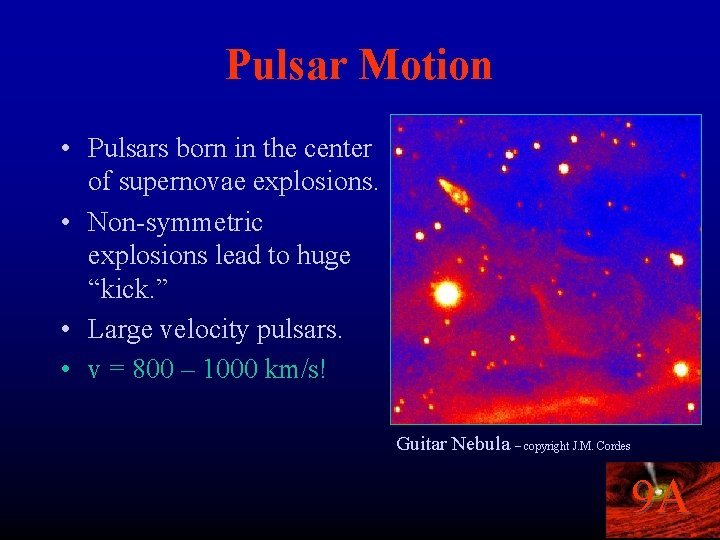
Pulsar Motion • Pulsars born in the center of supernovae explosions. • Non-symmetric explosions lead to huge “kick. ” • Large velocity pulsars. • v = 800 – 1000 km/s! Guitar Nebula – copyright J. M. Cordes 9 A
Neutron Degeneracy • Neutron stars are held up by neutron degeneracy pressure. – Recall electron degeneracy pressure for white dwarfs. – For white dwarfs, maximum mass of 1. 4 Msun • For neutron stars, maximum mass ~3 Msun • What happens if a high-mass star is SO big that its central core is bigger than this? • What happens when gravity is stronger than even neutron degeneracy pressure? 9 A
Density • Density = mass per volume • From Red Giant cores to White Dwarfs to Neutron Stars, density has been increasing. • As density increases, the force of gravity on the surface increases. • The greater the force, the higher the escape velocity: – How fast you need to go in order to escape the surface. • How dense can something get? • How strong can the force of gravity be? • What if the escape velocity is faster than light? 9 A
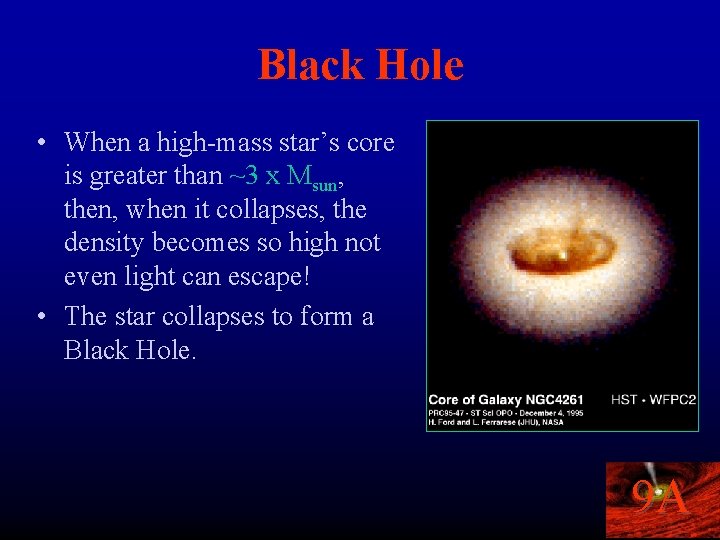
Black Hole • When a high-mass star’s core is greater than ~3 x Msun, then, when it collapses, the density becomes so high not even light can escape! • The star collapses to form a Black Hole. 9 A
9 A
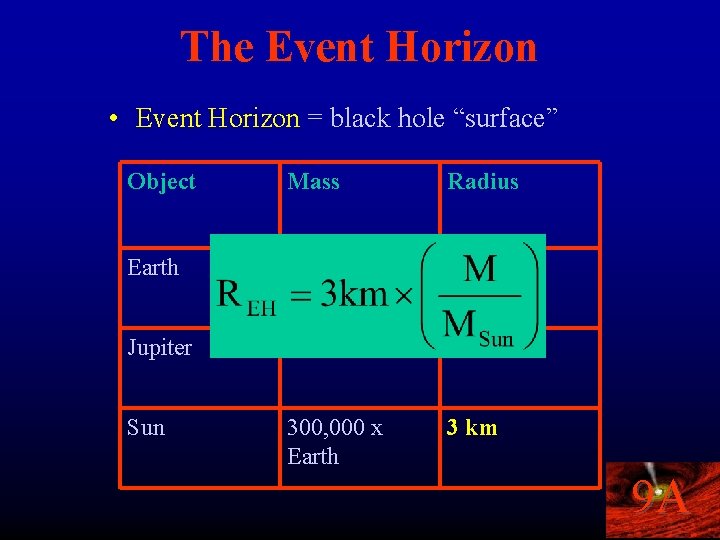
The Event Horizon • Event Horizon = black hole “surface” Object Mass Radius Earth 6 x 1024 kg 1 cm Jupiter 300 x Earth 3 m Sun 300, 000 x Earth 3 km 9 A
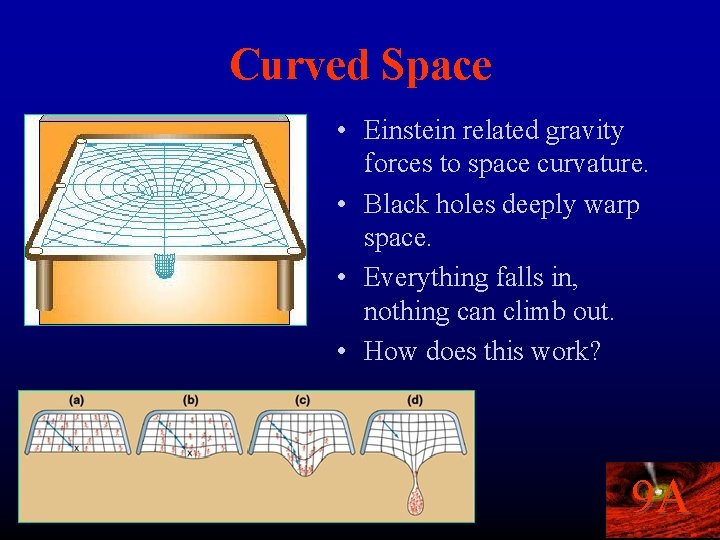
Curved Space • Einstein related gravity forces to space curvature. • Black holes deeply warp space. • Everything falls in, nothing can climb out. • How does this work? 9 A
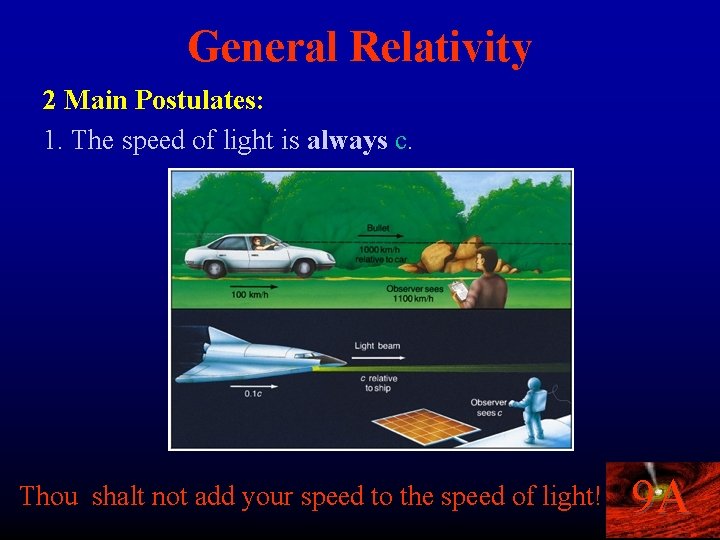
General Relativity 2 Main Postulates: 1. The speed of light is always c. Thou shalt not add your speed to the speed of light! 9 A
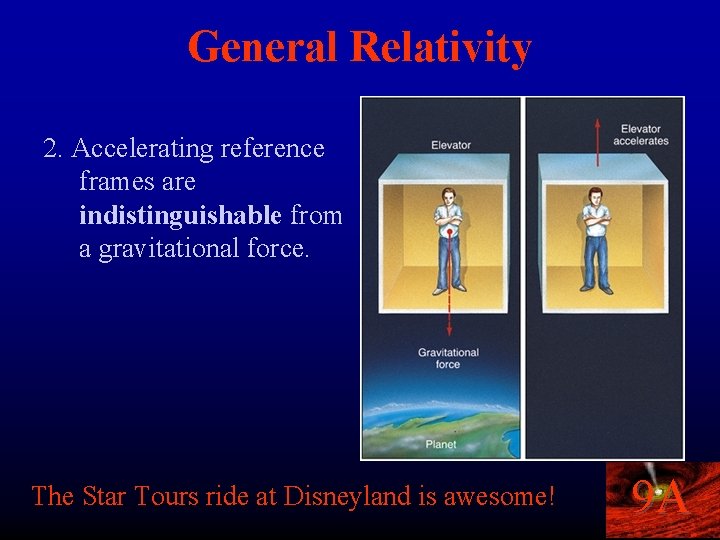
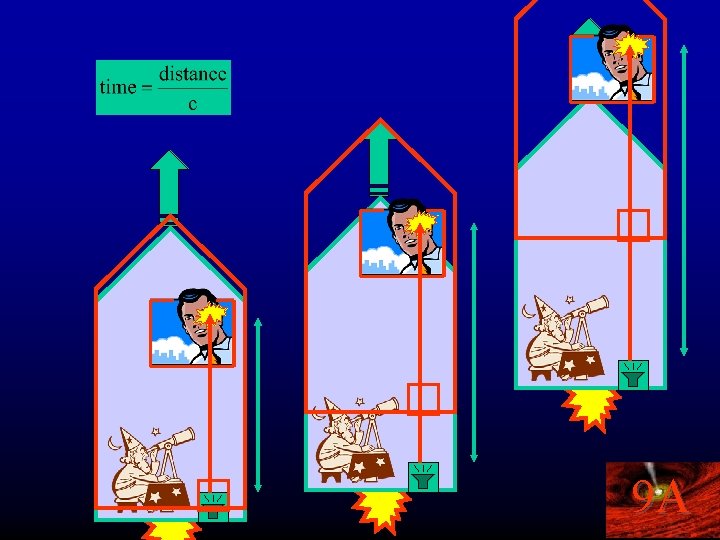
General Relativity 2. Accelerating reference frames are indistinguishable from a gravitational force. The Star Tours ride at Disneyland is awesome! 9 A
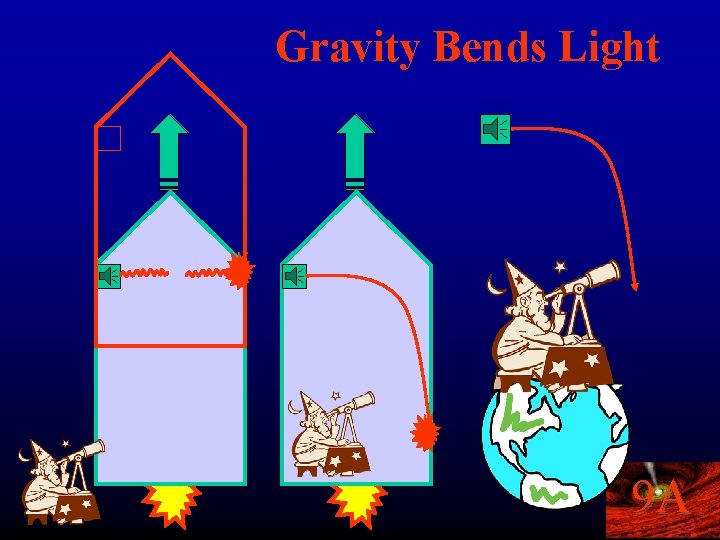
Gravity Bends Light 9 A
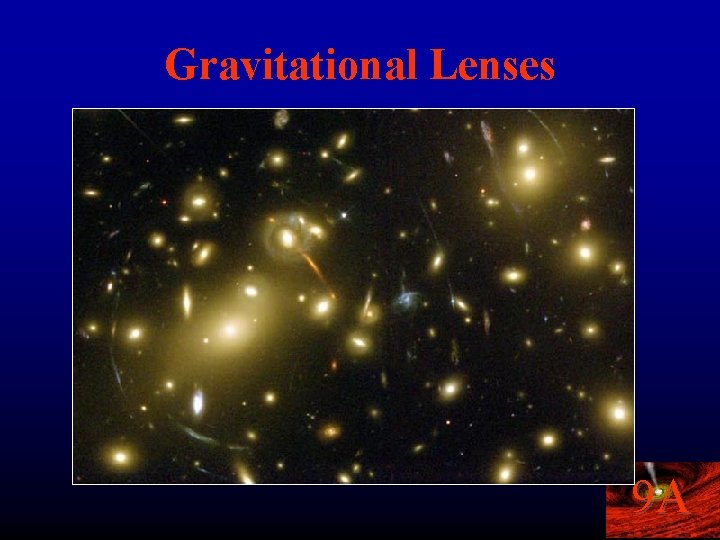
Gravitational Lenses 9 A
9 A
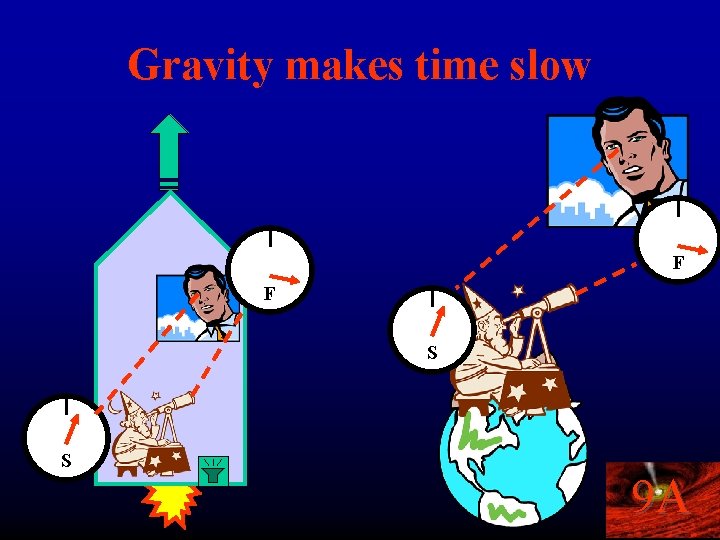
Gravity makes time slow F F S S 9 A
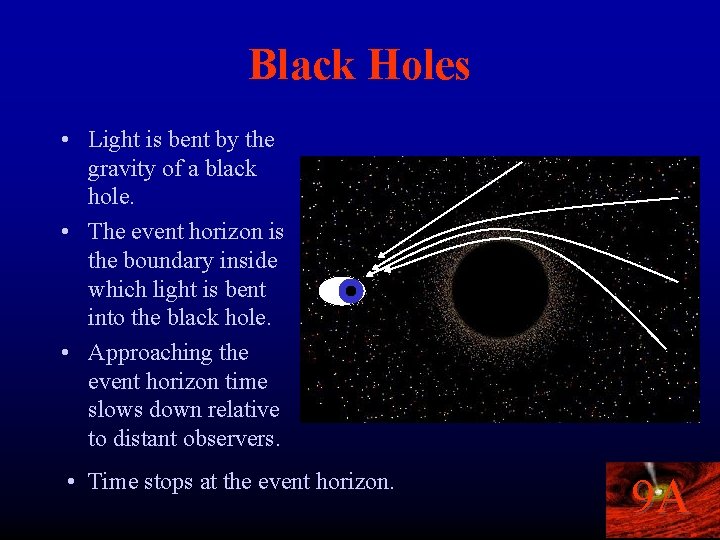
Black Holes • Light is bent by the gravity of a black hole. • The event horizon is the boundary inside which light is bent into the black hole. • Approaching the event horizon time slows down relative to distant observers. • Time stops at the event horizon. 9 A
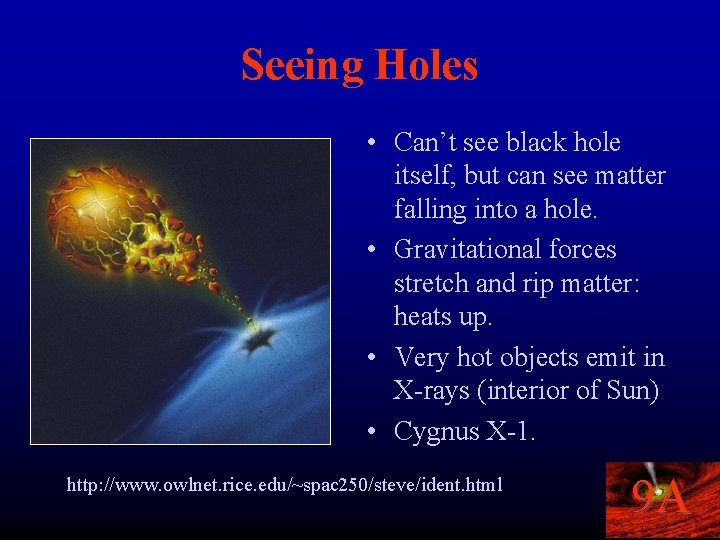
Seeing Holes • Can’t see black hole itself, but can see matter falling into a hole. • Gravitational forces stretch and rip matter: heats up. • Very hot objects emit in X-rays (interior of Sun) • Cygnus X-1. http: //www. owlnet. rice. edu/~spac 250/steve/ident. html 9 A
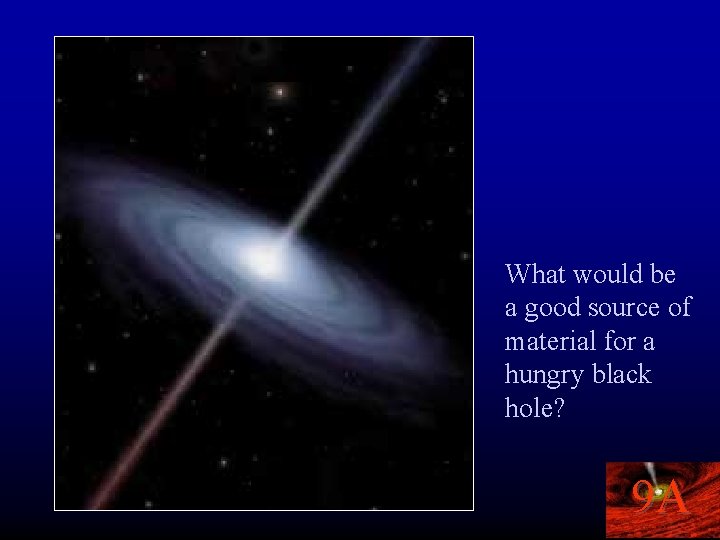
What would be a good source of material for a hungry black hole? 9 A
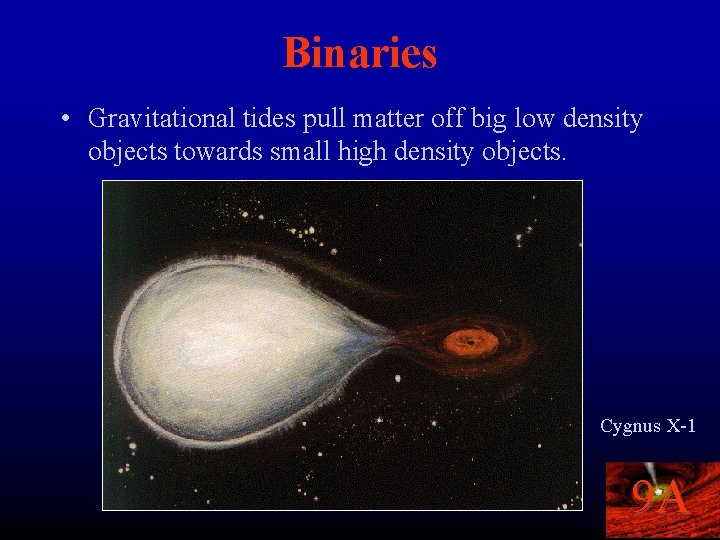
Binaries • Gravitational tides pull matter off big low density objects towards small high density objects. Cygnus X-1 9 A
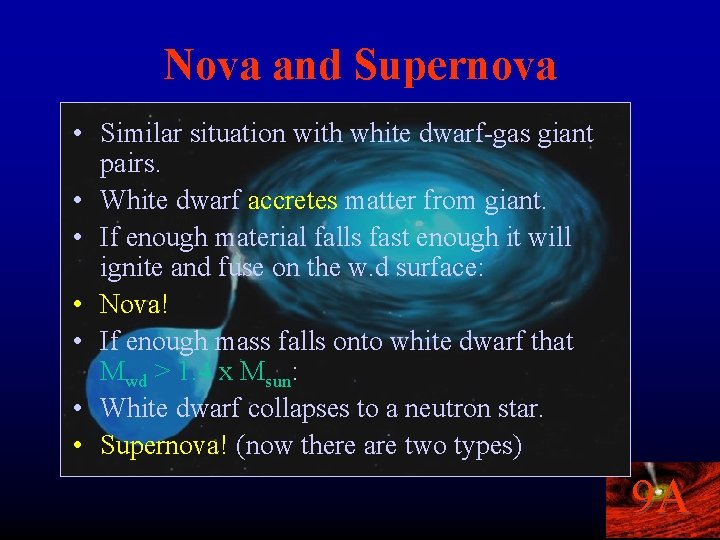
Nova and Supernova • Similar situation with white dwarf-gas giant pairs. • White dwarf accretes matter from giant. • If enough material falls fast enough it will ignite and fuse on the w. d surface: • Nova! • If enough mass falls onto white dwarf that Mwd > 1. 4 x Msun: • White dwarf collapses to a neutron star. • Supernova! (now there are two types) 9 A
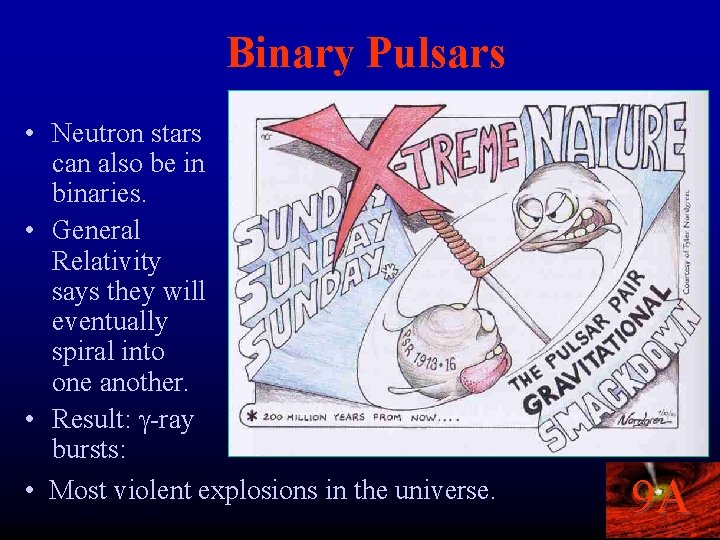
Binary Pulsars • Neutron stars can also be in binaries. • General Relativity says they will eventually spiral into one another. • Result: g-ray bursts: • Most violent explosions in the universe. 9 A
- Slides: 25