
Black Hole Thermodynamics The horizon area theorem Stephen
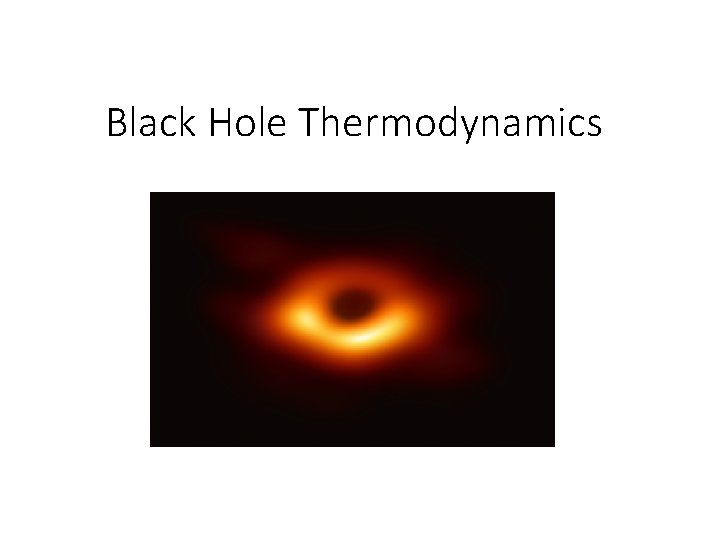
Black Hole Thermodynamics
![The horizon area theorem [Stephen Hawking] 1970: Stephen Hawking uses theory of general relativity](http://slidetodoc.com/presentation_image_h/148b002ff001a683fc8db7318faf3201/image-2.jpg "The horizon area theorem [Stephen Hawking] 1970: Stephen Hawking uses theory of general relativity")
The horizon area theorem [Stephen Hawking] 1970: Stephen Hawking uses theory of general relativity to derive the so-called Horizon area theorem The total horizon area in a closed system containing black holes never decreases. It can only increase or stay the same
![Analogy between the area theorem and the 2 nd law of thermodynamic [Jacob Beckenstein]](http://slidetodoc.com/presentation_image_h/148b002ff001a683fc8db7318faf3201/image-3.jpg "Analogy between the area theorem and the 2 nd law of thermodynamic [Jacob Beckenstein]")
Analogy between the area theorem and the 2 nd law of thermodynamic [Jacob Beckenstein] Shortly after Stephen Hawking Formulated the area theorem, Jacob Beckenstein, at the time a graduate student at Princeton, noticed the analogy between the area theorem and the 2 nd law of thermodynamics: The total area of a closed system never decreases. Entropy: logarithm of the number of ways you can relocate the atoms and molecules of a system without changing the overall properties of the system.
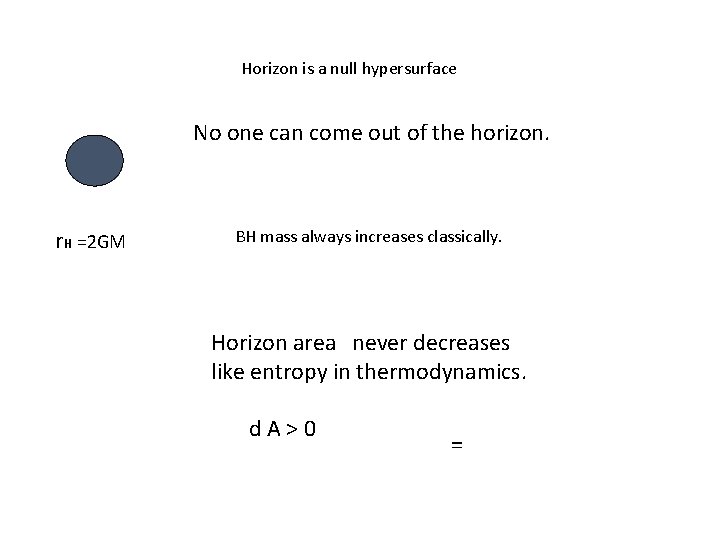
Horizon is a null hypersurface No one can come out of the horizon. r. H =2 GM BH mass always increases classically. Horizon area never decreases like entropy in thermodynamics. d. A>0 =
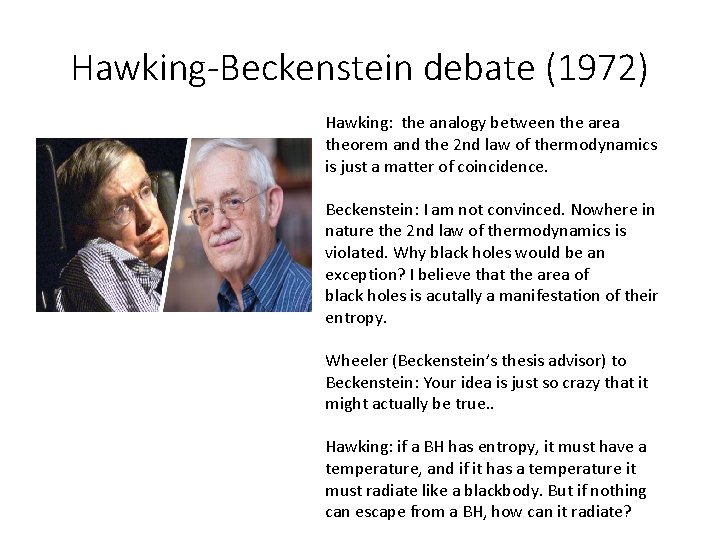
Hawking-Beckenstein debate (1972) Hawking: the analogy between the area theorem and the 2 nd law of thermodynamics is just a matter of coincidence. Beckenstein: I am not convinced. Nowhere in nature the 2 nd law of thermodynamics is violated. Why black holes would be an exception? I believe that the area of black holes is acutally a manifestation of their entropy. Wheeler (Beckenstein’s thesis advisor) to Beckenstein: Your idea is just so crazy that it might actually be true. . Hawking: if a BH has entropy, it must have a temperature, and if it has a temperature it must radiate like a blackbody. But if nothing can escape from a BH, how can it radiate?
1974: end of the debate and discovery of the Hawking radiation • 1974: Hawking admits that Beckenstein was right: Black Holes have entropy, which is proportional to their area. However, this no longer constitutes a problem, because Hawking discovers a mechanism by which black holes can radiate. This mechanism involves quantum-mechanical processes near the BH horizon. According to quantum mechanics, vacuum is no longer an “empty” state as in classical physics. Instead, it is a place where “virtual particles” are constantly created and destroyed. The creation of a couple of particleantiparticle pair of energy is allowed in quantum mechanics as long as their lifetime satisfies the Heisenberg uncertainty principle.
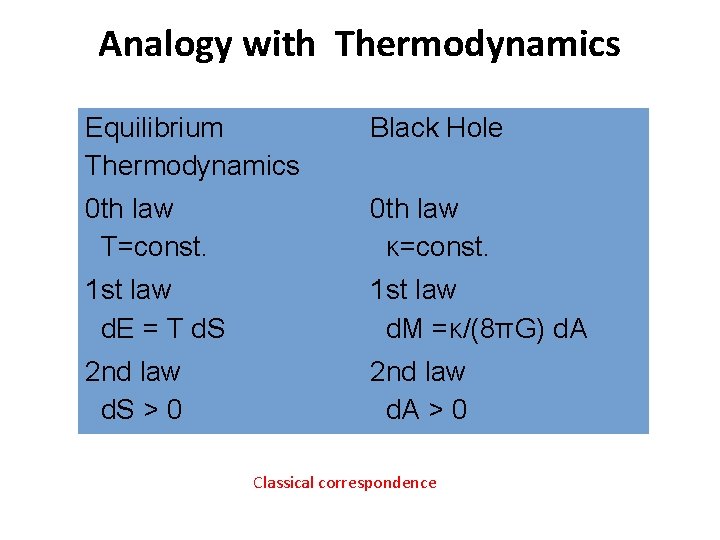
Analogy with Thermodynamics Equilibrium Thermodynamics Black Hole 0 th law T=const. 0 th law κ=const. 1 st law d. E = T d. S 1 st law d. M =κ/(8πG) d. A 2 nd law d. S > 0 2 nd law d. A > 0 Classical correspondence
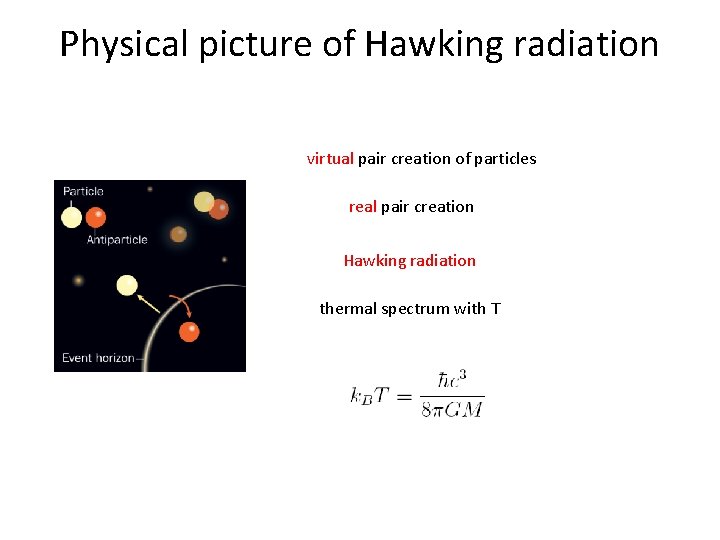
Physical picture of Hawking radiation virtual pair creation of particles real pair creation Hawking radiation thermal spectrum with T
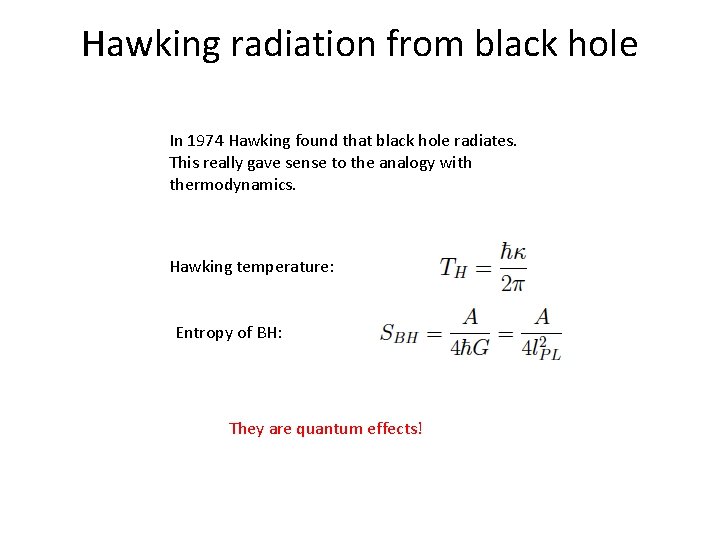
Hawking radiation from black hole In 1974 Hawking found that black hole radiates. This really gave sense to the analogy with thermodynamics. Hawking temperature: Entropy of BH: They are quantum effects!
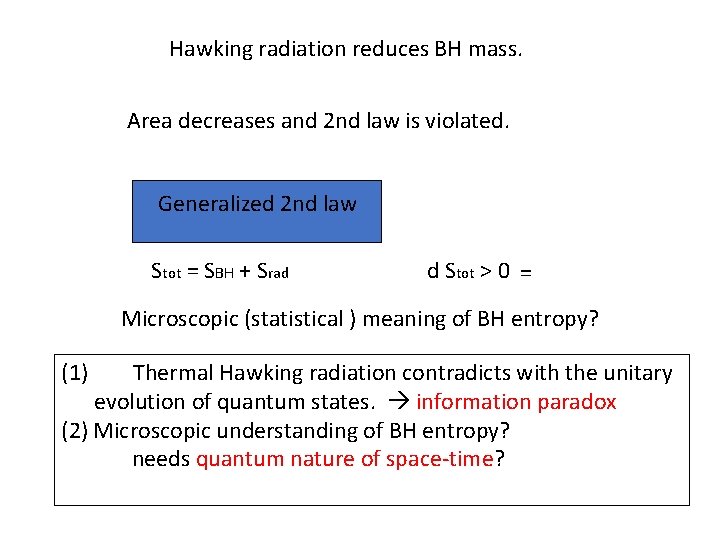
Hawking radiation reduces BH mass. Area decreases and 2 nd law is violated. Generalized 2 nd law Stot = SBH + Srad d Stot > 0 = Microscopic (statistical ) meaning of BH entropy? (1) Thermal Hawking radiation contradicts with the unitary evolution of quantum states. information paradox (2) Microscopic understanding of BH entropy? needs quantum nature of space-time?
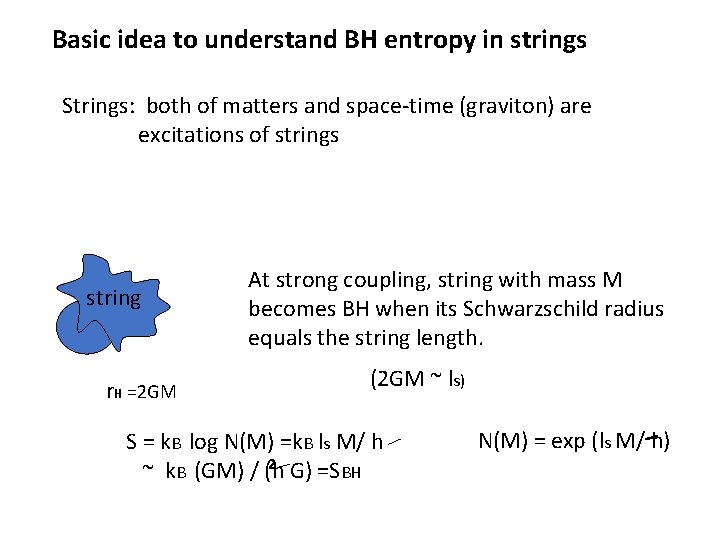
Basic idea to understand BH entropy in strings Strings: both of matters and space-time (graviton) are excitations of strings string r. H =2 GM At strong coupling, string with mass M becomes BH when its Schwarzschild radius equals the string length. (2 GM ~ ls) S = k. B log N(M) =k. B ls M/ h 2 ~ k. B (GM) / (h G) =SBH N(M) = exp (ls M/ h)
Hawking’s latest discovery (2004) information is not completely lost when falling into a BH into a black hole If you jump into a BH, your mass and energy will be returned to our Universe, but in a mangled form, which contains information about what you were like, but in an unrecognizable state

Thank you
- Slides: 13