
BKCASE Body of Knowledge and Curriculum to Advance
BKCASE: Body of Knowledge and Curriculum to Advance Systems Engineering Status Update Dave Olwell, Department of Systems Engineering, NPS IEEE Systems Conference
What is BKCASE? • Project led by Stevens Institute of Technology and Naval Postgraduate School to create two primary products: – Body of Knowledge in systems engineering (SEBo. K) – Graduate Reference Curriculum in Systems Engineering (GRCSE) • Started in September 2009 and will run through 2012 • Intended for world-wide use • Not intended to be used directly for accreditation 01/27/2010 2
BKCASE Vision and Objectives Vision “Systems Engineering competency models, certification programs, textbooks, graduate programs, and related workforce development initiatives around the world align with BKCASE. ” Objectives 1. Create a SEBo. K that is globally recognized by the SE community as the authoritative Bo. K for the SE discipline. 2. Create a graduate reference curriculum for SE (GRCSE – pronounced “Gracie”) that is globally recognized by the SE community as the authoritative guidance for graduate programs in SE. 3. Facilitate the global alignment of related workforce development initiatives with SEBo. K and GRCSE. 4. Transfer stewardship of SE Bo. K and GRCSE to INCOSE and the IEEE after BKCASE publishes version 1. 0 of those products, including possible integration into their certification, accreditation, and other workforce development and education initiatives. 01/27/2010 3 3
37 Authors as of April 2010 Rick Adcock, Cranfield University and INCOSE, UK Bud Lawson, Lawson Konsult AB, Sweden Johann Amsenga, Eclipse RDC, South Africa Alex Lee, Defence Science and Technology Agency, Singapore Erik Aslaksen, Sinclair Knight Merz, Australia Ray Madachy, Naval Postgraduate School, US John Baras, IEEE Systems Council and University of Maryland, US Andrew Mc. Gettrick, Association for Computing Machinery (ACM) Education Board and Education Council Barry Boehm, University of Southern California, US Cihan Dagli, Missouri University of Science and Technology, US J. Ekstrom, Brigham Young University, US Ken Nidiffer, Software Engineering Institute and IEEE Systems Council, US Dave Olwell, Naval Postgraduate School and BKCASE Co-Principal Investigator, US Art Pyster, Stevens Institute of Technology and BKCASE Principal Investigator, US Alain Faisandier, Map Systeme, France Garry Roedler, Lockheed Martin and National Defense Industrial Association Systems Engineering Division, US Tim Ferris, University of South Australia and INCOSE, Australia Jean-Claude Roussel, EADS, France Kevin Forsberg, Center for Systems Management and INCOSE, US Sven-Olaf Schulze, Berner & Mattner Systemtechnik Gmb. H, Germany Richard Freeman, Air Force Center for Systems Engineering, US Jon Gye Shin, Seoul National University, South Korea Sandy Friedenthal, Lockheed Martin, US Richard Frost, General Motors, US Edward Ghafari, ICES Corporation and Defense Information Systems Agency, US Richard Grzybowski, Corning Incorporated, US Hillary Sillitto, Thales Group and INCOSE, UK John Snoderly, Defense Acquisition University, US Tom Hilburn, IEEE Computer Society and Embry-Riddle University, US Scott Jackson, University of Southern California, US 01/27/2010 Michael Krueger, ASE Consulting, US 30 -31 March 2010 Alice Squires, Stevens Institute of Technology, US Massood Towhidnejad, Embry-Riddle University, US Guilherme Travassos, Federal University of Rio de Janeiro and Brazilian Computer Society, Brazil Mary Van. Leer, Arkansas Scholarship Lottery, US Brian Wells, Raytheon, US 4 4
Our Partners 5 30 -31 March 2010
SEBo. K Value Proposition 1. There is no authoritative source that defines and organizes the knowledge of the SE discipline, including its methods, processes, practices, and tools. The resulting knowledge gap creates unnecessary inconsistency and confusion in understanding the role of SE in projects and programs; and in defining SE products and processes. SEBOK will fill that gap, becoming the “go to” SE reference. 2. The process of creating the SEBo. K will help to build community consensus on the boundaries and context of SE thinking and to use this to help understand improve the ability of management, science and engineering disciplines to work together. 3. Having a common way to refer to SE knowledge will facilitate communication among systems engineers and provide a baseline for competency models, certification programs, educational programs, and other workforce development initiatives around the world. Having common ways to identify metadata about SE knowledge will facilitate search and other automated actions on SE knowledge. 01/27/2010 6 6
GRCSE Value Proposition • There is no authoritative source to guide universities in establishing the outcomes graduating students should achieve with a master’s degree in SE, nor a guidance source on reasonable entrance expectations, curriculum architecture, or curriculum content. • This gap in guidance creates unnecessary inconsistency in student proficiency at graduation, makes it harder for students to select where to attend, and makes it harder for employers to evaluate prospective new graduates. • GRCSE will fill that gap, becoming the “go to” reference to develop, modify, and evaluate graduate programs in SE. – Initial focus is on systems engineering centric programs. – Approach to Domain centric programs is still under discussion. 01/27/2010 7
01/27/2010 http: //www. BKCASE. org/about-bkcase/bkcase-story/ 8
What Has Software Engineering Done to Address Similar Challenges? 01/27/2010 9
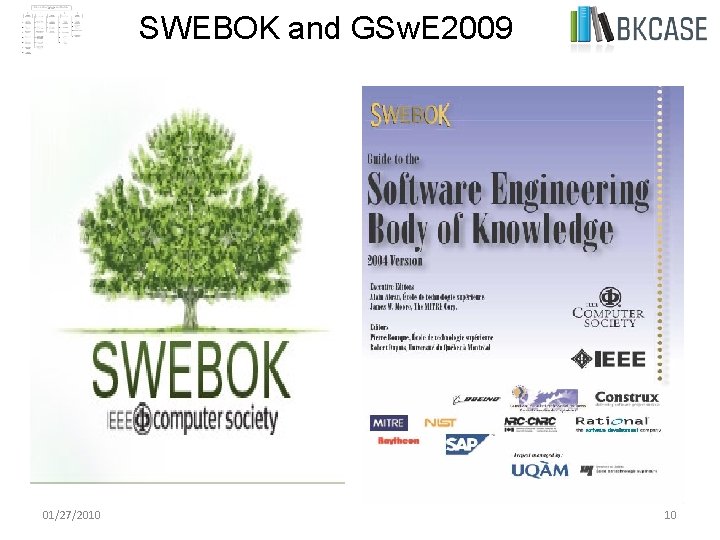
SWEBOK and GSw. E 2009 01/27/2010 10
SWEBOK • SWEBOK is a way of organizing all the knowledge that is within the software engineering (Sw. E) discipline • It is a hierarchical structure for the knowledge and references to key documents stating the knowledge as of 2004 • It was developed by a community of authors and reviewers from around the world • It is static – it has not changed since it was published • A refresh project is underway to produce a new version in 2010 www. SWEBOK. org 01/27/2010 11
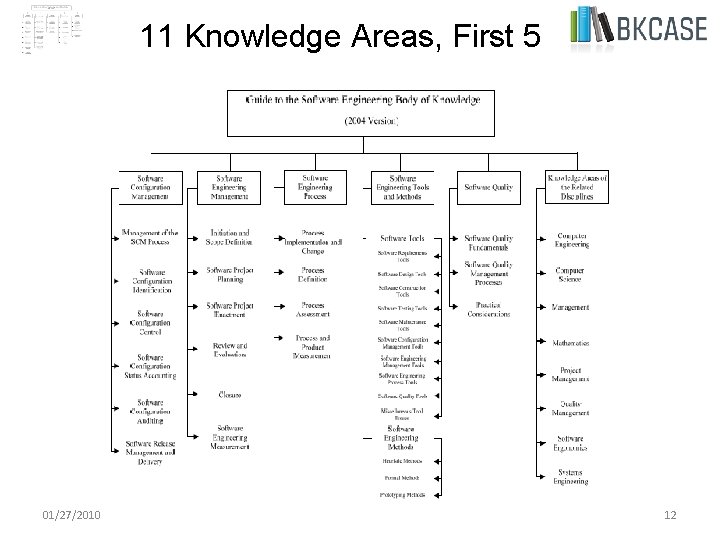
11 Knowledge Areas, First 5 01/27/2010 12
11 Knowledge Areas, Last 6 01/27/2010 13
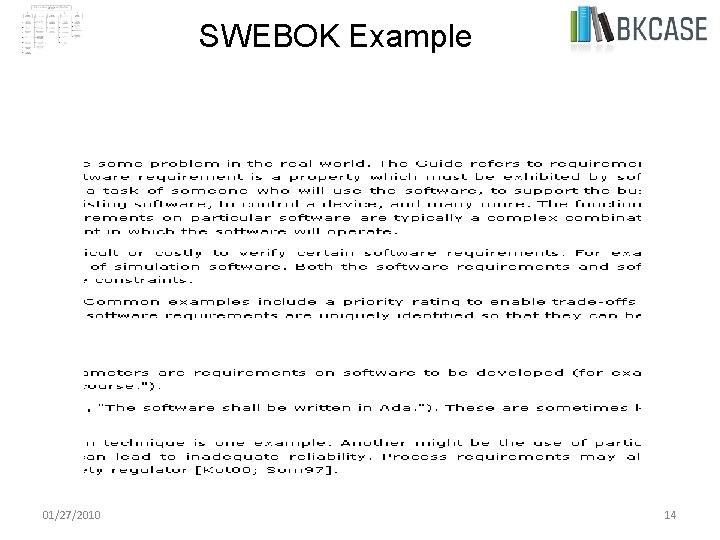
SWEBOK Example 01/27/2010 14
SWEBOK Topic Text 01/27/2010 15
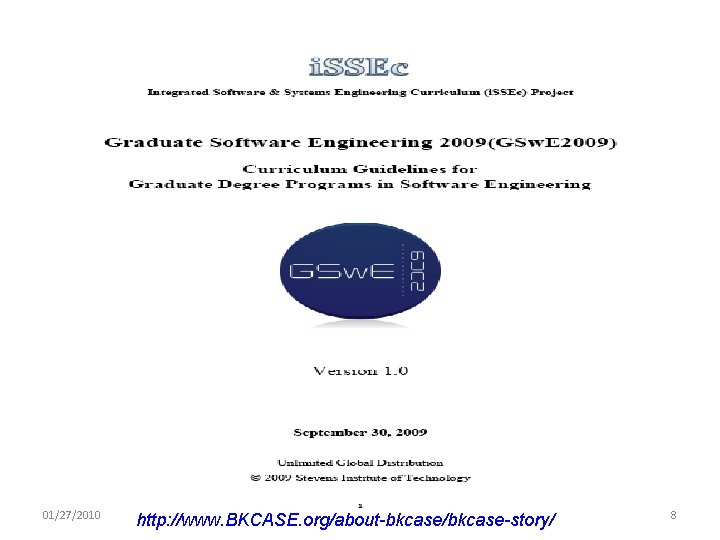
What is GSw. E 2009? • Recommendations for faculty who are creating or updating a graduate program in software engineering (Sw. E) • Secondarily, it can be used by employers selecting new Sw. E graduates, and students selecting graduate programs • Intended for world-wide use • Not intended to be used directly for accreditation • Two companion documents released in November 2009 01/27/2010 16
GSw. E 2009 Structure • Guidance for Constructing and Maintaining GSw. E 2009: the fundamental principles, assumptions, and context for the GSw. E 2009 authors • Entrance Expectations: what students should be capable of and have experienced before they enter a graduate program • Outcomes: what students should achieve by graduation • Architecture: the structure of a curriculum to accommodate core material, university-specific material, and elective material • Core Body of Knowledge (CBOK): material that all students should master in a graduate Sw. E program 01/27/2010 17
GSw. E 2009 Operational Concept • For a program that fully satisfies the GSw. E 2009 recommendations: Each student should arrive meeting all entrance expectations, participate in a program that follows the architecture, master the entire CBOK, and achieve all the outcomes • HOWEVER, because this is a reference curriculum, actual programs will likely choose to deviate from some GSw. E 2009 recommendations – this is both expected and reasonable 01/27/2010 18
Project History and Process 1. Project to create Graduate Software Engineering Reference Curriculum (GSw. ERC) started in July 2007 at Stevens Institute of Technology with Department of Defense funding (GSw. ERC renamed in August to GSw. E 2009) 2. Do. D agreed at beginning of project to take a “hands off” approach to technical content – critical to achieving primary objective 3. Formed Early Start Team of about 15 authors who met in August 2007 to shape project 4. Early Start Team gradually expanded and became Curriculum Author Team (CAT) 5. Workshop held every 3 months to synchronize work, adjust plan, and approve interim products – workshop minutes posted on website 6. Email, Web. Ex, and teleconferences to conduct business between workshops 7. Teams formed to work on specific sections of GSw. E 2009 8. Open and transparent operations at all times 01/27/2010 19
More History and Process 9. Built GSw. E 2009 on foundation documents, primarily SWEBOK, SE 2004, and INCOSE Handbook 10. Created GSw. E 2009 incrementally and iteratively – Version 0. 25 in February 2008, Version 0. 5 in October 2008, Version 1. 0 in September 2009 11. Invited reviewers for Version 0. 25, unlimited review for Version 0. 5 12. More than 100 reviewers from 23 countries: Australia, Brazil, Canada, China, Egypt, France, Germany, Greece, India, Israel, Italy, Japan, Latvia, Mexico, Netherlands, Poland, Portugal, Russia, Singapore, Sweden, Thailand, UK, US 13. About 800 review comments for Version 0. 5, each adjudicated 14. Numerous presentations and workshops to obtain feedback, and to generate awareness and demand: – 01/27/2010 NDIA SE 2007, NDIA SE 2008, SIGCSE 2008, INCOSE IS 2008, ASEE 2008; APCOSE 2008; INCOSE IS 2009, CSEET 2009, ICSE 2009, SIGCSE 2009, CSEET 2010, ICSE 2010, INCOSE IS 2010, SSTC 2010, ASEE 2010 20
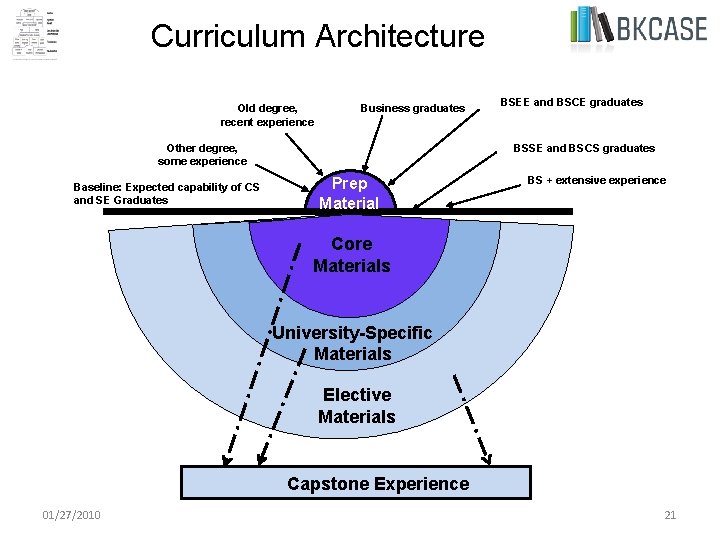
Curriculum Architecture Old degree, recent experience Business graduates BSSE and BSCS graduates Other degree, some experience Baseline: Expected capability of CS and SE Graduates BSEE and BSCE graduates Prep Material BS + extensive experience Core Materials University-Specific Materials Elective Materials Capstone Experience 01/27/2010 21
Lessons Learned: GSw. E 2009 1. Involve professional societies from the very beginning 2. Build a highly diverse author team from the start 3. Create a sense of camaraderie among the author team 4. Actively seek reviewers from global stakeholders 5. Hold face-to-face workshops at least once every 3 months 6. Establish a project plan early but expect it to evolve – most of the labor is voluntary and reviewers will throw curve balls 01/27/2010 22
BKCASE Revisited • Project led by Stevens Institute of Technology and Naval Postgraduate School that is creating two primary products: – Body of Knowledge in systems engineering (SEBo. K) – Graduate Reference Curriculum in Systems Engineering (GRCSE) • Started in September 2009 and will run through 2012 • Intended for world-wide use • Not intended to be used directly for accreditation 01/27/2010 23
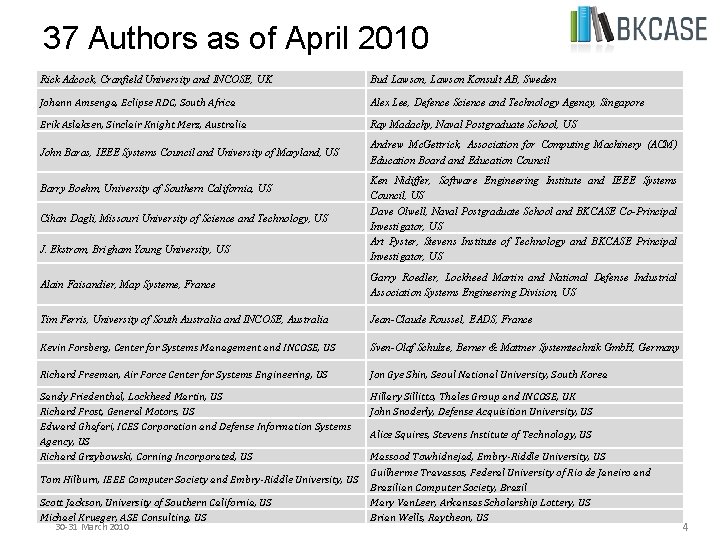
BKCASE Staffing 1. BKCASE is an open, collaborative project with international participation sought from academia, industry, government, related projects, and professional societies. 2. Art Pyster (Stevens) is Principal Investigator (PI); Dave Olwell (NPS) is Co-Principal Investigator. Alice Squires, Stephanie Enck and Nicole Hutchinson are key researchers. 3. BKCASE sought 30 -40 active volunteer authors + several hundred volunteer reviewers. Nearly 40 authors have already signed up. 01/27/2010 24
More BKCASE Staffing 4. Each participating professional society will provide at least one active author. (INCOSE has agreed to participate and fund 3 authors. IEEE Systems Council has 2: John Baras and Ken Nidiffer. ) 5. Authors are invited onto the project by the Principal Investigators (PI); anyone is welcome to be a reviewer. 6. BKCASE will pay for authors to attend workshops to the extent possible, analogous to GSw. E 2009. First workshop took place December 8 -9 at Naval Postgraduate School. Second Workshop took place 30 -31 March at ERAU. 7. BKCASE will generally not pay for the labor of authors or reviewers. 01/27/2010 25
Tentative line-up Section/Knowledge Area SEBo. K Version 0. 25 01/27/2010 Responsible Art Pyster/Dave Olwell 1. Executive Summary Dave Olwell 2. Introduction (Overview) Barry Boehm/Art Pyster 3. System Concepts Bud Lawson (lead); Johann Amsenga, Erik Aslaksen, Sandy Friedenthal, Alice Squires, Scott Jackson 4. Fundamentals Rick Adcock (lead); Johann Amsenga, Alain Faisandier, Scott Jackson 5. SE Approach and Practices 5. 1 Life Cycles Kevin Forsberg (lead) 5. 2 Organization No Lead yet 5. 3 Management Ray Madachy (lead); Garry Roedler, Mike Krueger 5. 4 Technical John Snoderly (lead); Jean-Claude Roussel, Alain Faisandier, Garry Roedler, Mike Krueger 5. 5 Agreement No Lead yet 5. 6 Specialty Engineering/Design Considerations No Lead yet 6. SE Applications/Case Studies (introduction only) Sandy Friedenthal (lead) 7. SE Competency (ethics, statistical modeling, etc. ) Brian Wells (lead); Ken Nidifer, Rick Adcock, Don Gelosh, Alice Squires 8. Glossary 9. Other Closing Matter 26
BKCASE Products 1. BKCASE will iteratively deliver a SE Bo. K and a reference curriculum for a master’s degree in SE together with supplementary material (i. e. , case studies) to facilitate their dissemination and adoption. 2. Products freely available without charge provided credit is given. 3. Ideally, any other SE Bo. K or curriculum effort would merge with BKCASE and efforts to create or evolve SE competency models and certification programs would closely coordinate with BKCASE. 4. Nominal schedule is: a. SE Bo. K: Version 0. 25 June 2010, Version 0. 5 June 2011, Version 1. 0 June 2012 b. Reference Curriculum: Version 0. 25 September 2010, Version 0. 5 September 2011, Version 1. 0 September 2012 01/27/2010 27
Strategy 1. 2. 3. Publish incrementally/iteratively with GRCSE trailing SEBo. K Create common vocabulary to facilitate communications among the team Throughout the project, involve professional societies to facilitate quality, acceptance, and their eventual role as stewards 4. Build early consensus and maintain it throughout the lifetime of the project 5. Rely on and include academia, industry, and government from multiple fields for authors and reviewers 6. Extensively leverage volunteer labor for both authoring and review 7. Rely on existing source material wherever possible and involve principals from efforts that created source material wherever possible 8. Leverage the processes used to create GSw. E 2009 and the NPS Modeling and Simulation Acquisition Curriculum 9. Keep completely open and collaborative at a global level – but authors make content decisions 10. Hold physical workshops every 3 months to synchronize teams and build team relationships – rely on virtual meetings, email, and other collaboration technology at other times 11. Keep the team focused on the value propositions when conflicts arise. 01/27/2010 28
Primary Technical Decisions 1 -2 1. The SEBo. K organizes domain independent SE knowledge. It provides a structure for that knowledge, defines important terms, summarizes important topics, selectively helps users choose among popular alternative methods, facilitates search, printing, and application by its intended users, and identifies references which elaborate more fully on all topics. For Version 0. 25, the SEBo. K will include a set of primary references based on the expert opinion of the SEBo. K authors. For subsequent versions, secondary references may be added. 2. The BKCASE Project will develop recommendations on how INCOSE and the IEEE will maintain and evolve SEBo. K in accordance with the BKCASE charter, assuming those organizations become stewards of SEBo. K after Version 1. 0 is released. Version 1. 0 of SEBo. K itself will include features to facilitate its maintenance and evolution, including the ability for SEBo. K users to readily propose new references and evaluate existing references, as well as readily propose changes to all other aspects of the SEBo. K. 01/27/2010 29
Primary Technical Decisions 3 -4 3. Primary direct SEBo. K users will be (a) practicing systems engineers ranging from novices up through senior experts, (b) those responsible for defining and implementing SE processes within organizations, projects, and programs; (c) those responsible for certifying systems engineers and developing certification programs; (d) customers of SE organizations to help them better select and evaluate those organizations; (e) any project manager, engineer, technologist, researcher, or scientist who needs to know about SE; (f) those who educate and train systems engineers; and (g) the GRCSE author team. The SEBo. K will facilitate easy access and use by these different types of users. 4. Secondary SEBo. K users will be human resource professionals and other workforce development professionals, senior non-technical managers, and lawyers who will use the SEBo. K with the support of systems engineers. The SEBo. K will facilitate easy access and use by these users. 01/27/2010 30
Primary Technical Decisions 5 -6 5. The ISO/IEC/IEEE 15288 process structure will be the initial architecture for the SEBo. K. The authors will divide into several teams. Each team will be assigned non-overlapping subsets of 15288 processes. Each team will independently develop initial SEBo. K content for their process subset, including methods, techniques, and primary references, taking into account primary and secondary SEBo. K users. At Workshop 2, the results of the individual team efforts will be jointly evaluated by the entire author team leading to a revised architecture. 6. Version 0. 25 of the SEBo. K will be domain independent. Domain dependent knowledge will be captured through case studies of individual systems within specific domains. Those case studies will be companion documents to Version 0. 25. After Version 0. 25 is complete, the decision to use case studies as the only means to capture domain specific knowledge will be revisited. 01/27/2010 31
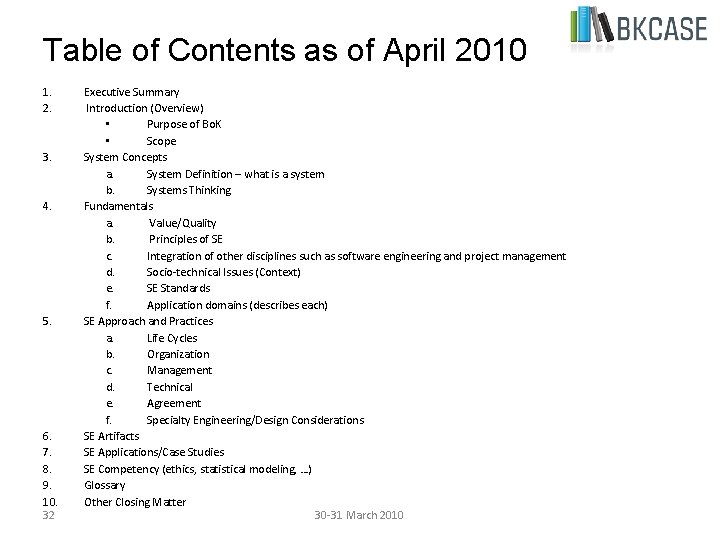
Table of Contents as of April 2010 1. 2. 3. 4. 5. 6. 7. 8. 9. 10. 32 Executive Summary Introduction (Overview) • Purpose of Bo. K • Scope System Concepts a. System Definition – what is a system b. Systems Thinking Fundamentals a. Value/Quality b. Principles of SE c. Integration of other disciplines such as software engineering and project management d. Socio-technical Issues (Context) e. SE Standards f. Application domains (describes each) SE Approach and Practices a. Life Cycles b. Organization c. Management d. Technical e. Agreement f. Specialty Engineering/Design Considerations SE Artifacts SE Applications/Case Studies SE Competency (ethics, statistical modeling, …) Glossary Other Closing Matter 30 -31 March 2010
Representation of Evolved INCOSE Graduate Reference Curriculum 01/27/2010 33
GRCSE Outline as of April 2010 • • • 34 Intro/front matter Curricular Objectives Curricular Outcomes Entrance expectations Curriculum architecture Common Body Of Knowledge (CBOK) Assessment Maintenance / refresh Closing matter Appendix: catalog of programs / benchmarks 30 -31 March 2010
Tentative Line-up for GRCSE • • • Tim Ferris (lead) Alice Squires* J. J. Ekstrom Mary van Leer Dave Olwell Tom Hilburn* Massood Towhidnejad* Guilherme Travassos* Rick Adcock* Eric Bonjour * means participated in GSw. E 2009 01/27/2010 35
State of BKCASE • Significant funding support from US Department of Defense • INCOSE, IEEE Systems Council, IEEE Computer Society Educational Activities Board, ACM, and the NDIA Systems Engineering Division are all participants • Seeking participation from Brazilian Computer Society • Seeking authors from medical, power, and transportation industries. • Explicitly seek INCOSE and the IEEE to become sponsors and assume maintenance and revision responsibilities after Version 1. 0 is published • First two workshops complete; initial teams formed to create Version 0. 25, due out this summer; next 4 workshops scheduled; special events at INCOSE IW and Eu. SEC scheduled; presentation scheduled at SSTC 01/27/2010 36
We are working it! • Questions? 01/27/2010 37
www. bkcase. org bkcase@stevens. edu 01/27/2010 38
- Slides: 38