
Bitemporal Data making it happened in Postgres Henrietta
Bitemporal Data: making it happened in Postgres Henrietta Dombrovskaya, Chad Slaughter Scale Genius, Inc.
Including time into data models Why we may need to include time into our data model? • When was a change made? What exactly the change was? Was it an actual update or a correction of a mistake previously made? • How did the data look at some moment in the past? How the data will look at some moment in the future? • When did attribute X has value ‘a’? What was the value of attribute Y, when the value of attribute X was ‘a’?
I am skipping the list of temporal SQL researches – we all know there were plenty!
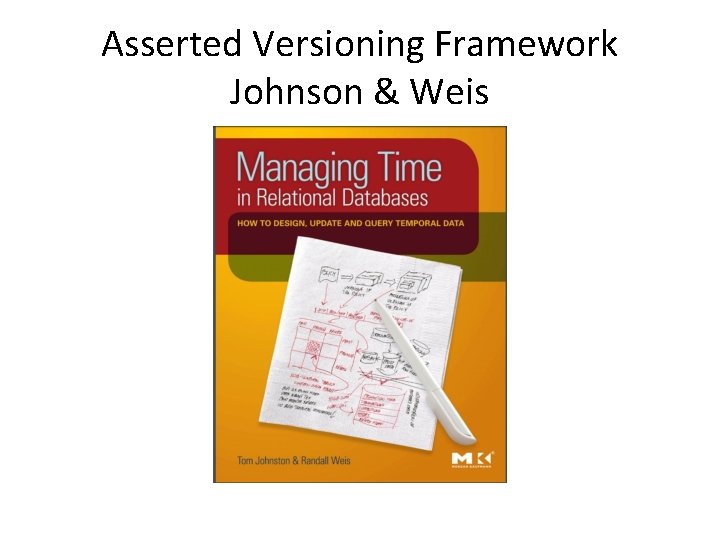
Asserted Versioning Framework Johnson & Weis
Amazon reference • http: //www. amazon. com/Managing-Time. Relational-Databases. Temporal/dp/0123750415/ • The web site of the project: • http: //assertedversioning. com/index. asp
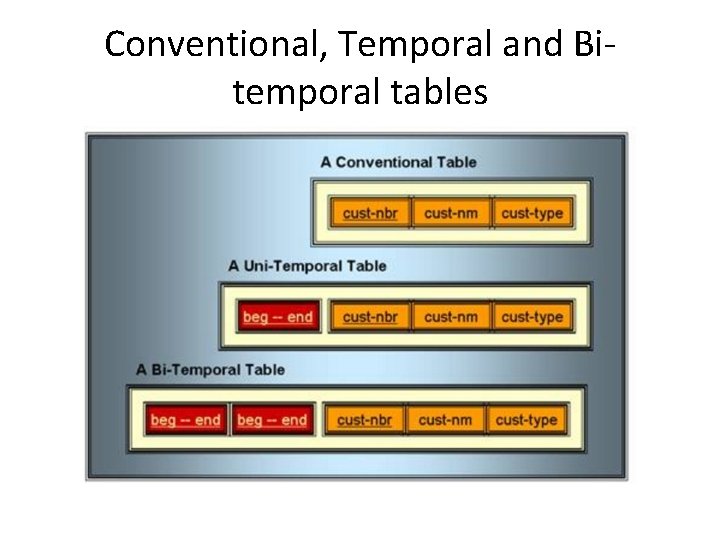
Conventional, Temporal and Bitemporal tables
Next several slides represent examples from the AVF project
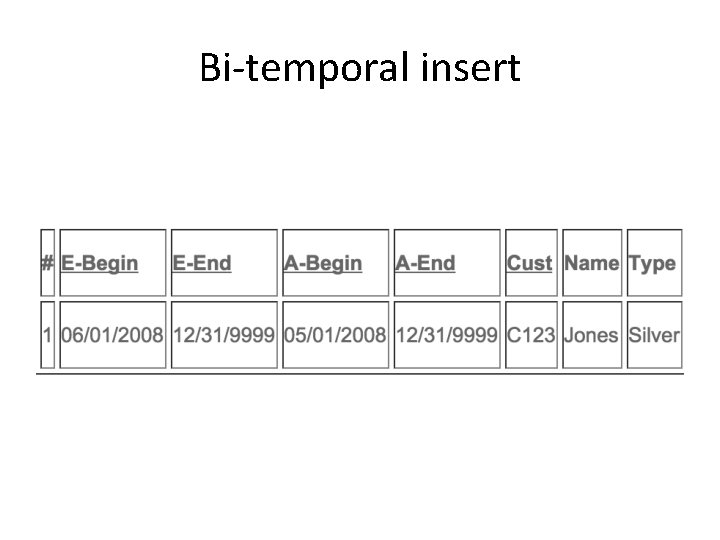
Bi-temporal insert
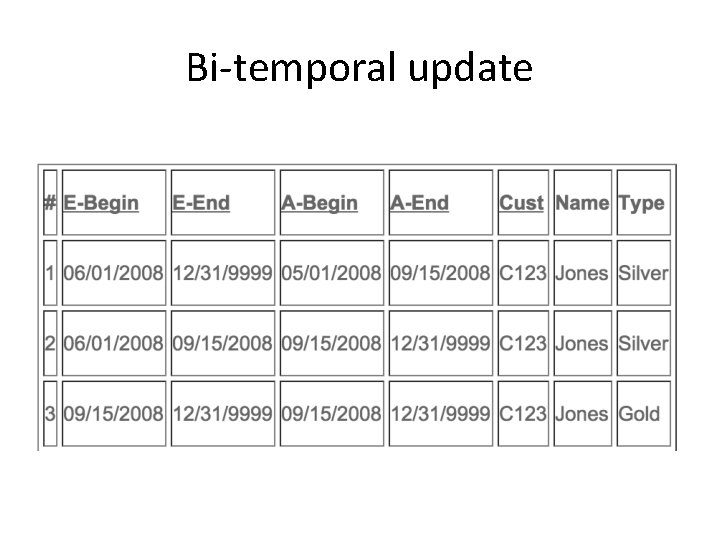
Bi-temporal update
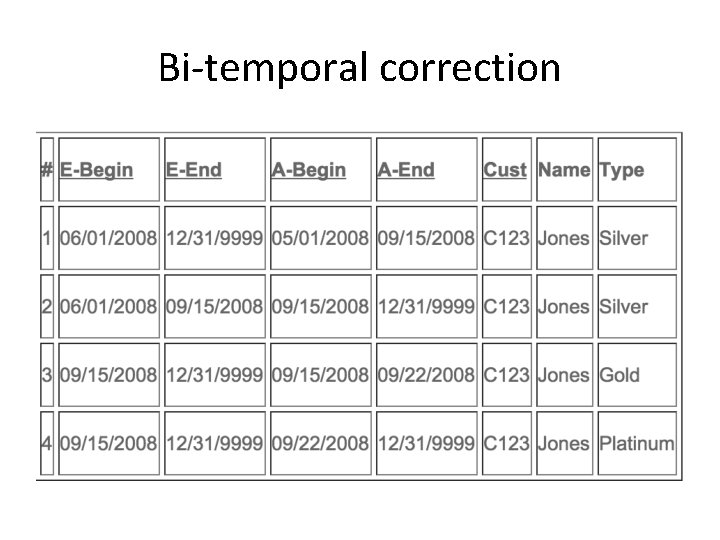
Bi-temporal correction
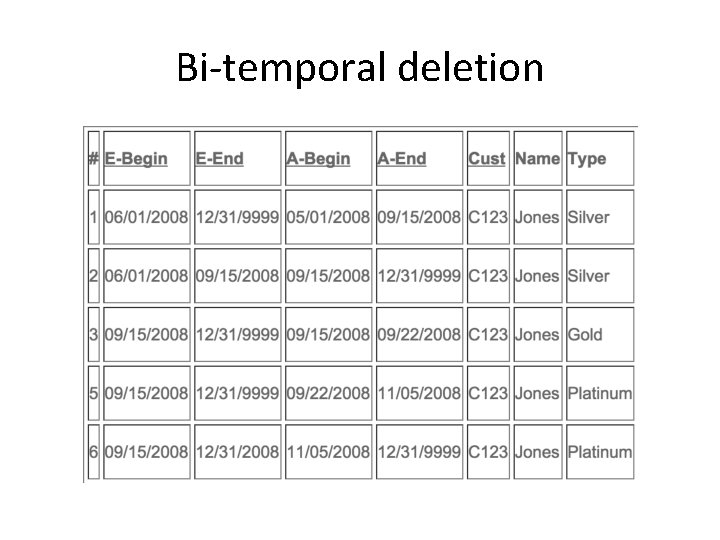
Bi-temporal deletion
Bi-temporal constraints • Temporal Entity Integrity (TEI) – the primary key and unique constraints for temporal tables are different – how? • Temporal Referential Integrity (TRI) – the foreign keys should be defined differently – how?
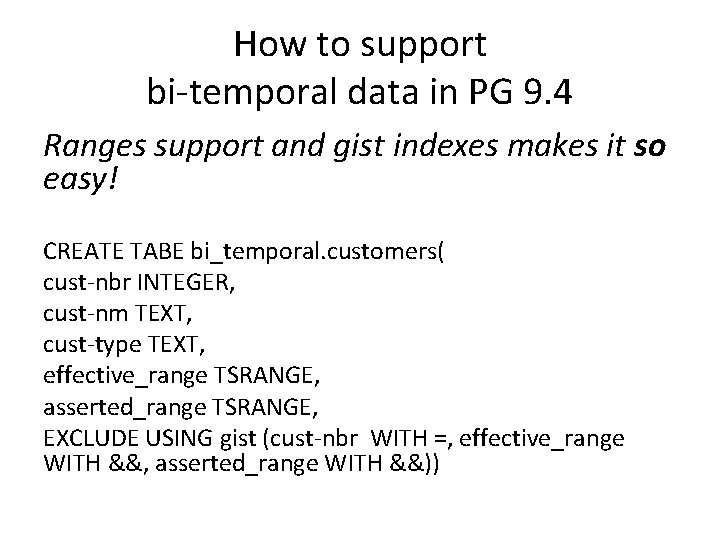
How to support bi-temporal data in PG 9. 4 Ranges support and gist indexes makes it so easy! CREATE TABE bi_temporal. customers( cust-nbr INTEGER, cust-nm TEXT, cust-type TEXT, effective_range TSRANGE, asserted_range TSRANGE, EXCLUDE USING gist (cust-nbr WITH =, effective_range WITH &&, asserted_range WITH &&))
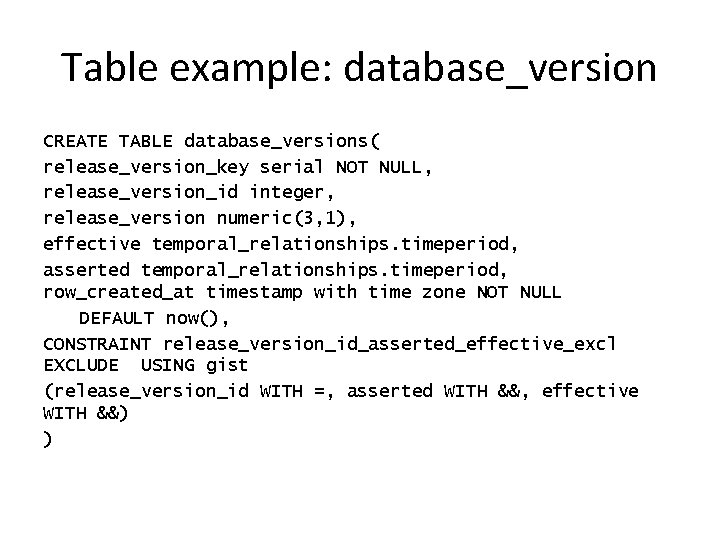
Table example: database_version CREATE TABLE database_versions( release_version_key serial NOT NULL, release_version_id integer, release_version numeric(3, 1), effective temporal_relationships. timeperiod, asserted temporal_relationships. timeperiod, row_created_at timestamp with time zone NOT NULL DEFAULT now(), CONSTRAINT release_version_id_asserted_effective_excl EXCLUDE USING gist (release_version_id WITH =, asserted WITH &&, effective WITH &&) )
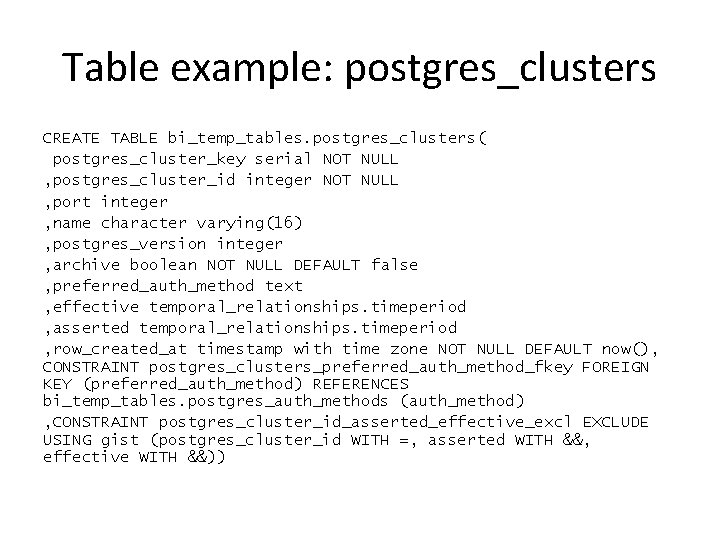
Table example: postgres_clusters CREATE TABLE bi_temp_tables. postgres_clusters( postgres_cluster_key serial NOT NULL , postgres_cluster_id integer NOT NULL , port integer , name character varying(16) , postgres_version integer , archive boolean NOT NULL DEFAULT false , preferred_auth_method text , effective temporal_relationships. timeperiod , asserted temporal_relationships. timeperiod , row_created_at timestamp with time zone NOT NULL DEFAULT now(), CONSTRAINT postgres_clusters_preferred_auth_method_fkey FOREIGN KEY (preferred_auth_method) REFERENCES bi_temp_tables. postgres_auth_methods (auth_method) , CONSTRAINT postgres_cluster_id_asserted_effective_excl EXCLUDE USING gist (postgres_cluster_id WITH =, asserted WITH &&, effective WITH &&))
Repo: https: //github. com/scalegenius/pg_bitemporal
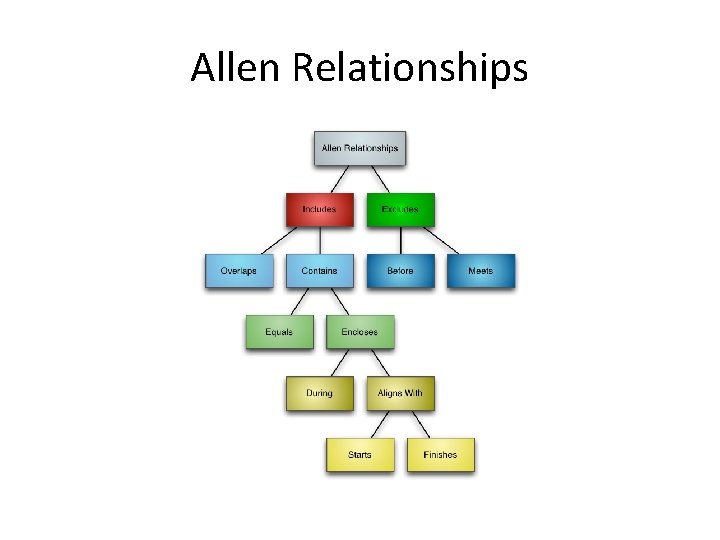
Allen Relationships
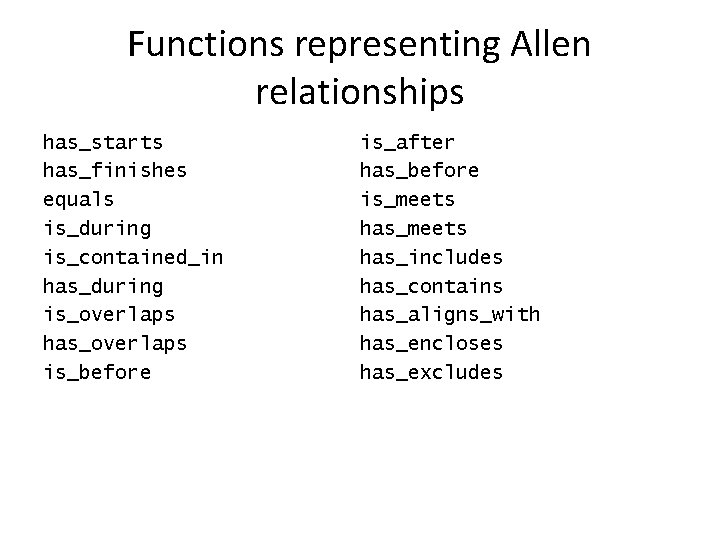
Functions representing Allen relationships has_starts has_finishes equals is_during is_contained_in has_during is_overlaps has_overlaps is_before is_after has_before is_meets has_includes has_contains has_aligns_with has_encloses has_excludes
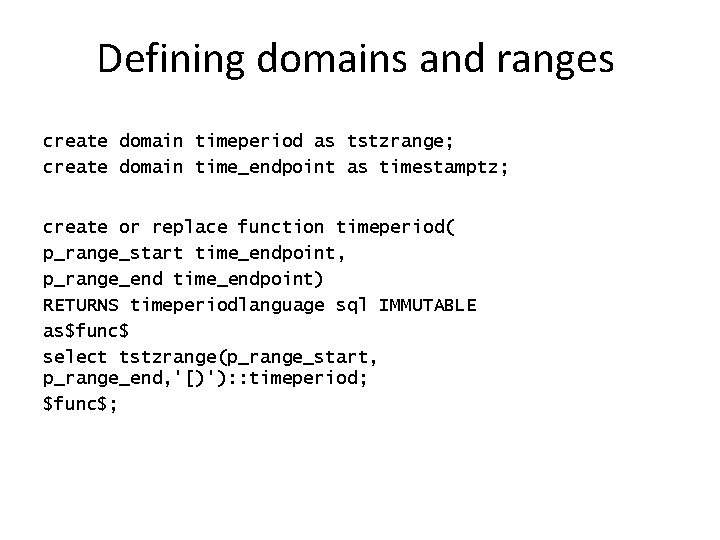
Defining domains and ranges create domain timeperiod as tstzrange; create domain time_endpoint as timestamptz; create or replace function timeperiod( p_range_start time_endpoint, p_range_end time_endpoint) RETURNS timeperiodlanguage sql IMMUTABLE as$func$ select tstzrange(p_range_start, p_range_end, '[)'): : timeperiod; $func$;
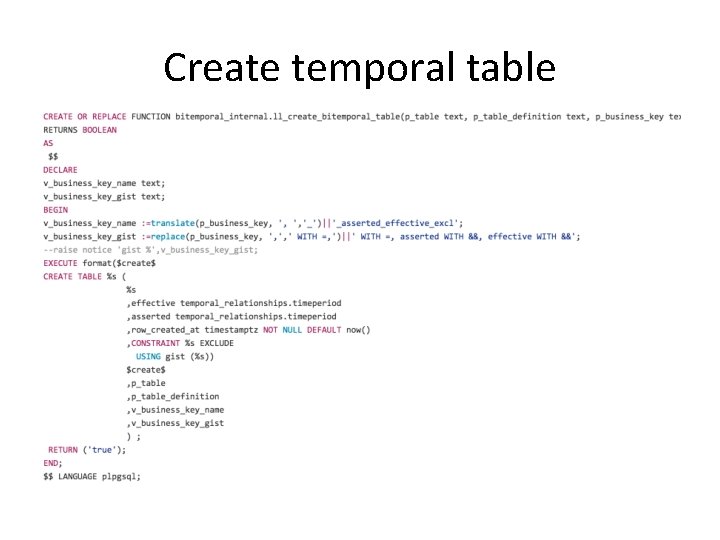
Create temporal table
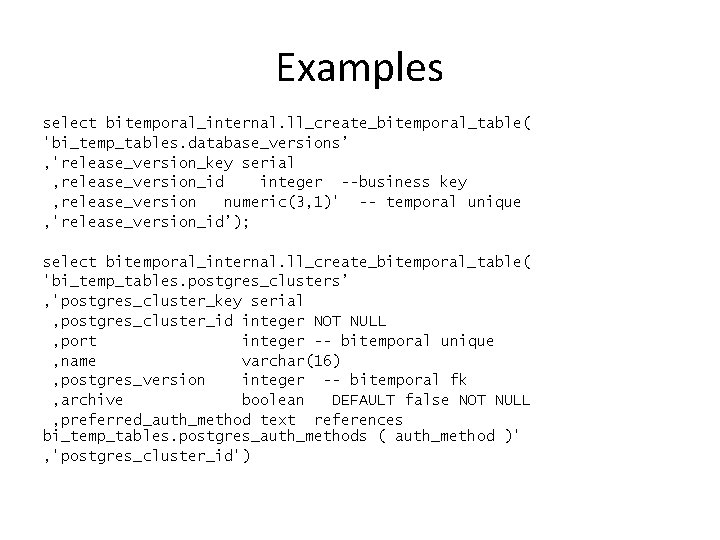
Examples select bitemporal_internal. ll_create_bitemporal_table( 'bi_temp_tables. database_versions’ , 'release_version_key serial , release_version_id integer --business key , release_version numeric(3, 1)' -- temporal unique , 'release_version_id’); select bitemporal_internal. ll_create_bitemporal_table( 'bi_temp_tables. postgres_clusters’ , 'postgres_cluster_key serial , postgres_cluster_id integer NOT NULL , port integer -- bitemporal unique , name varchar(16) , postgres_version integer -- bitemporal fk , archive boolean DEFAULT false NOT NULL , preferred_auth_method text references bi_temp_tables. postgres_auth_methods ( auth_method )' , 'postgres_cluster_id')
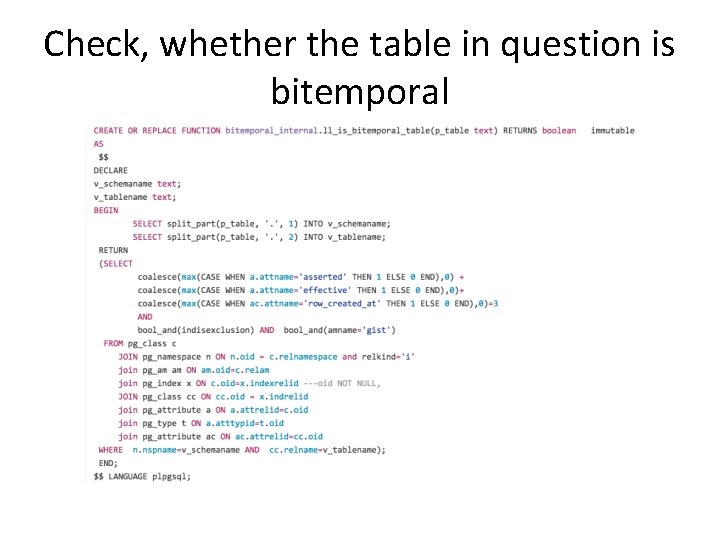
Check, whether the table in question is bitemporal
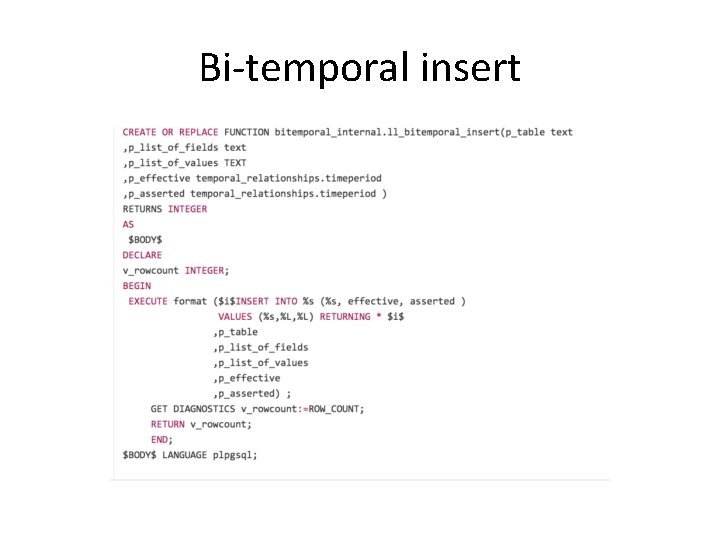
Bi-temporal insert
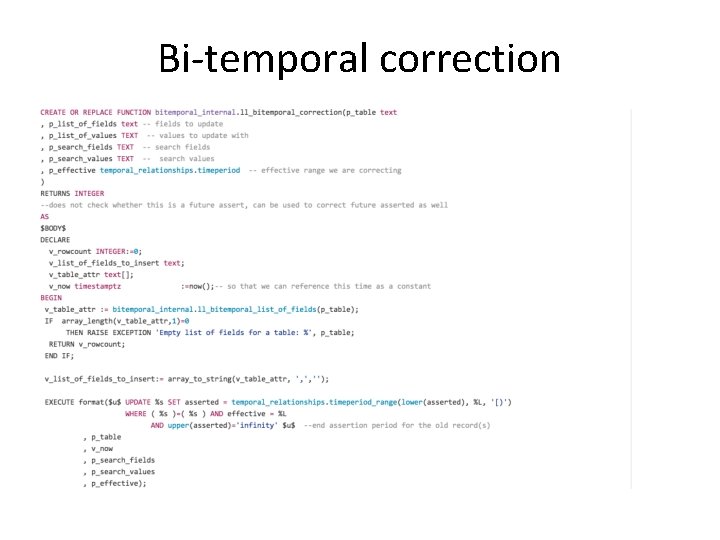
Bi-temporal correction
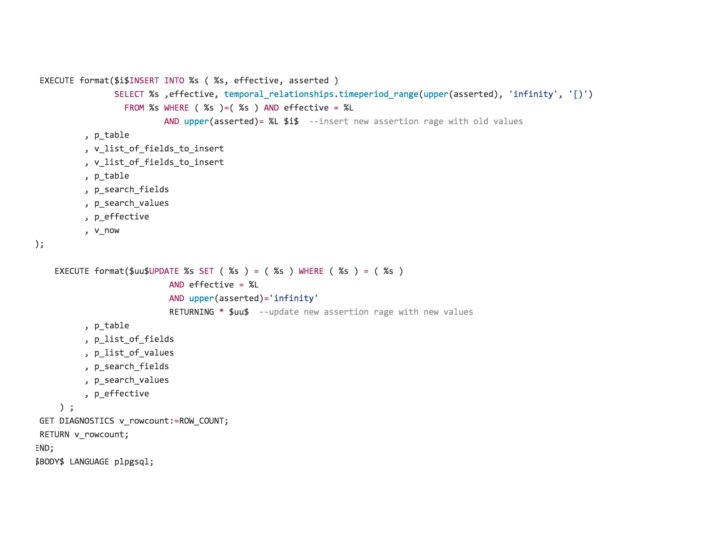
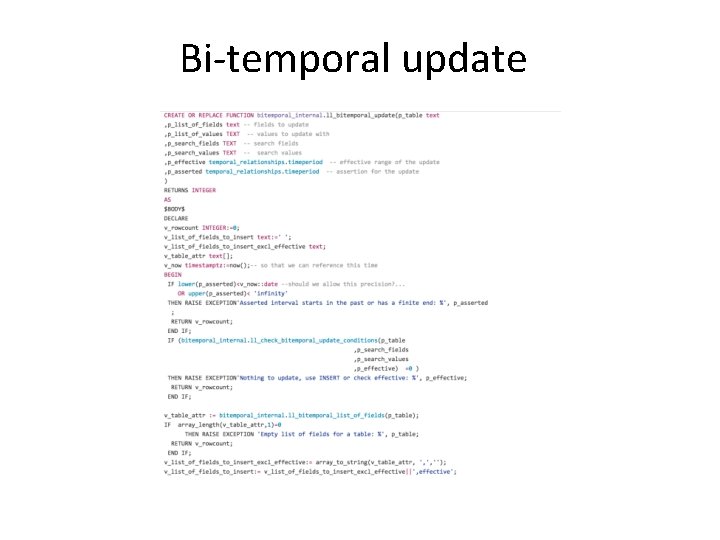
Bi-temporal update
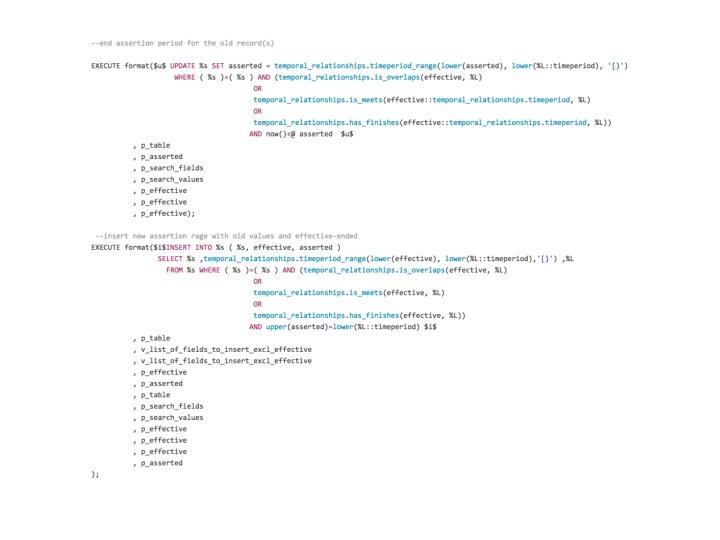
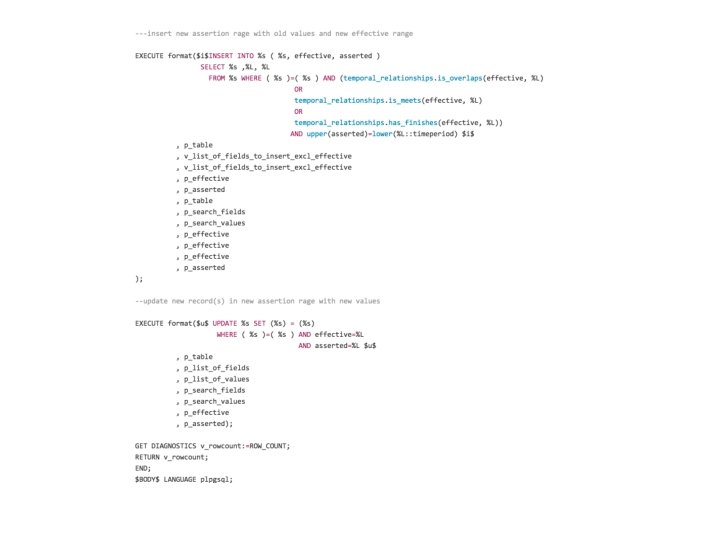
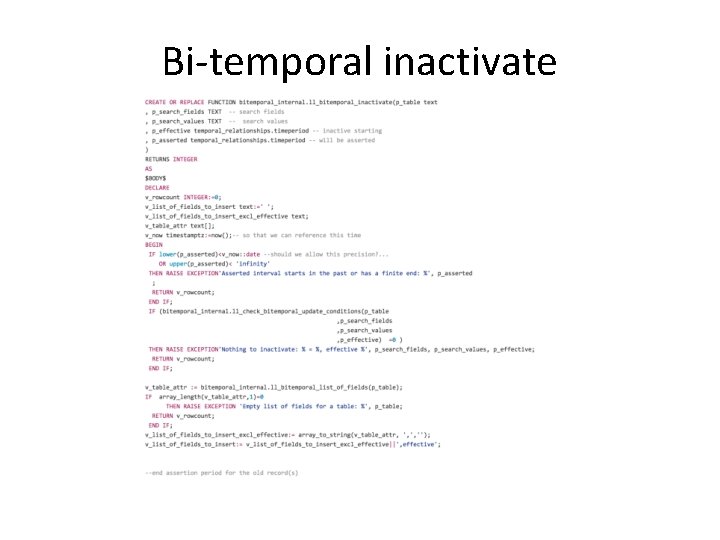
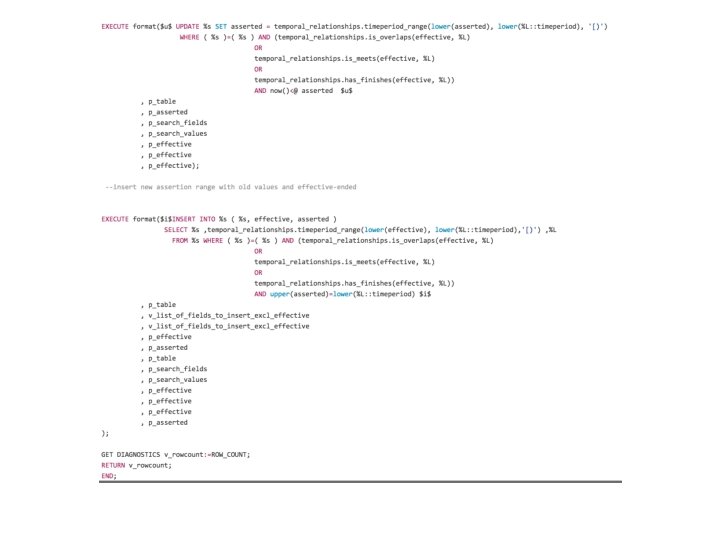
Bi-temporal inactivate
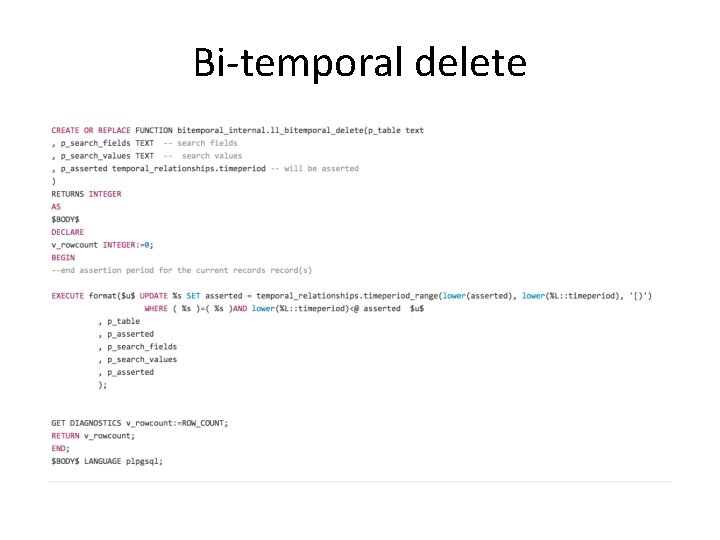
Bi-temporal delete
How to define constraints • We need to support the following constraint types: – Primary key – Unique – Check – no difference from regular tables – IS/IS NOT NULL – no difference from regular tables – Foreign key • Metacode – How we record the presence of the bitemporal constraints?
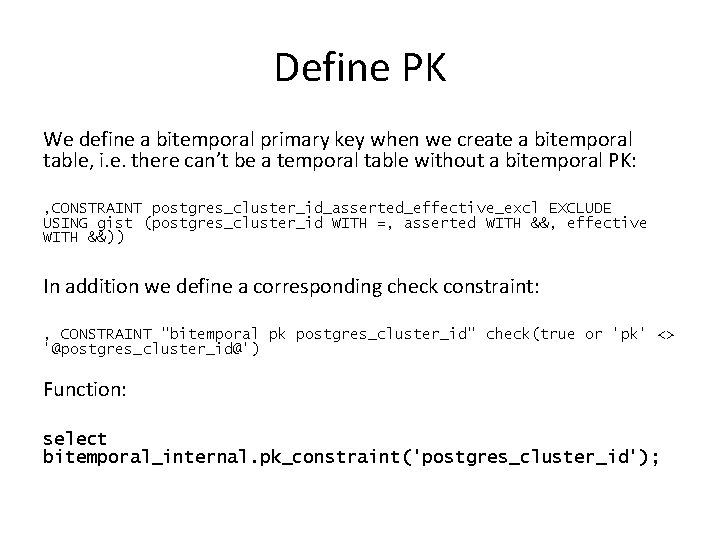
Define PK We define a bitemporal primary key when we create a bitemporal table, i. e. there can’t be a temporal table without a bitemporal PK: , CONSTRAINT postgres_cluster_id_asserted_effective_excl EXCLUDE USING gist (postgres_cluster_id WITH =, asserted WITH &&, effective WITH &&)) In addition we define a corresponding check constraint: , CONSTRAINT "bitemporal pk postgres_cluster_id" check(true or 'pk' <> '@postgres_cluster_id@') Function: select bitemporal_internal. pk_constraint('postgres_cluster_id');
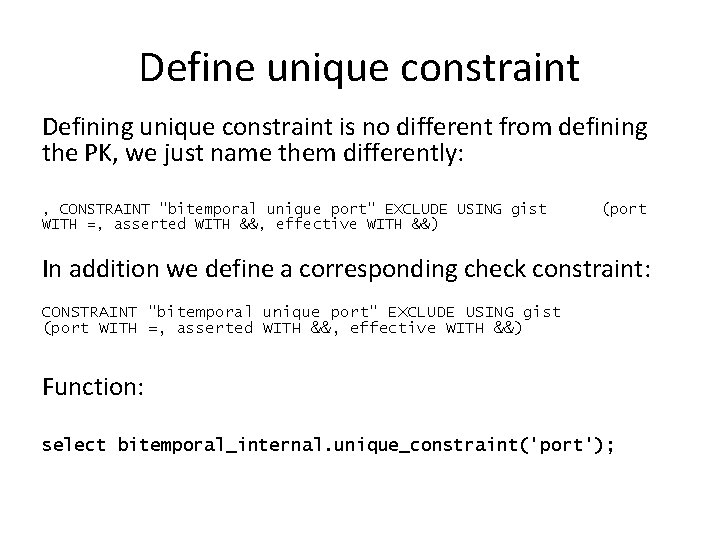
Define unique constraint Defining unique constraint is no different from defining the PK, we just name them differently: , CONSTRAINT "bitemporal unique port" EXCLUDE USING gist WITH =, asserted WITH &&, effective WITH &&) (port In addition we define a corresponding check constraint: CONSTRAINT "bitemporal unique port" EXCLUDE USING gist (port WITH =, asserted WITH &&, effective WITH &&) Function: select bitemporal_internal. unique_constraint('port');
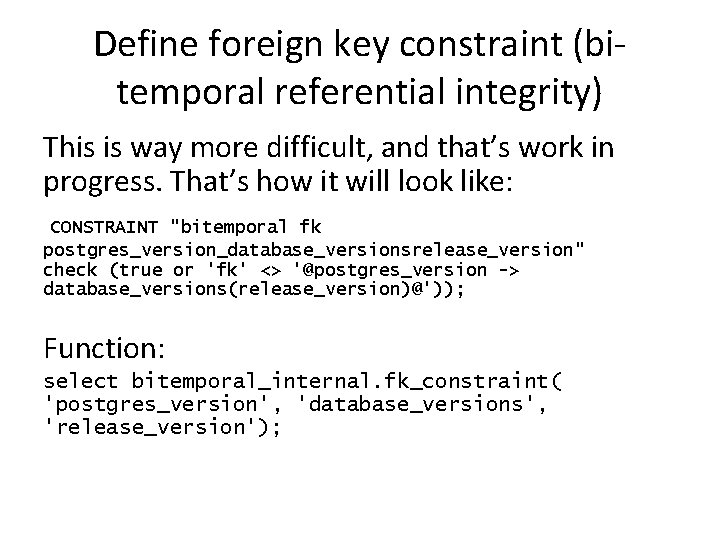
Define foreign key constraint (bitemporal referential integrity) This is way more difficult, and that’s work in progress. That’s how it will look like: CONSTRAINT "bitemporal fk postgres_version_database_versionsrelease_version" check (true or 'fk' <> '@postgres_version -> database_versions(release_version)@')); Function: select bitemporal_internal. fk_constraint( 'postgres_version', 'database_versions', 'release_version');
Future work • • Bitemporal foreign keys full support Finalizing low-level functions Using in the real apps Conversion to C.
- Slides: 36