
Bitemarks and Tooth Impression Forensic Science 42215 Drill
Bitemarks and Tooth Impression Forensic Science 4/22/15
Drill • What are two reasons why a bite might be a better form of identification than a fingerprint? • HW: Continue with pg. 2 & 3 of packet
Objectives • IWBAT – define impression evidence and give examples, such as • • tool mark bite marks shoe prints tire prints – Analyze bite marks
Agenda • • Drill Bite marks & Analysis Activity 15 -5 Dental Impressions Closure
Presentation developed by T. Trimpe 2010 http: //sciencespot. net

Materials • Bite Mark ID worksheet (yellow half sheet) • Styrofoam plate • Permanent marker (Sharpie fine tip)
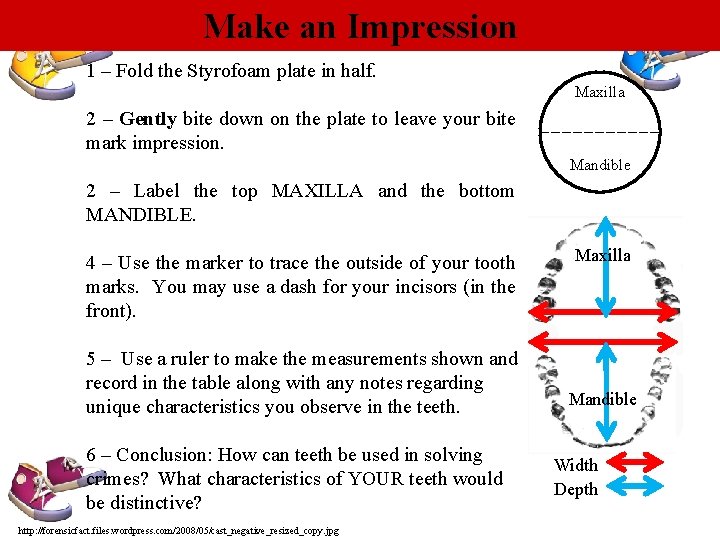
Make an Impression 1 – Fold the Styrofoam plate in half. Maxilla 2 – Gently bite down on the plate to leave your bite mark impression. Mandible 2 – Label the top MAXILLA and the bottom MANDIBLE. 4 – Use the marker to trace the outside of your tooth marks. You may use a dash for your incisors (in the front). 5 – Use a ruler to make the measurements shown and record in the table along with any notes regarding unique characteristics you observe in the teeth. 6 – Conclusion: How can teeth be used in solving crimes? What characteristics of YOUR teeth would be distinctive? http: //forensicfact. files. wordpress. com/2008/05/cast_negative_resized_copy. jpg Maxilla Mandible Width Depth
Activity 15 -5 Dental Impressions • You need: – – Activity 15 -5 WS Samples handout – yellow (do not write on this) ½ overhead sheet Permanent marker (same one) • Identify – Which mandible goes with each maxilla – Which bite mark goes with each mandible • When done, staple the WS to the ½ overhead sheet and return the marker
All done? • Work on the review sheets—pg. 2 & 3 in your packet. Use the textbook for ones you’re confused by.
Wrap-Up • Let’s discuss – Do you think it would be easy or hard to match a bite mark to a suspect? Why? What could make it more obvious? – Does it depend on what material the bite is in?
- Slides: 10