
Bit Torrent Nathan Marz Raylene Yung Bit Torrent
Bit. Torrent Nathan Marz Raylene Yung
Bit. Torrent • Bit. Torrent consists of two protocols – Tracker HTTP protocol (THP) • How an agent joins a swarm • How an agent learns of other agents in the swarm – Peer Wire Protocol (PWP) • • How agents connect with each other (handshake) How agents tell each other what data they have How agents request and send data We focused on this part of the protocol
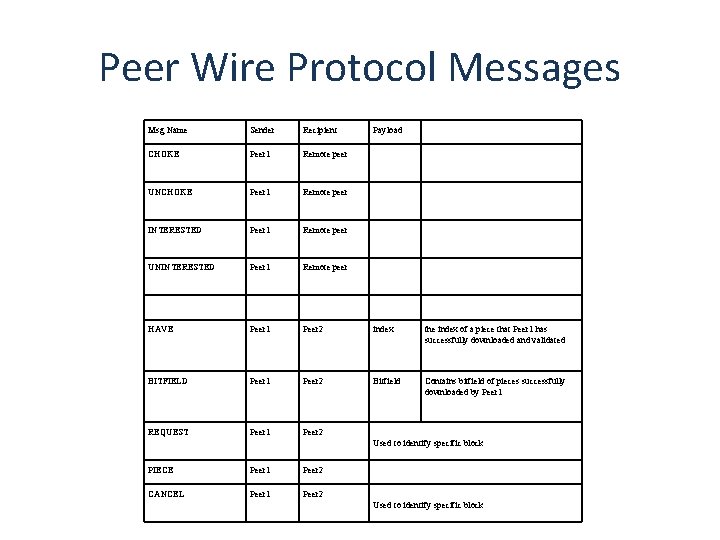
Peer Wire Protocol Messages Msg Name Sender Recipient Payload CHOKE Peer 1 Remote peer UNCHOKE Peer 1 Remote peer INTERESTED Peer 1 Remote peer UNINTERESTED Peer 1 Remote peer HAVE Peer 1 Peer 2 index the index of a piece that Peer 1 has successfully downloaded and validated BITFIELD Peer 1 Peer 2 Bitfield Contains bitfield of pieces successfully downloaded by Peer 1 REQUEST Peer 1 Peer 2 Used to identify specific block PIECE Peer 1 Peer 2 CANCEL Peer 1 Peer 2 Used to identify specific block
Overview • PRISM is not a natural way to define distributed protocols with non-deterministic adversary • Presentation: 1. Overview of challenges of modeling a complicated protocol in PRISM 2. Techniques we used to overcome these challenges 3. Results
Generating PRISM Model • We wrote PHP Script – Always generates: • One seeder • One attacker – Takes parameters: • # Agents • # Pieces • # Blocks per Piece
Issues with PRISM • Problem #1: We want to model logical structures like: If received block “l” for piece “p” If all blocks downloaded for “p” if all blocks for “p” verify set status of “p” to dl/verified else clear all blocks for “p” • PRISM only allows commands of the following form: [condition] -> [probability distribution of results]
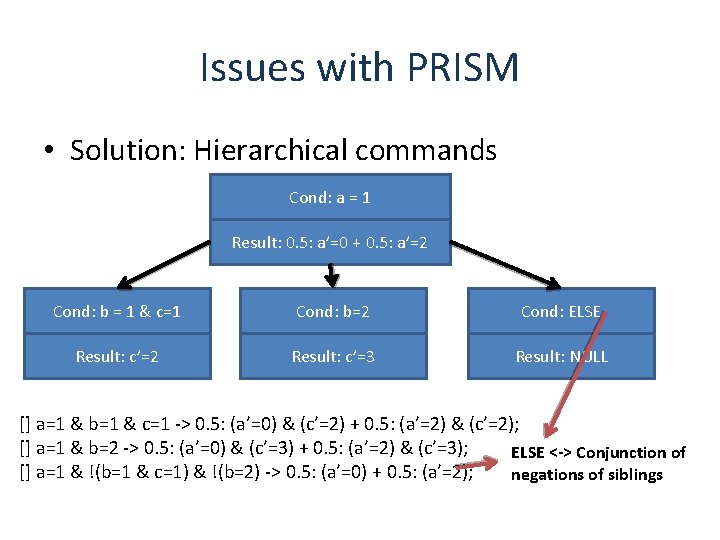
Issues with PRISM • Solution: Hierarchical commands Cond: a = 1 Result: 0. 5: a’=0 + 0. 5: a’=2 Cond: b = 1 & c=1 Cond: b=2 Cond: ELSE Result: c’=2 Result: c’=3 Result: NULL [] a=1 & b=1 & c=1 -> 0. 5: (a’=0) & (c’=2) + 0. 5: (a’=2) & (c’=2); [] a=1 & b=2 -> 0. 5: (a’=0) & (c’=3) + 0. 5: (a’=2) & (c’=3); ELSE <-> Conjunction of [] a=1 & !(b=1 & c=1) & !(b=2) -> 0. 5: (a’=0) + 0. 5: (a’=2); negations of siblings
Issues with PRISM • Problem #2: ONLY the attacker can be nondeterministic AND all agents must be able to make progress at the same time • If agents are nondeterministic: – “Attacks” PRISM finds will include attacker’s decisions and agent’s decisions – This doesn’t make sense • Attacker should only be allowed to do a certain amount of actions before letting the agents process their state/make requests/etc.
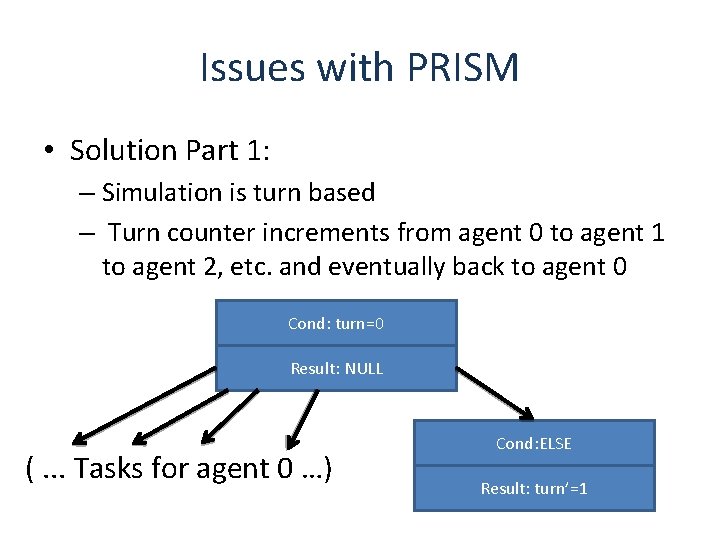
Issues with PRISM • Solution Part 1: – Simulation is turn based – Turn counter increments from agent 0 to agent 1 to agent 2, etc. and eventually back to agent 0 Cond: turn=0 Result: NULL (. . . Tasks for agent 0 …) Cond: ELSE Result: turn’=1
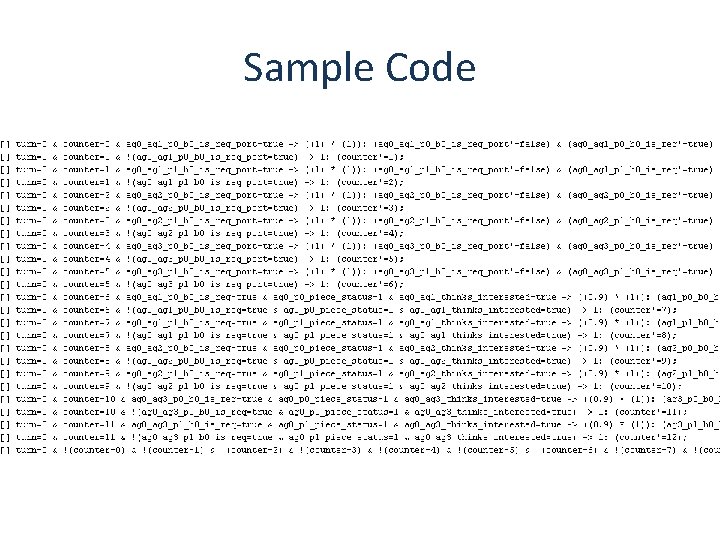
Issues with PRISM • Solution Part 2: Force agent to execute tasks in sequence – Takes advantage of most tasks being selfcontained and independent • Ex: If I received an “interested” message from agent “ 2”, set internal state of “thinks_agent_2_is_interested” to true • Ex: If I think agent “ 2” has a block, make a request for that block with random probability – Implemented with a “counter” variable
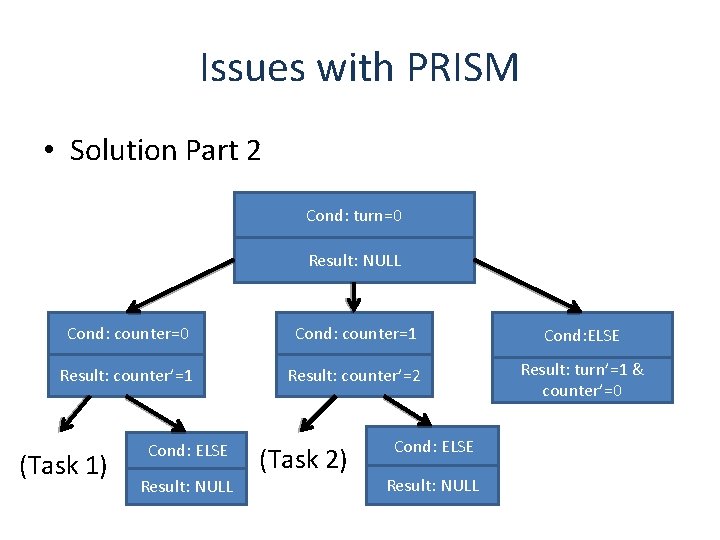
Issues with PRISM • Solution Part 2 Cond: turn=0 Result: NULL Cond: counter=0 Cond: counter=1 Cond: ELSE Result: counter’=1 Result: counter’=2 Result: turn’=1 & counter’=0 (Task 1) Cond: ELSE Result: NULL (Task 2) Cond: ELSE Result: NULL
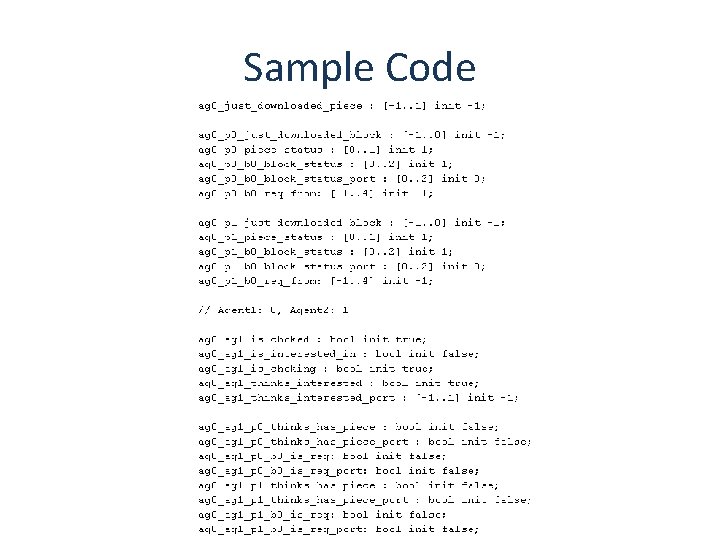
Issues with PRISM • Problem #3: State space must be kept small or else PRISM runs out of memory – Various optimizations were made to reduce state space: 1. Counter variable instead of boolean flag for whether task was done during turn 2. Seeder doesn’t send requests and agents don’t send blocks to seeder – Maximum feasible model was (unfortunately): • • • 2 agents 2 pieces 1 blocks 1 seeder 1 attacker Anything bigger causes PRISM to run out of memory
Sample Code
Sample Code
Results • Our feasible model is too small to simulate any realistic scenario – Key part of attacks is #blocks/piece – # agents changes how attacks would work – In realistic scenario, agents are downloading from many different peers
Rational Reconstruction • Handshaking protocol – Attackers can easily change agents perception of other agents (what pieces they have, what pieces they are interested in) – When something unusual happens, agents break connections – When connection reestablished they reset their perceptions
Rational Reconstruction • Verify message consistency – Bit. Torrent protocol is unclear about what to do when a message is received – Example: What happens when an agent receives a “Piece” message? • An agent should verify that they made a request for that data from the source IP address • Otherwise, it could be an attacker sending bad data – Similar verification of IP addresses should occur with other Bit. Torrent messages
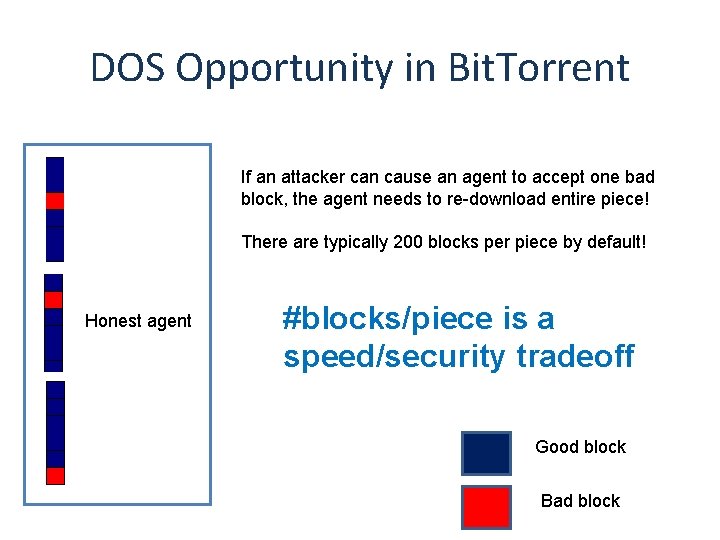
DOS Opportunity in Bit. Torrent If an attacker can cause an agent to accept one bad block, the agent needs to re-download entire piece! There are typically 200 blocks per piece by default! Honest agent #blocks/piece is a speed/security tradeoff Good block Bad block
Conclusion • Bit. Torrent is too large and complicated to be analyzed by model checker • More feasible approach would be to define specific attacks and use simulation to estimate their efficiency • The conditions under which to accept data should be stricter than described in RFC
- Slides: 19