
BismillahirRahmanirRahim Practical Ghusl and Shrouding of the Deceased
Bismillah-ir-Rahman-ir-Rahim Practical Ghusl and Shrouding of the Deceased A WORKSHOP FOR WOMEN (LOWRY MASJID)
Agenda • • Introduction to – death Processing of Forms(Funeral Service) Ghusl Practical - Ghusl of deceased Kafan Practical – Shrouding of deceased Conclusion
Introduction to death v. Death v. Unnatural Death v. Natural Death v. Husnul Khatimah & Su’ul Khatimah v What to do v. Unnatural Death v. Natural Death v Sunnah to let her lie on her right side facing the Qibla, or on her back with feet towards Qibla and head slightly raised v Read surah Yaseen, Al-Ra’d– no worldly talks v The Talqeen – Remind the dying person of the Shahadat – Ash hadu lailaha illal-lahu. . Don’t order to recite the Kalimah v Signs of dying person when end is near (breath quickens, knees become weak, nose becomes bent and temples subside) v Close the mouth - tie around head, eyes closed, arms on side, heavy object on stomach (avoid bloating) and cover with clean sheet v. When the soul departs
Introduction - death v. Common Requests v. Request for burial in India, Pakistan, Bangladesh (Embalming) v. Coroners v Will – Wish to bury in different country v. Allah (Ta’ala) has said in the Holy Quran “Every soul shall taste death” Ali Imran, [3: 185] v “Wherever! You may be, death will overtake you, even if you are in towers built up strong and high !” An-nisa [4: 78] v “And Allah grants respite to none when his appointed time (death) comes. And Allah is All-Aware of what you do. ” Al munafiqun [63: 11] v. Death is a reality for all of us. When a Muslim dies, it is the responsibility of his family members or other muslims within the community to wash him according to Islamic rites of washing the deceased. v Reward for giving ghusl - Abu Rafi` Aslam (May Allah be pleased with him), the freed slave of the Messenger of Allah ( ﷺ reported: The Messenger of Allah ( ﷺ said, "He who washes a dead body and conceals what he notices of physical defects, he will be forgiven forty times. " [Al-Hakim]
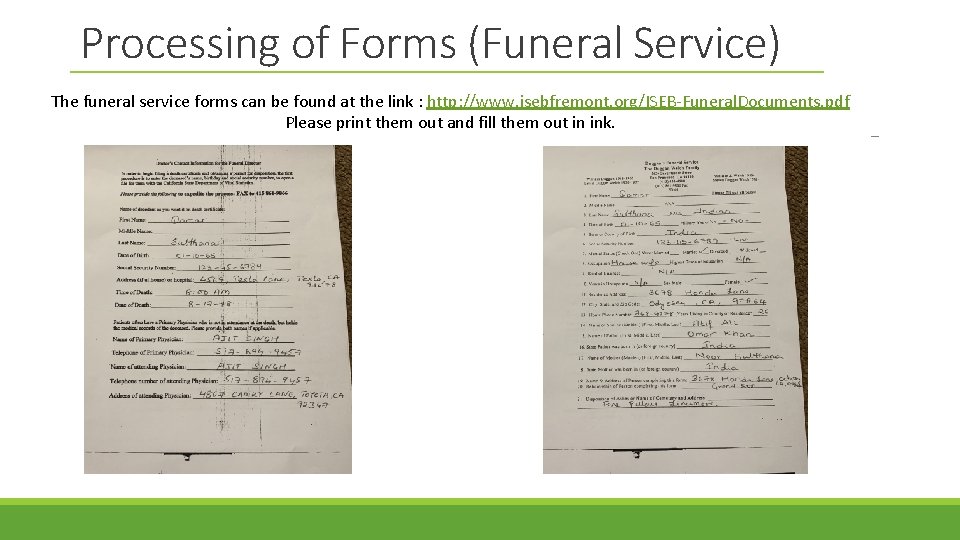
Processing of Forms (Funeral Service) The funeral service forms can be found at the link : http: //www. isebfremont. org/ISEB-Funeral. Documents. pdf Please print them out and fill them out in ink.
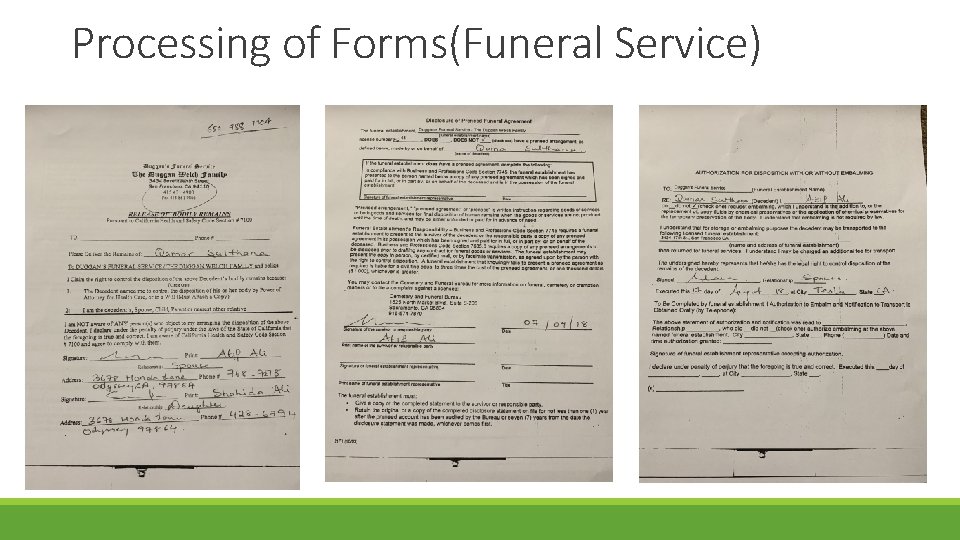
Processing of Forms(Funeral Service)
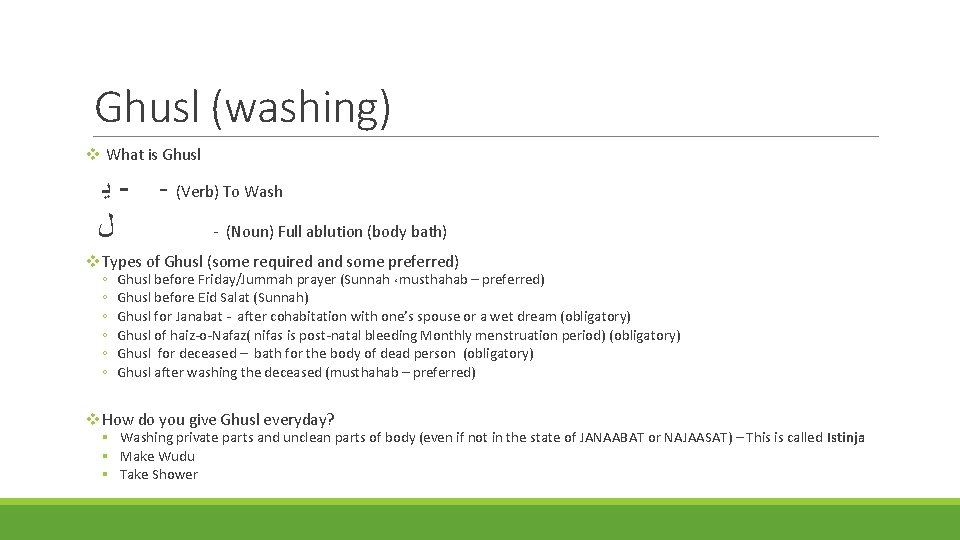
Ghusl (washing) v What is Ghusl ﻳ - - (Verb) To Wash ﻝ - (Noun) Full ablution (body bath) v. Types of Ghusl (some required and some preferred) ◦ ◦ ◦ Ghusl before Friday/Jummah prayer (Sunnah ،musthahab – preferred) Ghusl before Eid Salat (Sunnah) Ghusl for Janabat - after cohabitation with one’s spouse or a wet dream (obligatory) Ghusl of haiz-o-Nafaz( nifas is post-natal bleeding Monthly menstruation period) (obligatory) Ghusl for deceased – bath for the body of dead person (obligatory) Ghusl after washing the deceased (musthahab – preferred) v. How do you give Ghusl everyday? § Washing private parts and unclean parts of body (even if not in the state of JANAABAT or NAJAASAT) – This is called Istinja § Make Wudu § Take Shower
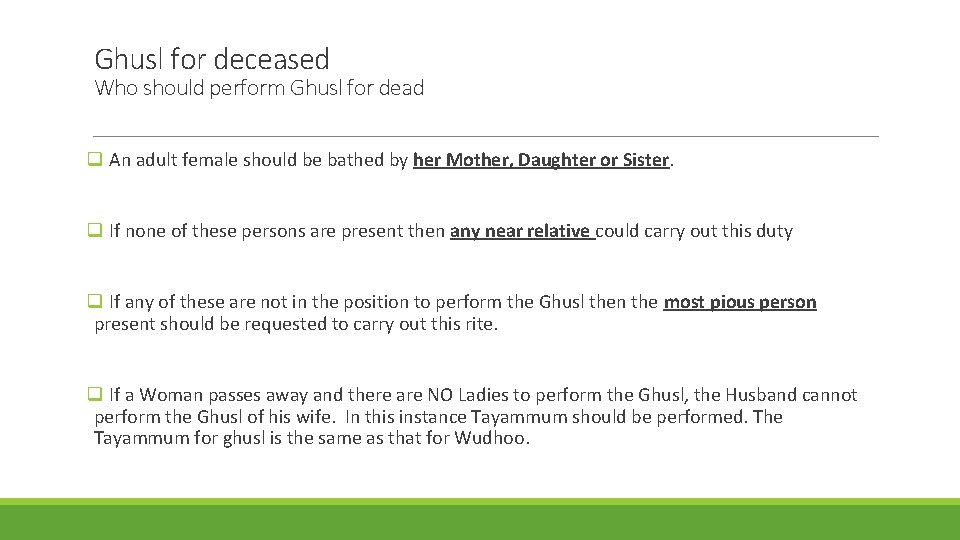
Ghusl for deceased Who should perform Ghusl for dead q An adult female should be bathed by her Mother, Daughter or Sister. q If none of these persons are present then any near relative could carry out this duty q If any of these are not in the position to perform the Ghusl then the most pious person present should be requested to carry out this rite. q If a Woman passes away and there are NO Ladies to perform the Ghusl, the Husband cannot perform the Ghusl of his wife. In this instance Tayammum should be performed. The Tayammum for ghusl is the same as that for Wudhoo.
Kafan and Ghusl Materials The following materials are needed for washing (Ghusl) the deceased and for shrouding (Kafan) after the Ghusl. Most of the Masajids in the Bay Area carry Kafan kits. Some Masajids will provide a trained Muslim brother or sister to assist in with performing the Ghusl. White pure Cotton Unstitched Sheets (7 ft X 7 ft): three for males; five for females (Any King-size 100% Cotton bed-sheets from the linen department will suffice) With a pair of scissors cut seams along the whole sheet(s) Also cut (3) thin strips to use as ties for the tying the Shroud and holding it in place) Items needed: Camphor, Powdered dry Sidr leaves. - Non-Alcoholic perfumes (Attar for men/woman) - Warm water - Soap - Gloves/Apron/Mask/Shoe Cover/Cap - Wash-cloths + large towels - Cardboard box (low-cost option recommended) to place the body in after the Ghusl =
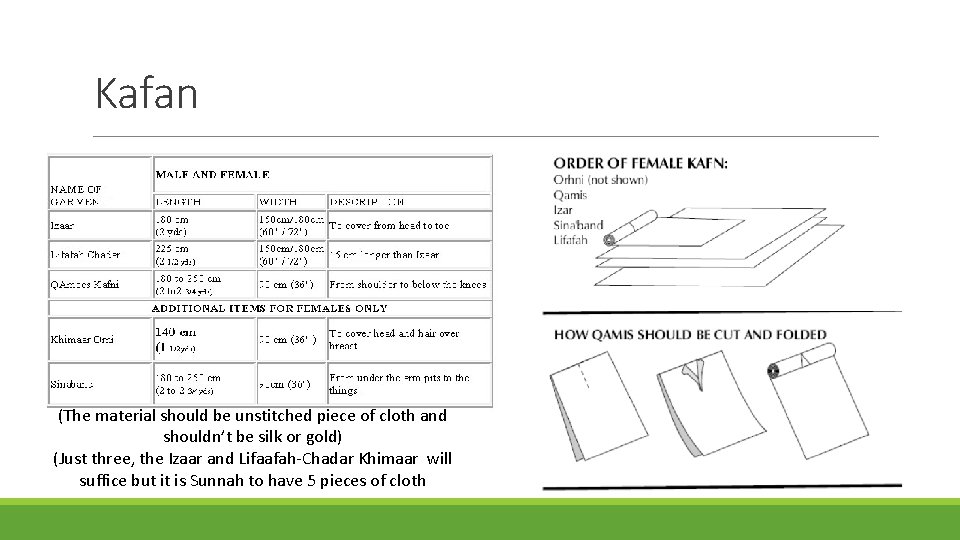
Kafan (The material should be unstitched piece of cloth and shouldn’t be silk or gold) (Just three, the Izaar and Lifaafah-Chadar Khimaar will suffice but it is Sunnah to have 5 pieces of cloth
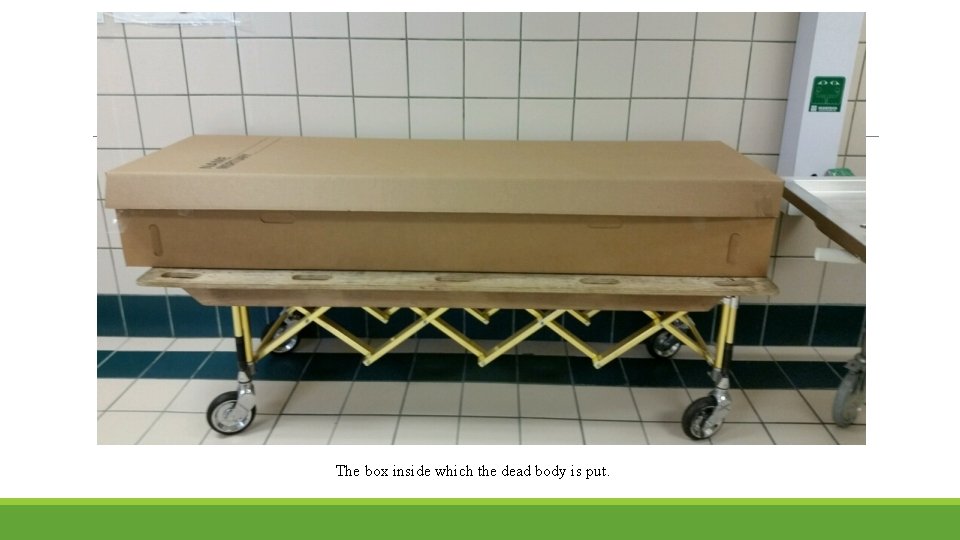
The box inside which the dead body is put.
Ghusl for deceased before starting the ghusl of deceased o Have wudu o Conceals what she notices of physical defects till the person who gives ghusl dies o No recitation of Quran or any worldly talks o Recite dua “Allahum-Maghfir-Laha” O Allah! Forgive her o Place the body with the face towards the QIBLAH o Cover the satr (shoulder to toe) of the deceased all the time. Cannot see private areas o Make intention before performing ghusl of the deceased I am giving ghusl to this deceased person to fulfil Sunnah and to please Allah (ta’ala)
Practical - Ghusl of deceased (Masnoon Sequence) 1. NO HAIR of the head, beard or any other part of the body must be cut, shaved, trimmed or combed. All rings, jewelry, wigs etc. , should be removed. No nail should be cut. 2. Thereafter the body should he put on the table. 3. Satr from the Shoulder to the ankles should be covered all the time 4. The stomach should gently be massaged 5. Then both the Istinja places should be washed with mittens on, without looking at the private parts. 6. The nostrils, ears and mouth should be closed with cotton wool to prevent water from entering the body during the Ghusl. 7. Give Wudhu, the proper sequence should be to wash : FACE, ARMS to the ELBOWS, MASAH of the HEAD and FEET up to the ANKLES, clean mouth with wet cotton, clean the nostrils with cotton, 8. After Wudhu, the head should first be washed. Soap or pure clean water will suffice. The temperature of the water must be that which a living person normally uses when bathing.
Practical - Ghusl of deceased (Masnoon Sequence) 9. Thereafter the body should be tilted onto its left side to allow the right side to be washed first. Warm water should now be poured over the body from head to the toes three times, and the body should be washed with soap or water will suffice. 10. The body should then be turned onto it's right side and the left side bathed similarly 3 times. 11. Thereafter the body should be lifted slightly to a sitting position, and the stomach be gently massage with a downward stroke. Whatever comes out of the body should be washed away. The WUDHU and GHUSL need NOT be REPEATED in case any impurity dries come out. 12. Finally camphor water should be poured over from head to toe three times (right side and left side). 13. All the cotton wool should now removed from the mouth, ears and nose. 14. With this, the Ghusl is complete and the body could be wiped with a towel or a piece of material. 15. The SATR must be kept covered.
Practical - Shrouding of deceased (Masnoon Sequence) 1. Spread the LIFAFAH/SHEET on the floor, then on it the Seenaband/Chest wrapper) on it the Izaar(Kamarband/waist wrapper) and on it the QAMEES that will be under the body. The portion that will cover the top of the body should be folded and put at the head side. 2. Lower the body gently onto the Kafan and cover the top of the belly up to the calf with the folded portion of the Qamees. 3. Then rub camphor mixture paste on the places of SAJDAH, (i. e. those parts of the body that touch the ground in Salah: forehead, nose both the palms, knees and the forefeet. ) 4. First fold the LEFT flap and on it the RIGHT flap of the IZAAR and the Khimaar over the QAMEES. 5. Thereafter fold the LIFAFAH in the same manner. Remember that the RIGHT flap must be always on the top. 6. Lastly fasten the ends of the LIFAFAH at the head side, feet and around the middle with strips of the cloth.
After Kafan PROHIBITED ARTICLES IN THE KAFN 1. It is prohibited to enclose any Du’a on the Kafan. 2. It is forbidden to write the Kalimah or any other Du’a on the Kafan or on the chest of the deceased with camphor, ink, etc. Abu Hurairah (May Allah be pleased with him) reported: I heard the Prophet (sallallaahu � alayhi wa sallam) saying, “Hurry up with the dead body (for its burial), for if it is pious, you are speeding it to goodness and if it is otherwise, you are laying an evil off your necks. ” [Al-Bukhari and Muslim]. The Janaza Salah should be arranged quickly and the deceased should be buried in the nearest Muslim Cemetery.
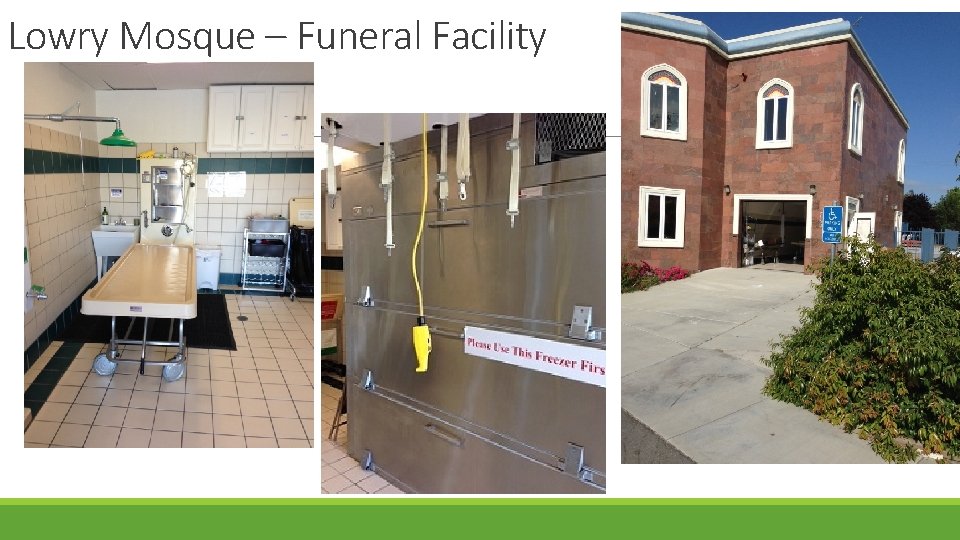
Lowry Mosque – Funeral Facility
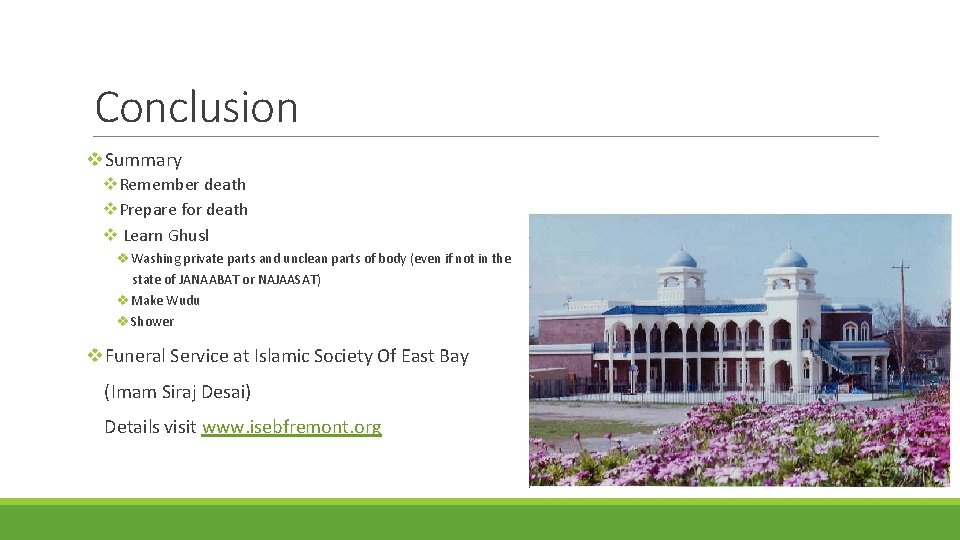
Conclusion v. Summary v. Remember death v. Prepare for death v Learn Ghusl v Washing private parts and unclean parts of body (even if not in the state of JANAABAT or NAJAASAT) v Make Wudu v Shower v. Funeral Service at Islamic Society Of East Bay (Imam Siraj Desai) Details visit www. isebfremont. org
Frequently Asked Questions 1. Can a woman see a man’s body after the ghussul? Answer: Yes, only mahram women can see the man’s deceased body. An example of mahram is wife, daughter, sister, mother, and nieces. 2. Is there a maximum or minimum number of sisters who can perform the ghussul? Answer: No, there is no such thing as maximum or minimum requirements, but ISEB management has rules to have only 5 family members and 4 experiences women from ISEB, in which, one would be a new trainee. The reason they have four participants from ISEB is because the body is kept in the freezer and the body may be heavy and they need to lift the body up if they are not using the machine. Most of the family members that come are in grief and mourning and cannot always lift the body. They normally can do the ghussul, but emotionally lifting may be too difficult. Also, the room is too small according to the radius. 3. How do you get release of the body to transport it in a family car? Answer: ISEB has no knowledge or information in regards to transporting family members in a family car.
4. Why do we have to throw away all the clothes, why can’t we take as a memory? Answer: California law does not allow you to take clothes home. All clothes worn must be disposed of in a hazardous waste bag. 5. Does a body need to be picked up by only mahram men from the freezer? Answer: No, before the ghussul any man can pick up the body from the freezer and put it on the table. 6. Why do we bury women deeper in the grave than men? Answer: This is not true, we bury them in the same depth. 7. If there is no mahram who will put the body in the grave? Answer: The most pious person or other family members. 8. Is the Ghussul only done through organizations or can we do it at home? Answer: ISEB has no input on regards to ghussul’s being done at home. However, Ghussul’s can be done at home if proper arrangements are made. They should contact the state and city requirements to find out more information.
9. Could you please list steps to be taken after the person is dead, especially requiring paperwork? Answer: Please contact www. ISEB. org for complete details on how to fill out paperwork. Also, contact Imam Siraj. 510 943 9600. 10. Does the family provide the kafan or pay the masjid for it? Answer: ISEB provides the kafan and all necessary items for the ghussul. 11. Can a woman on her period perform the ghussul of her dead relative? Answer: No. 12. What is the width of the lifafa? Answer: 150 cm/180 cm to cover from head to toe. This is the measurement used in Taleem-al. Haqq, but I use 120 cm width. 13. Where is the cemetery? Answer: There is a Muslim cemetery in Livermore – at 1761 Laughlin Road. It is called the Five Pillars cemetery. There are is also a cemetery in Hayward called The Chapel of Chimes with a Muslim area. These are the primary two that are used in the East bay that I am aware of.
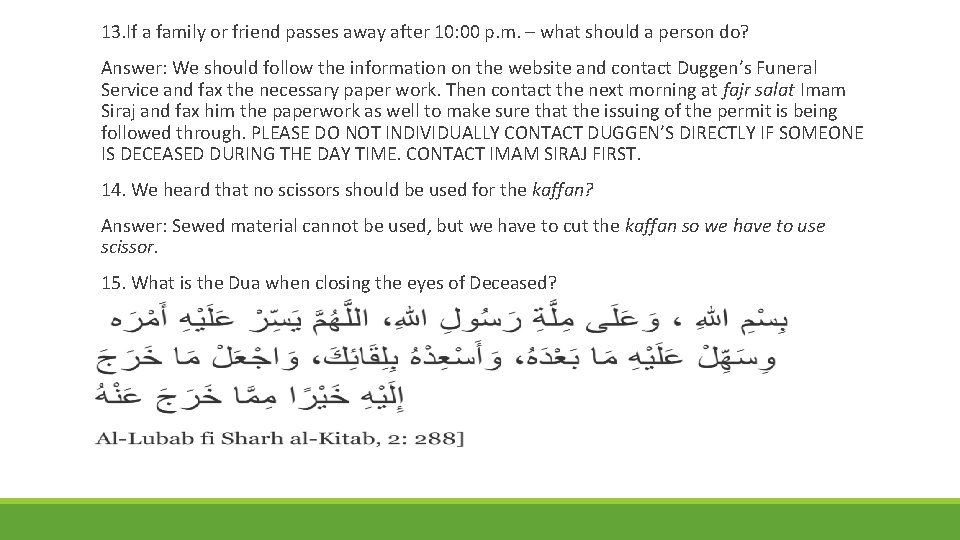
13. If a family or friend passes away after 10: 00 p. m. – what should a person do? Answer: We should follow the information on the website and contact Duggen’s Funeral Service and fax the necessary paper work. Then contact the next morning at fajr salat Imam Siraj and fax him the paperwork as well to make sure that the issuing of the permit is being followed through. PLEASE DO NOT INDIVIDUALLY CONTACT DUGGEN’S DIRECTLY IF SOMEONE IS DECEASED DURING THE DAY TIME. CONTACT IMAM SIRAJ FIRST. 14. We heard that no scissors should be used for the kaffan? Answer: Sewed material cannot be used, but we have to cut the kaffan so we have to use scissor. 15. What is the Dua when closing the eyes of Deceased?
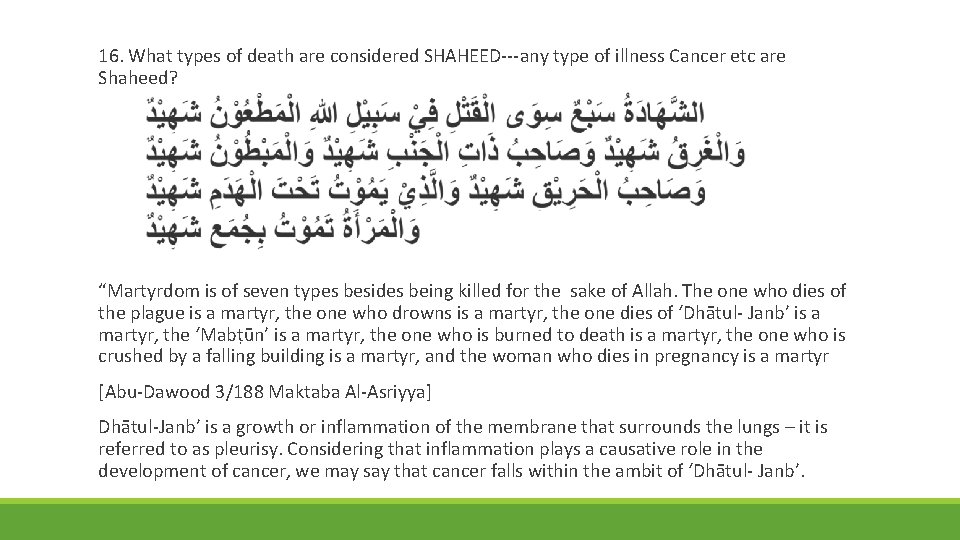
16. What types of death are considered SHAHEED---any type of illness Cancer etc are Shaheed? “Martyrdom is of seven types besides being killed for the sake of Allah. The one who dies of the plague is a martyr, the one who drowns is a martyr, the one dies of ‘Dhātul- Janb’ is a martyr, the ‘Mabṭūn’ is a martyr, the one who is burned to death is a martyr, the one who is crushed by a falling building is a martyr, and the woman who dies in pregnancy is a martyr [Abu-Dawood 3/188 Maktaba Al-Asriyya] Dhātul-Janb’ is a growth or inflammation of the membrane that surrounds the lungs – it is referred to as pleurisy. Considering that inflammation plays a causative role in the development of cancer, we may say that cancer falls within the ambit of ‘Dhātul- Janb’.
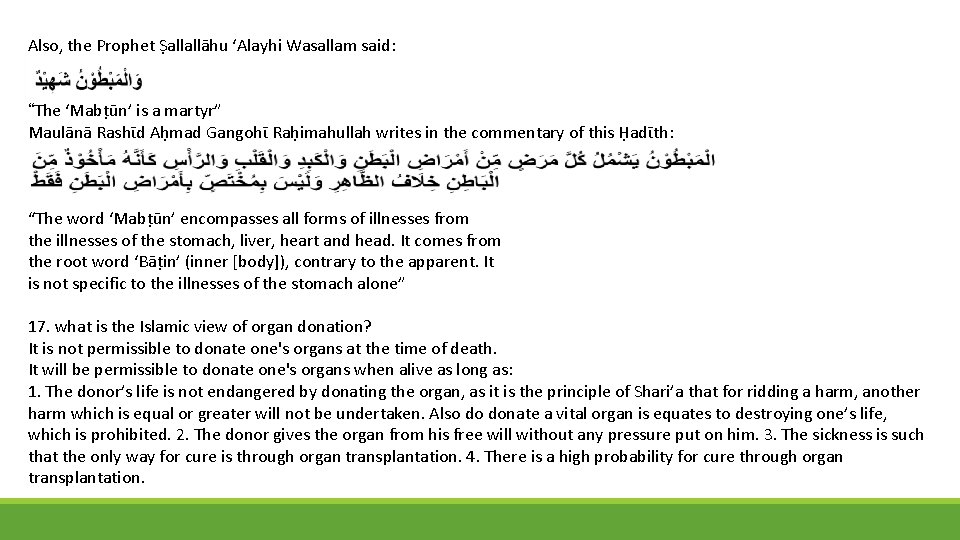
Also, the Prophet Ṣallallāhu ‘Alayhi Wasallam said: “The ‘Mabṭūn’ is a martyr” Maulānā Rashῑd Aḥmad Gangohῑ Raḥimahullah writes in the commentary of this Ḥadῑth: “The word ‘Mabṭūn’ encompasses all forms of illnesses from the illnesses of the stomach, liver, heart and head. It comes from the root word ‘Bāṭin’ (inner [body]), contrary to the apparent. It is not specific to the illnesses of the stomach alone” 17. what is the Islamic view of organ donation? It is not permissible to donate one's organs at the time of death. It will be permissible to donate one's organs when alive as long as: 1. The donor’s life is not endangered by donating the organ, as it is the principle of Shari’a that for ridding a harm, another harm which is equal or greater will not be undertaken. Also do donate a vital organ is equates to destroying one’s life, which is prohibited. 2. The donor gives the organ from his free will without any pressure put on him. 3. The sickness is such that the only way for cure is through organ transplantation. 4. There is a high probability for cure through organ transplantation.
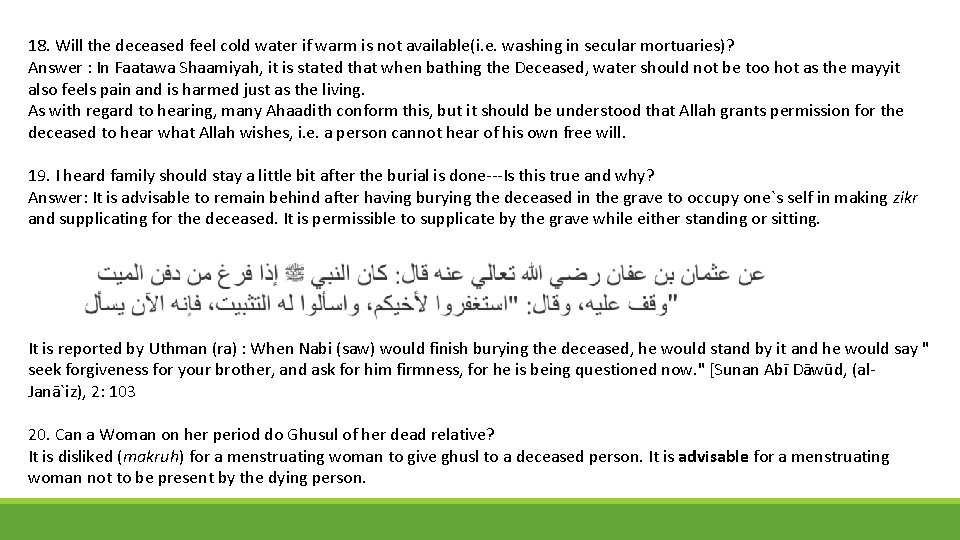
18. Will the deceased feel cold water if warm is not available(i. e. washing in secular mortuaries)? Answer : In Faatawa Shaamiyah, it is stated that when bathing the Deceased, water should not be too hot as the mayyit also feels pain and is harmed just as the living. As with regard to hearing, many Ahaadith conform this, but it should be understood that Allah grants permission for the deceased to hear what Allah wishes, i. e. a person cannot hear of his own free will. 19. I heard family should stay a little bit after the burial is done---Is this true and why? Answer: It is advisable to remain behind after having burying the deceased in the grave to occupy one`s self in making zikr and supplicating for the deceased. It is permissible to supplicate by the grave while either standing or sitting. It is reported by Uthman (ra) : When Nabi (saw) would finish burying the deceased, he would stand by it and he would say " seek forgiveness for your brother, and ask for him firmness, for he is being questioned now. " [Sunan Abī Dāwūd, (al. Janā`iz), 2: 103 20. Can a Woman on her period do Ghusul of her dead relative? It is disliked (makruh) for a menstruating woman to give ghusl to a deceased person. It is advisable for a menstruating woman not to be present by the dying person.
- Slides: 25