
Bisectors of a Triangle Geometry Objectives Use properties
Bisectors of a Triangle Geometry
Objectives • Use properties of perpendicular bisectors of a triangle as applied in Example 1. • Use properties of angle bisectors of a triangle.
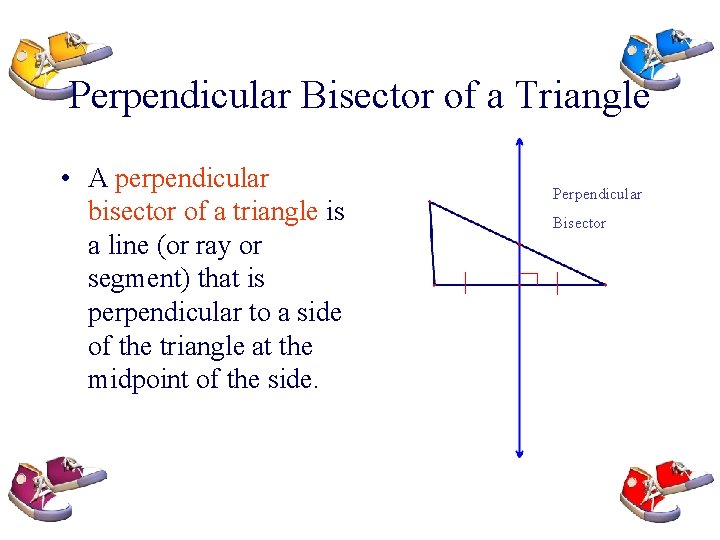
Perpendicular Bisector of a Triangle • A perpendicular bisector of a triangle is a line (or ray or segment) that is perpendicular to a side of the triangle at the midpoint of the side. Perpendicular Bisector
Class Activity 1. 2. 3. 4. Cut four large acute scalene triangles out of paper. Make each one different. Choose one triangle. Fold the triangle to form the perpendicular bisectors of the three sides. Do the three bisectors intersect at the same point? Repeat the process for the other three triangles. What do you observe? Write your observation in the form of a conjecture. Choose one triangle. Label the vertices A, B, C. Label the point of intersection of the perpendicular bisectors as P. Measure AP, BP, and CP. What do you observe?
Notes: • When three or more concurrent lines (or rays or segments) intersect in the same point, then they are called concurrent lines (or rays or segments). The point of intersection of the lines is called the point of concurrency.
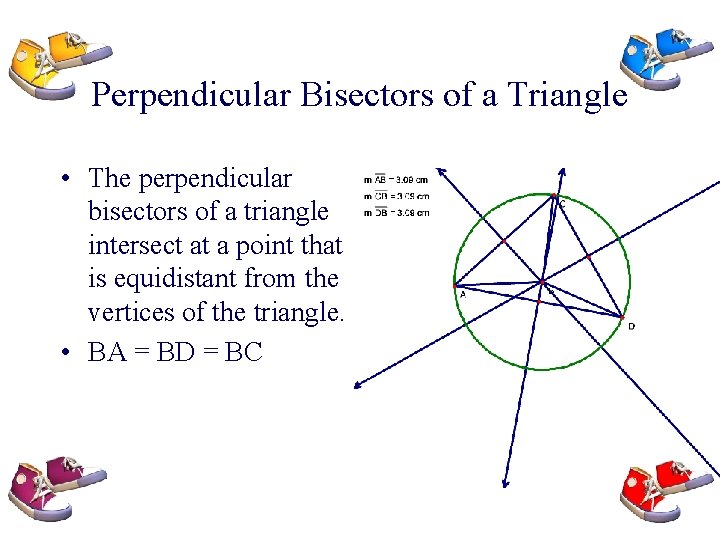
Perpendicular Bisectors of a Triangle • The perpendicular bisectors of a triangle intersect at a point that is equidistant from the vertices of the triangle. • BA = BD = BC
Using angle bisectors of a triangle • An angle bisector of a triangle is a bisector of an angle of the triangle. The three angle bisectors are concurrent. The point of concurrency of the angle bisectors is called the incenter of the triangle, and it always lies inside the triangle.
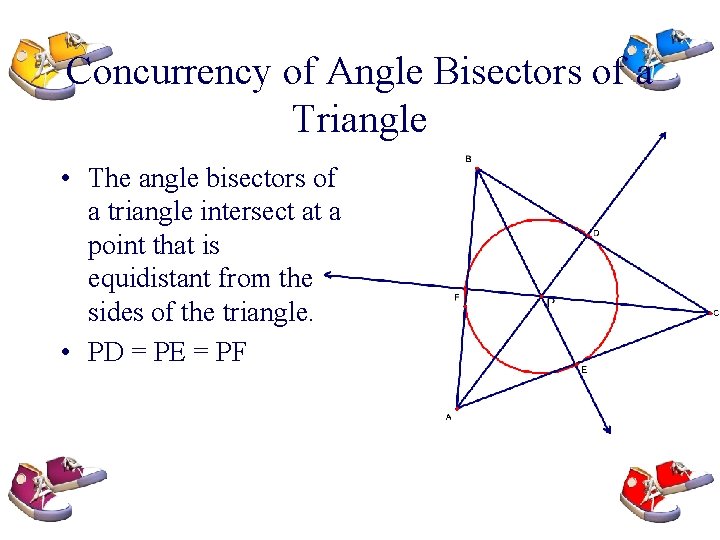
Concurrency of Angle Bisectors of a Triangle • The angle bisectors of a triangle intersect at a point that is equidistant from the sides of the triangle. • PD = PE = PF
Notes: • The diagram shows that the incenter is the center of the circle that touches each side of the triangle once. The circle is inscribed within ∆ABC. Thus the radius of this circle is the distance from the center to any of the sides.
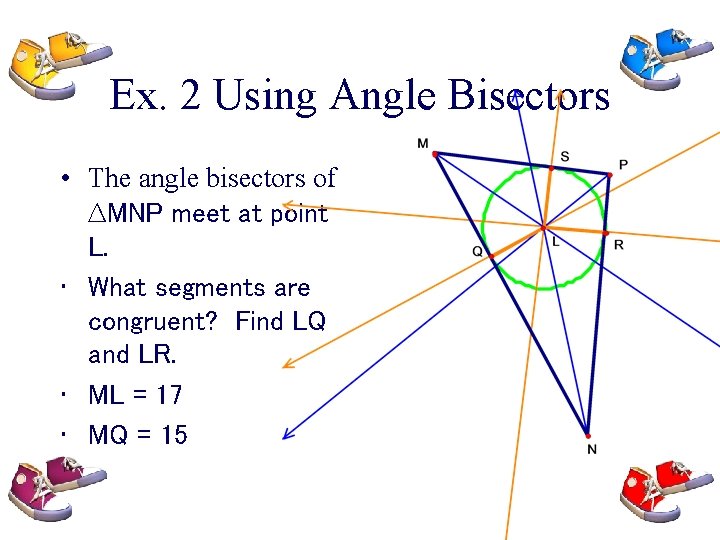
Ex. 2 Using Angle Bisectors • The angle bisectors of ∆MNP meet at point L. • What segments are congruent? Find LQ and LR. • ML = 17 • MQ = 15
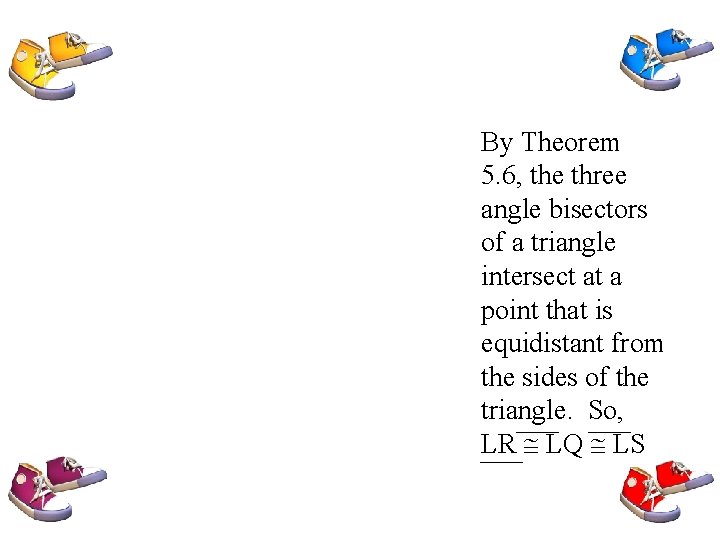
By Theorem 5. 6, the three angle bisectors of a triangle intersect at a point that is equidistant from the sides of the triangle. So, LR LQ LS
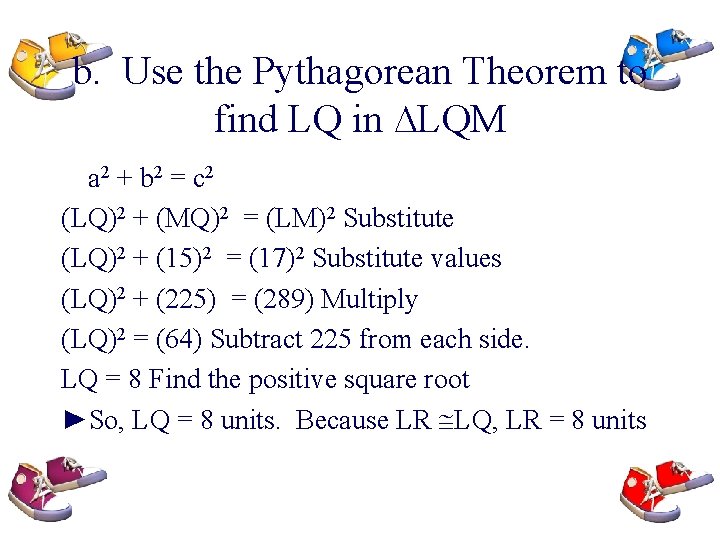
b. Use the Pythagorean Theorem to find LQ in ∆LQM a 2 + b 2 = c 2 (LQ)2 + (MQ)2 = (LM)2 Substitute (LQ)2 + (15)2 = (17)2 Substitute values (LQ)2 + (225) = (289) Multiply (LQ)2 = (64) Subtract 225 from each side. LQ = 8 Find the positive square root ►So, LQ = 8 units. Because LR LQ, LR = 8 units
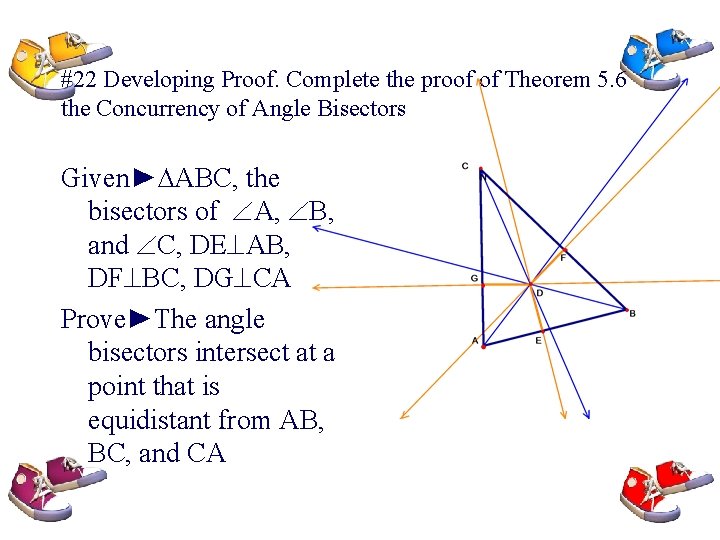
#22 Developing Proof. Complete the proof of Theorem 5. 6 the Concurrency of Angle Bisectors Given►∆ABC, the bisectors of A, B, and C, DE AB, DF BC, DG CA Prove►The angle bisectors intersect at a point that is equidistant from AB, BC, and CA
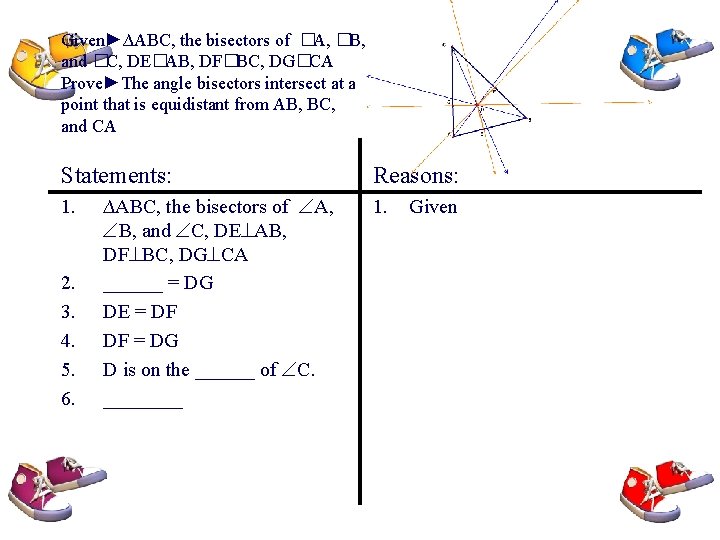
Given►∆ABC, the bisectors of �A, �B, and �C, DE�AB, DF�BC, DG�CA Prove►The angle bisectors intersect at a point that is equidistant from AB, BC, and CA Statements: 1. 2. 3. 4. 5. 6. ∆ABC, the bisectors of A, B, and C, DE AB, DF BC, DG CA ______ = DG DE = DF DF = DG D is on the ______ of C. ____ Reasons: 1. Given
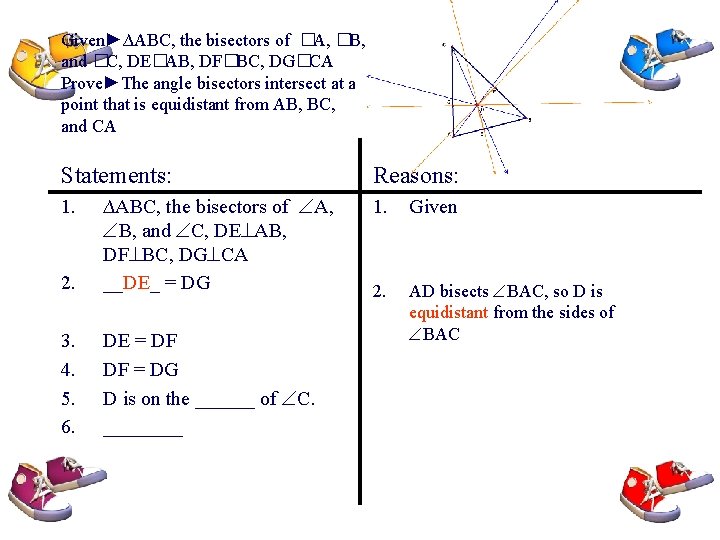
Given►∆ABC, the bisectors of �A, �B, and �C, DE�AB, DF�BC, DG�CA Prove►The angle bisectors intersect at a point that is equidistant from AB, BC, and CA Statements: 2. ∆ABC, the bisectors of A, B, and C, DE AB, DF BC, DG CA __DE_ = DG 3. 4. 5. 6. DE = DF DF = DG D is on the ______ of C. ____ 1. Reasons: 1. Given 2. AD bisects BAC, so D is equidistant from the sides of BAC
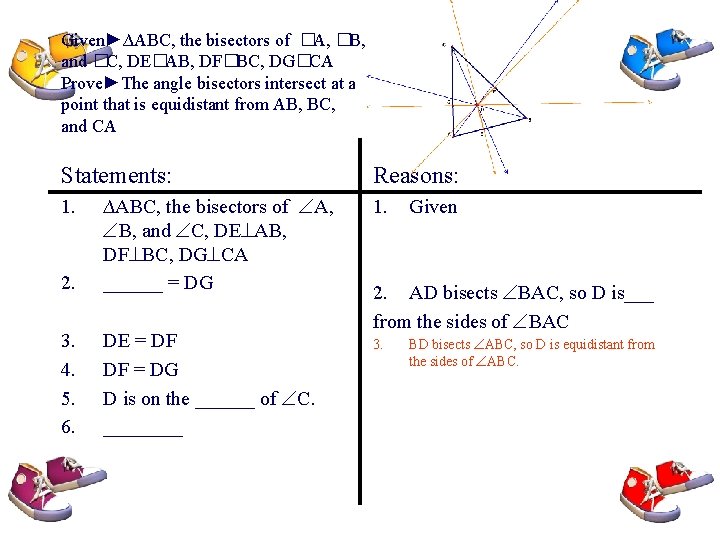
Given►∆ABC, the bisectors of �A, �B, and �C, DE�AB, DF�BC, DG�CA Prove►The angle bisectors intersect at a point that is equidistant from AB, BC, and CA Statements: 2. ∆ABC, the bisectors of A, B, and C, DE AB, DF BC, DG CA ______ = DG 3. 4. 5. 6. DE = DF DF = DG D is on the ______ of C. ____ 1. Reasons: 1. Given 2. AD bisects BAC, so D is___ from the sides of BAC 3. BD bisects ABC, so D is equidistant from the sides of ABC.
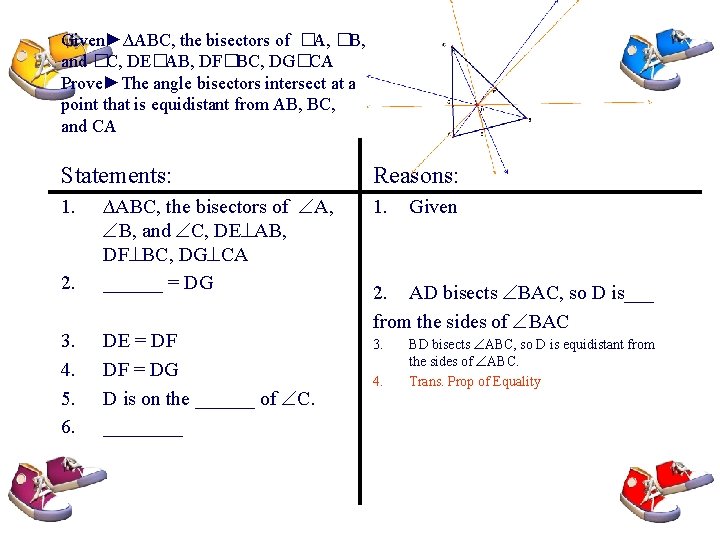
Given►∆ABC, the bisectors of �A, �B, and �C, DE�AB, DF�BC, DG�CA Prove►The angle bisectors intersect at a point that is equidistant from AB, BC, and CA Statements: 2. ∆ABC, the bisectors of A, B, and C, DE AB, DF BC, DG CA ______ = DG 3. 4. 5. 6. DE = DF DF = DG D is on the ______ of C. ____ 1. Reasons: 1. Given 2. AD bisects BAC, so D is___ from the sides of BAC 3. 4. BD bisects ABC, so D is equidistant from the sides of ABC. Trans. Prop of Equality
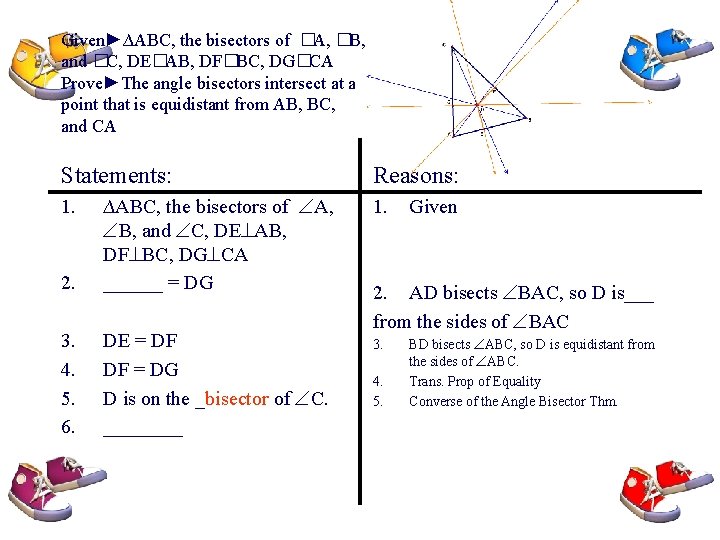
Given►∆ABC, the bisectors of �A, �B, and �C, DE�AB, DF�BC, DG�CA Prove►The angle bisectors intersect at a point that is equidistant from AB, BC, and CA Statements: 2. ∆ABC, the bisectors of A, B, and C, DE AB, DF BC, DG CA ______ = DG 3. 4. 5. 6. DE = DF DF = DG D is on the _bisector of C. ____ 1. Reasons: 1. Given 2. AD bisects BAC, so D is___ from the sides of BAC 3. 4. 5. BD bisects ABC, so D is equidistant from the sides of ABC. Trans. Prop of Equality Converse of the Angle Bisector Thm.
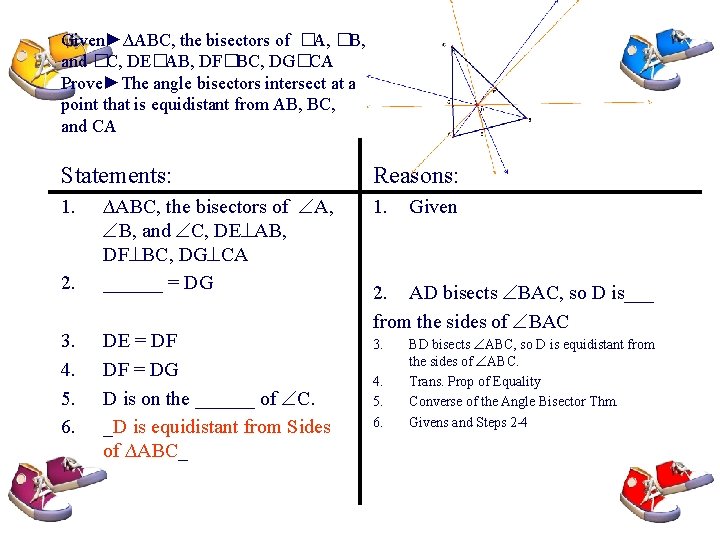
Given►∆ABC, the bisectors of �A, �B, and �C, DE�AB, DF�BC, DG�CA Prove►The angle bisectors intersect at a point that is equidistant from AB, BC, and CA Statements: 1. 2. 3. 4. 5. 6. ∆ABC, the bisectors of A, B, and C, DE AB, DF BC, DG CA ______ = DG DE = DF DF = DG D is on the ______ of C. _D is equidistant from Sides of ∆ABC_ Reasons: 1. Given 2. AD bisects BAC, so D is___ from the sides of BAC 3. 4. 5. 6. BD bisects ABC, so D is equidistant from the sides of ABC. Trans. Prop of Equality Converse of the Angle Bisector Thm. Givens and Steps 2 -4
- Slides: 19