
Bisection Method Basis of Bisection Method Theorem An

Bisection Method
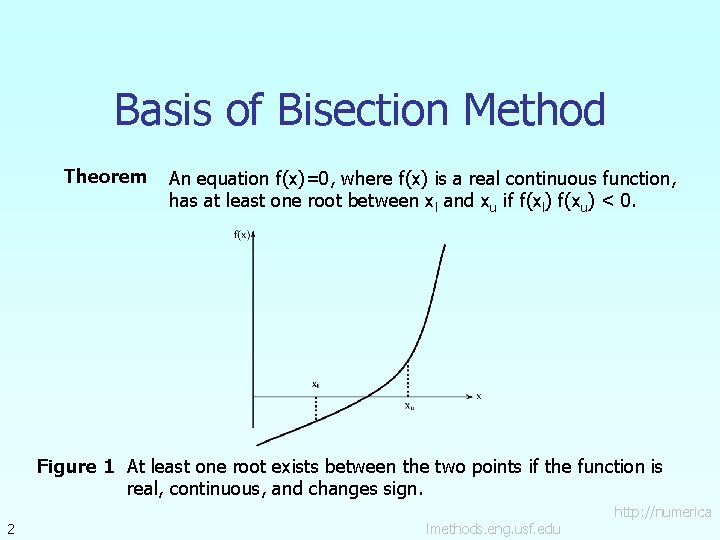
Basis of Bisection Method Theorem An equation f(x)=0, where f(x) is a real continuous function, has at least one root between xl and xu if f(xl) f(xu) < 0. Figure 1 At least one root exists between the two points if the function is real, continuous, and changes sign. 2 lmethods. eng. usf. edu http: //numerica

Algorithm for Bisection Method 3 lmethods. eng. usf. edu http: //numerica
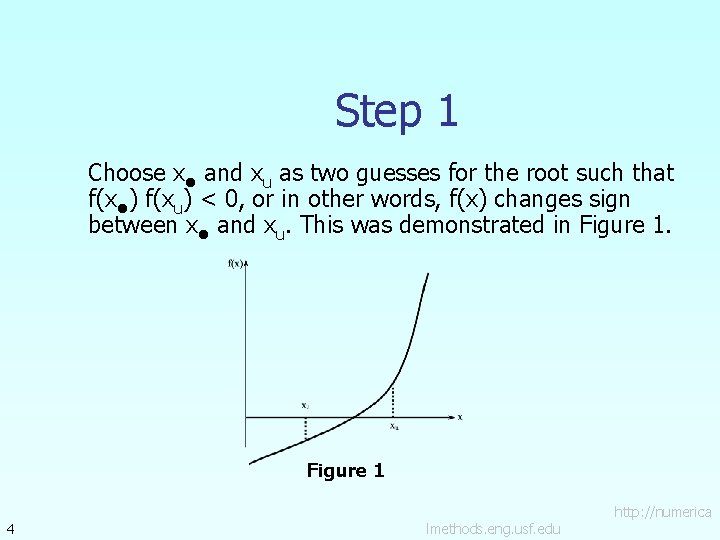
Step 1 Choose xl and xu as two guesses for the root such that f(xl) f(xu) < 0, or in other words, f(x) changes sign between xl and xu. This was demonstrated in Figure 1 4 lmethods. eng. usf. edu http: //numerica
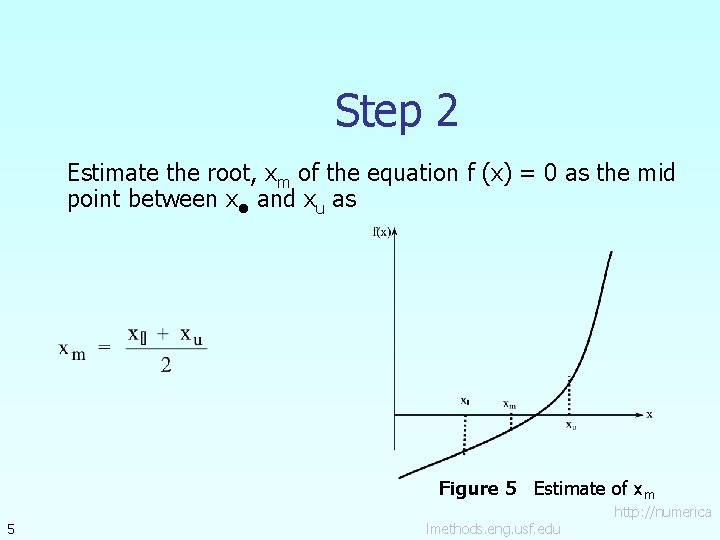
Step 2 Estimate the root, xm of the equation f (x) = 0 as the mid point between xl and xu as Figure 5 Estimate of xm 5 lmethods. eng. usf. edu http: //numerica
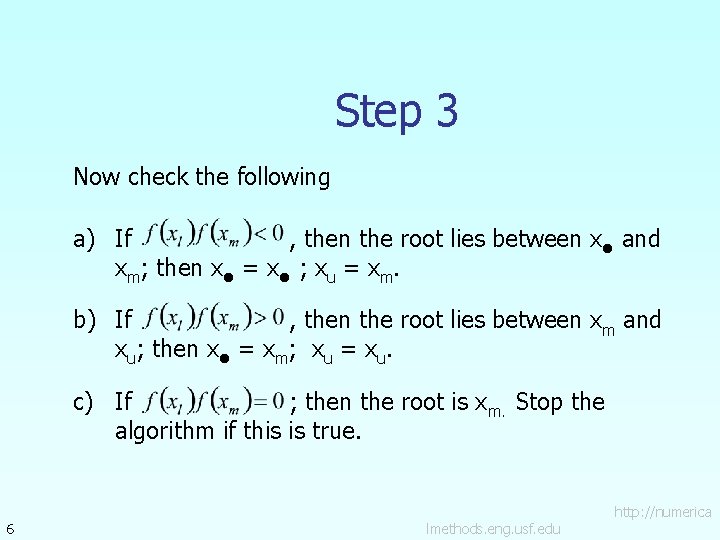
Step 3 Now check the following a) If , then the root lies between xl and xm; then xl = xl ; xu = xm. b) If , then the root lies between xm and xu; then xl = xm; xu = xu. c) If ; then the root is xm. Stop the algorithm if this is true. 6 lmethods. eng. usf. edu http: //numerica
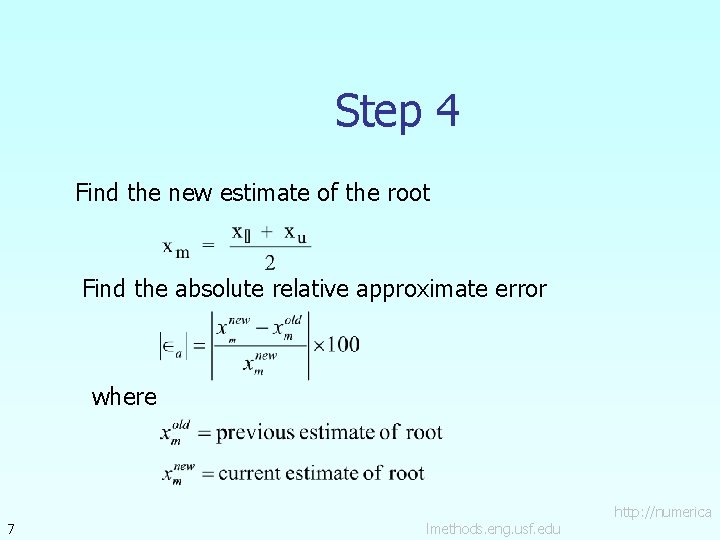
Step 4 Find the new estimate of the root Find the absolute relative approximate error where 7 lmethods. eng. usf. edu http: //numerica
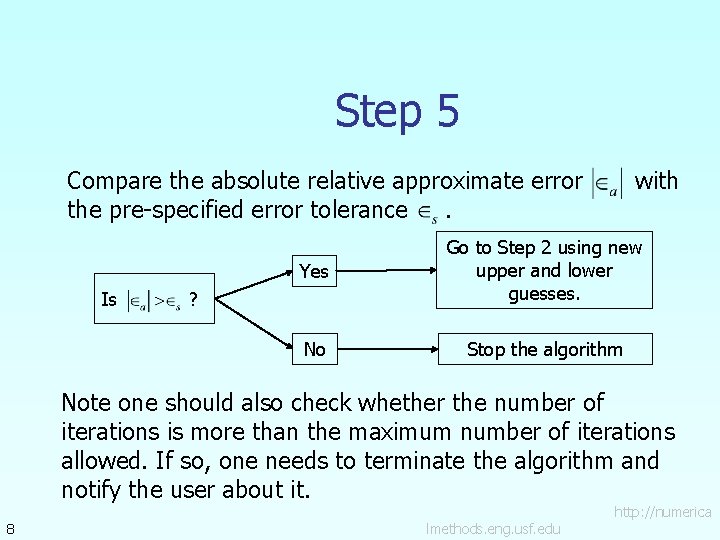
Step 5 Compare the absolute relative approximate error the pre-specified error tolerance. Is with Yes Go to Step 2 using new upper and lower guesses. No Stop the algorithm ? Note one should also check whether the number of iterations is more than the maximum number of iterations allowed. If so, one needs to terminate the algorithm and notify the user about it. 8 lmethods. eng. usf. edu http: //numerica
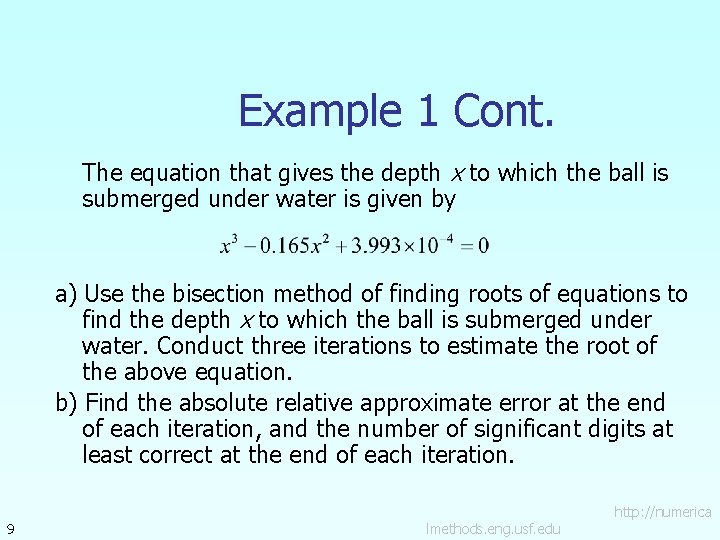
Example 1 Cont. The equation that gives the depth x to which the ball is submerged under water is given by a) Use the bisection method of finding roots of equations to find the depth x to which the ball is submerged under water. Conduct three iterations to estimate the root of the above equation. b) Find the absolute relative approximate error at the end of each iteration, and the number of significant digits at least correct at the end of each iteration. 9 lmethods. eng. usf. edu http: //numerica

Example 1 Cont. Solution To aid in the understanding of how this method works to find the root of an equation, the graph of f(x) is shown to the right, where Figure 7 Graph of the function f(x) 10 lmethods. eng. usf. edu http: //numerica
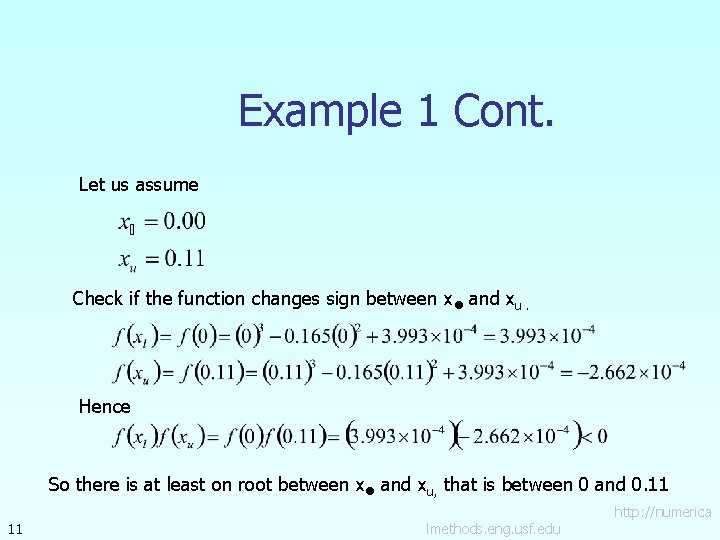
Example 1 Cont. Let us assume Check if the function changes sign between xl and xu. Hence So there is at least on root between xl and xu, that is between 0 and 0. 11 11 lmethods. eng. usf. edu http: //numerica
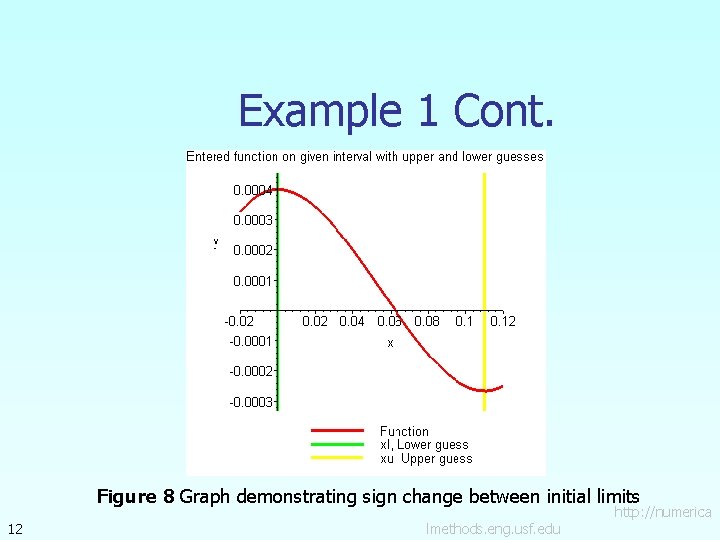
Example 1 Cont. Figure 8 Graph demonstrating sign change between initial limits 12 lmethods. eng. usf. edu http: //numerica
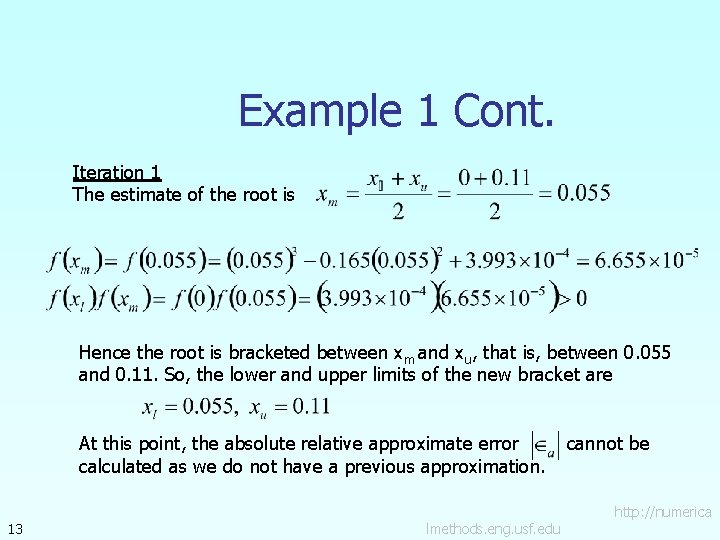
Example 1 Cont. Iteration 1 The estimate of the root is Hence the root is bracketed between xm and xu, that is, between 0. 055 and 0. 11. So, the lower and upper limits of the new bracket are At this point, the absolute relative approximate error calculated as we do not have a previous approximation. 13 lmethods. eng. usf. edu cannot be http: //numerica
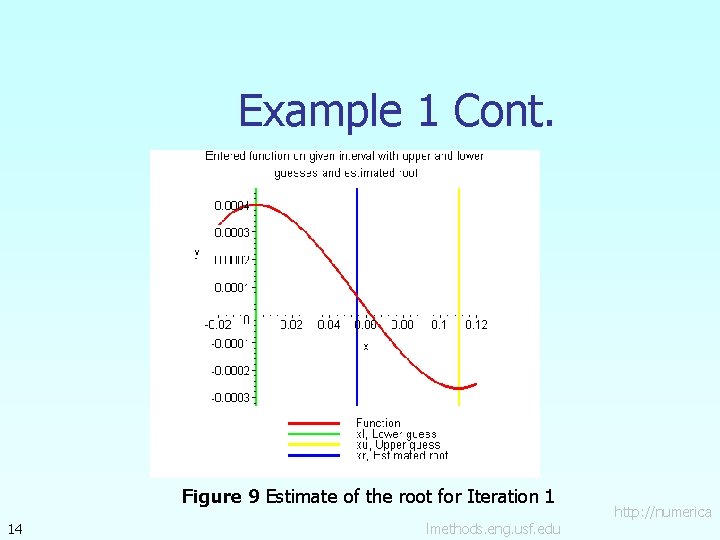
Example 1 Cont. Figure 9 Estimate of the root for Iteration 1 14 lmethods. eng. usf. edu http: //numerica
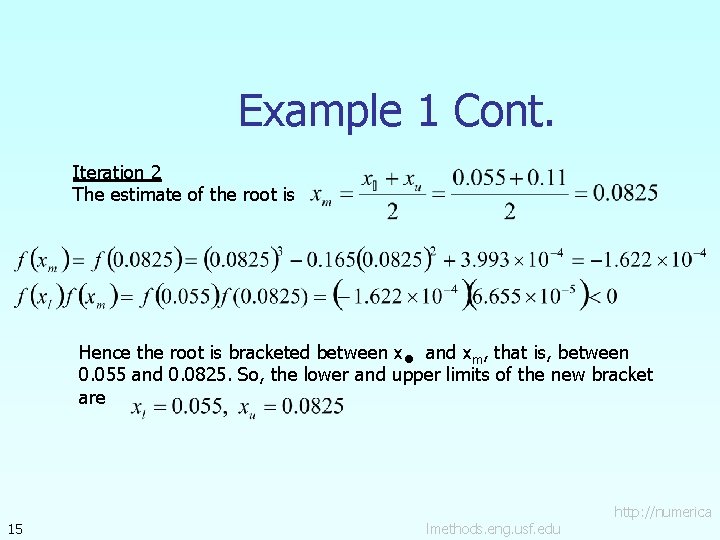
Example 1 Cont. Iteration 2 The estimate of the root is Hence the root is bracketed between xl and xm, that is, between 0. 055 and 0. 0825. So, the lower and upper limits of the new bracket are 15 lmethods. eng. usf. edu http: //numerica
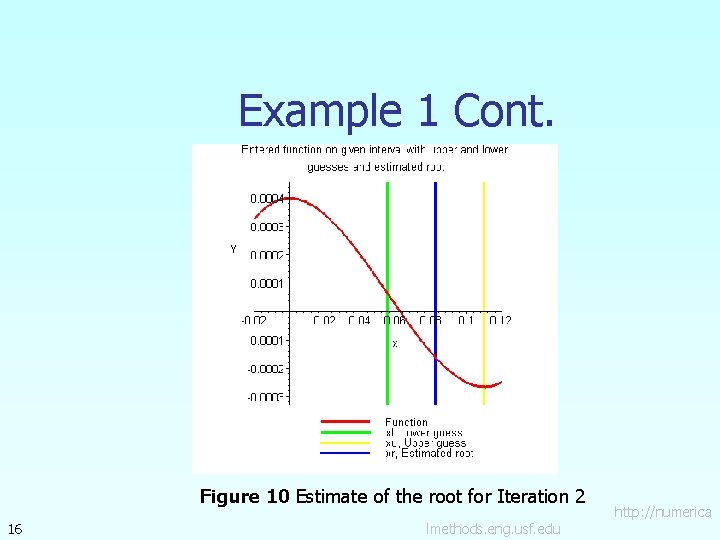
Example 1 Cont. Figure 10 Estimate of the root for Iteration 2 16 lmethods. eng. usf. edu http: //numerica
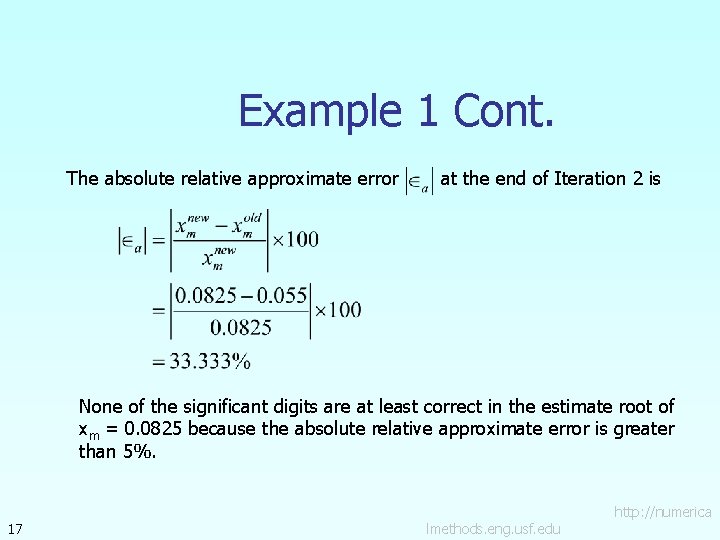
Example 1 Cont. The absolute relative approximate error at the end of Iteration 2 is None of the significant digits are at least correct in the estimate root of xm = 0. 0825 because the absolute relative approximate error is greater than 5%. 17 lmethods. eng. usf. edu http: //numerica
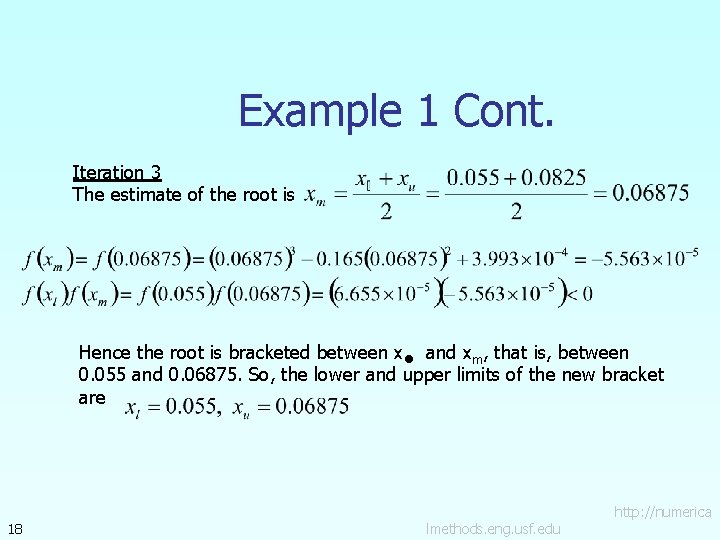
Example 1 Cont. Iteration 3 The estimate of the root is Hence the root is bracketed between xl and xm, that is, between 0. 055 and 0. 06875. So, the lower and upper limits of the new bracket are 18 lmethods. eng. usf. edu http: //numerica
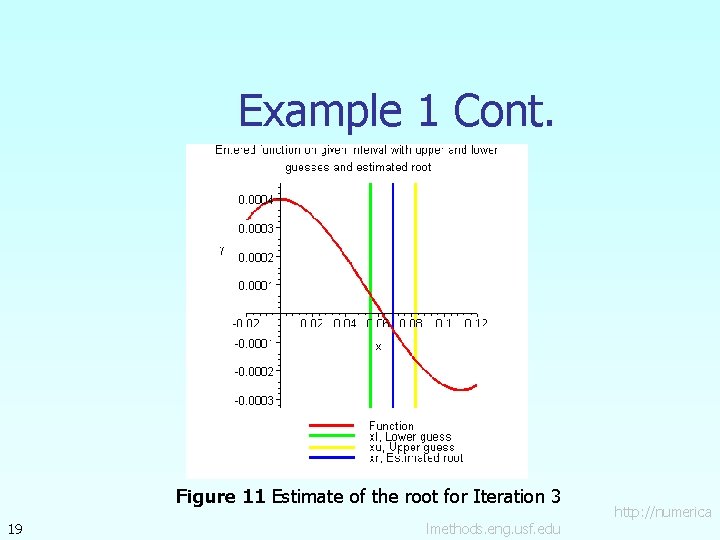
Example 1 Cont. Figure 11 Estimate of the root for Iteration 3 19 lmethods. eng. usf. edu http: //numerica
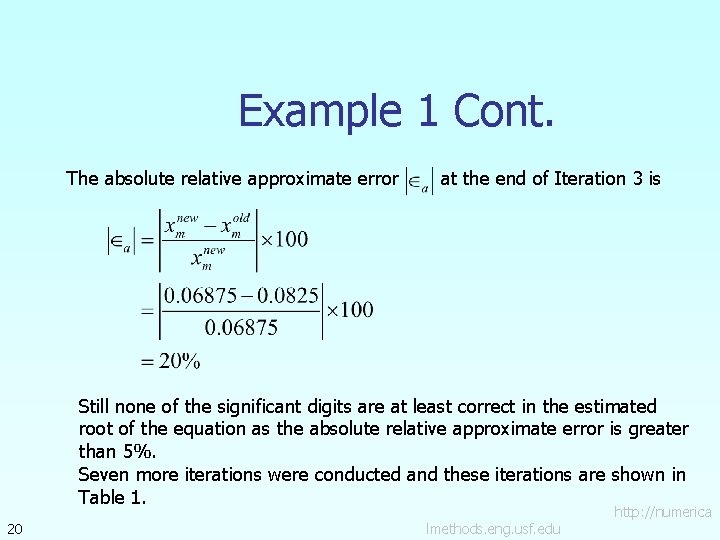
Example 1 Cont. The absolute relative approximate error at the end of Iteration 3 is Still none of the significant digits are at least correct in the estimated root of the equation as the absolute relative approximate error is greater than 5%. Seven more iterations were conducted and these iterations are shown in Table 1. 20 lmethods. eng. usf. edu http: //numerica
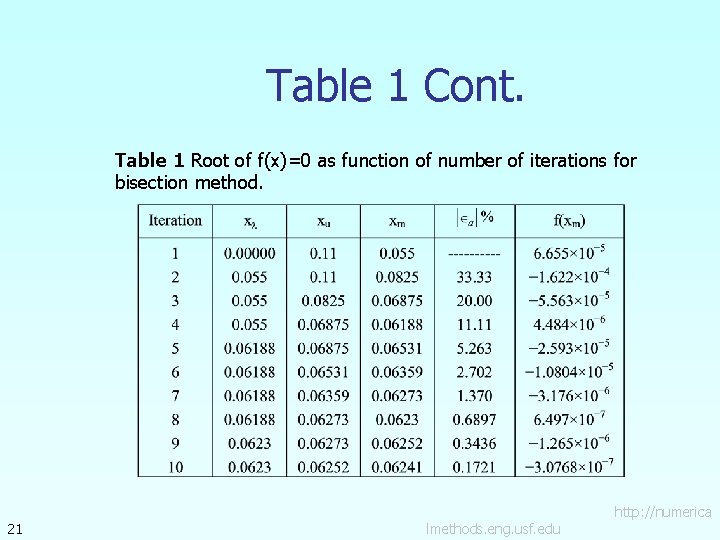
Table 1 Cont. Table 1 Root of f(x)=0 as function of number of iterations for bisection method. 21 lmethods. eng. usf. edu http: //numerica
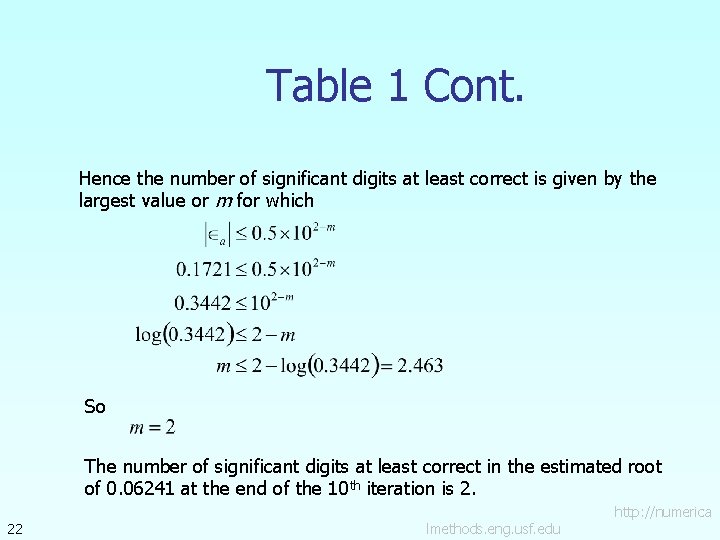
Table 1 Cont. Hence the number of significant digits at least correct is given by the largest value or m for which So The number of significant digits at least correct in the estimated root of 0. 06241 at the end of the 10 th iteration is 2. 22 lmethods. eng. usf. edu http: //numerica

Advantages n n 23 Always convergent The root bracket gets halved with each iteration - guaranteed. lmethods. eng. usf. edu http: //numerica
Drawbacks n n 24 Slow convergence If one of the initial guesses is close to the root, the convergence is slower lmethods. eng. usf. edu http: //numerica
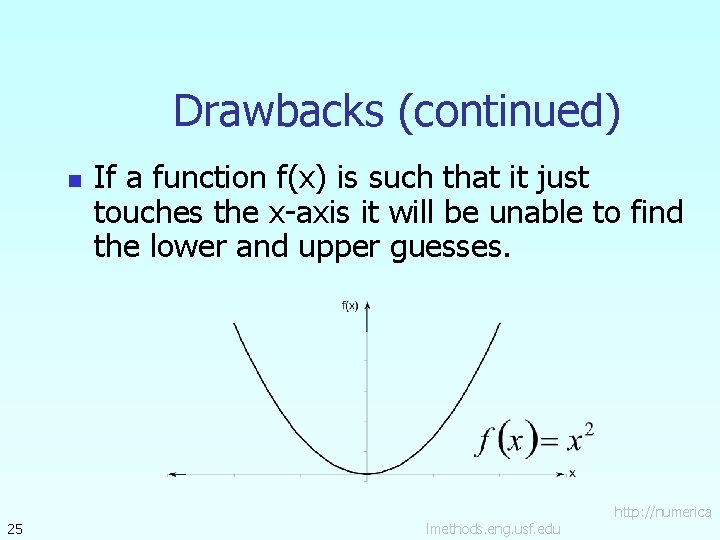
Drawbacks (continued) n 25 If a function f(x) is such that it just touches the x-axis it will be unable to find the lower and upper guesses. lmethods. eng. usf. edu http: //numerica
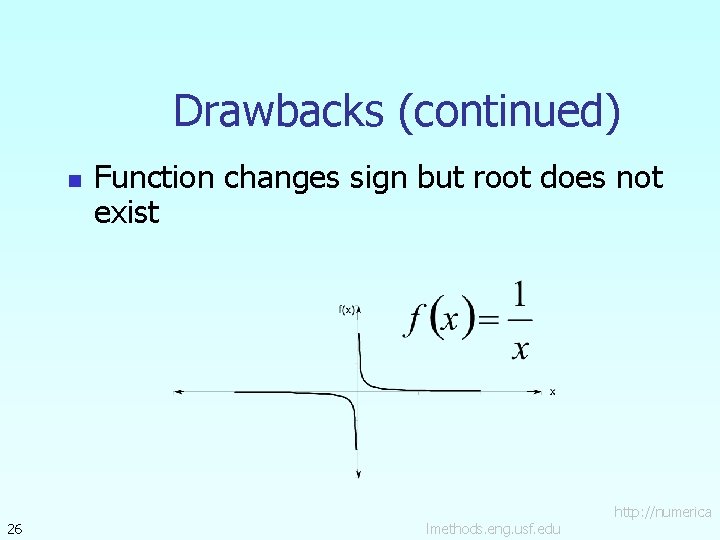
Drawbacks (continued) n 26 Function changes sign but root does not exist lmethods. eng. usf. edu http: //numerica

Additional Resources For all resources on this topic such as digital audiovisual lectures, primers, textbook chapters, multiple-choice tests, worksheets in MATLAB, MATHEMATICA, Math. Cad and MAPLE, blogs, related physical problems, please visit http: //numericalmethods. eng. usf. edu/topics/bisection_ method. html
THE END http: //numericalmethods. eng. usf. edu
- Slides: 28