
BISC 312 Environmental Toxicology I ABSORPTION Toxicokinetics n
BISC 312 Environmental Toxicology I ABSORPTION
Toxicokinetics n Encompasses: n n n Absorption (a. k. a. uptake) Distribution Storage __________________________ Most favorable scenario for an organism: n Toxicant is absorbed, detoxified by metabolic processes, and excreted with no harm resulting
Absorption n a. k. a. _______ n Process whereby toxicants gain entrance into organism by _____________ (enter bloodstream) n Ingested and inhaled materials are still considered outside body until they cross cellular barriers of GI tract or respiratory system

Absorption n There must be _____ and ______ before any effect can occur n A. k. a. ______ effect—toxic substance absorbed into body and distributed via bloodstream to a susceptible organ(s) n Resultant toxic effect may be seen in area quite distant from initial point of contact
Absorption n Some xenobiotics do need absorption to cause a toxic effect n Exception: _____ and ____ (no absorption required) n Referred to as ______ effect—effect has occurred at the point of contact with the body
Absorption n Several factors affect the likelihood that a xenobiotic will be absorbed n Most important are: n route of ______ n concentration of xenobiotic at the site of contact n _______ and _____ properties of xenobiotic
ROUTES OF ABSORPTION
Primary routes of absorption n Skin n Gastrointestinal (GI) tract n n Food and water Respiratory tract n Gas or water contaminants
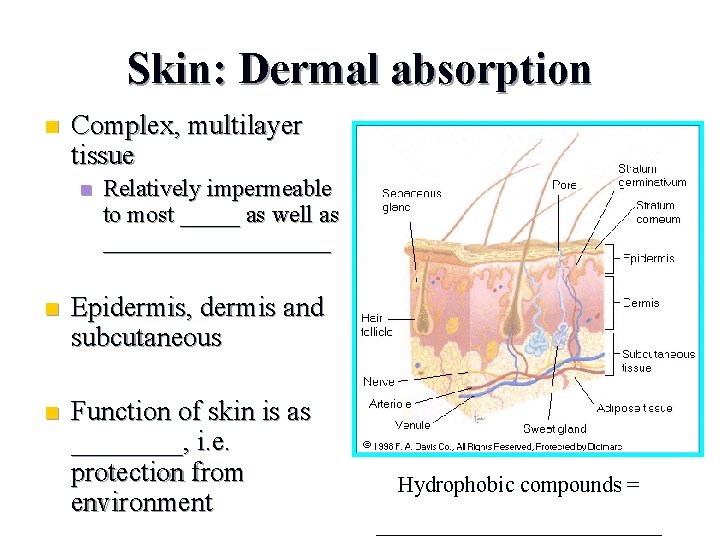
Skin: Dermal absorption n Complex, multilayer tissue n Relatively impermeable to most _____ as well as __________ n Epidermis, dermis and subcutaneous n Function of skin is as ____, i. e. protection from environment Hydrophobic compounds = _____________
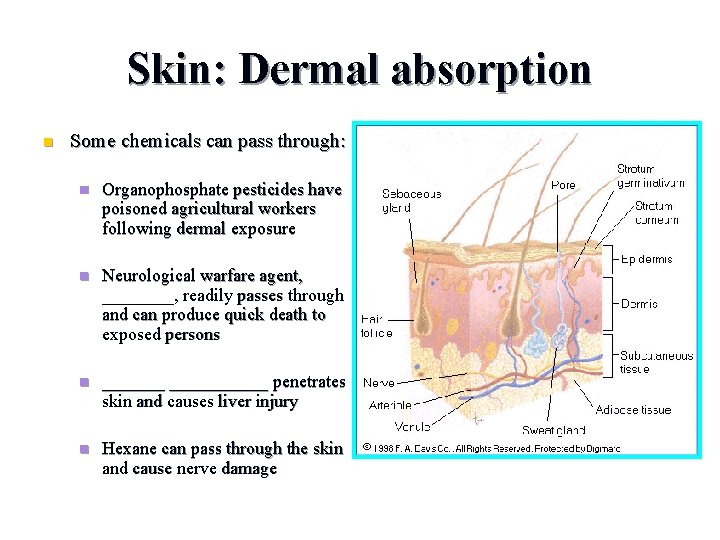
Skin: Dermal absorption n Some chemicals can pass through: n Organophosphate pesticides have poisoned agricultural workers following dermal exposure n Neurological warfare agent, ____, readily passes through and can produce quick death to exposed persons n ___________ penetrates skin and causes liver injury n Hexane can pass through the skin and cause nerve damage
Epidermis n Epidermis is only layer that is important in regulating penetration of skin contaminant n Consists of an outer layer of cells, packed with _______, known as the __________ layer n Stratum corneum is devoid of blood vessels n n n Blood vessels are usually about _____ from skin surface (humans) To enter a blood vessel, agent must pass through several cell layers of cells that are generally resistant to penetration by chemicals Resistance due to presence of the ____, which is chemically resistant and an impenetrable material
Skin Thickness of skin determines ease of entry n Thickness of stratum corneum varies greatly with regions of the body n n n Stratum corneum of the _______ and _______ is very thick (400600 µm) _______, legs and abdomen is much thinner (8 -15 µm) Stratum corneum of the ______ and ______ regions is thinnest (also scrotum) Efficiency of penetration of toxicants is ______ related to thickness of the epidermis!! Hair, feathers, cuticle, scales = __________
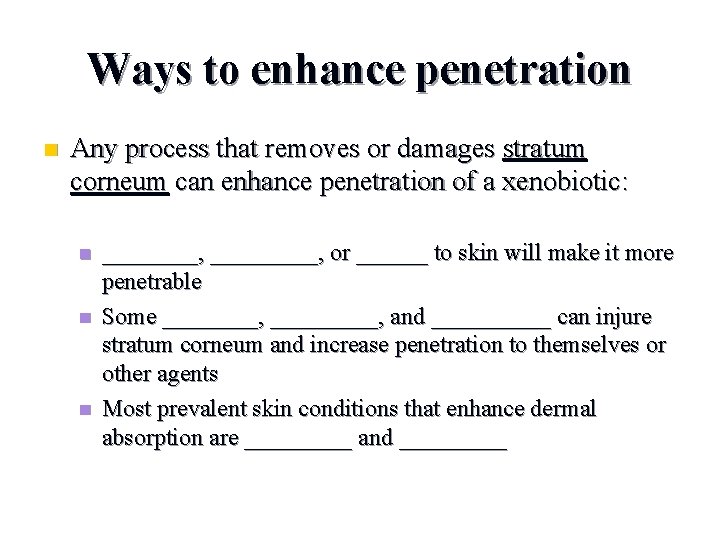
Ways to enhance penetration n Any process that removes or damages stratum corneum can enhance penetration of a xenobiotic: n n n ____, _____, or ______ to skin will make it more penetrable Some ____, _____, and _____ can injure stratum corneum and increase penetration to themselves or other agents Most prevalent skin conditions that enhance dermal absorption are _____ and _____
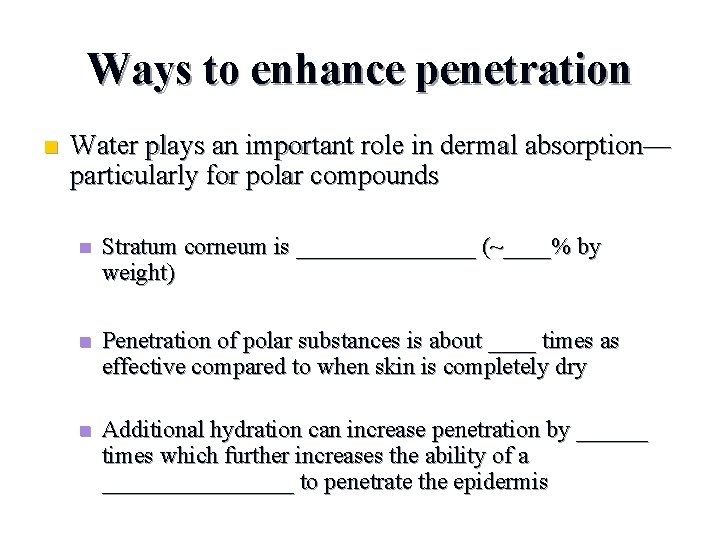
Ways to enhance penetration n Water plays an important role in dermal absorption— particularly for polar compounds n Stratum corneum is ________ (~____% by weight) n Penetration of polar substances is about ____ times as effective compared to when skin is completely dry n Additional hydration can increase penetration by ______ times which further increases the ability of a ________ to penetrate the epidermis
Dermal absorption routes (besides stratum corneum) n In addition to the stratum corneum, small amounts of chemicals may be absorbed through: n n ______________ However, since these structures represent only very small percentage of total surface area, they are not ordinarily important in dermal absorption
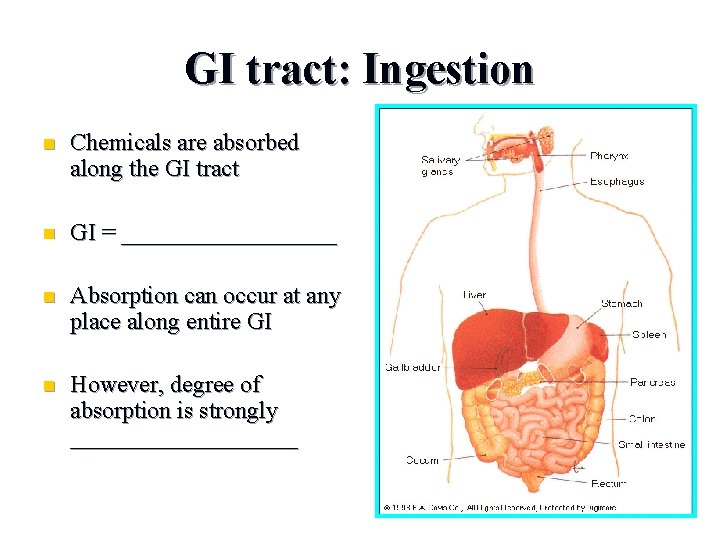
GI tract: Ingestion n Chemicals are absorbed along the GI tract n GI = _________ n Absorption can occur at any place along entire GI n However, degree of absorption is strongly __________
GI tract n Three main factors affect absorption within the various sites of the GI tract: n type of ____ at specific site n period of ____ that the substance remains at site n p. H of _____ or ______ contents at site
Mouth and Esophagus n Xenobiotics poorly absorbed within ______ and ______, due to very short time that substance resides within these portions of GI tract n Some notable exceptions: n n _____ readily penetrates ________________ placed under the tongue (sublingual) for immediate absorption and treatment of heart conditions n Sublingual mucosa under tongue and in some other areas of mouth is _____ and highly ________ = RAPID ABSORPTION
Stomach n High acidity (p. H ______) n Significant site for absorption of weak ________, which exist in a diffusible, nonionized and lipid-soluble form n Weak _____ will be highly ionized and therefore poorly absorbed n Food ingested at same time as xenobiotic may result in considerable difference in absorption of the xenobiotic n For example, LD 50 for dimethline (a respiratory stimulant) in rats is 30 mg/kg when ingested along with food, but only 12 mg/kg when administered to fasting rats
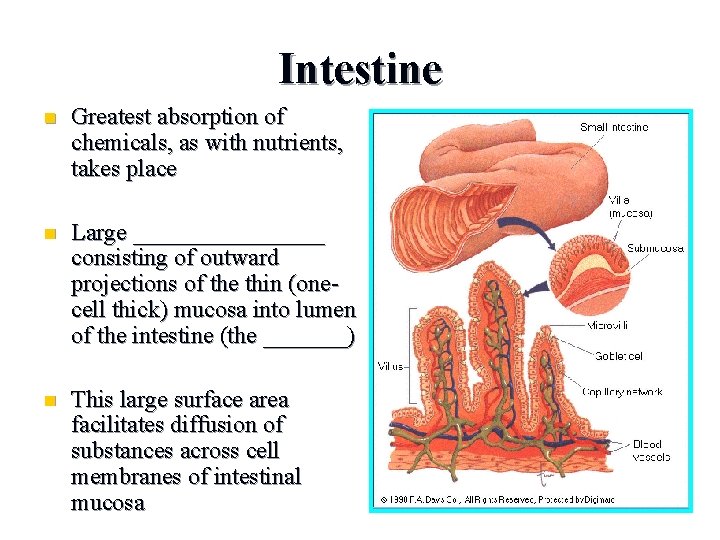
Intestine n Greatest absorption of chemicals, as with nutrients, takes place n Large ________ consisting of outward projections of the thin (onecell thick) mucosa into lumen of the intestine (the _______) n This large surface area facilitates diffusion of substances across cell membranes of intestinal mucosa
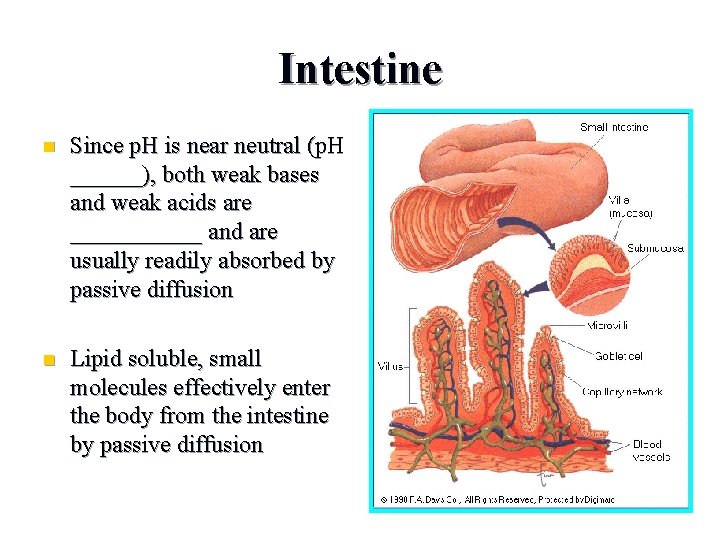
Intestine n Since p. H is near neutral (p. H ______), both weak bases and weak acids are ______ and are usually readily absorbed by passive diffusion n Lipid soluble, small molecules effectively enter the body from the intestine by passive diffusion
Intestine n In addition to passive diffusion, _____ and ____ transport mechanisms exist to move certain substances across intestinal cells into body: n Essential nutrients, such as ______, _____ and ______ n ___________, and ____ are also transported by these mechanisms, including some important toxins n For example, lead, thallium, and paraquat (herbicide) are toxins that transported across intestinal wall by active transport
Intestine n High degree of absorption of ingested xenobiotics is also due to the slow movement of substances through intestinal tract n This slow passage increases length of time that compound is available for absorption at intestinal membrane barrier
Intestine n Intestinal ______ and __________ can affect toxicity of ingested substances n Some ingested substances may be only poorly absorbed but they may be biotransformed within GI tract n In some cases, the biotransformed products may be absorbed and be more toxic than ingested substance n Example—formation of carcinogenic nitrosamines from non-carcinogenic amines by intestinal flora
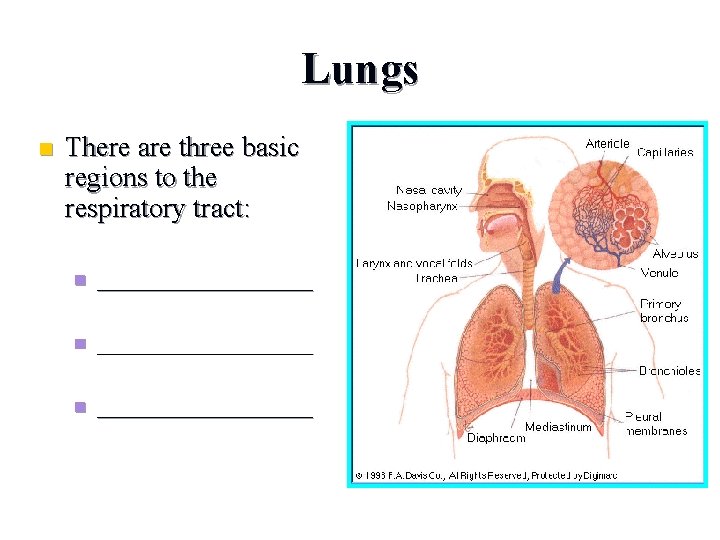
Lungs n There are three basic regions to the respiratory tract: n __________________ n _________
Lungs n Greatest rate of absorption occurs in pulmonary region n WHY? Consists of very small airways (bronchioles) and the alveolar sacs of the lung n Alveolar region has a ____________, about ____ times that of the skin n Alveoli only a _______ layer of cells with very thin membranes n
Lungs n Minimal absorption takes place in ________ region due to cell thickness of mucosa and rapid movement of gases and particles through the region n Within ________ region, relatively soluble gases can quickly enter blood stream n Most deposited particles are moved back up to mouth where they are swallowed
What determines rate of absorption via inhalation? n Solubility of the contaminant in blood— applicable to gases/vapors only!! n Physical form n Presence of macrophages—applicable to particles only!!
Solubility n In contrast to absorption via GI tract or skin, water-soluble gases and particles (and thus blood soluble), will be absorbed more efficiently from lung alveoli n Water-soluble gases and liquid aerosols can pass through the alveolar cell membrane by simple passive diffusion
Physical Form n Physical form = whether toxicant is ____ or ______ n Physical form determines penetration into deep lung n ______ or ______ can be inhaled deep into lung and if it has high solubility in blood, it is almost completely absorbed in one respiration n Absorption alveolar membrane is by passive diffusion, following concentration gradient
Physical Form n Absorption of airborne particles is usually different from that of gases or vapors n Absorption of solid particles, regardless of solubility, is dependent upon _________ n ________ (> __ µm) are generally deposited in _________ region with little absorption n Particles _____ µm can penetrate into ________ region n Very small particles (___ µm) are able to penetrate deep into _______ where they can deposit and be absorbed
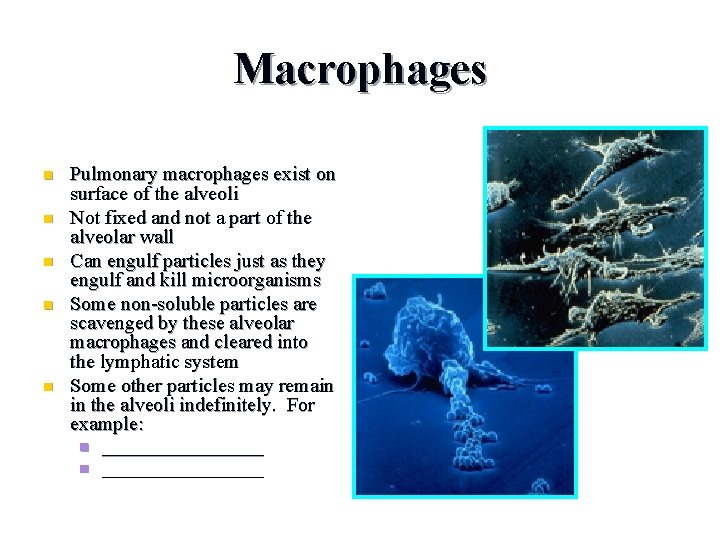
Macrophages n n n Pulmonary macrophages exist on surface of the alveoli Not fixed and not a part of the alveolar wall Can engulf particles just as they engulf and kill microorganisms Some non-soluble particles are scavenged by these alveolar macrophages and cleared into the lymphatic system Some other particles may remain in the alveoli indefinitely. For example: n n __________________ From http: //www. aids-info. ch/e_Te/aas-e-imm. htm
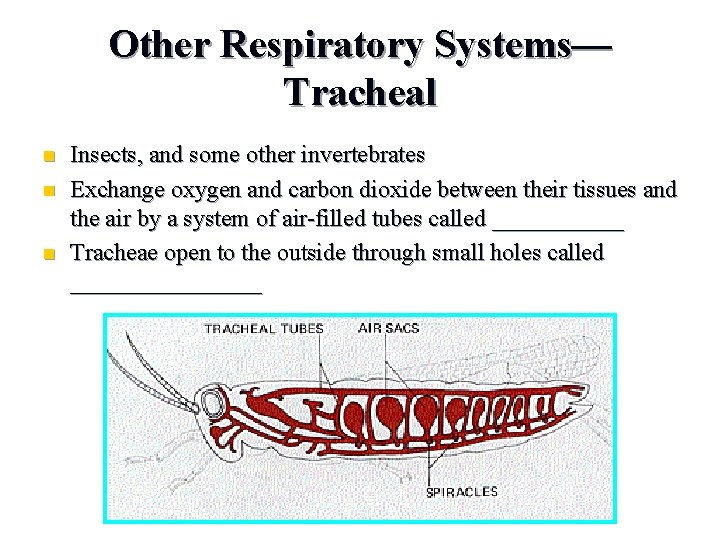
Other Respiratory Systems— Tracheal n n n Insects, and some other invertebrates Exchange oxygen and carbon dioxide between their tissues and the air by a system of air-filled tubes called ______ Tracheae open to the outside through small holes called ________ From http: //users. rcn. com/jkimball. ma. ultranet/Biology. Pages/T/Tracheal_Breathing. html
Tracheal System n Spiracles are guarded by n n valves controlled by muscles that enables the grasshopper to open and close them—prevent water from entering too!! hairs that filter out dust as the air enters the spiracles n Spiracles large tracheal tubes finer tracheal tubes (branches) at extreme ends, called ______ (0. 1 µm in diameter) n High surface area
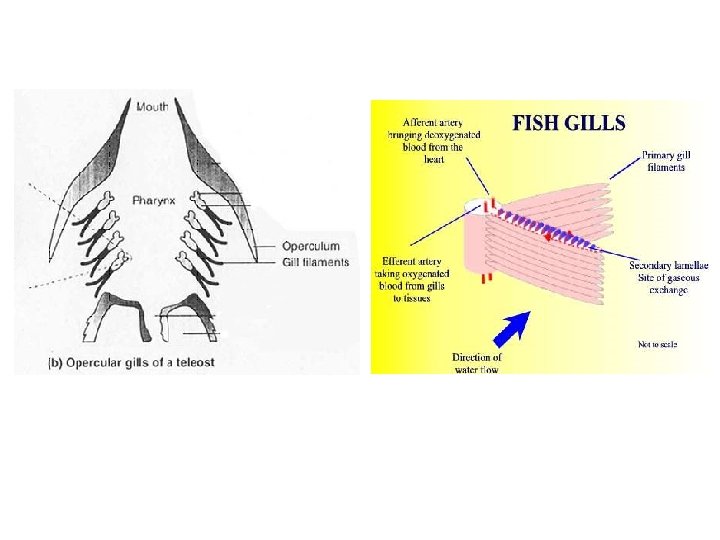
Other Respiratory Systems n Aquatic fish n Gill epithelium of fish is major site of gas exchange, acid-base balance, ionic regulation, and excretion of nitrogenous waste n Protected by ______—hard plate on either side of head n External so comes in contact with everything in water n ____ to ___ µm
Other Respiratory Systems— Gills n High surface area n Gill filaments = ________ n Off each are numerous smaller _________ n Tiny blood capillaries flow through the secondary lamellae n Direction of blood flow in secondary lamellae is opposite to that of water flow (_________ exchange) n Increase potential extraction efficiency to nearly 100% (versus 50% if system was concurrent exchange)
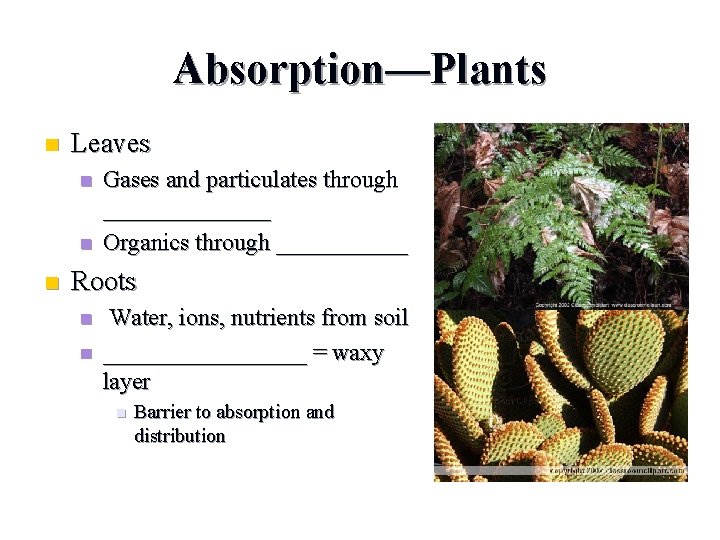
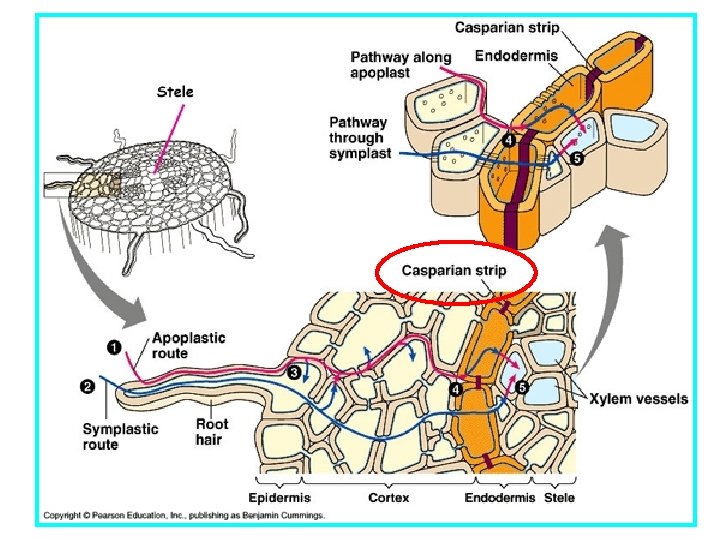
Absorption—Plants n Leaves n n n Gases and particulates through _______ Organics through ______ Roots n n Water, ions, nutrients from soil _________ = waxy layer n Barrier to absorption and distribution
Injections n _____ absorption n Not necessarily realistic but helpful at simulating _____ internal dose
Types of Injections n Subcutaneous: beneath the skin n Intraperitoneal (i. p. ): into abdominal cavity n _________________________________ n _________________
ABSORPTION THROUGH CELL MEMBRANE
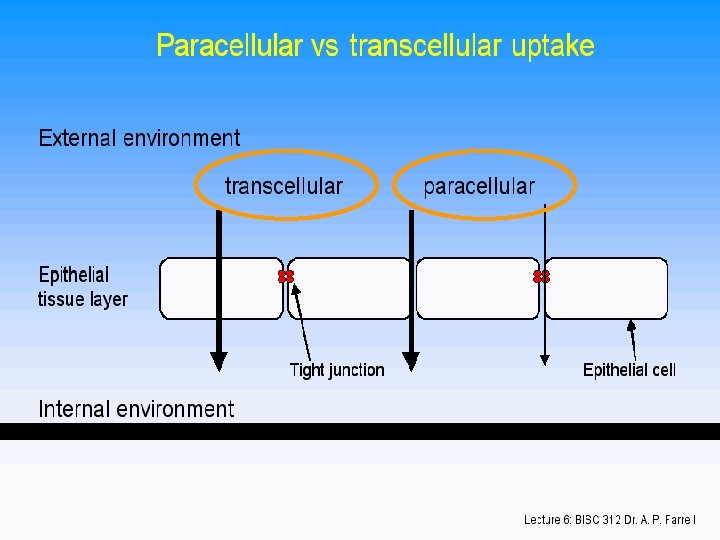
How do toxicants get absorbed? n ______: between cells n ______: through cells
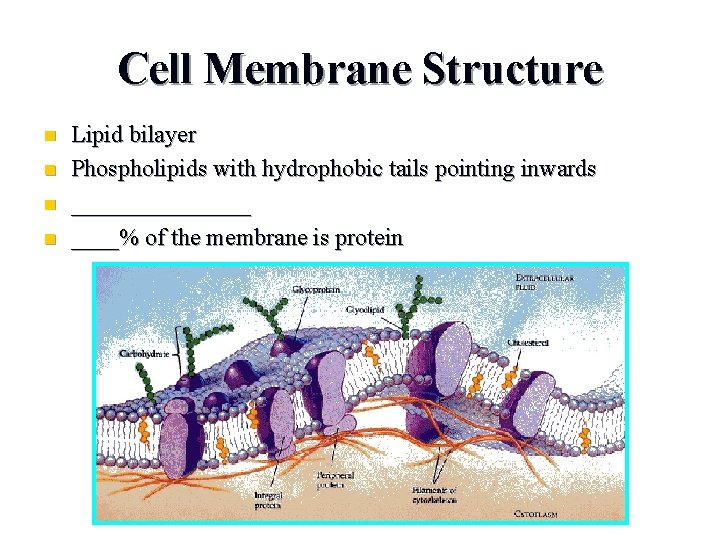
Cell Membrane Structure n n Lipid bilayer Phospholipids with hydrophobic tails pointing inwards ________% of the membrane is protein From Campbell’s introductory Biology text
Chemical/Physical Properties of Toxicant n Depends on the chemical properties of the toxicant n ____________
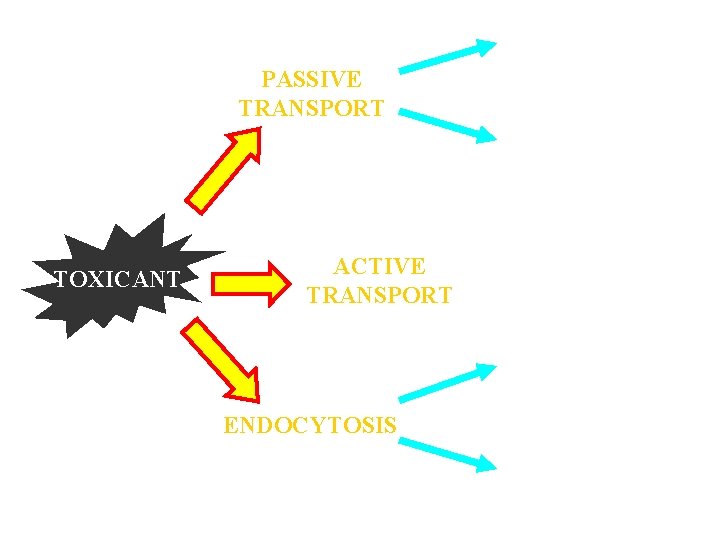
PASSIVE TRANSPORT SIMPLE DIFFUSION FACILITATED DIFFUSION TOXICANT ACTIVE TRANSPORT PHAGOCYTOSIS ENDOCYTOSIS PINOCYTOSIS
Passive Transport n Two factors determine the rate of passive transfer: n Difference in concentrations of substance on opposite sides of the membrane n n n Substance moves from a region of high concentration to one having a lower concentration Diffusion will continue until concentration is equal on both sides of membrane Ability of substance to move either through the small pores in membrane or lipophilic interior of membrane
Passive Transport n Consists of: n Simple diffusion—passes through cell membrane n n Facilitated diffusion—requires assistance of transport proteins n n n _______ compounds like benzene Small _____ molecules like water Gases and vapors Large _______ compounds like glucose Ions like metals and calcium No cellular ______
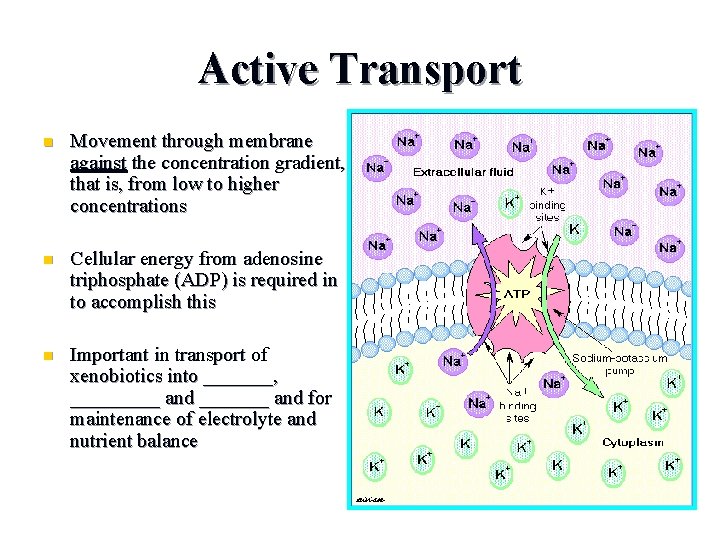
Active Transport n Movement through membrane against the concentration gradient, that is, from low to higher concentrations n Cellular energy from adenosine triphosphate (ADP) is required in to accomplish this n Important in transport of xenobiotics into _______, _____ and _______ and for maintenance of electrolyte and nutrient balance From http: //www. sis. nlm. nih. gov/Tox. Tutor/Tox 2/a 21. htm
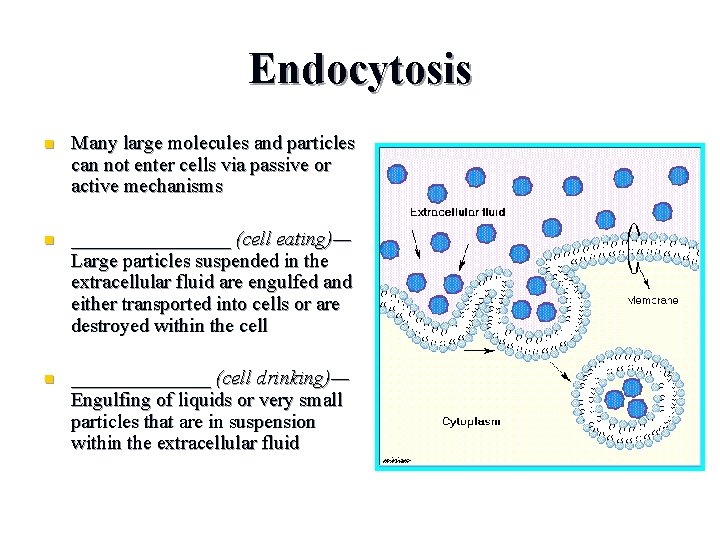
Endocytosis n Many large molecules and particles can not enter cells via passive or active mechanisms n ________ (cell eating)— Large particles suspended in the extracellular fluid are engulfed and either transported into cells or are destroyed within the cell n _______ (cell drinking)— Engulfing of liquids or very small particles that are in suspension within the extracellular fluid From http: //www. sis. nlm. nih. gov/Tox. Tutor/Tox 2/a 21. htm
- Slides: 52