
Birth Through Childhood Infancy Birth to 12 Months
Birth Through Childhood

Infancy – Birth to 12 Months Infancy is the time of fastest growth in a person’s life. It is a time of learning new things and learni how to trust others Smiles Laughs By around 2 months of age, the baby will smile in response to you! The sound of your voice or the sight of your face is often all it takes to trigger your baby's irresistible grin. By 4 months, you can look forward to another sound, baby's laughter. The best part is how easily a baby laughs. Silly faces, tickling, and peek-a-boo are usually more than enough to set off lots of squeals and giggles.
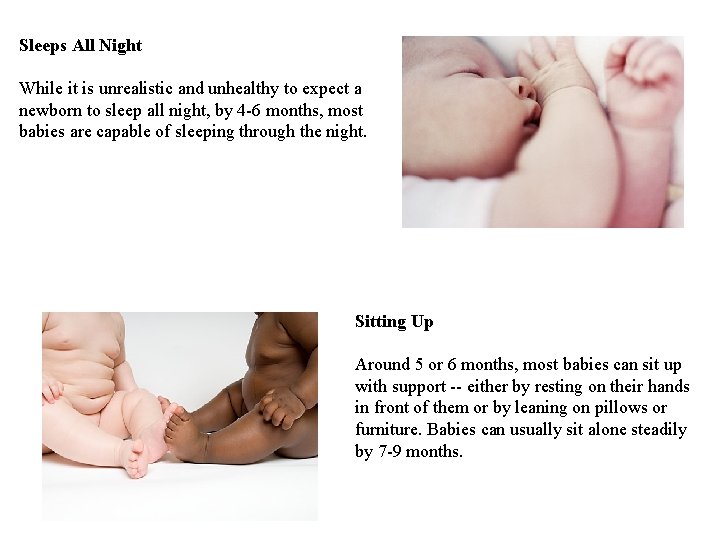
Sleeps All Night While it is unrealistic and unhealthy to expect a newborn to sleep all night, by 4 -6 months, most babies are capable of sleeping through the night. Sitting Up Around 5 or 6 months, most babies can sit up with support -- either by resting on their hands in front of them or by leaning on pillows or furniture. Babies can usually sit alone steadily by 7 -9 months.
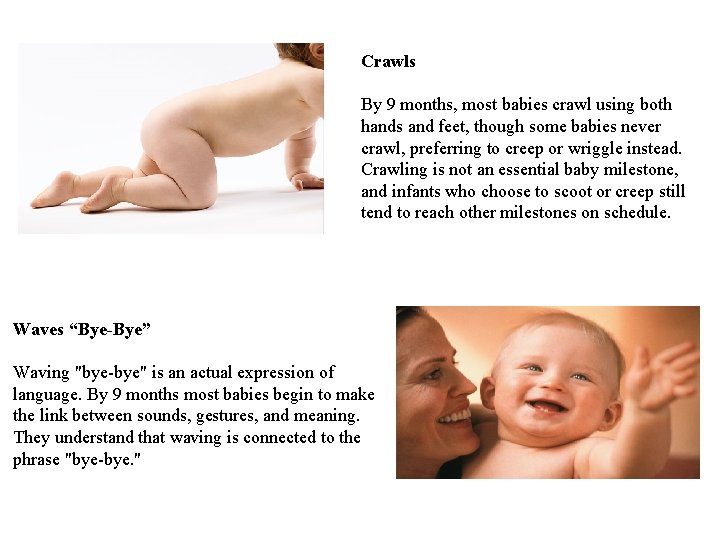
Crawls By 9 months, most babies crawl using both hands and feet, though some babies never crawl, preferring to creep or wriggle instead. Crawling is not an essential baby milestone, and infants who choose to scoot or creep still tend to reach other milestones on schedule. Waves “Bye-Bye” Waving "bye-bye" is an actual expression of language. By 9 months most babies begin to make the link between sounds, gestures, and meaning. They understand that waving is connected to the phrase "bye-bye. "
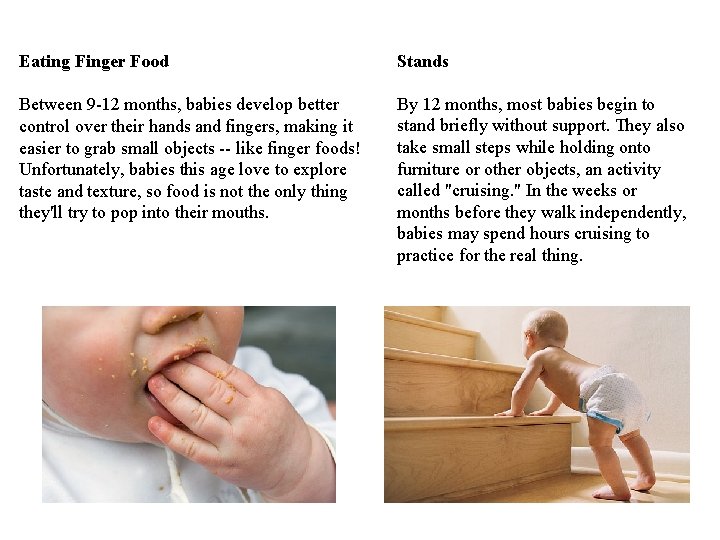
Eating Finger Food Stands Between 9 -12 months, babies develop better control over their hands and fingers, making it easier to grab small objects -- like finger foods! Unfortunately, babies this age love to explore taste and texture, so food is not the only thing they'll try to pop into their mouths. By 12 months, most babies begin to stand briefly without support. They also take small steps while holding onto furniture or other objects, an activity called "cruising. " In the weeks or months before they walk independently, babies may spend hours cruising to practice for the real thing.

Taking a Step The normal range is anywhere from 9 to 17 months, with most babies taking at least a few steps by about 13 months. First Words "Mama! Dada!" usually happens right around the one-year mark. By this time, most babies can say at least one real word and actively try to imitate others. It won't be long before you finally get to hear what's on your little one's mind.
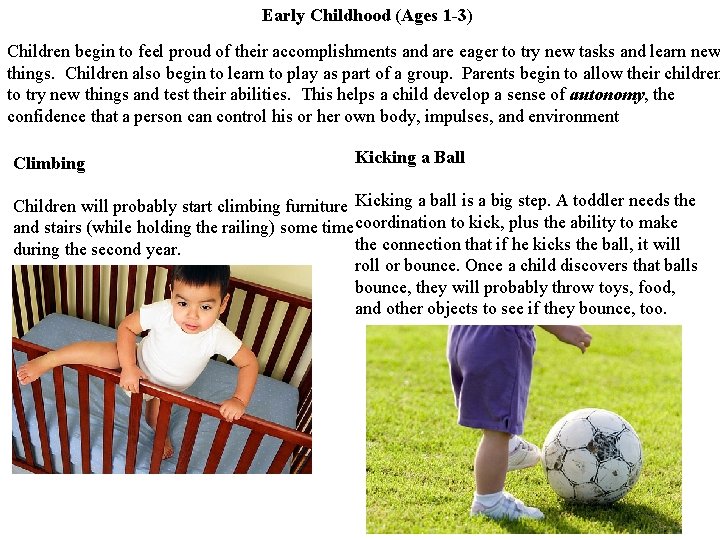
Early Childhood (Ages 1 -3) Children begin to feel proud of their accomplishments and are eager to try new tasks and learn new things. Children also begin to learn to play as part of a group. Parents begin to allow their children to try new things and test their abilities. This helps a child develop a sense of autonomy, the confidence that a person can control his or her own body, impulses, and environment Climbing Kicking a Ball Children will probably start climbing furniture Kicking a ball is a big step. A toddler needs the and stairs (while holding the railing) some time coordination to kick, plus the ability to make the connection that if he kicks the ball, it will during the second year. roll or bounce. Once a child discovers that balls bounce, they will probably throw toys, food, and other objects to see if they bounce, too.
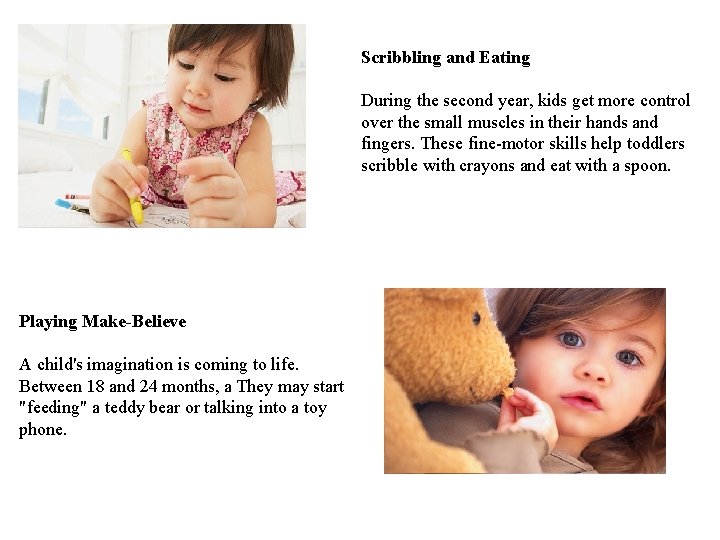
Scribbling and Eating During the second year, kids get more control over the small muscles in their hands and fingers. These fine-motor skills help toddlers scribble with crayons and eat with a spoon. Playing Make-Believe A child's imagination is coming to life. Between 18 and 24 months, a They may start "feeding" a teddy bear or talking into a toy phone.
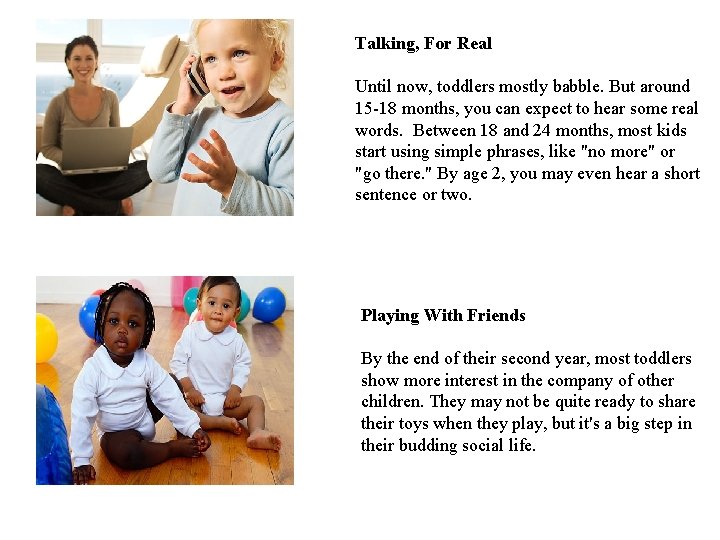
Talking, For Real Until now, toddlers mostly babble. But around 15 -18 months, you can expect to hear some real words. Between 18 and 24 months, most kids start using simple phrases, like "no more" or "go there. " By age 2, you may even hear a short sentence or two. Playing With Friends By the end of their second year, most toddlers show more interest in the company of other children. They may not be quite ready to share their toys when they play, but it's a big step in their budding social life.
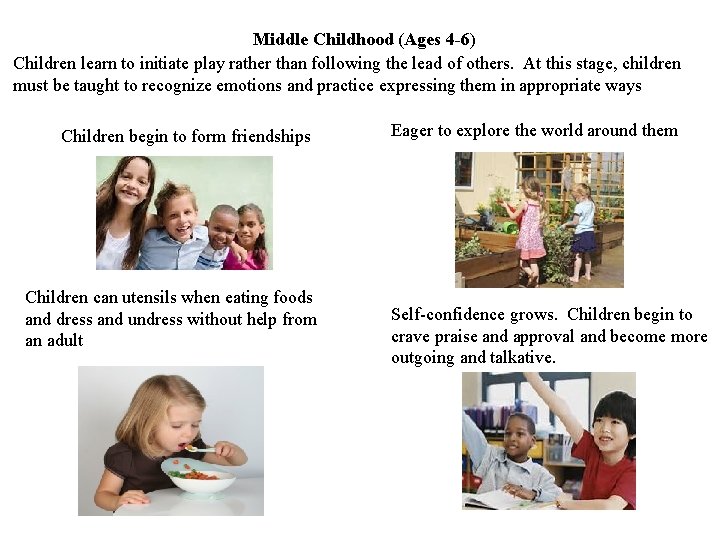
Middle Childhood (Ages 4 -6) Children learn to initiate play rather than following the lead of others. At this stage, children must be taught to recognize emotions and practice expressing them in appropriate ways Children begin to form friendships Children can utensils when eating foods and dress and undress without help from an adult Eager to explore the world around them Self-confidence grows. Children begin to crave praise and approval and become more outgoing and talkative.
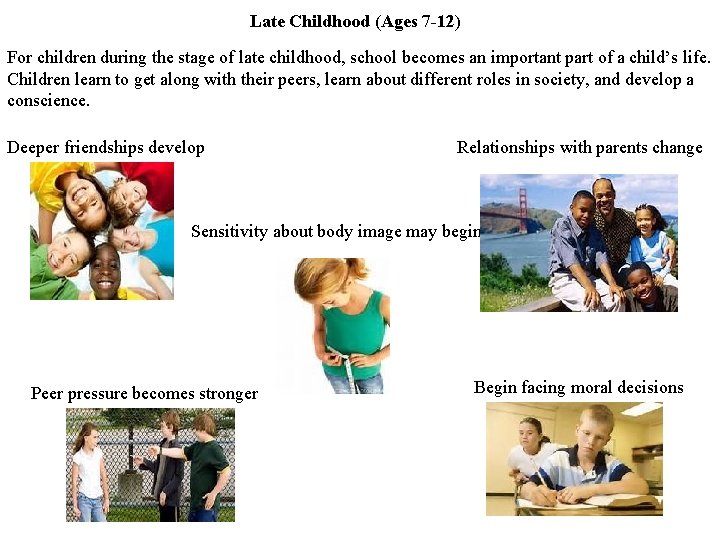
Late Childhood (Ages 7 -12) For children during the stage of late childhood, school becomes an important part of a child’s life. Children learn to get along with their peers, learn about different roles in society, and develop a conscience. Deeper friendships develop Relationships with parents change Sensitivity about body image may begin Peer pressure becomes stronger Begin facing moral decisions
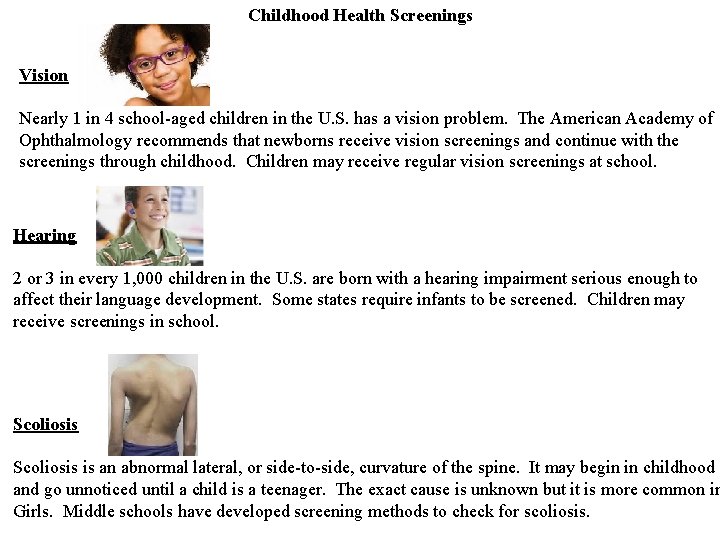
Childhood Health Screenings Vision Nearly 1 in 4 school-aged children in the U. S. has a vision problem. The American Academy of Ophthalmology recommends that newborns receive vision screenings and continue with the screenings through childhood. Children may receive regular vision screenings at school. Hearing 2 or 3 in every 1, 000 children in the U. S. are born with a hearing impairment serious enough to affect their language development. Some states require infants to be screened. Children may receive screenings in school. Scoliosis is an abnormal lateral, or side-to-side, curvature of the spine. It may begin in childhood and go unnoticed until a child is a teenager. The exact cause is unknown but it is more common in Girls. Middle schools have developed screening methods to check for scoliosis.
- Slides: 12