
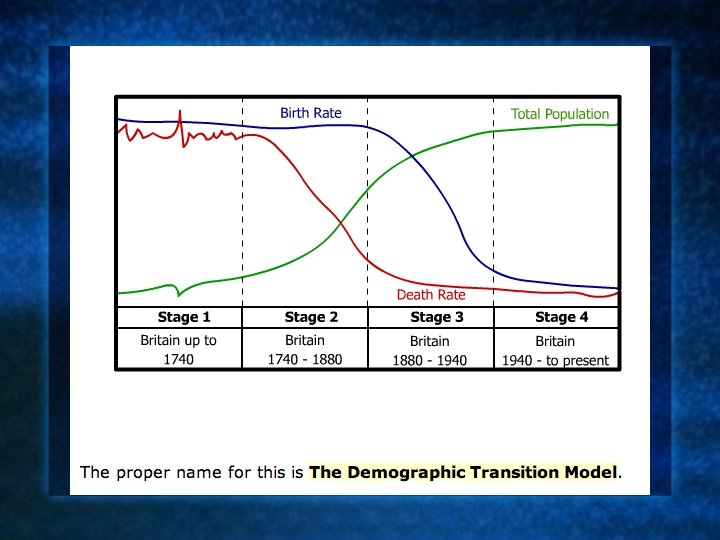
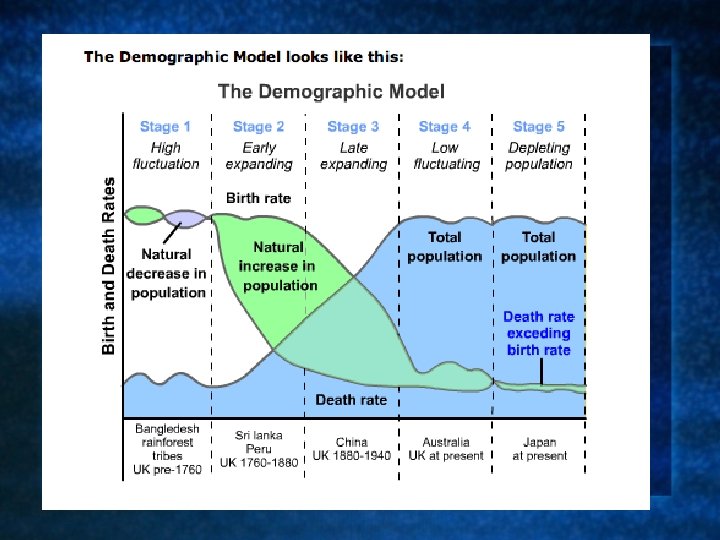
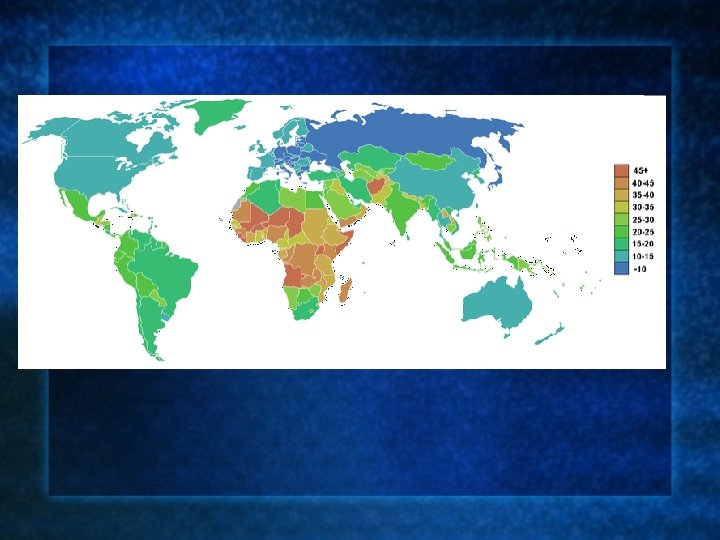
Birth Rate Death Rate Natural Increase 1 dot
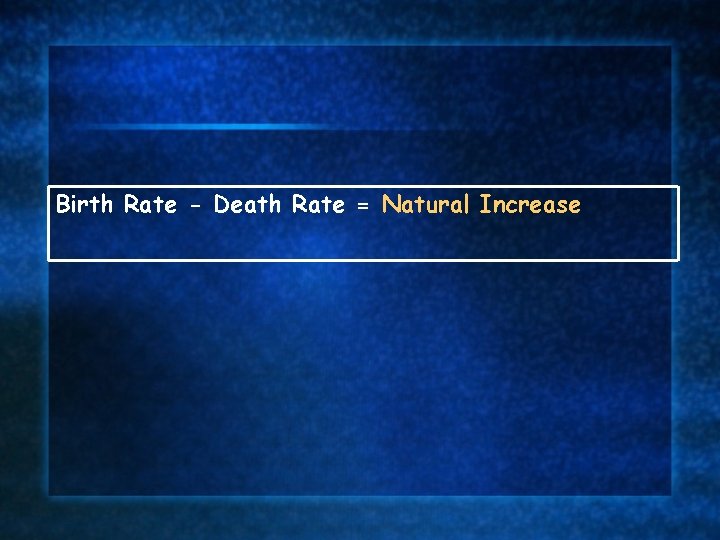
Birth Rate - Death Rate = Natural Increase

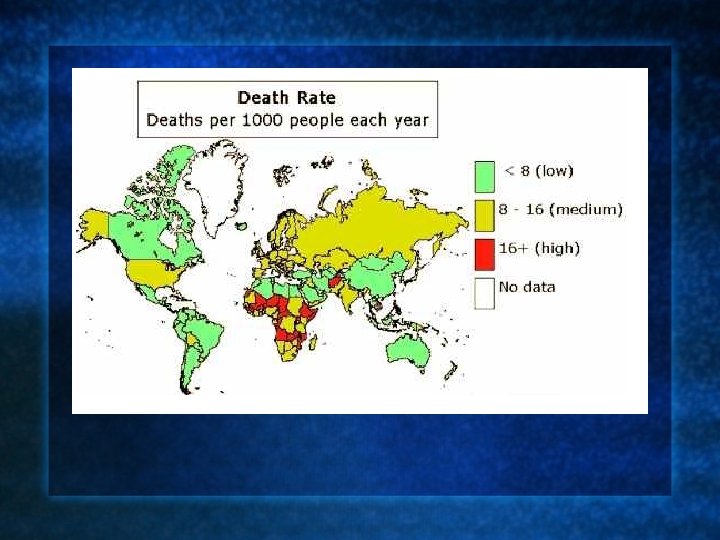
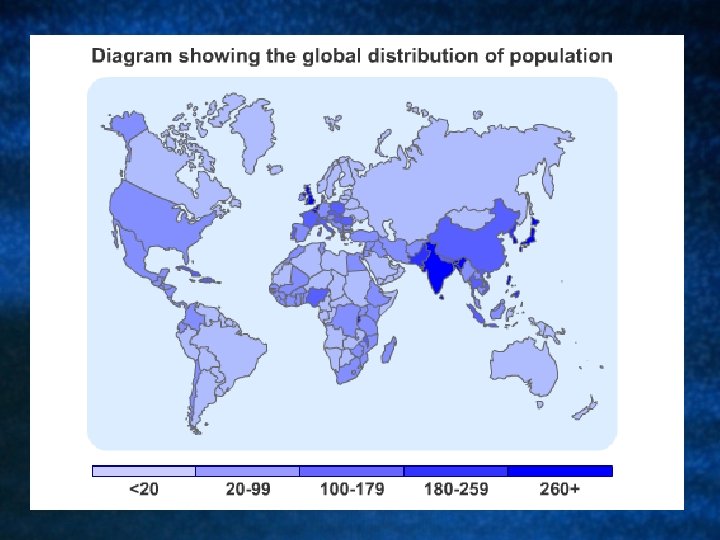
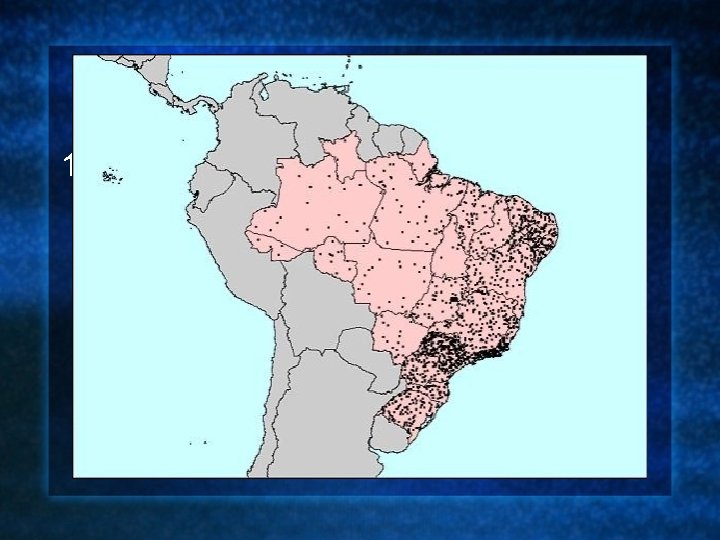
1 dot = 100, 000 people
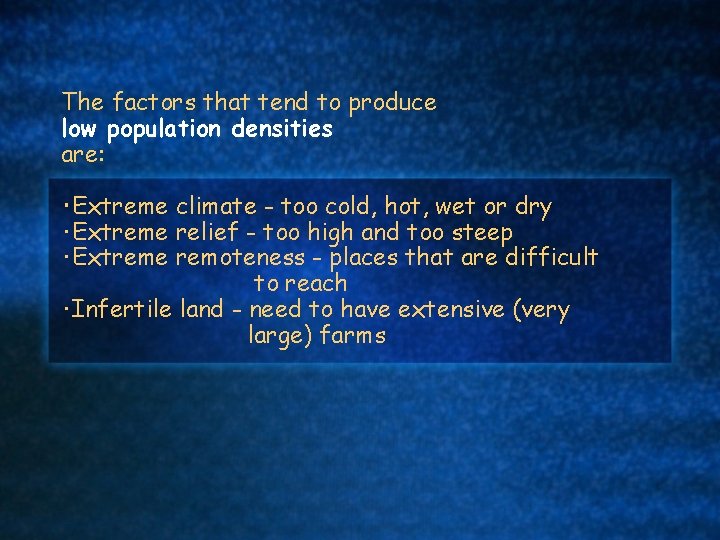
The factors that tend to produce low population densities are: ・Extreme climate - too cold, hot, wet or dry ・Extreme relief - too high and too steep ・Extreme remoteness - places that are difficult to reach ・Infertile land - need to have extensive (very large) farms
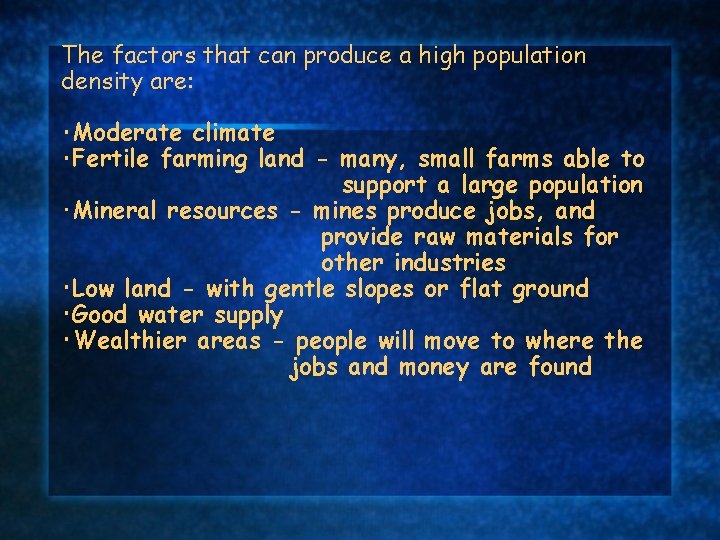
The factors that can produce a high population density are: ・Moderate climate ・Fertile farming land - many, small farms able to support a large population ・Mineral resources - mines produce jobs, and provide raw materials for other industries ・Low land - with gentle slopes or flat ground ・Good water supply ・Wealthier areas - people will move to where the jobs and money are found
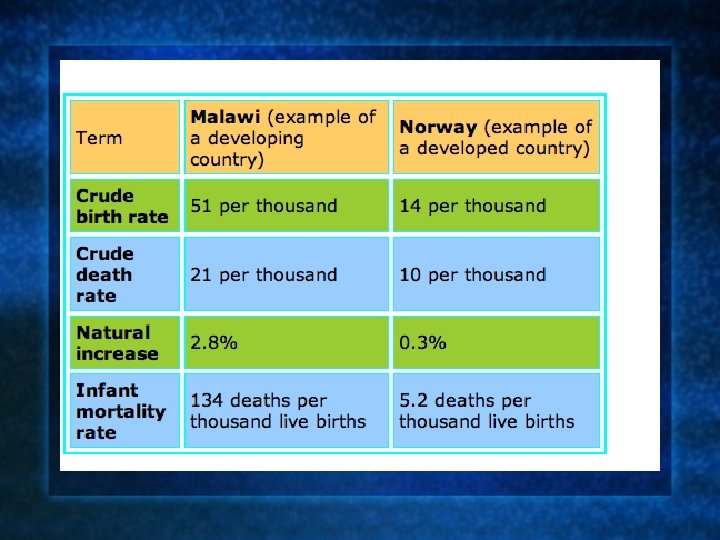
Population Definitions The infant mortality rate is the annual number of deaths of infants less than one year old per 1, 000 live births.
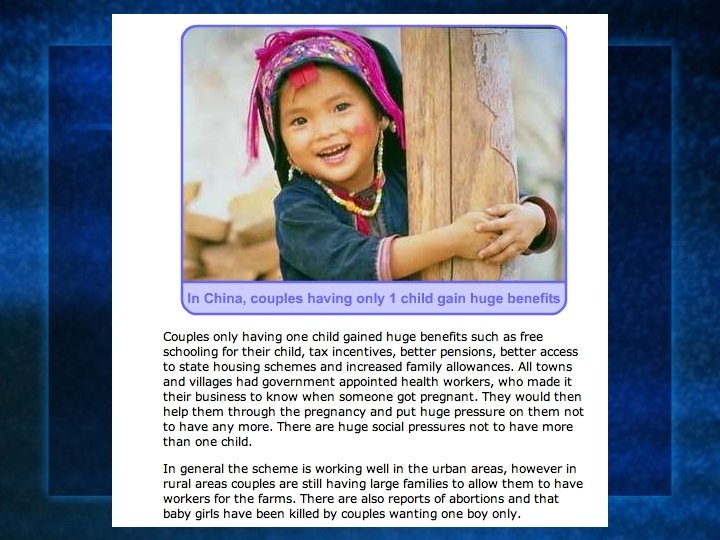
Populations growing too quickly The steps that have been taken to reduce the problems caused by a rapidly growing population include: ・Education about family planning, with the increased availability of a range of contraceptive methods ・Extra taxes for parents who have large families ・Extra benefits for the parents that have only one or two children ・Raising the age of marriage ・Increasing the industry and wealth in a country - this allows it to "afford" the increased population. When a country develops - that is has a higher quality of life, higher standard of living and increased wealth - the birth rate goes down. This is the greatest influence in reducing problems caused by rapid population growth.
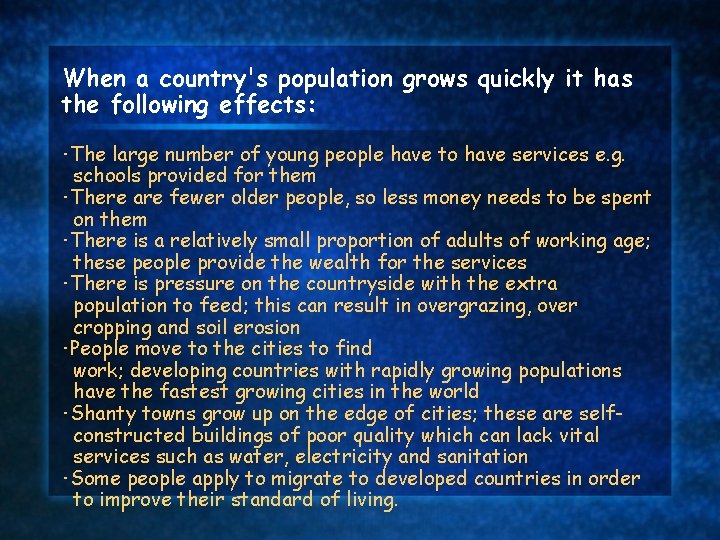
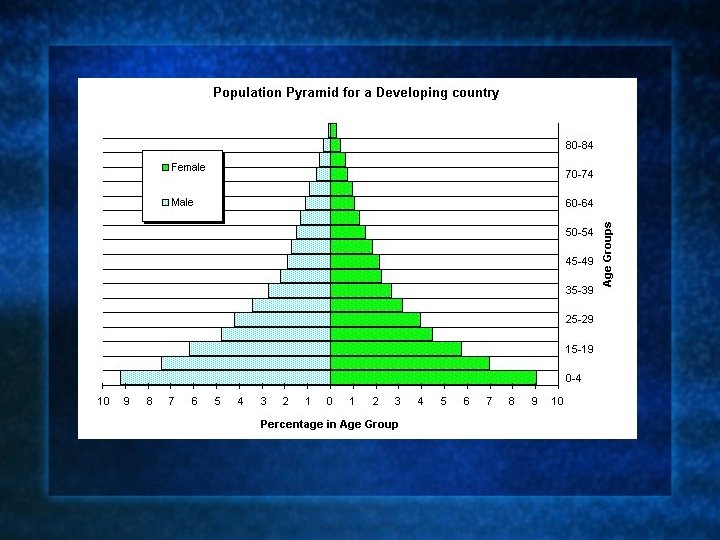
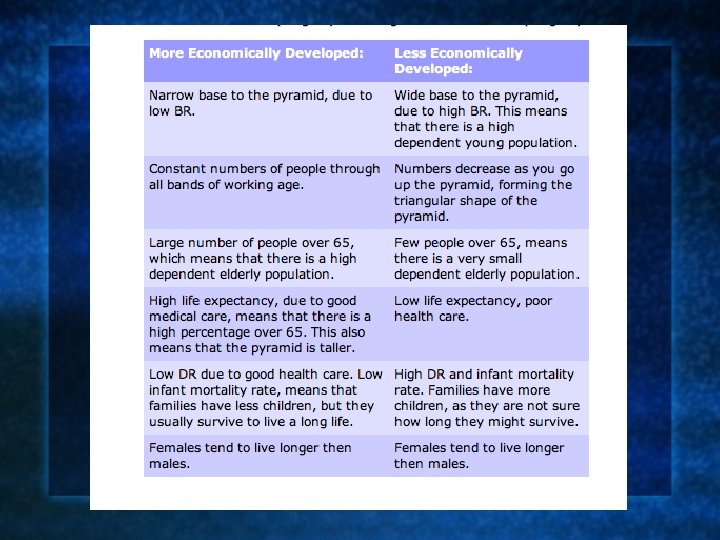
When a country's population grows quickly it has the following effects: ・The large number of young people have to have services e. g. schools provided for them ・There are fewer older people, so less money needs to be spent on them ・There is a relatively small proportion of adults of working age; these people provide the wealth for the services ・There is pressure on the countryside with the extra population to feed; this can result in overgrazing, over cropping and soil erosion ・People move to the cities to find work; developing countries with rapidly growing populations have the fastest growing cities in the world ・Shanty towns grow up on the edge of cities; these are selfconstructed buildings of poor quality which can lack vital services such as water, electricity and sanitation ・Some people apply to migrate to developed countries in order to improve their standard of living.
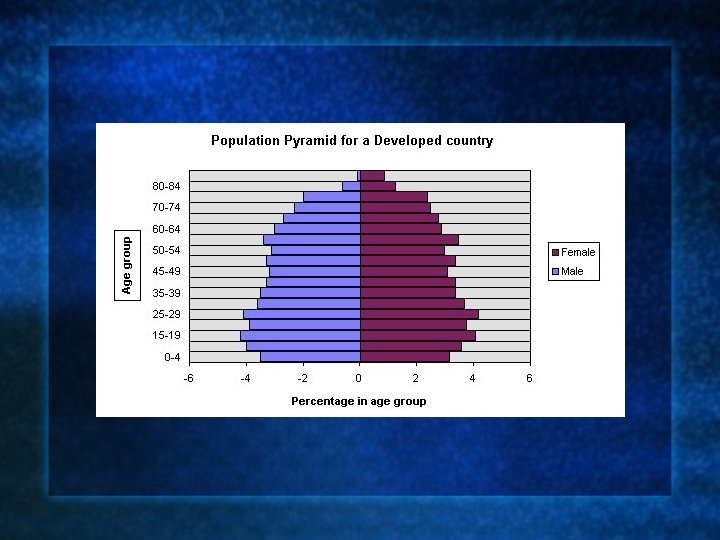
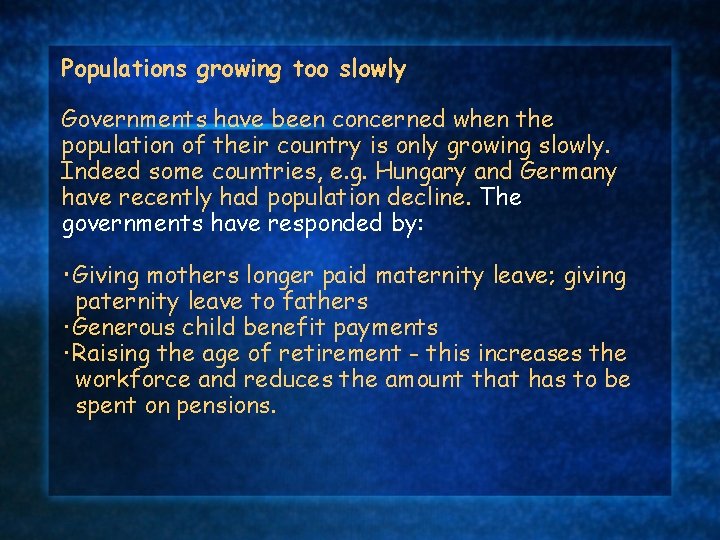
Populations growing too slowly Governments have been concerned when the population of their country is only growing slowly. Indeed some countries, e. g. Hungary and Germany have recently had population decline. The governments have responded by: ・Giving mothers longer paid maternity leave; giving paternity leave to fathers ・Generous child benefit payments ・Raising the age of retirement - this increases the workforce and reduces the amount that has to be spent on pensions.
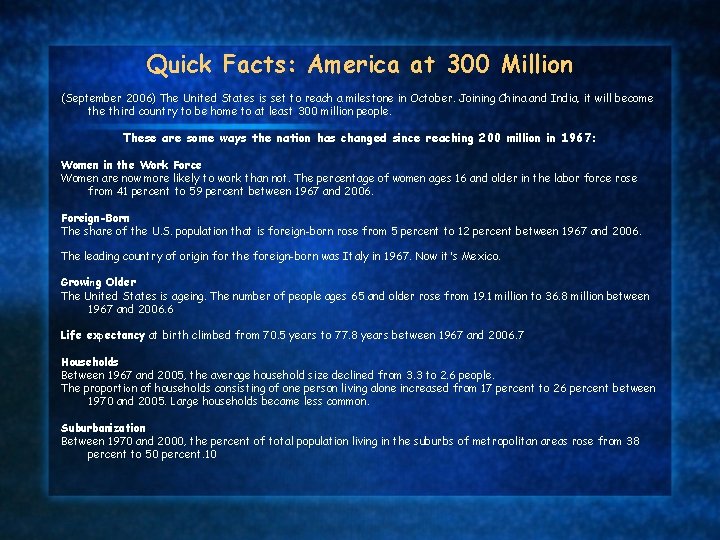
Quick Facts: America at 300 Million (September 2006) The United States is set to reach a milestone in October. Joining China and India, it will become third country to be home to at least 300 million people. These are some ways the nation has changed since reaching 200 million in 1967: Women in the Work Force Women are now more likely to work than not. The percentage of women ages 16 and older in the labor force rose from 41 percent to 59 percent between 1967 and 2006. Foreign-Born The share of the U. S. population that is foreign-born rose from 5 percent to 12 percent between 1967 and 2006. The leading country of origin for the foreign-born was Italy in 1967. Now it's Mexico. Growing Older The United States is ageing. The number of people ages 65 and older rose from 19. 1 million to 36. 8 million between 1967 and 2006. 6 Life expectancy at birth climbed from 70. 5 years to 77. 8 years between 1967 and 2006. 7 Households Between 1967 and 2005, the average household size declined from 3. 3 to 2. 6 people. The proportion of households consisting of one person living alone increased from 17 percent to 26 percent between 1970 and 2005. Large households became less common. Suburbanization Between 1970 and 2000, the percent of total population living in the suburbs of metropolitan areas rose from 38 percent to 50 percent. 10
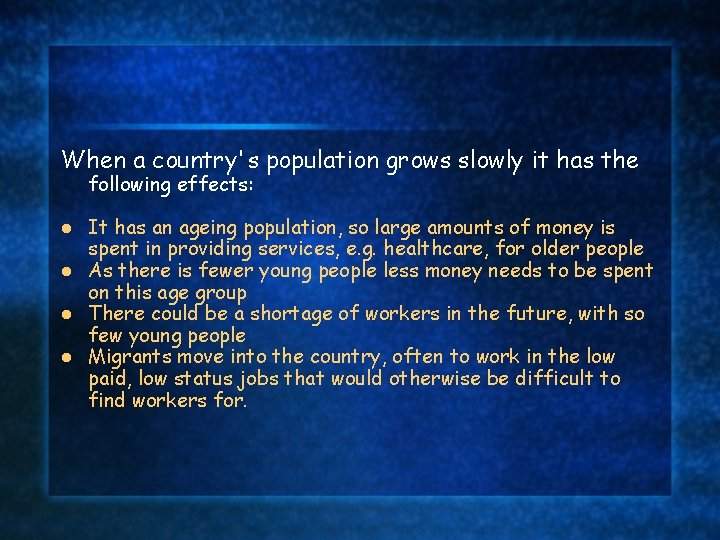
When a country's population grows slowly it has the following effects: It has an ageing population, so large amounts of money is spent in providing services, e. g. healthcare, for older people l As there is fewer young people less money needs to be spent on this age group l There could be a shortage of workers in the future, with so few young people l Migrants move into the country, often to work in the low paid, low status jobs that would otherwise be difficult to find workers for. l
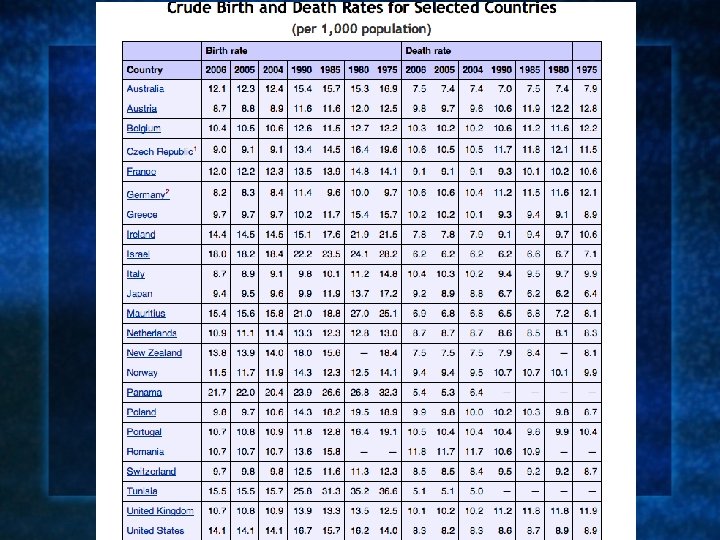
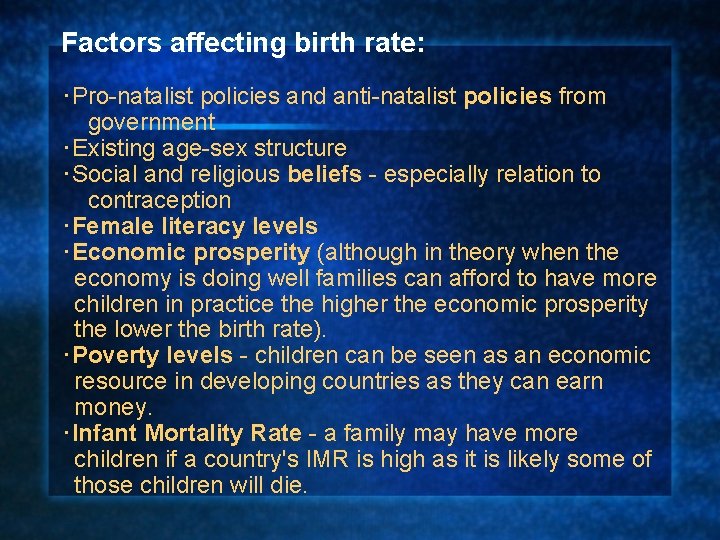
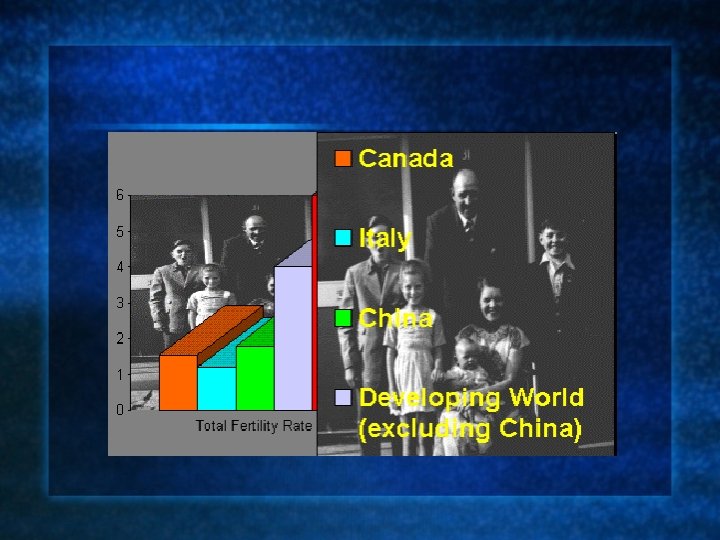
Factors affecting birth rate: ・Pro-natalist policies and anti-natalist policies from government ・Existing age-sex structure ・Social and religious beliefs - especially relation to contraception ・Female literacy levels ・Economic prosperity (although in theory when the economy is doing well families can afford to have more children in practice the higher the economic prosperity the lower the birth rate). ・Poverty levels - children can be seen as an economic resource in developing countries as they can earn money. ・Infant Mortality Rate - a family may have more children if a country's IMR is high as it is likely some of those children will die.

The USA Health care and social programs for the elderly are generally concentrated on the most needy--the 85+ population (the "old-old"). By 2030, there will be over 8 million people in this age group.

World 6, 785, 832, 19918 Sep 22, 2009
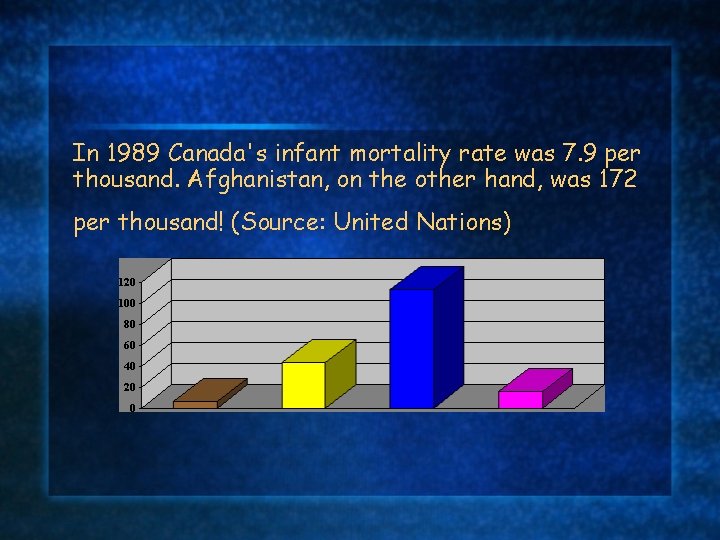
In 1989 Canada's infant mortality rate was 7. 9 per thousand. Afghanistan, on the other hand, was 172 per thousand! (Source: United Nations)
- Slides: 31