
Birsh Chapter 14 Assessment Brooke Lovell 3 types
Birsh Chapter 14 - Assessment Brooke Lovell
3 types of assessments • used to guide teaching • locate individuals “at risk” • determine the presence or absence of reading disability
Tests can be classified as. . • Norm-referenced -comparisons among people usually same age -standardized • Criterion-referenced -item by item description -which skills are acquired • Curriculum- referenced -like criterion, but test has to do with content learned in the classroom
Tests can be classified as. . • Formative • Summative -assessment for learning -assessment of learning -immediate/short term goals -long term goals -progress monitoring for acquiring specific skills -accumulated or integrated knowledge and complex skills
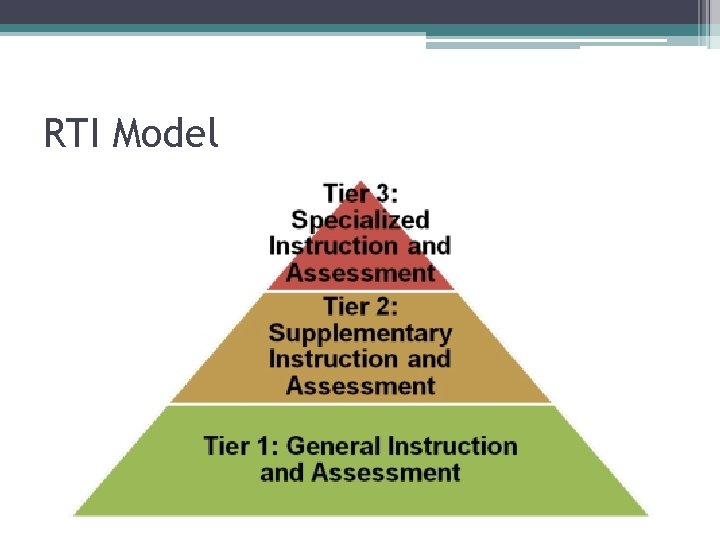
RTI Model

RTI Assessment Methodology • Curriculum based formative assessments are central to the RTI process • Shows specific subskill mastery • Provides for student performance data • Teachers make decisions on how to teach based off the data collected • Generally, a baseline is established and you monitor students growth with assessments
Early RTI Screening- “At Risk” Students • TPRI-K-3 grade, 3 sections 1. Graphophonemic knowledge-letter recognition and sound-symbol relationships 2. Phonemic Awareness 3. Word Reading • Phonological Awareness Literacy Screening (PALS)Given 3 times in K, used to guide instruction when students fail to meet benchmarks. Grades 1 -3 used as a leveled instrument to guide instruction
Early RTI Screening- “At Risk” Students • DIBELS -indicator of early literacy skills of phonemic awareness, alphabetic principle, phonics, accurate/fluent reading of text, reading comprehension -help establish benchmarks -used in upper elementary grades for progress monitoring
Informal Reading Inventories • Provide data needed to plan remedial groups • Establish a reading level for students based on accuracy for single words/words in a text and how they answer comprehension questions • Miscues help teachers recognize where/ what type of mistakes students are making • Narrative and expository texts used • DRA
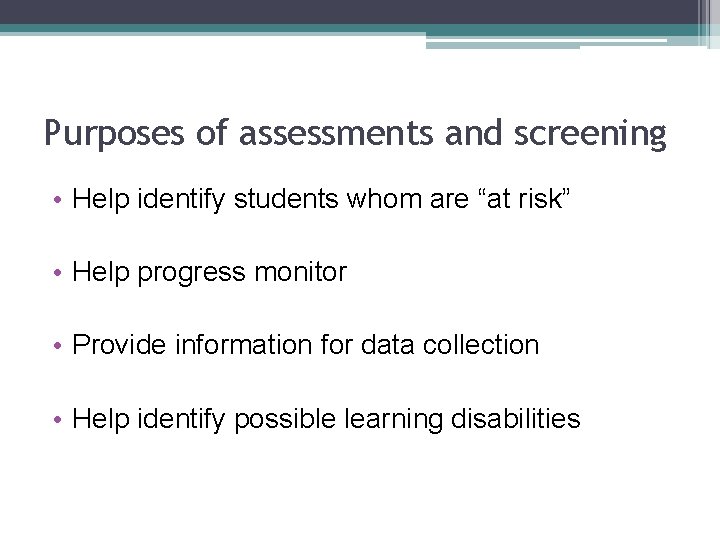
Purposes of assessments and screening • Help identify students whom are “at risk” • Help progress monitor • Provide information for data collection • Help identify possible learning disabilities

Activity
References Birsh, J. (2011). Multisensory teaching of basic language skills. Baltimore, Md. : P. H. Brookes Pub. Tiered Instruction - Project IDEAL. (n. d. ). Retrieved March 8, 2015, from http: / /www. projectidealonline. org/v/tiered -instruction/
- Slides: 12