
BIRS Geometry of Anatomy Sept 11 UNC Stat
BIRS – Geometry of Anatomy – Sept. ‘ 11 UNC, Stat & OR OODA of Tree Structured Objects (e. g. Data on Stratified Manifolds) J. S. Marron Univ. of North Carolina, Statistics & O. R. November 30, 2020 1
Special Thanks UNC, Stat & OR OODA SAMSI Program 2010 -2011 Led by Hans Georg Müller & Jane-Ling Wang Many Active Participants & Fun Research 2
Object Oriented Data Analysis UNC, Stat & OR What is the “atom” of a statistical analysis? • First Course: Numbers • Multivariate Analysis: Vectors • Functional Data Analysis: Curves • OODA: More Complicated Objects • • Images Movies Shapes Tree Structured Objects 3
Euclidean Data Spaces UNC, Stat & OR Data are vectors, in Effective (and Traditional) Analysis: • Linear Methods • Mean • Covariance • Principal Component Analysis • Gaussian Distribution 4
Euclidean Data Spaces UNC, Stat & OR Data are vectors, in Challenges: • High Dimension, Low Sample Size (Classical Methods Fail) • Visualization: • Find Structure (Expected & Unknown) • Understand range of “normal cases” • Find anomalies 5
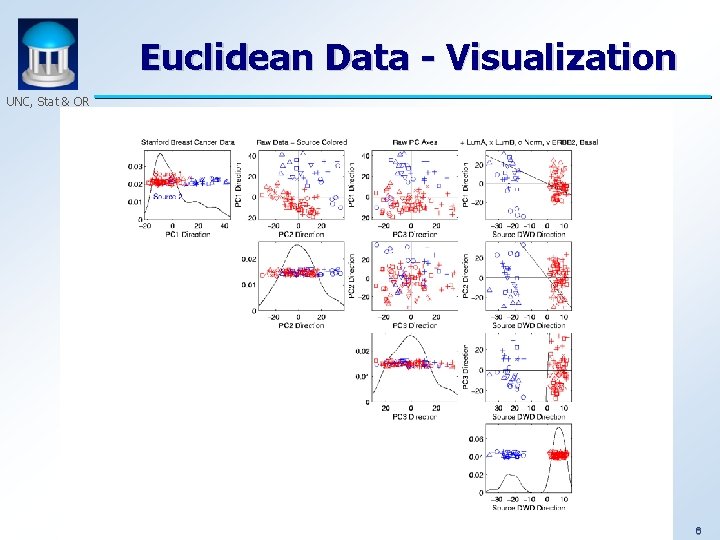
Euclidean Data - Visualization UNC, Stat & OR 6
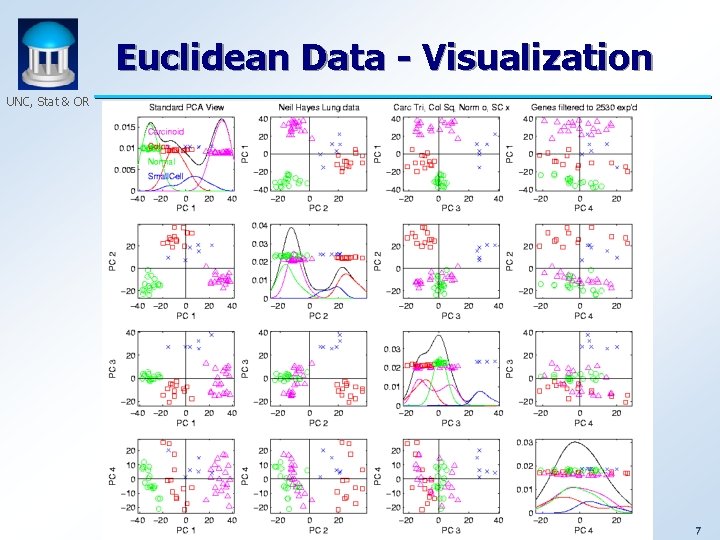
Euclidean Data - Visualization UNC, Stat & OR 7
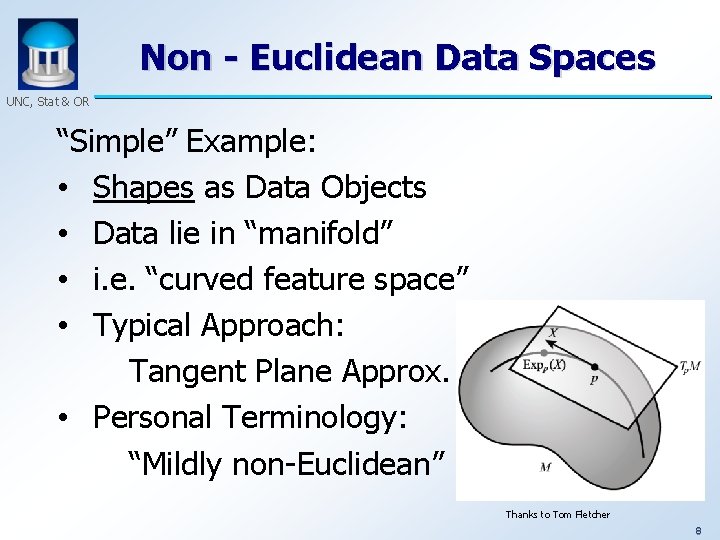
Non - Euclidean Data Spaces UNC, Stat & OR “Simple” Example: • Shapes as Data Objects • Data lie in “manifold” • i. e. “curved feature space” • Typical Approach: Tangent Plane Approx. • Personal Terminology: “Mildly non-Euclidean” Thanks to Tom Fletcher 8
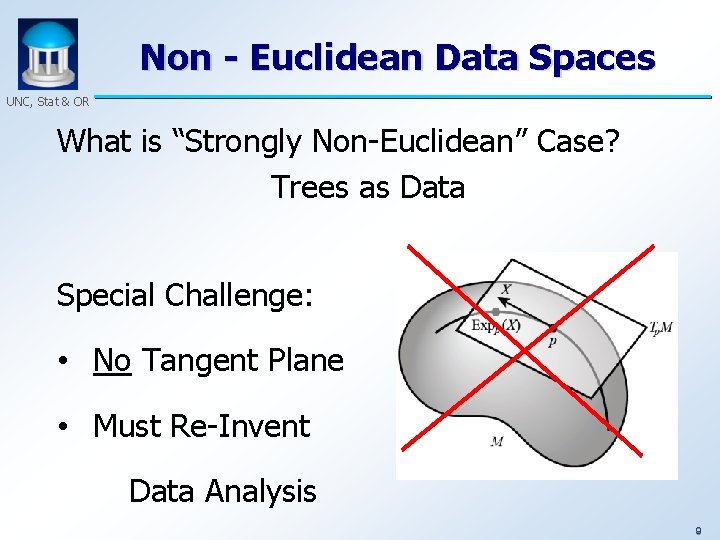
Non - Euclidean Data Spaces UNC, Stat & OR What is “Strongly Non-Euclidean” Case? Trees as Data Special Challenge: • No Tangent Plane • Must Re-Invent Data Analysis 9
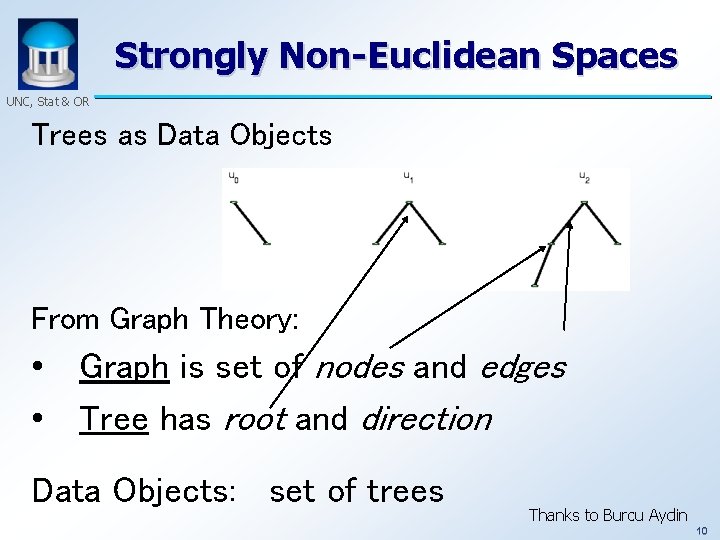
Strongly Non-Euclidean Spaces UNC, Stat & OR Trees as Data Objects From Graph Theory: • Graph is set of nodes and edges • Tree has root and direction Data Objects: set of trees Thanks to Burcu Aydin 10
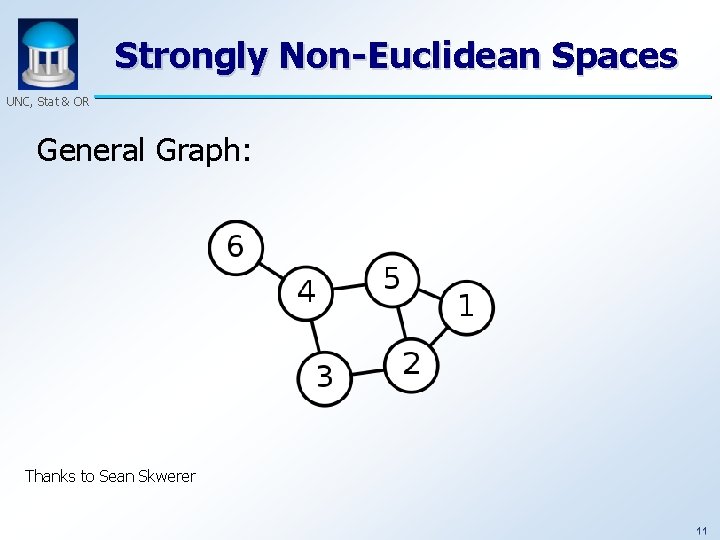
Strongly Non-Euclidean Spaces UNC, Stat & OR General Graph: Thanks to Sean Skwerer 11
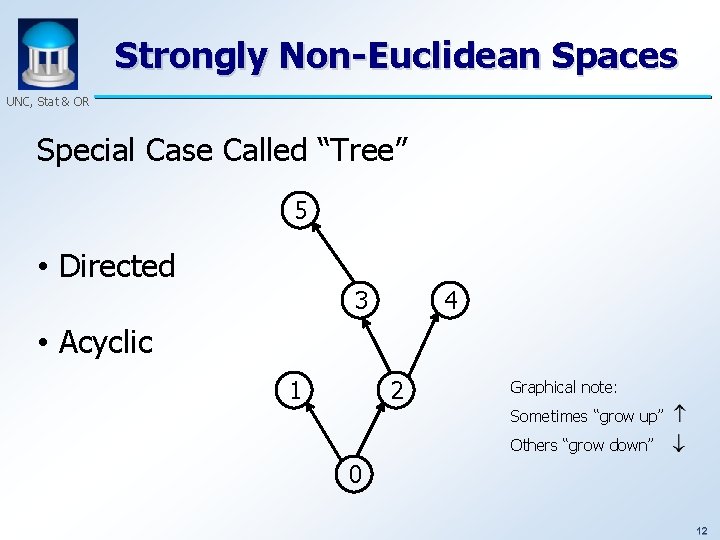
Strongly Non-Euclidean Spaces UNC, Stat & OR Special Case Called “Tree” 5 • Directed 4 3 • Acyclic 1 2 Graphical note: Sometimes “grow up” Others “grow down” 0 12
Strongly Non-Euclidean Spaces UNC, Stat & OR Motivating Example: • From Dr. Elizabeth Bullitt • Dept. of Neurosurgery, UNC • Blood Vessel Trees in Brains • Segmented from MRAs • Study population of trees Forest of Trees 13
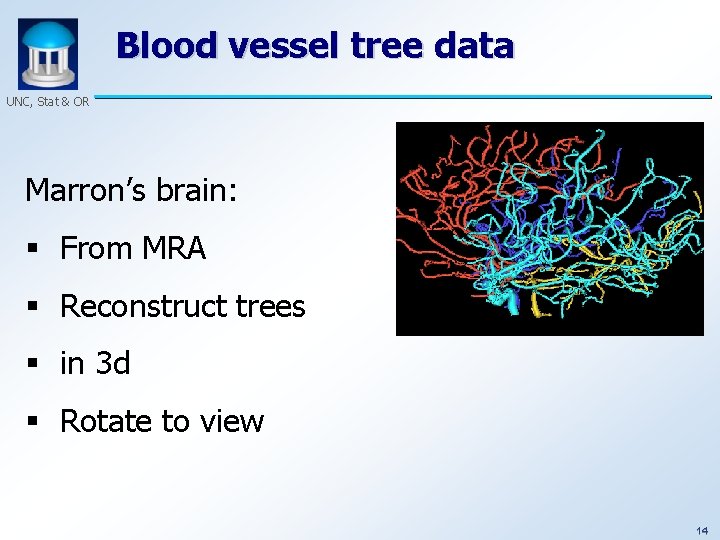
Blood vessel tree data UNC, Stat & OR Marron’s brain: § From MRA § Reconstruct trees § in 3 d § Rotate to view 14
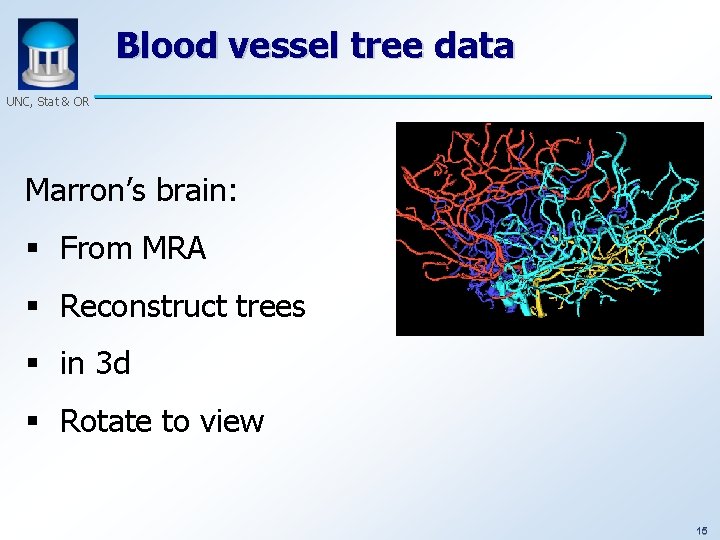
Blood vessel tree data UNC, Stat & OR Marron’s brain: § From MRA § Reconstruct trees § in 3 d § Rotate to view 15
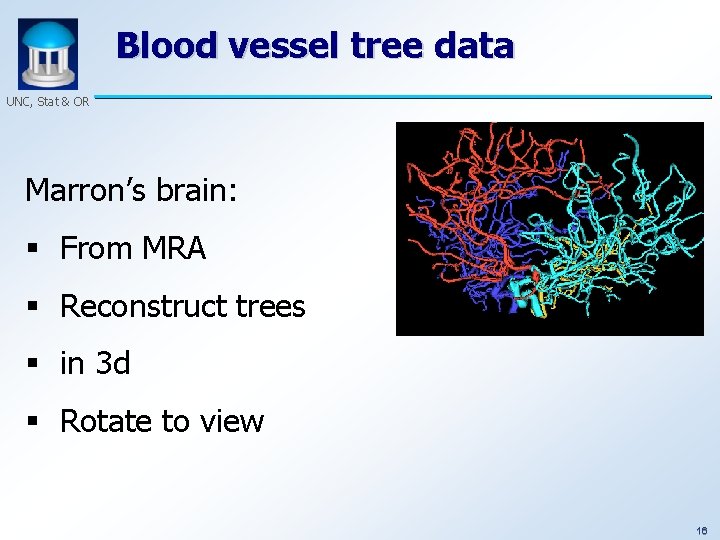
Blood vessel tree data UNC, Stat & OR Marron’s brain: § From MRA § Reconstruct trees § in 3 d § Rotate to view 16
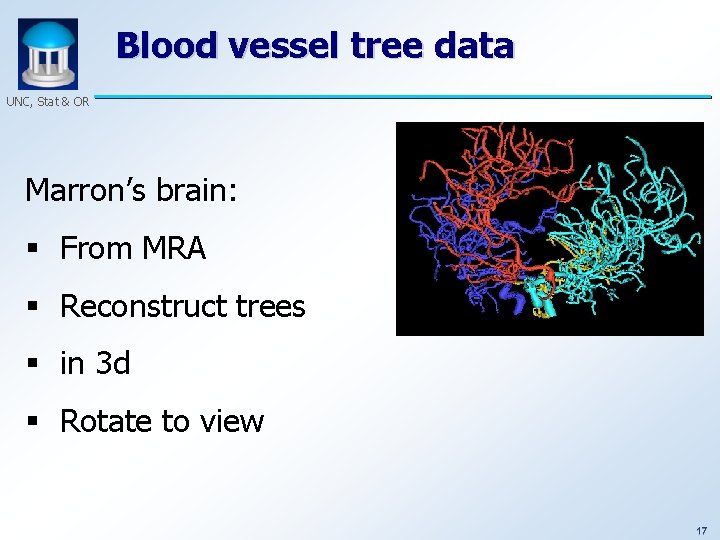
Blood vessel tree data UNC, Stat & OR Marron’s brain: § From MRA § Reconstruct trees § in 3 d § Rotate to view 17
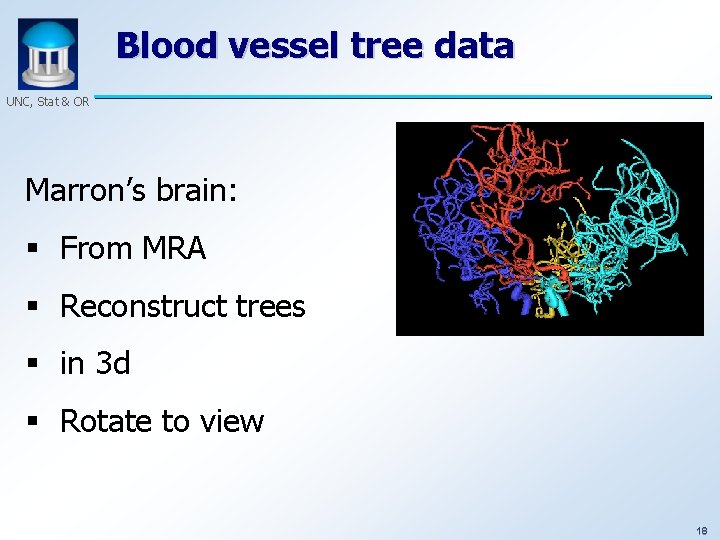
Blood vessel tree data UNC, Stat & OR Marron’s brain: § From MRA § Reconstruct trees § in 3 d § Rotate to view 18
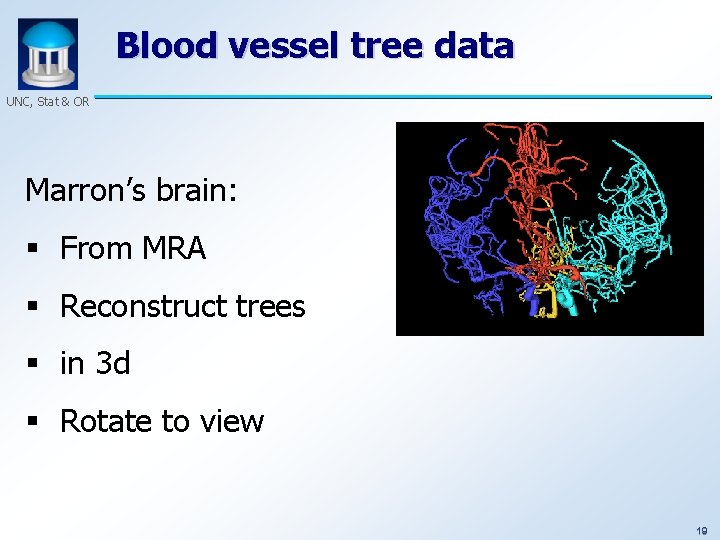
Blood vessel tree data UNC, Stat & OR Marron’s brain: § From MRA § Reconstruct trees § in 3 d § Rotate to view 19
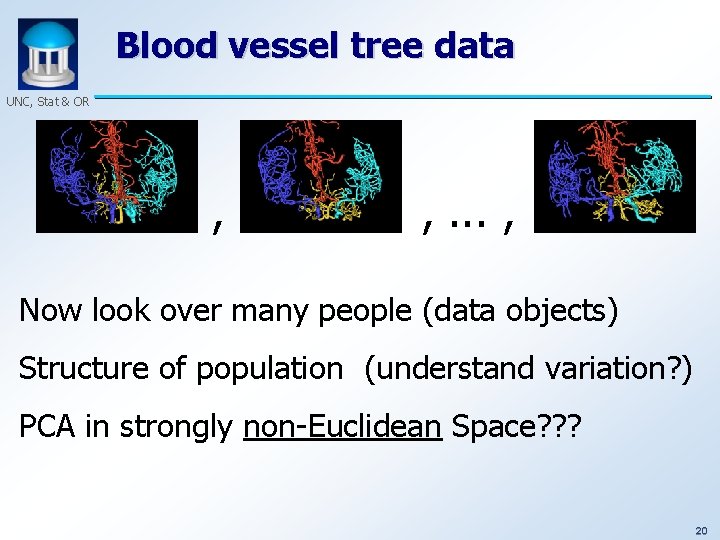
Blood vessel tree data UNC, Stat & OR , , . . . , Now look over many people (data objects) Structure of population (understand variation? ) PCA in strongly non-Euclidean Space? ? ? 20
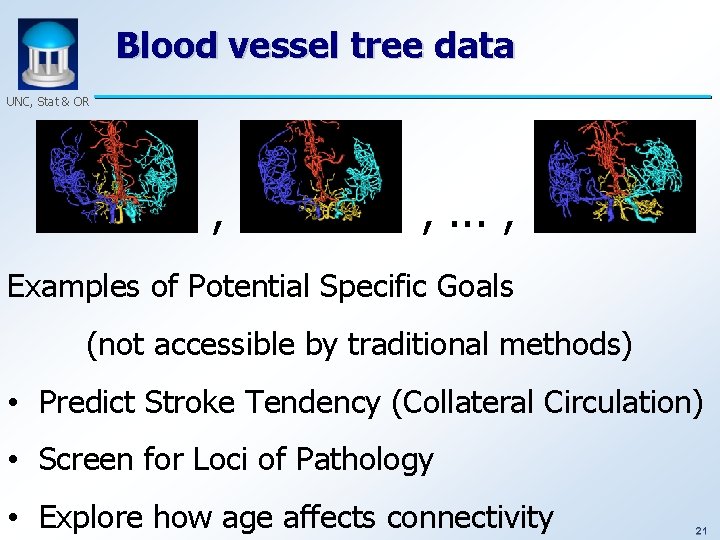
Blood vessel tree data UNC, Stat & OR , , . . . , Examples of Potential Specific Goals (not accessible by traditional methods) • Predict Stroke Tendency (Collateral Circulation) • Screen for Loci of Pathology • Explore how age affects connectivity 21
Blood vessel tree data UNC, Stat & OR Big Picture: 3 Approaches 1. Purely Combinatorial 2. Euclidean Orthant 3. Dyck Path 22
Blood vessel tree data UNC, Stat & OR Big Picture: 3 Approaches 1. Purely Combinatorial 2. Euclidean Orthant 3. Dyck Path 23
Euclidean Orthant Approach UNC, Stat & OR People: • Scott Provan • Sean Skwerer • Megan Owen • Ezra Miller • Martin Styner • Ipek Oguz 24
Euclidean Orthant Approach UNC, Stat & OR Setting: Connectivity & Length Background: Phylogenetic Trees 25
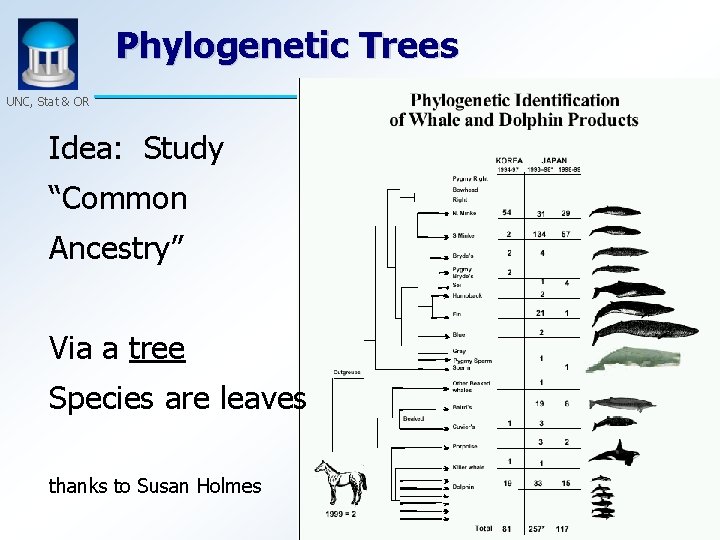
Phylogenetic Trees UNC, Stat & OR Idea: Study “Common Ancestry” Via a tree Species are leaves thanks to Susan Holmes 26
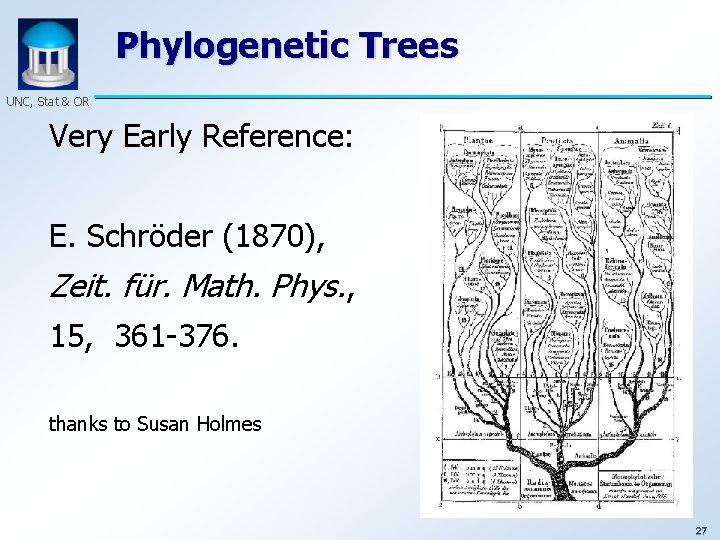
Phylogenetic Trees UNC, Stat & OR Very Early Reference: E. Schröder (1870), Zeit. für. Math. Phys. , 15, 361 -376. thanks to Susan Holmes 27
Phylogenetic Trees UNC, Stat & OR Important Reference: Billera L, Holmes S, & Vogtmann K (2001) "A Grove of Evolutionary Trees", Advances in Applied Mathematics 27, 733– 767. 28
Euclidean Orthant Approach UNC, Stat & OR Setting: Connectivity & Length Background: Phylogenetic Trees Major Restriction: Need common leaves Big Payoff: Data space nearly Euclidean sort of Euclidean 29
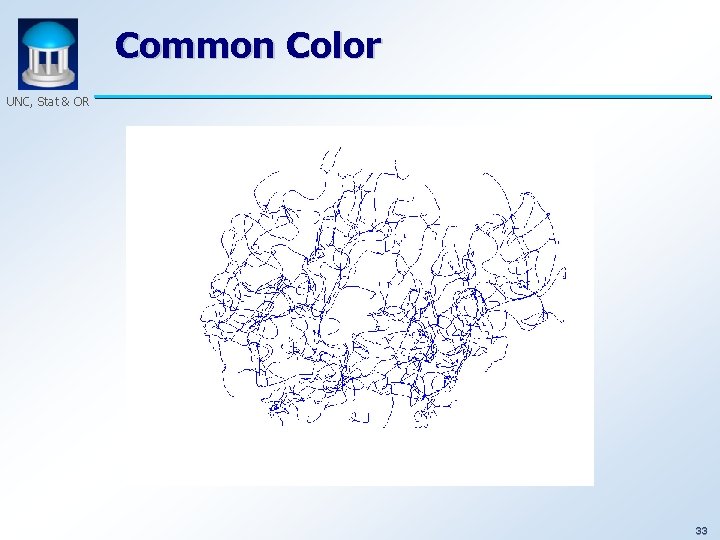
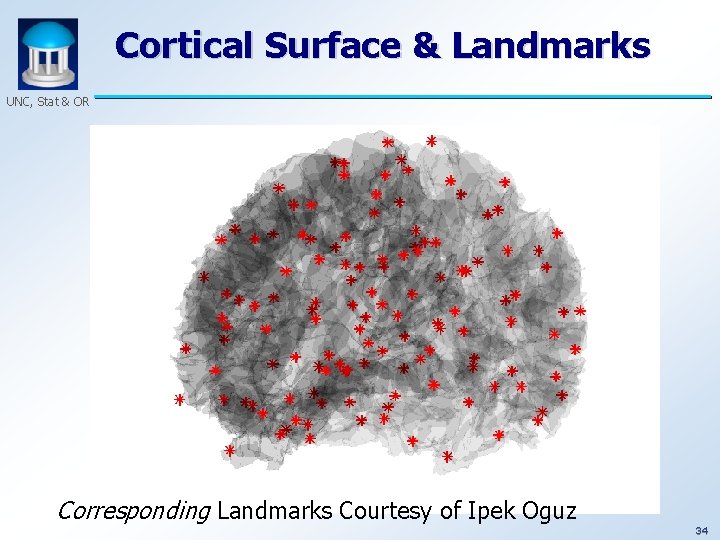
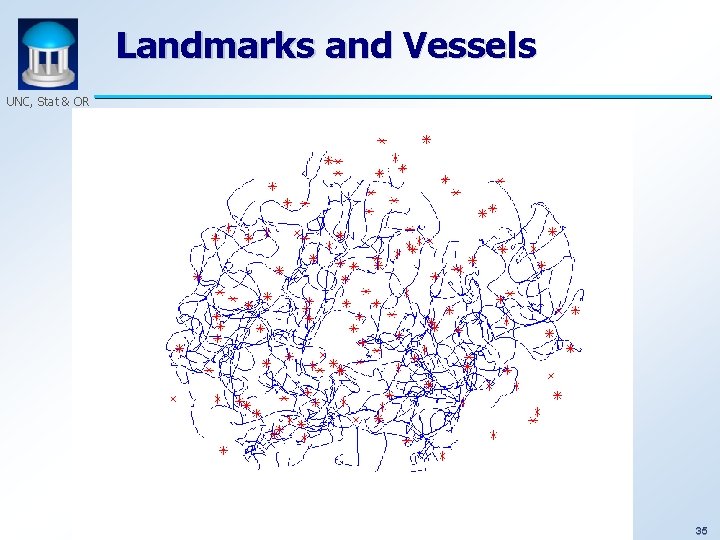
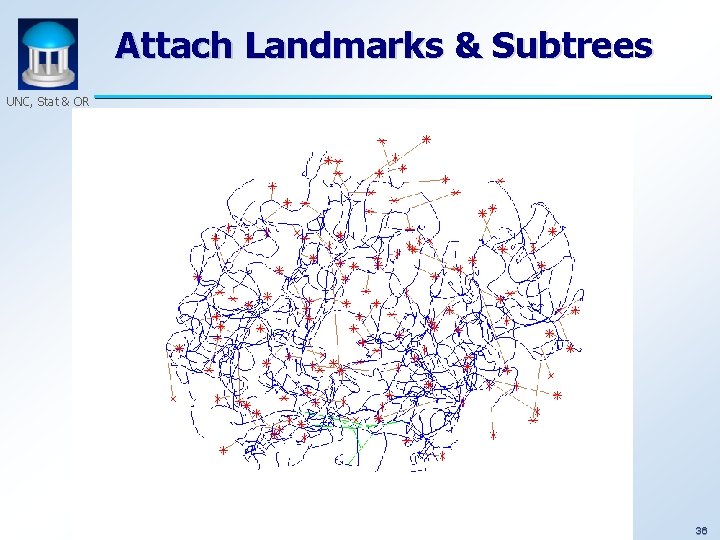
Euclidean Orthant Approach UNC, Stat & OR Major Restriction: Need common leaves Approach: • Find common cortical landmarks (Oguz) corresponding across cases • Treat as pseudo – leaves by projecting to points on tree (draw pic) 30
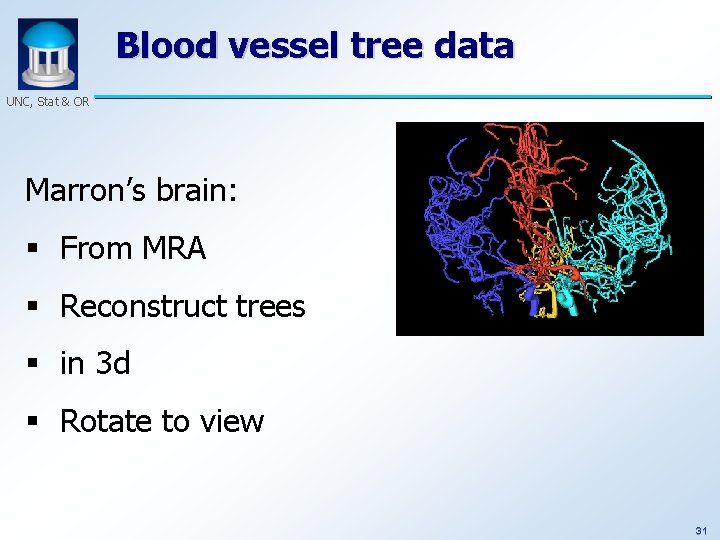
Blood vessel tree data UNC, Stat & OR Marron’s brain: § From MRA § Reconstruct trees § in 3 d § Rotate to view 31
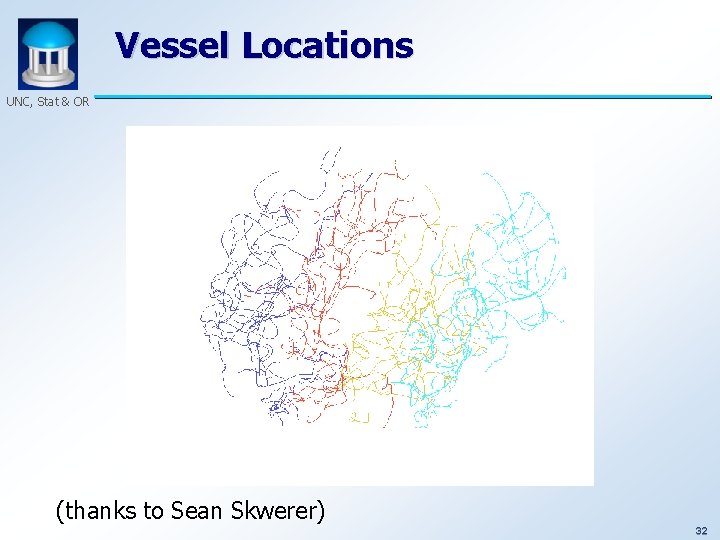
Vessel Locations UNC, Stat & OR (thanks to Sean Skwerer) 32
Common Color UNC, Stat & OR 33
Cortical Surface & Landmarks UNC, Stat & OR Corresponding Landmarks Courtesy of Ipek Oguz 34
Landmarks and Vessels UNC, Stat & OR 35
Attach Landmarks & Subtrees UNC, Stat & OR 36
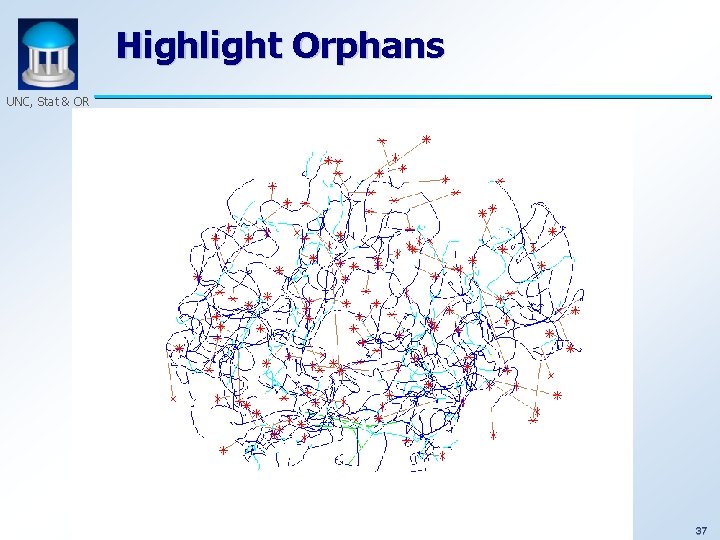
Highlight Orphans UNC, Stat & OR 37
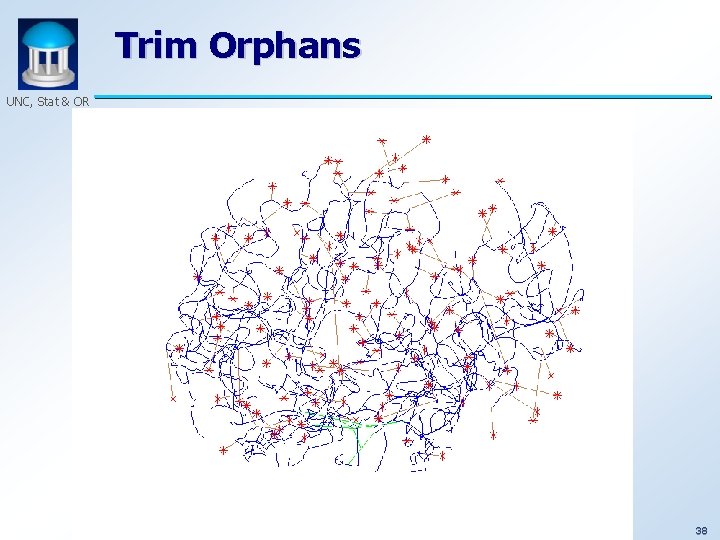
Trim Orphans UNC, Stat & OR 38
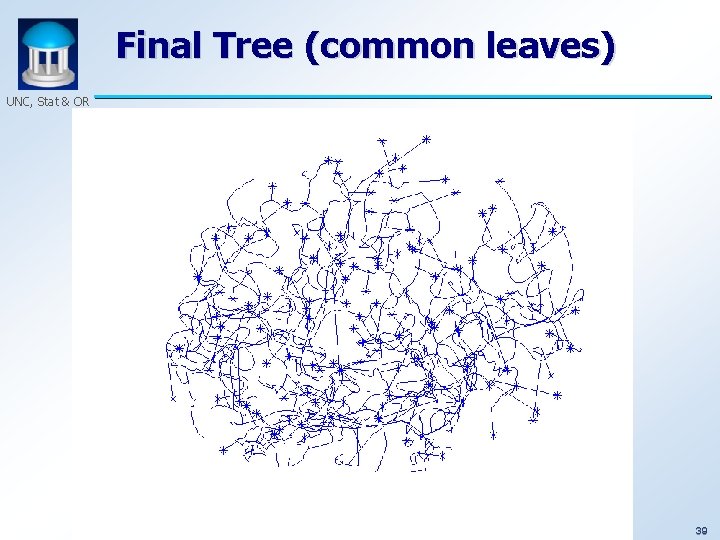
Final Tree (common leaves) UNC, Stat & OR 39
Euclidean Orthant Approach UNC, Stat & OR Setting: Connectivity & Length Background: Phylogenetic Trees Major Restriction: Need common leaves Big Payoff: Data space nearly Euclidean sort of Euclidean 40
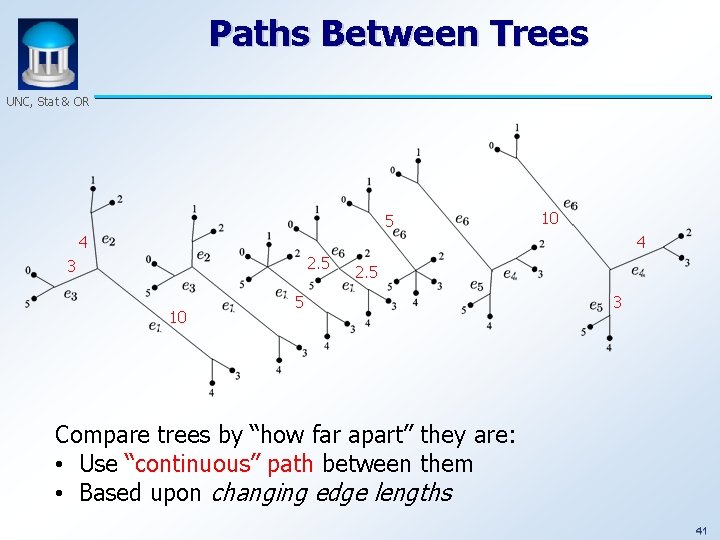
Paths Between Trees UNC, Stat & OR 5 10 4 4 2. 5 3 10 2. 5 5 3 Compare trees by “how far apart” they are: • Use “continuous” path between them • Based upon changing edge lengths 41
Geodesic Paths UNC, Stat & OR Given 2 trees, Shortest path between is called a geodesic 42
Geodesic Paths UNC, Stat & OR Given 2 trees, Shortest path between is called the geodesic Some math: • Can show unique in this space (non-positive curvature) 43
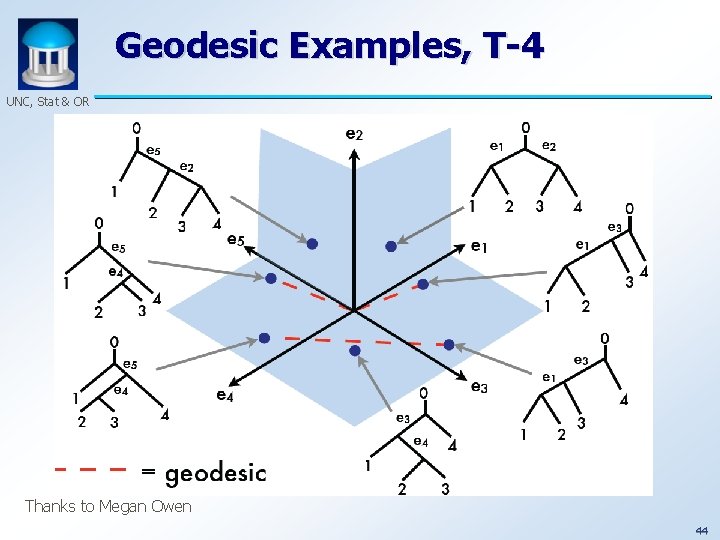
Geodesic Examples, T-4 UNC, Stat & OR Thanks to Megan Owen 44
Geodesic Paths UNC, Stat & OR Given 2 trees, Shortest path between is called the geodesic Fast Computation (polynomial time): Owen M &, Provan JS (2011) IEEE/ACM Transactions on Computational Biology and Bioinformatics, 8, 2 -13. 45
Metric in Euclidean Orthant Space UNC, Stat & OR Given 2 trees: § Can (quickly) find geodesic between § Use length of path as “distance” Can check “metric” properties § Called “Geodesic Distance” 46
Metric in Euclidean Orthant Space UNC, Stat & OR Consequences of metric: ü Useful for statistical analyses ü Fréchet (Geodesic) Mean ü Multi-Dimensional Scaling 47
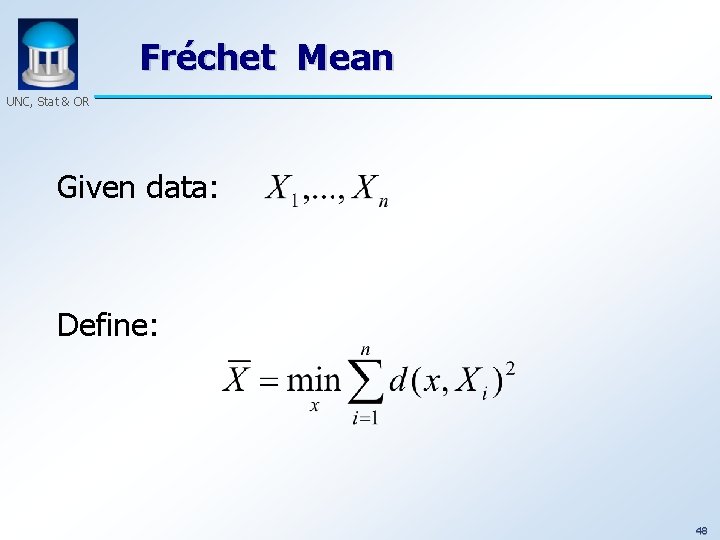
Fréchet Mean UNC, Stat & OR Given data: Define: 48
Fréchet Mean UNC, Stat & OR Notes: v In Euclidean space gives usual mean (easy exercise) v Works in any metric space v Modifications give “robust means” v Also called v Geodesic mean v Intrinsic mean 49
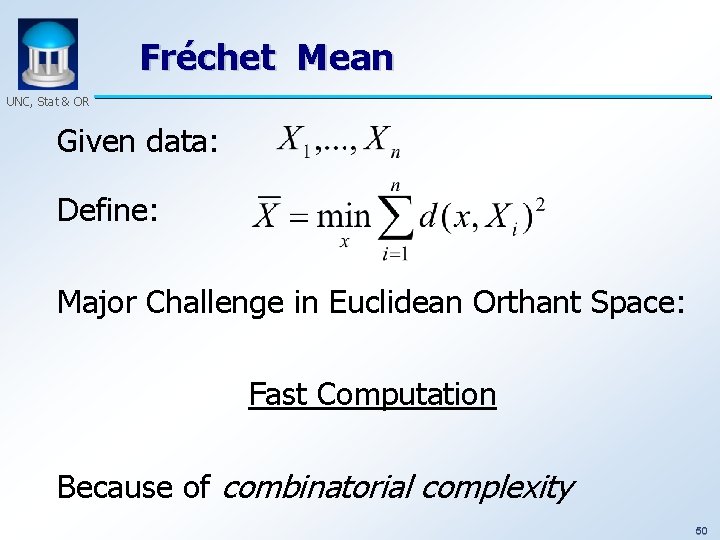
Fréchet Mean UNC, Stat & OR Given data: Define: Major Challenge in Euclidean Orthant Space: Fast Computation Because of combinatorial complexity 50
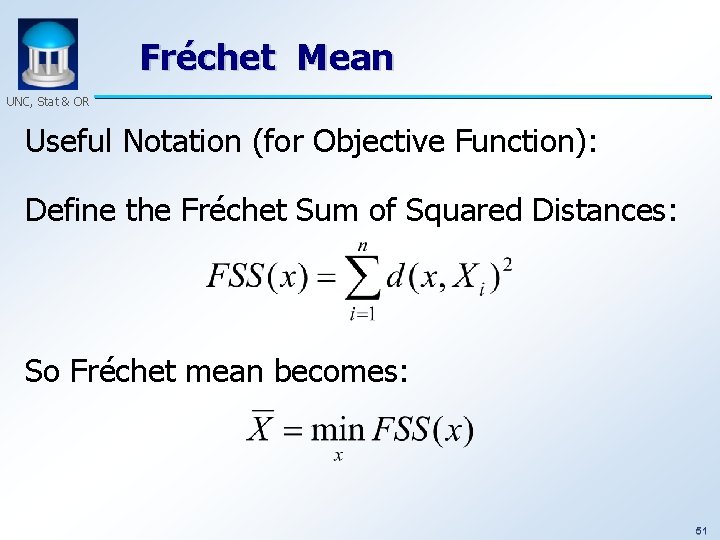
Fréchet Mean UNC, Stat & OR Useful Notation (for Objective Function): Define the Fréchet Sum of Squared Distances: So Fréchet mean becomes: 51
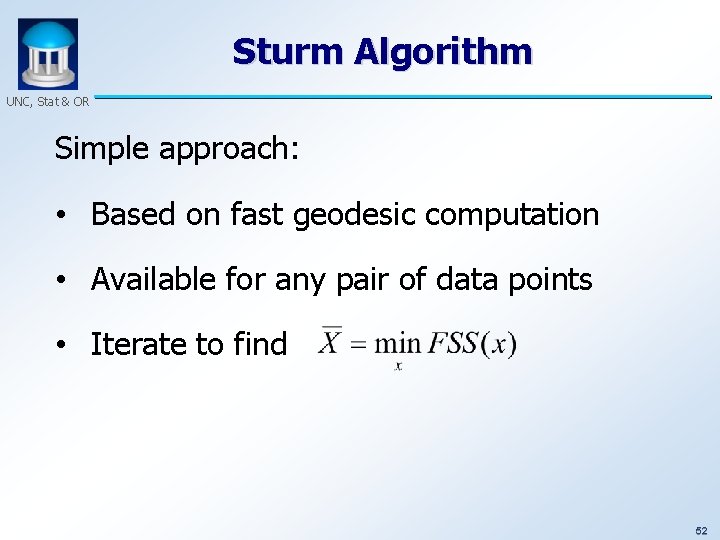
Sturm Algorithm UNC, Stat & OR Simple approach: • Based on fast geodesic computation • Available for any pair of data points • Iterate to find 52
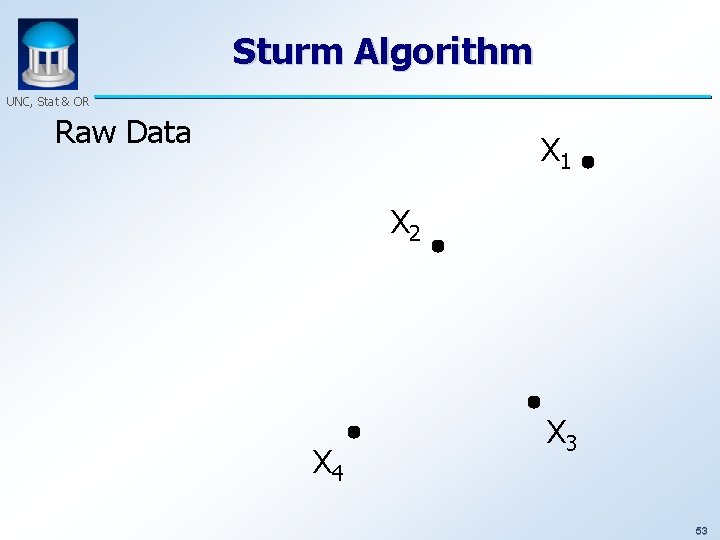
Sturm Algorithm UNC, Stat & OR Raw Data X 1 X 2 X 4 X 3 53
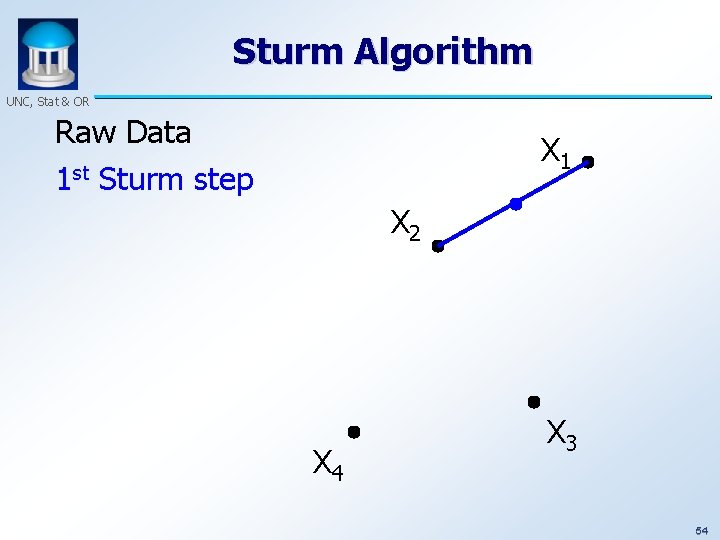
Sturm Algorithm UNC, Stat & OR Raw Data 1 st Sturm step X 1 X 2 X 4 X 3 54
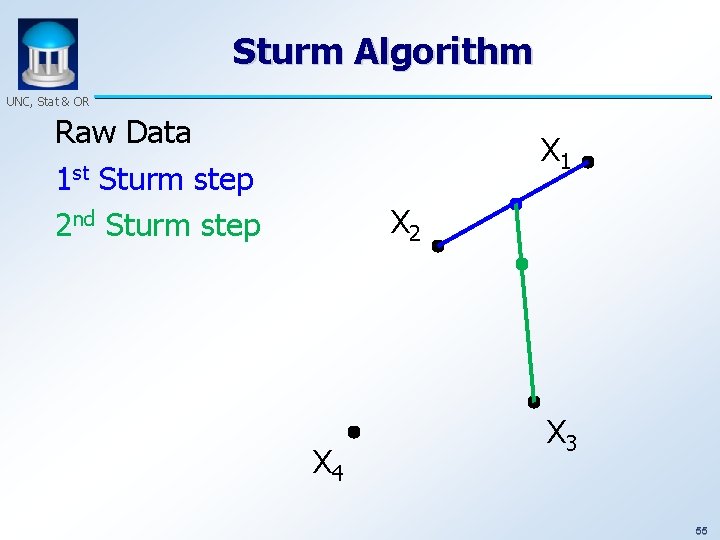
Sturm Algorithm UNC, Stat & OR Raw Data 1 st Sturm step 2 nd Sturm step X 1 X 2 X 4 X 3 55
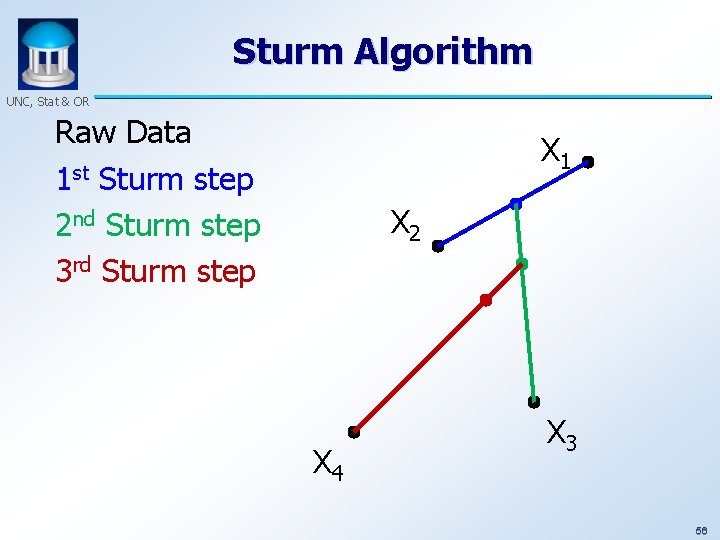
Sturm Algorithm UNC, Stat & OR Raw Data 1 st Sturm step 2 nd Sturm step 3 rd Sturm step X 1 X 2 X 4 X 3 56
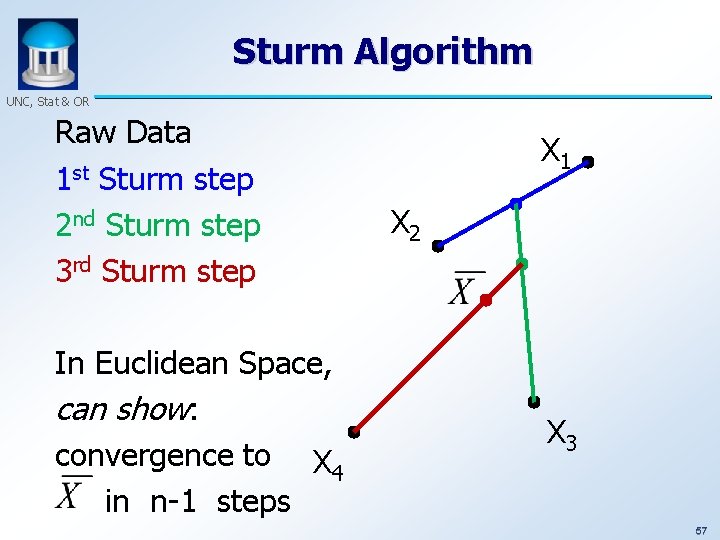
Sturm Algorithm UNC, Stat & OR Raw Data 1 st Sturm step 2 nd Sturm step 3 rd Sturm step In Euclidean Space, can show: convergence to X 4 in n-1 steps X 1 X 2 X 3 57
Sturm Algorithm UNC, Stat & OR Application to brain artery data: • Didn’t converge after 50, 000 steps (for n = 85 trees, d = 128 leaves) 58
Sturm Algorithm UNC, Stat & OR Application to brain artery data: • Didn’t converge after 50, 000 steps (for n = 85 trees, d = 128 leaves) • Trees live in diverse orthants • Not well “traversed” by Sturm Algorithm Will revisit this in a moment 59
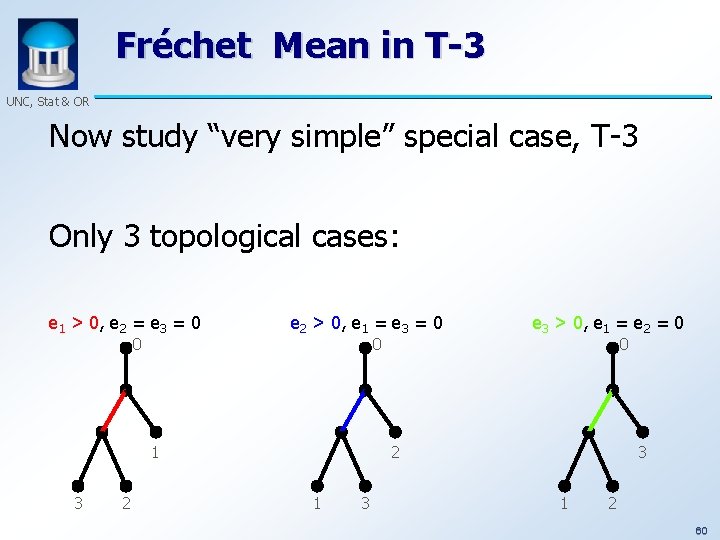
Fréchet Mean in T-3 UNC, Stat & OR Now study “very simple” special case, T-3 Only 3 topological cases: e 1 > 0, e 2 = e 3 = 0 0 e 2 > 0, e 1 = e 3 = 0 0 1 3 2 e 3 > 0, e 1 = e 2 = 0 0 2 1 3 3 1 2 60
Fréchet Mean in T-3 UNC, Stat & OR Now study “very simple” special case, T-3 Interesting Structure determined by Just one of 3 lengths: e 1 e 2 e 3 61
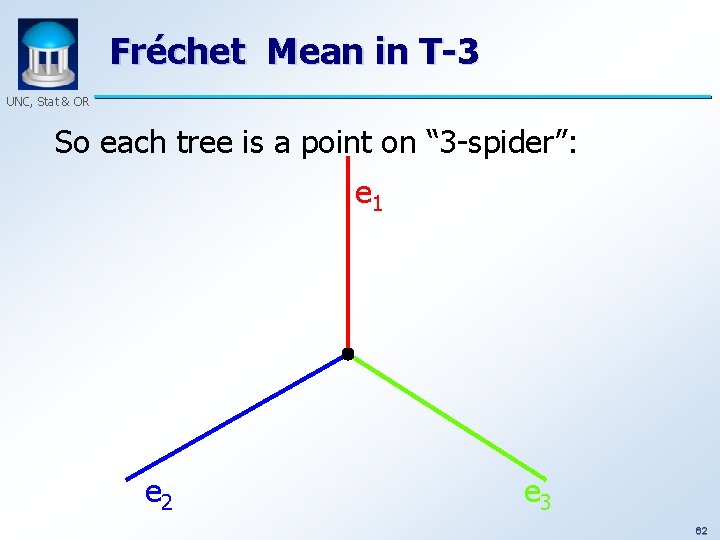
Fréchet Mean in T-3 UNC, Stat & OR So each tree is a point on “ 3 -spider”: e 1 e 2 e 3 62
Fréchet Mean in T-3 UNC, Stat & OR Two versions of mean: o Empirical – Based on Data o Theoretical – Based on Prob. Dist’n, P Both need geodesic metric d 63
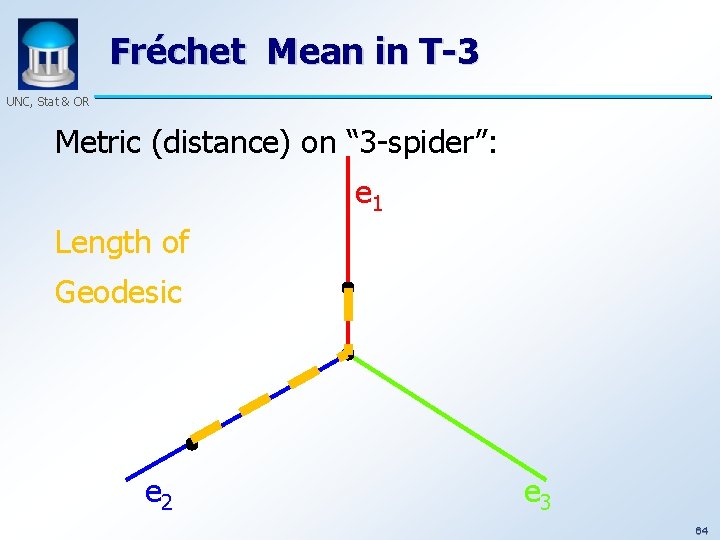
Fréchet Mean in T-3 UNC, Stat & OR Metric (distance) on “ 3 -spider”: e 1 Length of Geodesic e 2 e 3 64
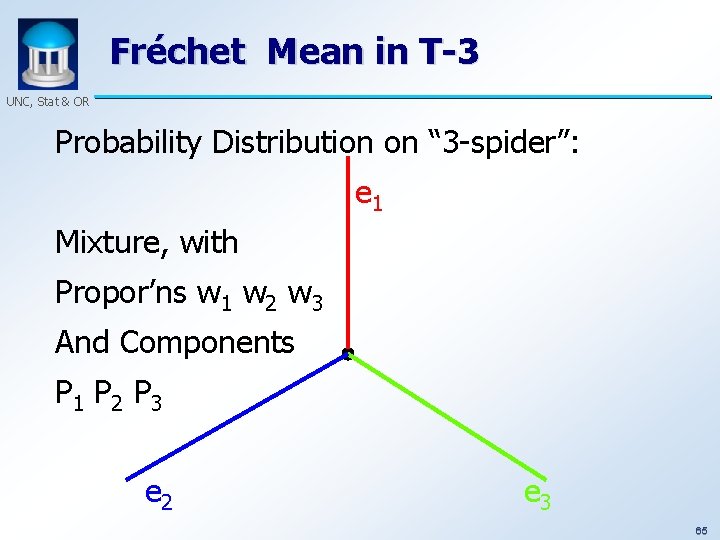
Fréchet Mean in T-3 UNC, Stat & OR Probability Distribution on “ 3 -spider”: e 1 Mixture, with Propor’ns w 1 w 2 w 3 And Components P 1 P 2 P 3 e 2 e 3 65
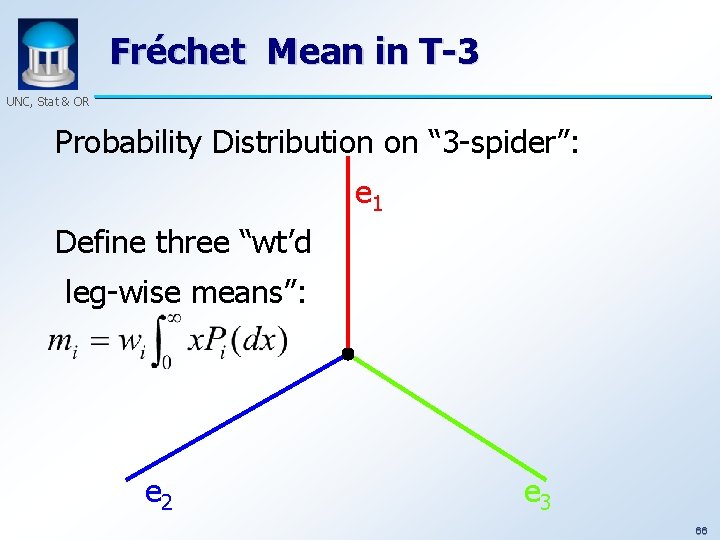
Fréchet Mean in T-3 UNC, Stat & OR Probability Distribution on “ 3 -spider”: e 1 Define three “wt’d leg-wise means”: e 2 e 3 66
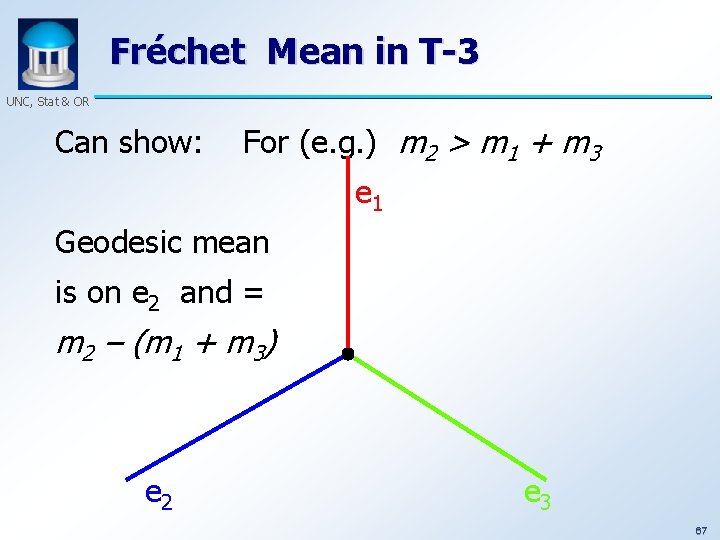
Fréchet Mean in T-3 UNC, Stat & OR Can show: For (e. g. ) m 2 > m 1 + m 3 e 1 Geodesic mean is on e 2 and = m 2 – (m 1 + m 3) e 2 e 3 67
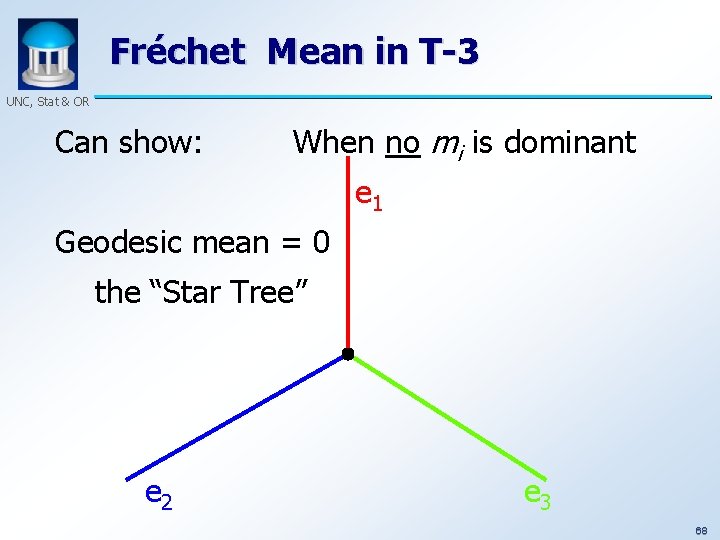
Fréchet Mean in T-3 UNC, Stat & OR Can show: When no mi is dominant e 1 Geodesic mean = 0 the “Star Tree” e 2 e 3 68
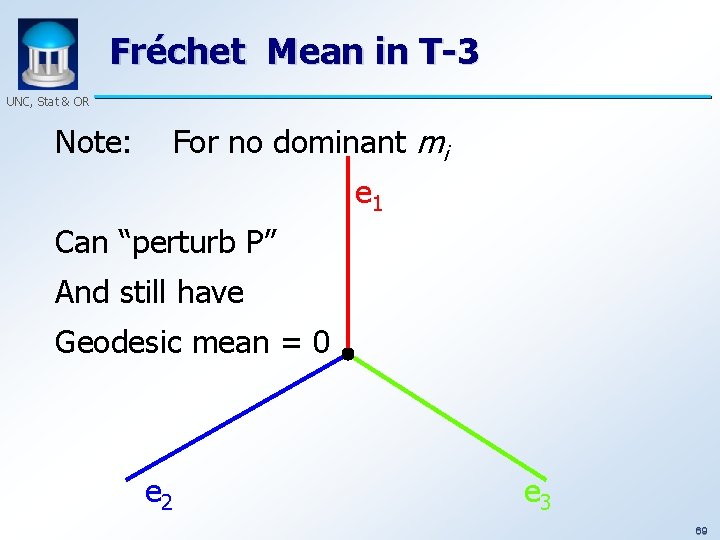
Fréchet Mean in T-3 UNC, Stat & OR Note: For no dominant mi e 1 Can “perturb P” And still have Geodesic mean = 0 e 2 e 3 69
Fréchet Mean in T-3 UNC, Stat & OR Note: For no dominant mi Can “perturb P” and still have Geodesic mean = 0 Very unusual behavior: Ø Not true in Euclidean space (where mean “non-robust”) (very sensitive to perturbations) Ø Phenomenon is called “stickiness” 70
Sturm Algorithm UNC, Stat & OR Application to brain artery data: • Didn’t converge after 50, 000 steps (for n = 85 trees, d = 128 leaves) 71
Sturm Algorithm UNC, Stat & OR Application to brain artery data: • Didn’t converge after 50, 000 steps • How good was it? 72
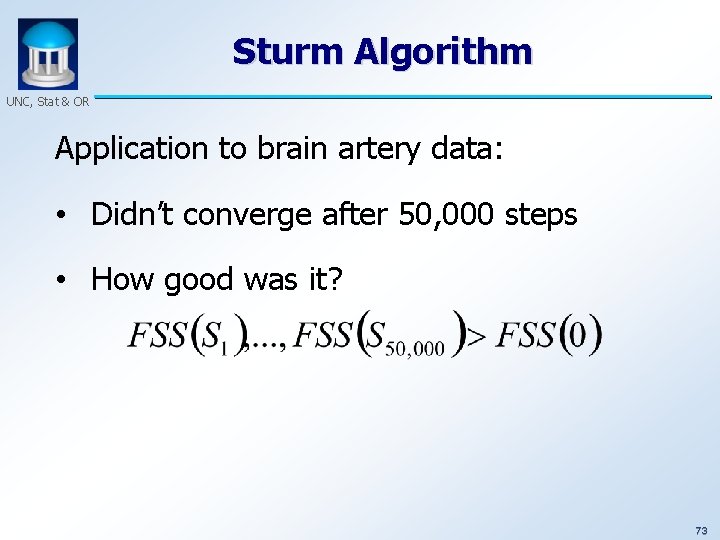
Sturm Algorithm UNC, Stat & OR Application to brain artery data: • Didn’t converge after 50, 000 steps • How good was it? 73
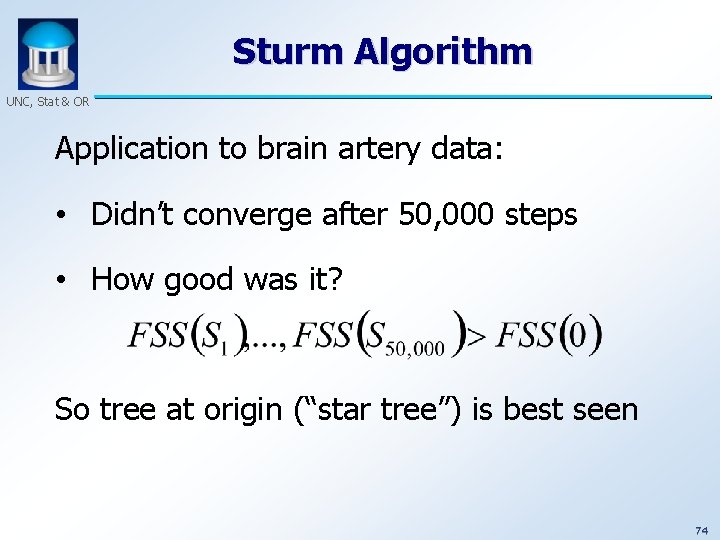
Sturm Algorithm UNC, Stat & OR Application to brain artery data: • Didn’t converge after 50, 000 steps • How good was it? So tree at origin (“star tree”) is best seen 74
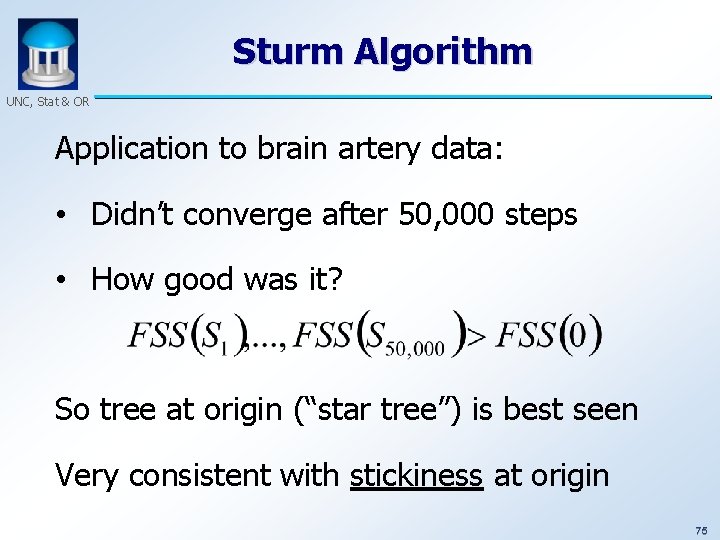
Sturm Algorithm UNC, Stat & OR Application to brain artery data: • Didn’t converge after 50, 000 steps • How good was it? So tree at origin (“star tree”) is best seen Very consistent with stickiness at origin 75
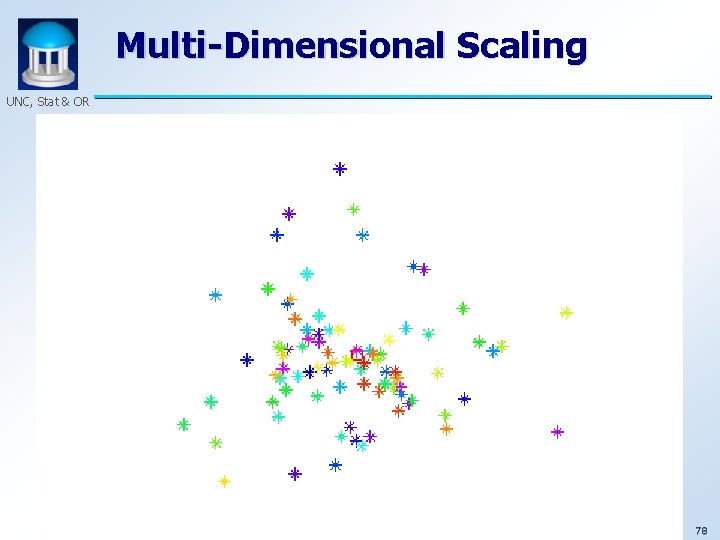
Multi-Dimensional Scaling UNC, Stat & OR Idea: Variation of PCA • Not based on covariance matrix • Instead on Pairwise distances • Solves STRAIN optimization problem • Works on any metric space • Matrix of Euclidean Distances PCA 76
Multi-Dimensional Scaling UNC, Stat & OR Application: Brain Artery Trees • Pairwise Geodesic Distances • Color code for age (as before) • Displays distribution • Include Star tree (best guess at mean) 77
Multi-Dimensional Scaling UNC, Stat & OR 78
Multi-Dimensional Scaling UNC, Stat & OR o Shows variation o Not easy to interpret o Star Tree near center Next study “curvature” 79
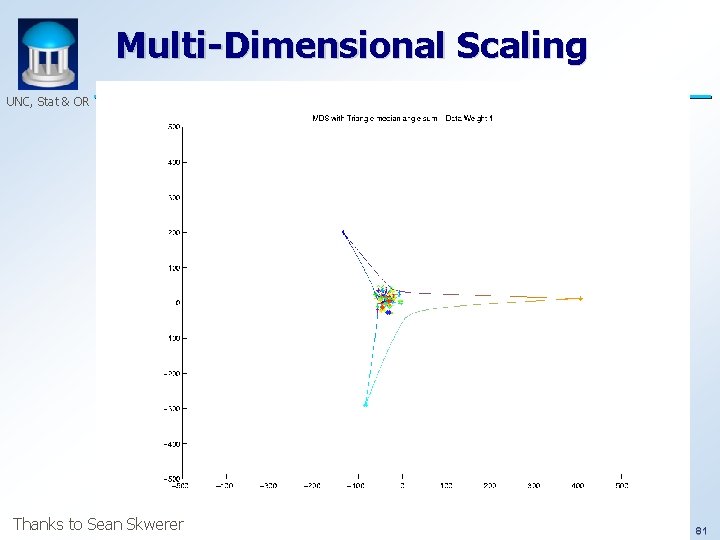
Multi-Dimensional Scaling UNC, Stat & OR Next study “curvature” of space, by: Ø Adding points into MDS Ø That lie along triangle Ø Equally spaced along 3 geodesics Ø Between triple of data points Ø Choose triple as “median curvature” 80
Multi-Dimensional Scaling UNC, Stat & OR Thanks to Sean Skwerer 81
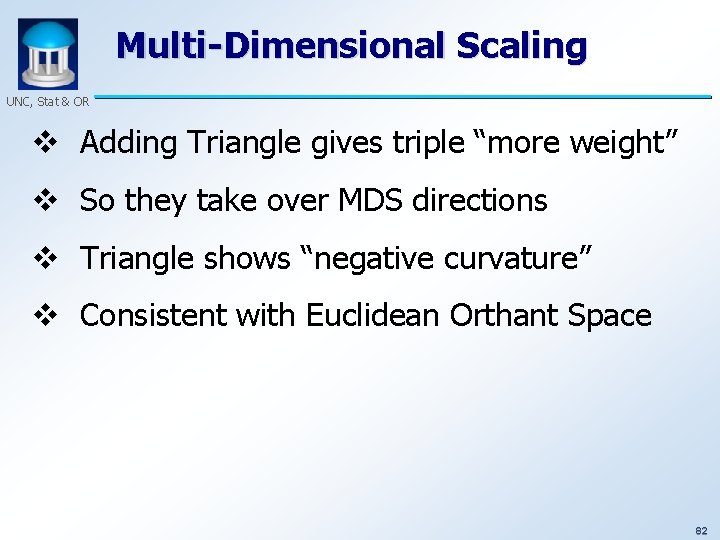
Multi-Dimensional Scaling UNC, Stat & OR v Adding Triangle gives triple “more weight” v So they take over MDS directions v Triangle shows “negative curvature” v Consistent with Euclidean Orthant Space 82
Multi-Dimensional Scaling UNC, Stat & OR Ø Could Tell Longer Story Ø But Time is too short 83
Euclidean Orthant Approach UNC, Stat & OR • Next tasks: Statistical Analysis, e. g. • Calculation of Mean • PCA (“Backwards” approach? ? ? ) • Classification (“linear method” ? ? ? ) • Work in Progress • Heavy & Specialized Optimization 84

Concept to Watch UNC, Stat & OR Stratified Manifolds 85
Concept to Watch UNC, Stat & OR Stratified Manifolds People: - Vic Patrangenaru, Statistics, Florida S. U. - Ezra Miller, Mathematics, Duke U. - Stephan Huckemann, U. Göttingen 86
Concept to Watch UNC, Stat & OR Stratified Manifolds People: - Vic Patrangenaru, Statistics, Florida S. U. - Ezra Miller, Mathematics, Duke U. - Stephan Huckemann, U. Göttingen More Precise Mathematics: “Whitney Stratification” 87
Concept to Watch UNC, Stat & OR Stratified Manifolds Idea: v Manifolds of Different Dimension i. e. “Strata” v Glued Together 88
Concept to Watch UNC, Stat & OR Stratified Manifolds Example 1: Phylogenetic Trees q Orthants = Highest Dim’al Strata q Glued at Edges q Edges are Lower Dim’al Strata q {Star Tree} = 0 Dim’al Stratum 89
Concept to Watch UNC, Stat & OR Stratified Manifolds Example 2: Covariance Matrices o {Pos. Def. } = Highest Dim’al Stratum o {k non-0 E. V. s} = Lower Dim’al Strata o Glue: lim as smallest E. V. 0 o {0 Matrix} = 0 Dim’al Stratum 90

Concept to Watch UNC, Stat & OR Stratified Manifolds At this meeting 91
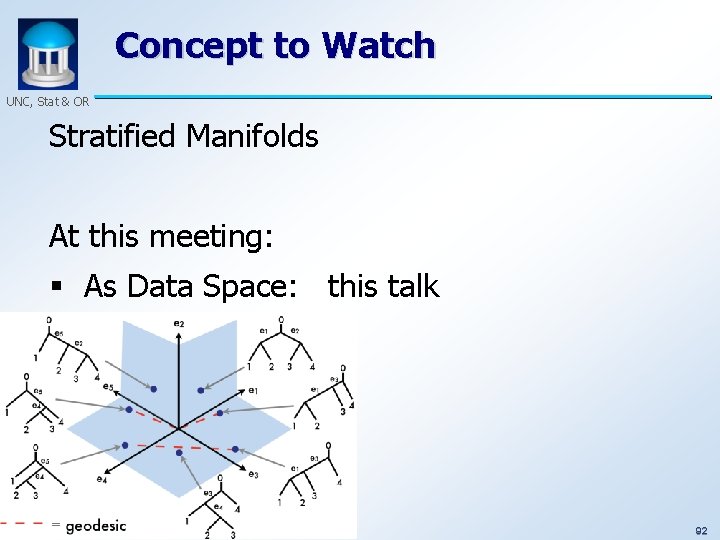
Concept to Watch UNC, Stat & OR Stratified Manifolds At this meeting: § As Data Space: this talk 92
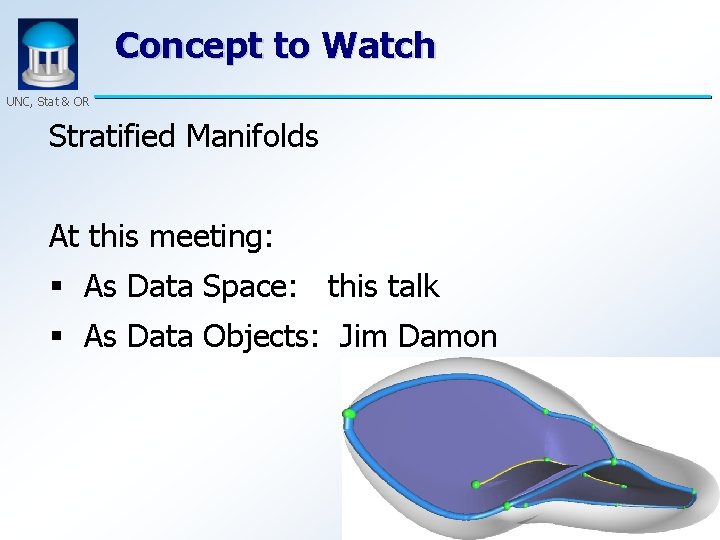
Concept to Watch UNC, Stat & OR Stratified Manifolds At this meeting: § As Data Space: this talk § As Data Objects: Jim Damon 93
Concept to Watch UNC, Stat & OR Stratified Manifolds At this meeting: § As Data Space: this talk § As Data Objects: Jim Damon § As Parameter Space: Peter Kim 94
- Slides: 94