
Birefringence Halite cubic sodium chloride crystal optically isotropic
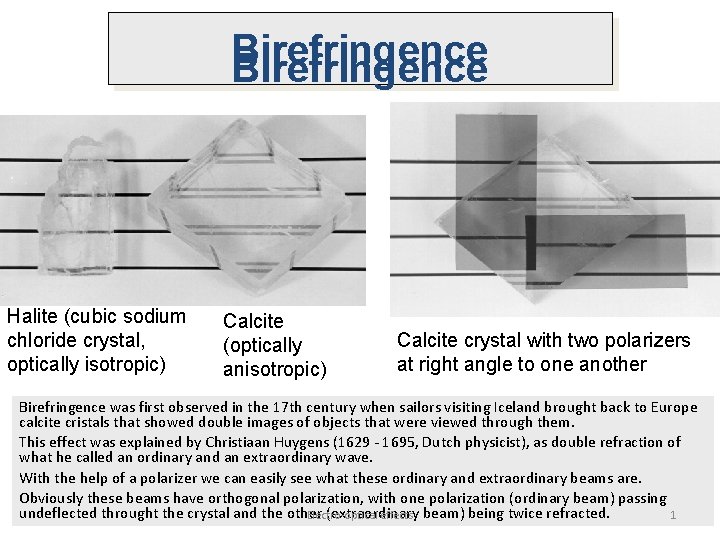
Birefringence Halite (cubic sodium chloride crystal, optically isotropic) Calcite (optically anisotropic) Calcite crystal with two polarizers at right angle to one another Birefringence was first observed in the 17 th century when sailors visiting Iceland brought back to Europe calcite cristals that showed double images of objects that were viewed through them. This effect was explained by Christiaan Huygens (1629 - 1695, Dutch physicist), as double refraction of what he called an ordinary and an extraordinary wave. With the help of a polarizer we can easily see what these ordinary and extraordinary beams are. Obviously these beams have orthogonal polarization, with one polarization (ordinary beam) passing undeflected throught the crystal and the other (extraordinary Electro-optical effects beam) being twice refracted. 1

c E
E
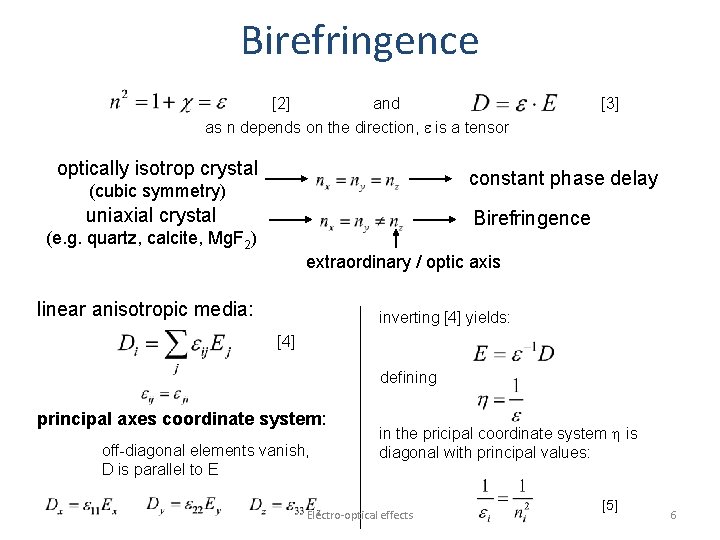
Birefringence [2] and as n depends on the direction, is a tensor optically isotrop crystal [3] constant phase delay (cubic symmetry) uniaxial crystal Birefringence (e. g. quartz, calcite, Mg. F 2) extraordinary / optic axis linear anisotropic media: inverting [4] yields: [4] defining principal axes coordinate system: off-diagonal elements vanish, D is parallel to E in the pricipal coordinate system is diagonal with principal values: Electro-optical effects [5] 6
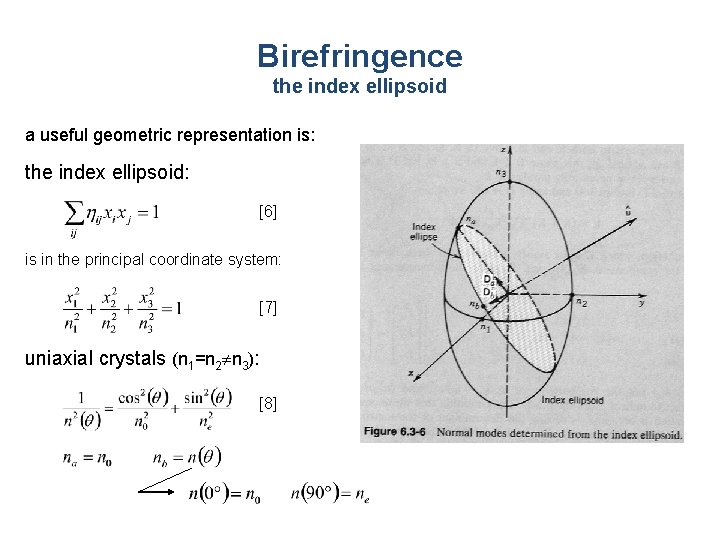
Birefringence the index ellipsoid a useful geometric representation is: the index ellipsoid: [6] is in the principal coordinate system: [7] uniaxial crystals (n 1=n 2 n 3): [8]
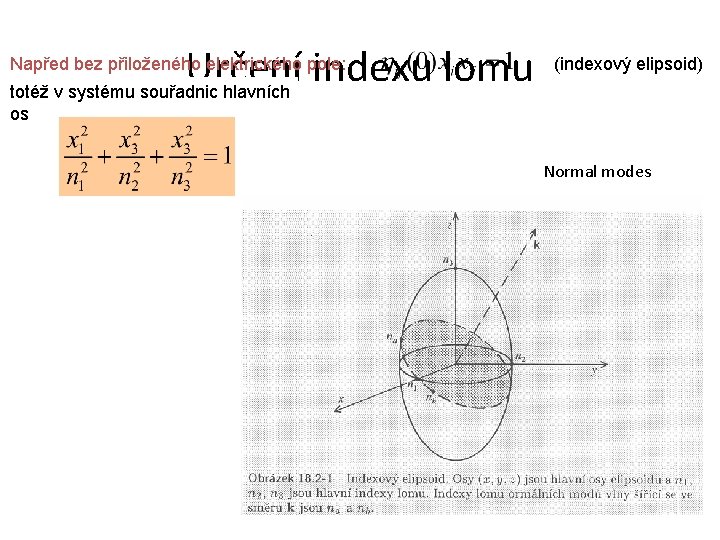
Určení indexu lomu totéž v systému souřadnic hlavních Napřed bez přiloženého elektrického pole: (indexový elipsoid) os Normal modes
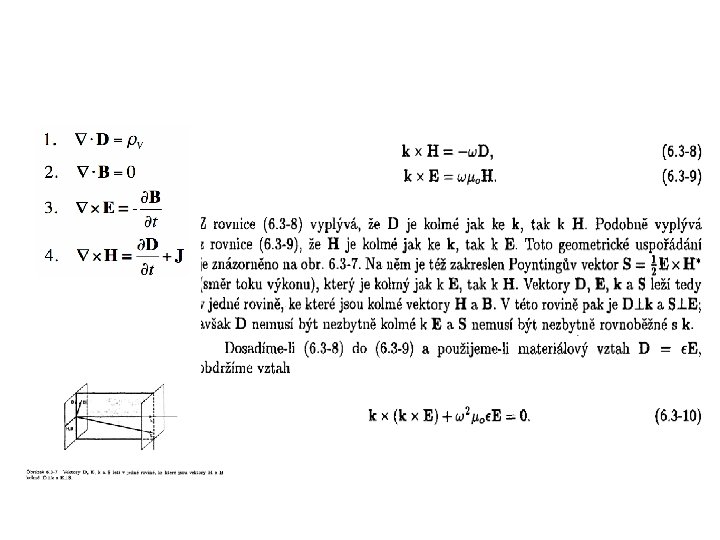
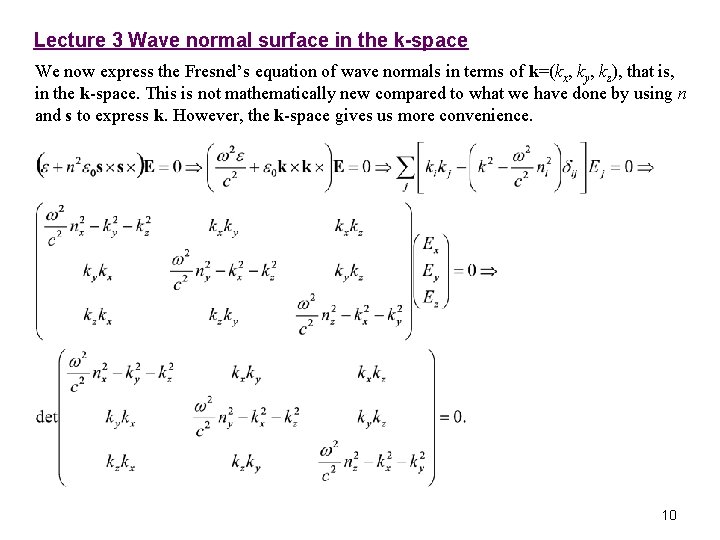
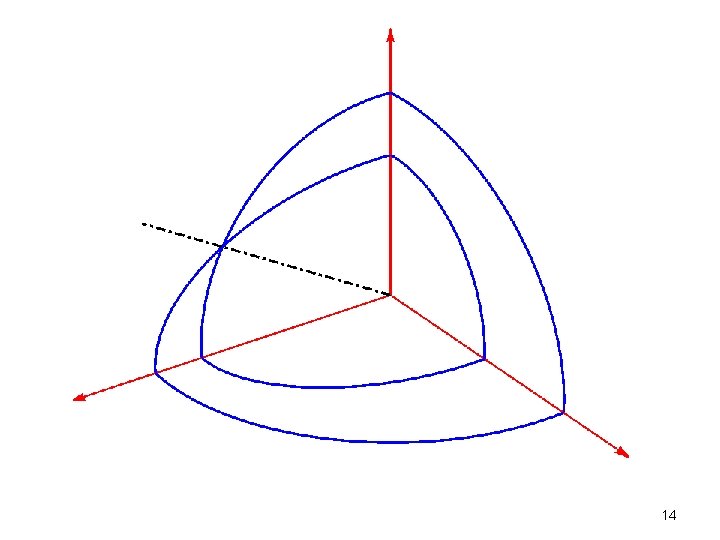
Lecture 3 Wave normal surface in the k-space We now express the Fresnel’s equation of wave normals in terms of k=(kx, ky, kz), that is, in the k-space. This is not mathematically new compared to what we have done by using n and s to express k. However, the k-space gives us more convenience. 10
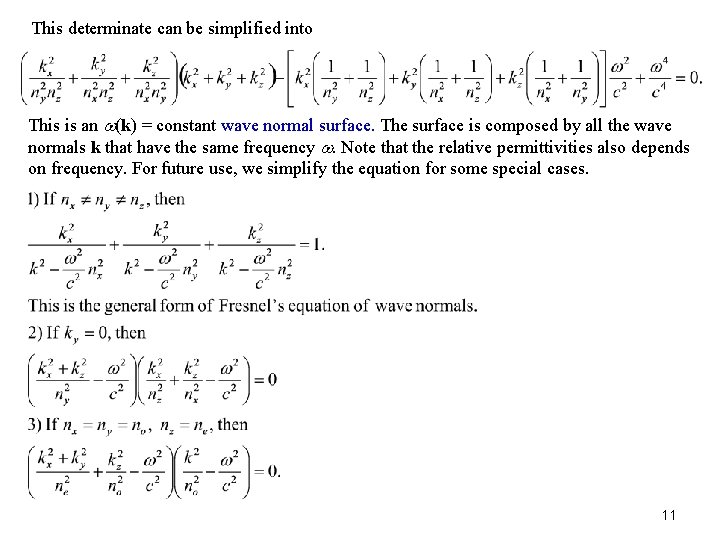
This determinate can be simplified into This is an w(k) = constant wave normal surface. The surface is composed by all the wave normals k that have the same frequency w. Note that the relative permittivities also depends on frequency. For future use, we simplify the equation for some special cases. 11
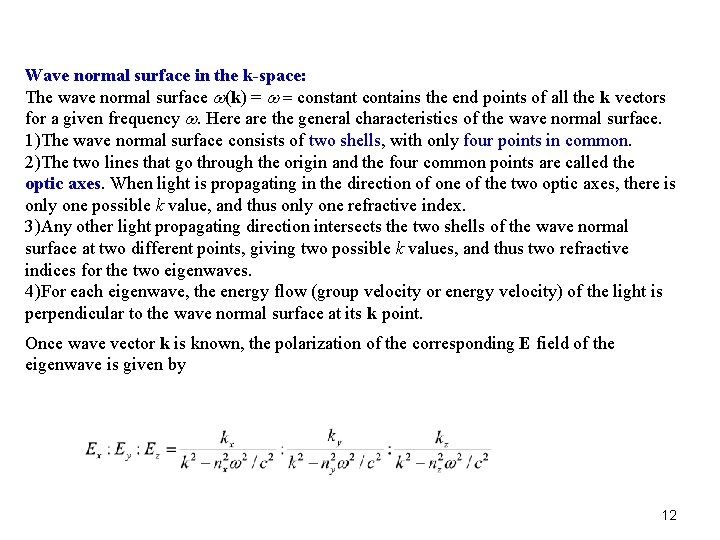
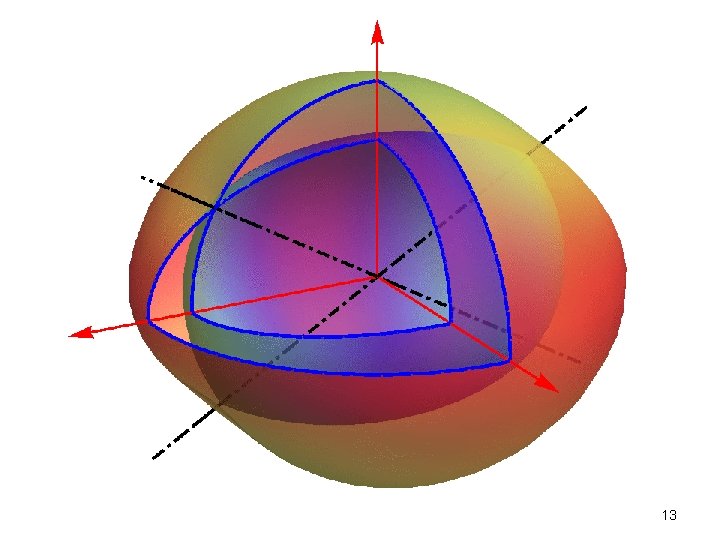
Wave normal surface in the k-space: The wave normal surface w(k) = w = constant contains the end points of all the k vectors for a given frequency w. Here are the general characteristics of the wave normal surface. 1)The wave normal surface consists of two shells, with only four points in common. 2)The two lines that go through the origin and the four common points are called the optic axes. When light is propagating in the direction of one of the two optic axes, there is only one possible k value, and thus only one refractive index. 3)Any other light propagating direction intersects the two shells of the wave normal surface at two different points, giving two possible k values, and thus two refractive indices for the two eigenwaves. 4)For each eigenwave, the energy flow (group velocity or energy velocity) of the light is perpendicular to the wave normal surface at its k point. Once wave vector k is known, the polarization of the corresponding E field of the eigenwave is given by 12
13
14
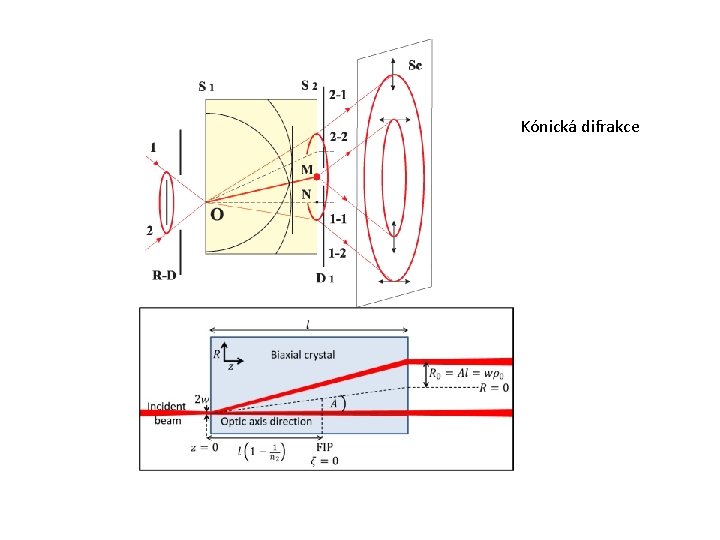
Kónická difrakce
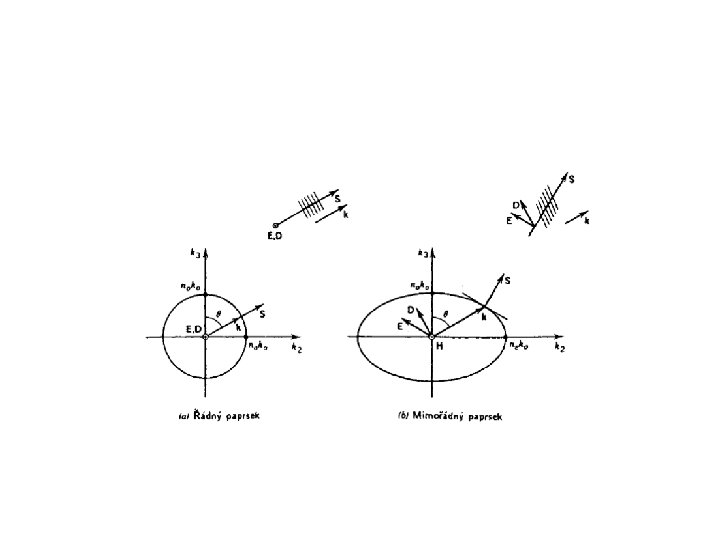
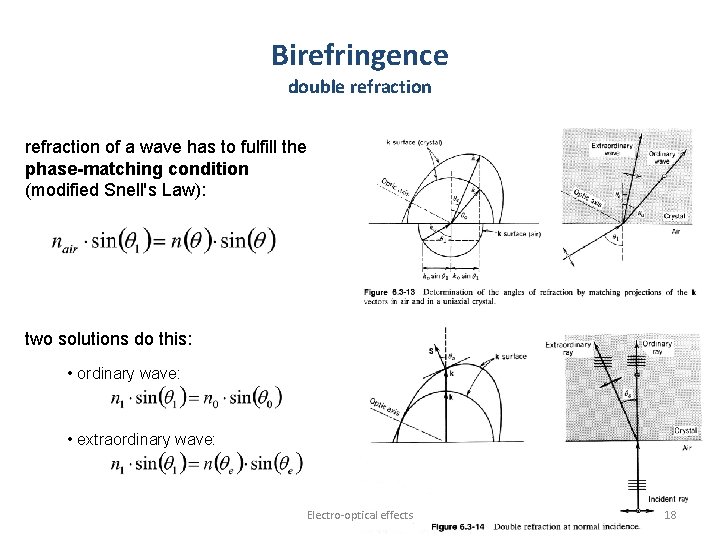
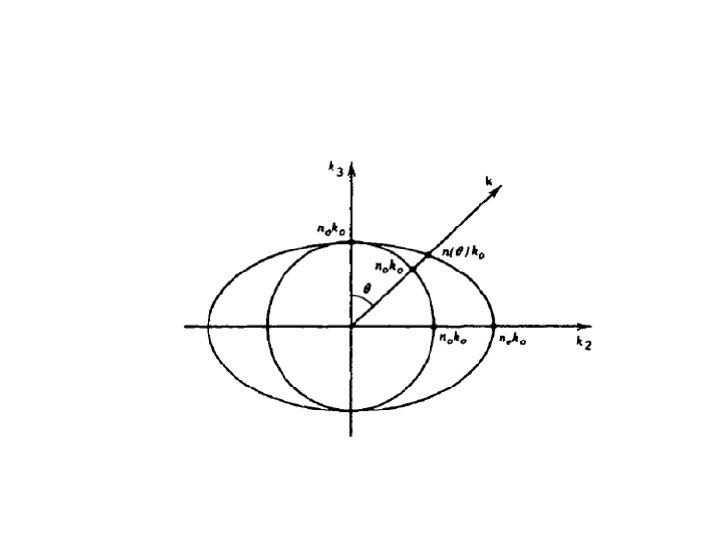
Birefringence double refraction of a wave has to fulfill the phase-matching condition (modified Snell's Law): two solutions do this: • ordinary wave: • extraordinary wave: Electro-optical effects 18
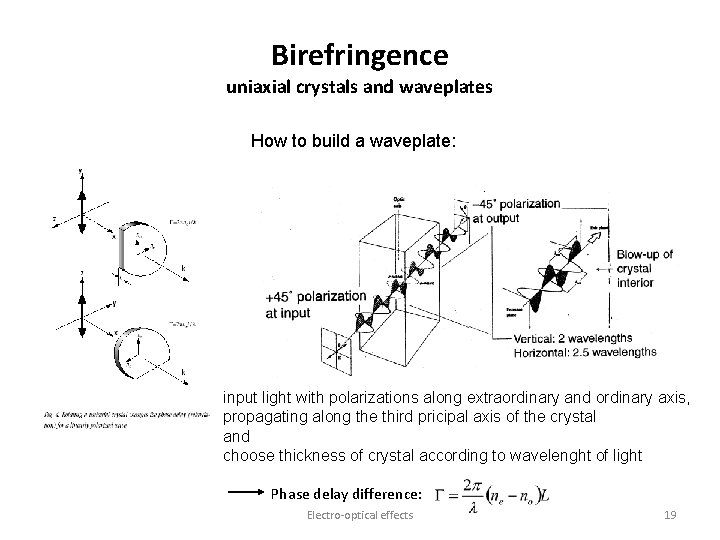
Birefringence uniaxial crystals and waveplates How to build a waveplate: input light with polarizations along extraordinary and ordinary axis, propagating along the third pricipal axis of the crystal and choose thickness of crystal according to wavelenght of light Phase delay difference: Electro-optical effects 19
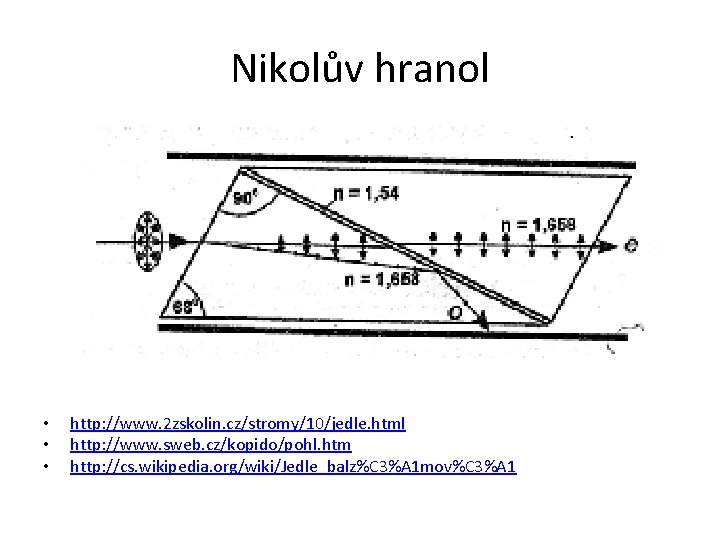
Nikolův hranol • • • http: //www. 2 zskolin. cz/stromy/10/jedle. html http: //www. sweb. cz/kopido/pohl. htm http: //cs. wikipedia. org/wiki/Jedle_balz%C 3%A 1 mov%C 3%A 1
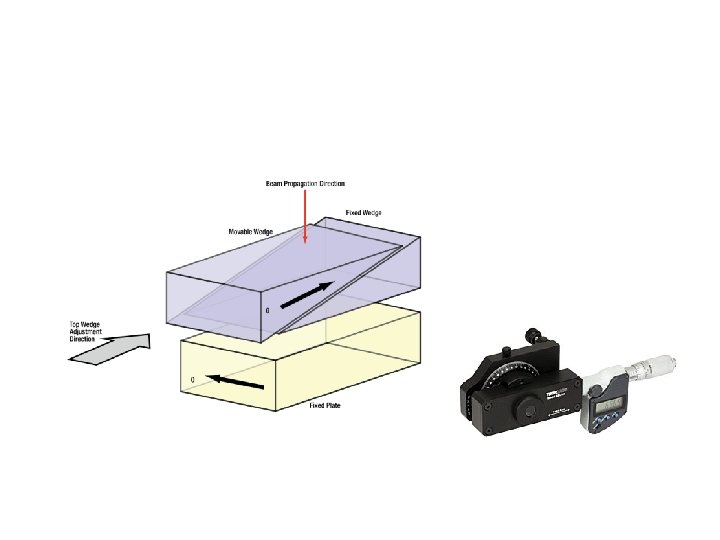
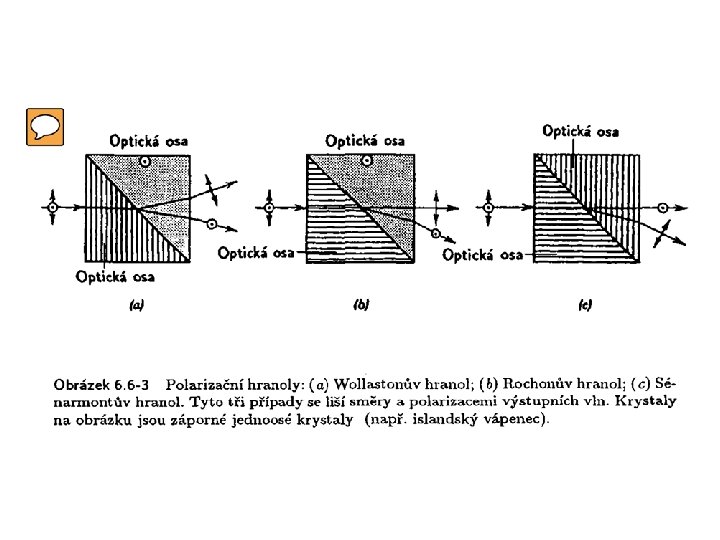
• • • • • Fázová destička je charakterizována svým fázovým zpožděním F a svou rychlou a pomalou osou (viz odst. 6. 1 B). Normální mody jsou vlny lineárně polarizované ve směrech os a jejich rychlosti jsou různé. Po průchodu fázovou destičkou dochází k relativnímu fázovému posuvu modů vůči sobě o velikosti F. Fázové destičky jsou často zhotovovány z anizotropních látek. Jak bylo vysvětleno v odst. 6. 3 B, prochází-li světlo podél hlavní osy krystalu (řekněme osy z), jsou normální mody vlny lineárně polarizované do směrů dvou druhých hlavních os (osy x a y). Dvěma modům přísluší hlavní indexy lomu ni a ni- Je-li ni < n. 2, je osa x rychlou osou. Má-li destička tloušťku d, je fázové zpoždění F = (112 — n)kod = = 2 -n{v, 2 — ni)d/o. Fázové zpoždění je přímo úměrné tloušťce destičky d a nepřímo úměrné vlnové délce Ao (mějme však na paměti, že rozdíl n 2 — ni je sám závislý na vlnové délce). Například indexy lomu slídy jsou 1, 599 a 1, 594 pro vlnovou délku Ao = 633 um, takže T/d « 15, 8 TT rad/mm. Tenký list tloušťky 63, 3 /im je půlvlnová destička (F « R; W). (o) Obrázek 6. 6 -3 Polarizační hranoly: (a) Wollastonův hranol; (6) Rochonův hranol; (c) Sénarmontův hranol. Tyto tři případy se liší směry a polarizacemi výstupních vln. Krystaly na obrázku jsou záporné jednoosé krystaly (např. islandský vápenec).
- Slides: 23