
Bird Anatomy Notes Anatomy 1 Bones Hollow but

Bird Anatomy Notes

Anatomy 1. ) Bones -Hollow but very strong -Honeycombs inside bone for support -Large eye sockets reduce skull weight -Wing bones lighter, leg bones heavier -All vertebrae but neck are fused together 2. ) Muscles -Large and relatively heavy -Pectoral muscles=25% of total body weight

Anatomy 3. ) Feathers Preening = zipping up barbs that separated -Four kinds, need to know 2 of them a. ) Contour feather (flight feather) - Stiff central shaft - Many side branches called barbs - Barbs have interlocking barbules b. ) Downy feather – clustered at base of contour -Short shafts with long fluffy barbs -Insulate bird trap air close to body

Anatomy 4. ) Crop and Gizzard -Crop is a storage area at the end of the esophagus softens food - Gizzard contains small stones (and muscular walls) breaks food into small pieces which travel to the intestines, where nutrients are absorbed
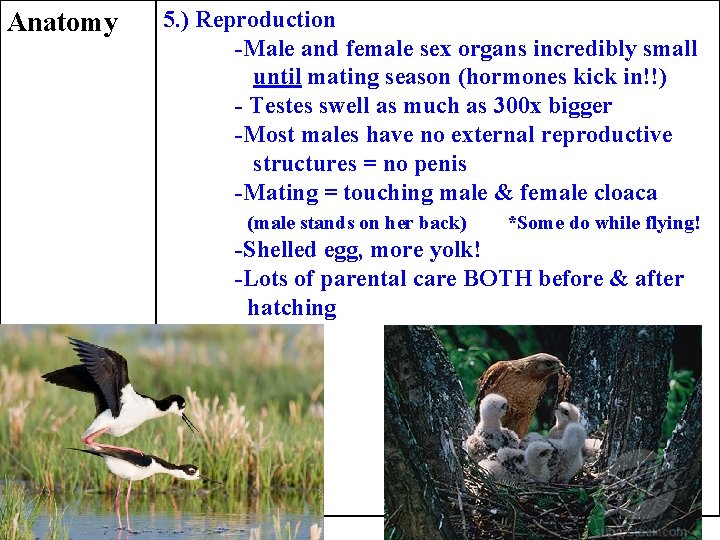
Anatomy 5. ) Reproduction -Male and female sex organs incredibly small until mating season (hormones kick in!!) - Testes swell as much as 300 x bigger -Most males have no external reproductive structures = no penis -Mating = touching male & female cloaca (male stands on her back) *Some do while flying! -Shelled egg, more yolk! -Lots of parental care BOTH before & after hatching
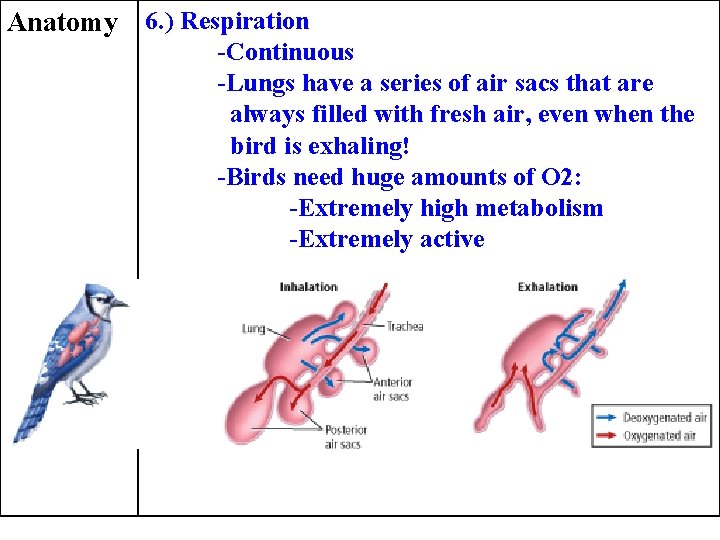
Anatomy 6. ) Respiration -Continuous -Lungs have a series of air sacs that are always filled with fresh air, even when the bird is exhaling! -Birds need huge amounts of O 2: -Extremely high metabolism -Extremely active
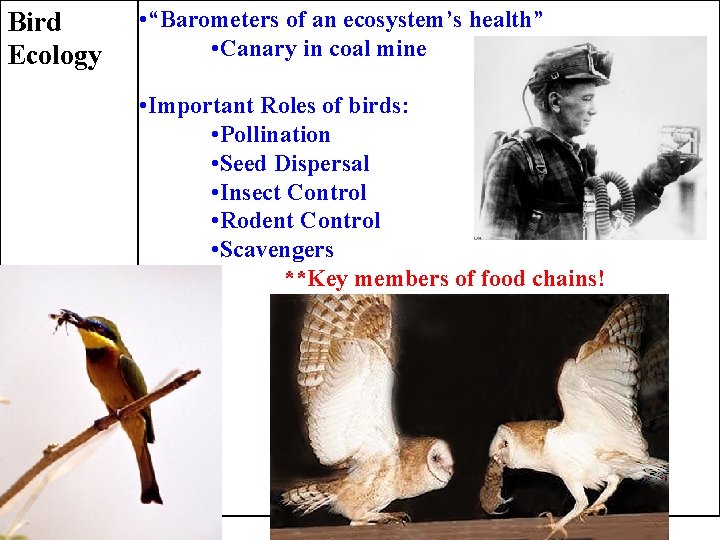
Bird Ecology • “Barometers of an ecosystem’s health” • Canary in coal mine • Important Roles of birds: • Pollination • Seed Dispersal • Insect Control • Rodent Control • Scavengers **Key members of food chains!
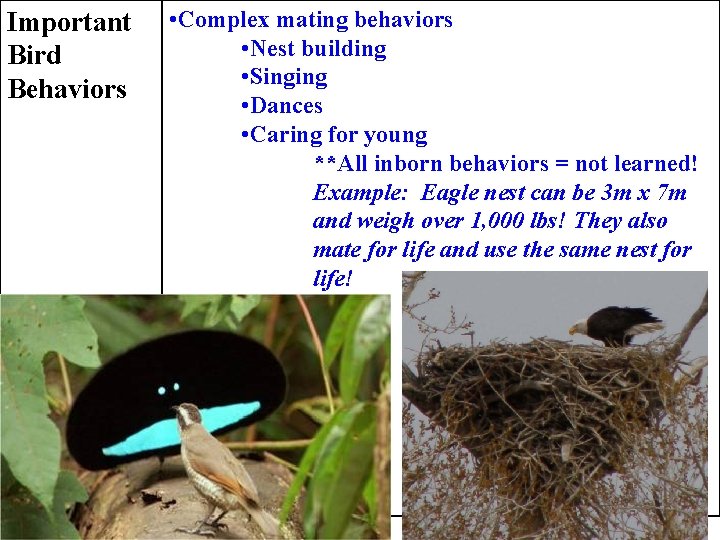
Important Bird Behaviors • Complex mating behaviors • Nest building • Singing • Dances • Caring for young **All inborn behaviors = not learned! Example: Eagle nest can be 3 m x 7 m and weigh over 1, 000 lbs! They also mate for life and use the same nest for life!
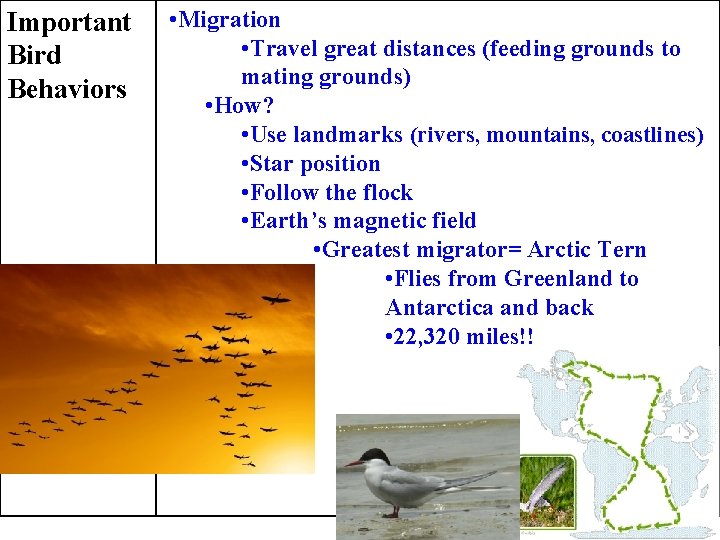
Important Bird Behaviors • Migration • Travel great distances (feeding grounds to mating grounds) • How? • Use landmarks (rivers, mountains, coastlines) • Star position • Follow the flock • Earth’s magnetic field • Greatest migrator= Arctic Tern • Flies from Greenland to Antarctica and back • 22, 320 miles!!

• Builds appreciation and empathy Bird Watching • Beautiful colors & songs • Interesting behaviors (feeding, mating…) • ALSO • Indicators or environment’s health • If see/hear less birds: • Habitat loss (more farm, less forest = Cowbird parasites!!) • Introduction of Exotics (Guam snakes) • Pollution • Population of humans • Overharvest/Overconsumption (pet trade of tropical birds & chicken farming)
- Slides: 10