
BIRCH Balanced Iterative Reducing and Clustering Using Hierarchies

BIRCH: Balanced Iterative Reducing and Clustering Using Hierarchies
Motivation u Major weakness of agglomerative clustering methods l l u Do not scale well; time complexity of at least O(n 2), where n is total number of objects Can never undo what was done previously Birch: Balanced Iterative Reducing and Clustering using Hierarchies l l Incrementally construct a CF (Clustering Feature) tree, a hierarchical data structure summarizing cluster info; finds a good clustering with a single scan Apply multi-phase clustering; improves quality with a few additional scans 2
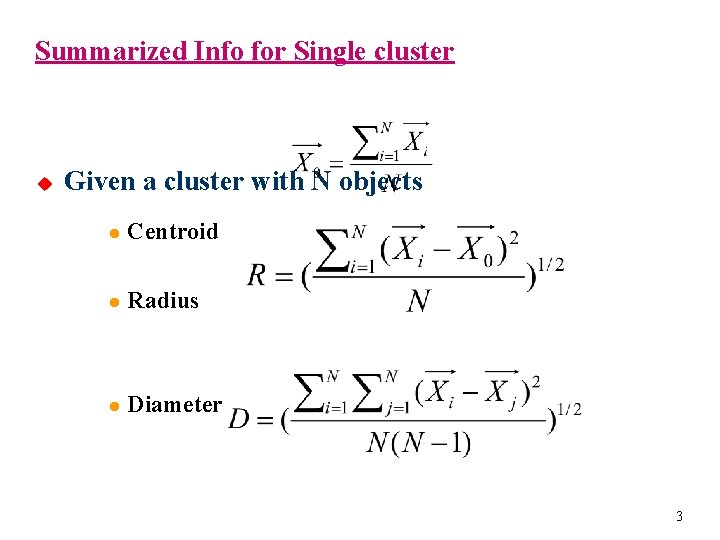
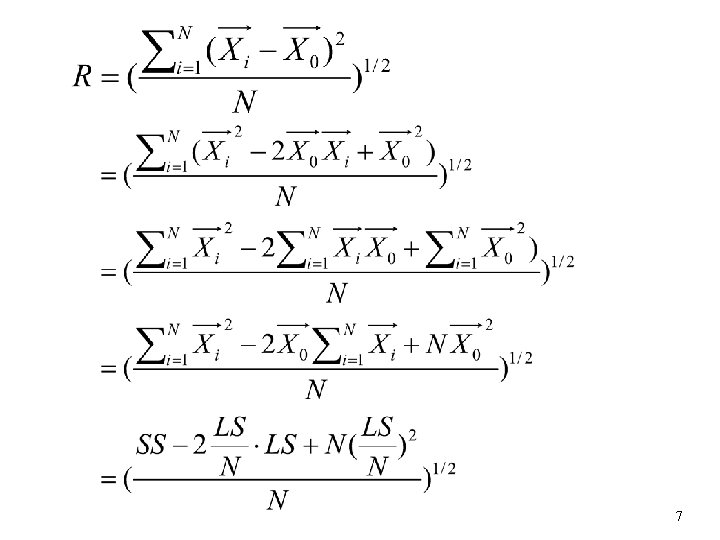
Summarized Info for Single cluster u Given a cluster with N objects l Centroid l Radius l Diameter 3
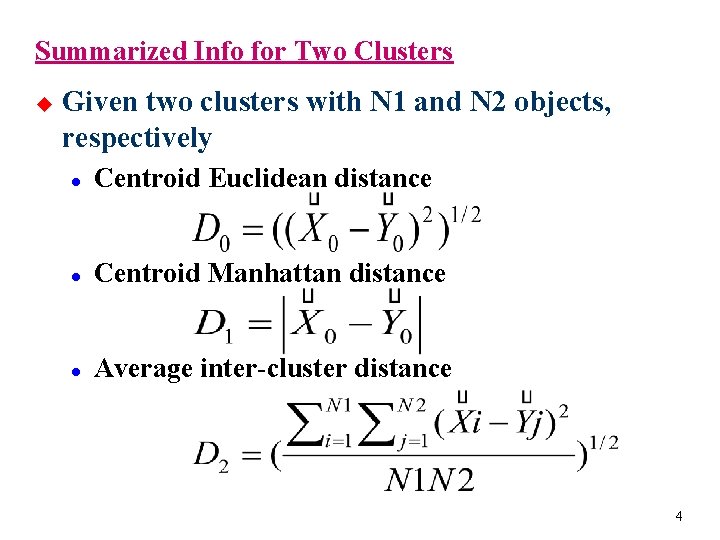
Summarized Info for Two Clusters u Given two clusters with N 1 and N 2 objects, respectively l Centroid Euclidean distance l Centroid Manhattan distance l Average inter-cluster distance 4
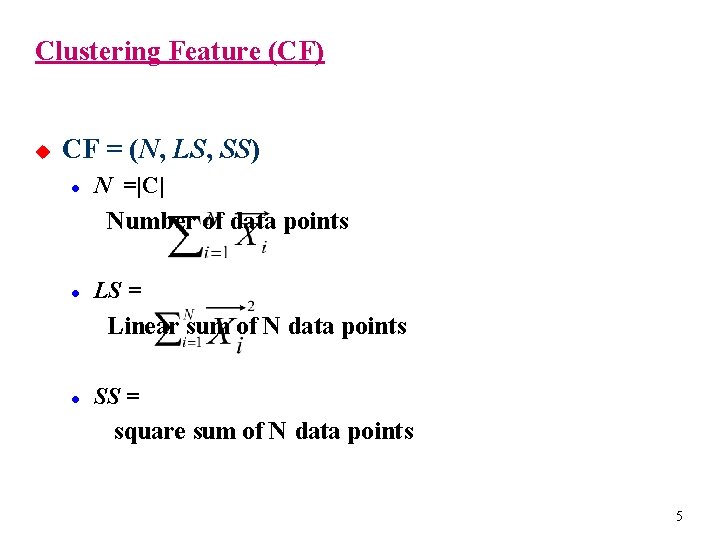
Clustering Feature (CF) u CF = (N, LS, SS) l l l N =|C| Number of data points LS = Linear sum of N data points SS = square sum of N data points 5
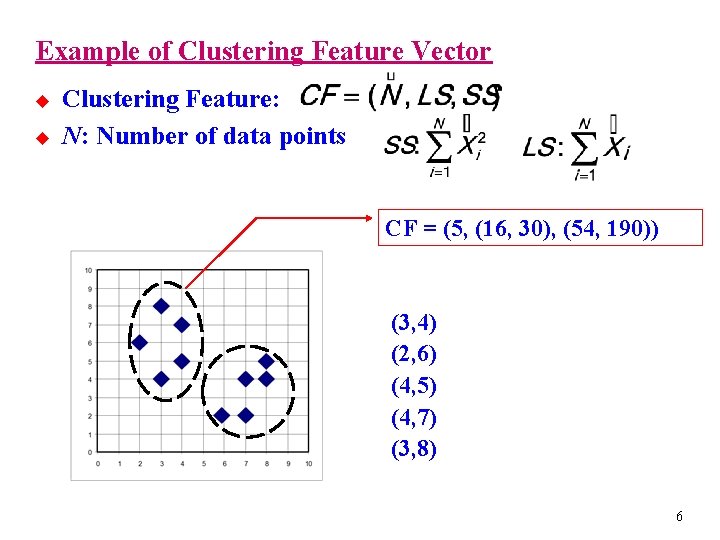
Example of Clustering Feature Vector u u Clustering Feature: N: Number of data points CF = (5, (16, 30), (54, 190)) (3, 4) (2, 6) (4, 5) (4, 7) (3, 8) 6
7
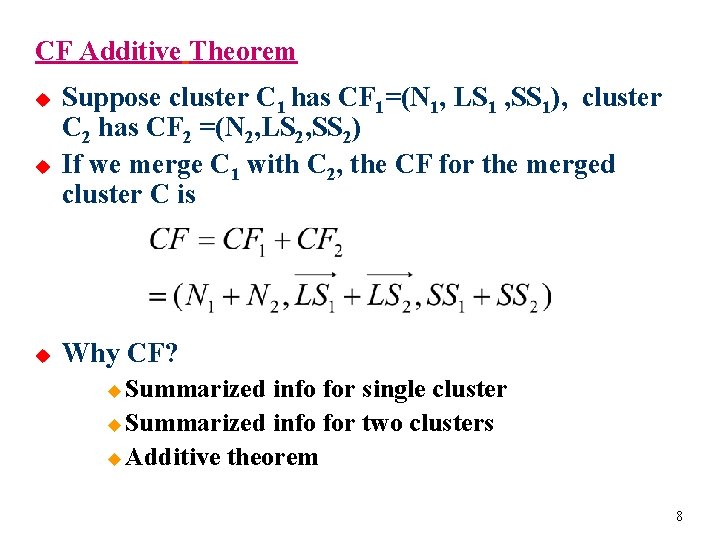
CF Additive Theorem u u u Suppose cluster C 1 has CF 1=(N 1, LS 1 , SS 1), cluster C 2 has CF 2 =(N 2, LS 2, SS 2) If we merge C 1 with C 2, the CF for the merged cluster C is Why CF? Summarized info for single cluster u Summarized info for two clusters u Additive theorem u 8
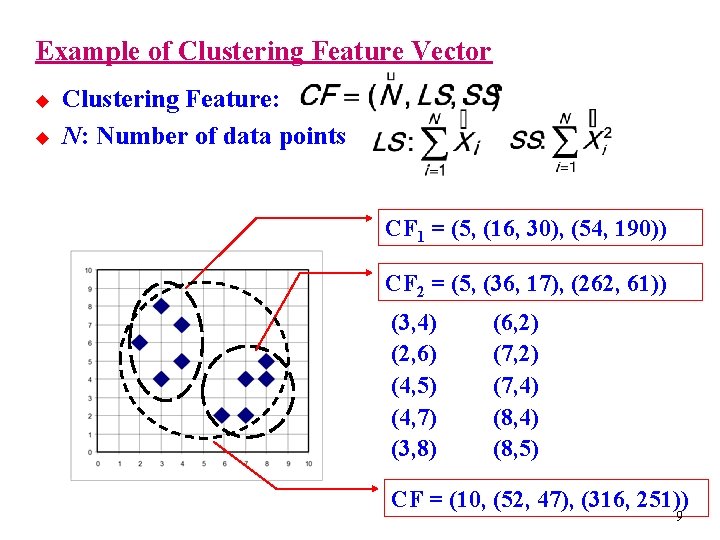
Example of Clustering Feature Vector u u Clustering Feature: N: Number of data points CF 1 = (5, (16, 30), (54, 190)) CF 2 = (5, (36, 17), (262, 61)) (3, 4) (2, 6) (4, 5) (4, 7) (3, 8) (6, 2) (7, 4) (8, 5) CF = (10, (52, 47), (316, 251)) 9
Clustering Feature Tree (CFT) u Clustering feature tree (CFT) is an alternative representation of data set: l l l Each non-leaf node is a cluster comprising sub-clusters corresponding to entries (at most B) in non-leaf node Each leaf node is a cluster comprising sub-clusters corresponding to entries (at most L) in leaf node and each sub-cluster’s diameter is at most T; when T is larger, CFT is smaller Each node must fit a memory page 10
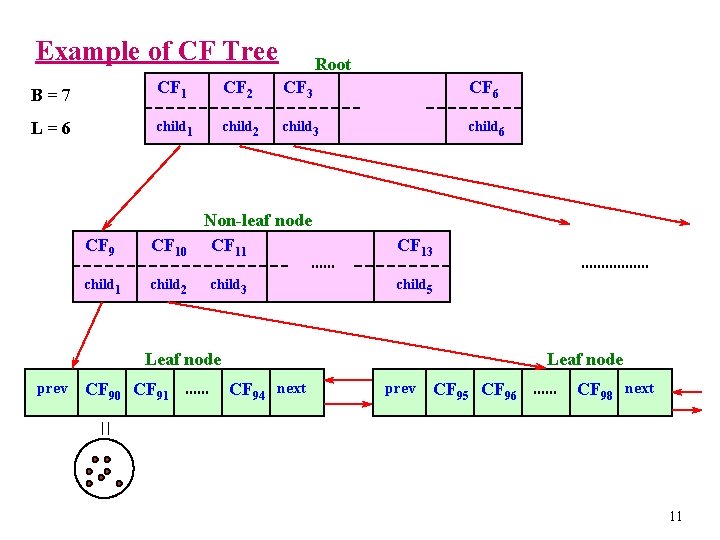
Example of CF Tree Root B=7 CF 1 CF 2 CF 3 CF 6 L=6 child 1 child 2 child 3 child 6 CF 9 CF 10 child 1 child 2 Non-leaf node CF 11 child 3 CF 13 child 5 Leaf node prev CF 90 CF 91 Leaf node CF 94 next prev CF 95 CF 96 CF 98 next 11

BIRCH Phase 1 u u u Phase 1 scans data points and build in-memory CFT; Start from root, traverse down tree to choose closest leaf node for d Search for closest entry Li in leaf node If d can be inserted in Li, then update CF vector of Li Else if node has space to insert new entry, insert; else split node Once inserted, update nodes along path to the root; if there is splitting, need to insert new entry in parent node (which may result in further splitting) 12
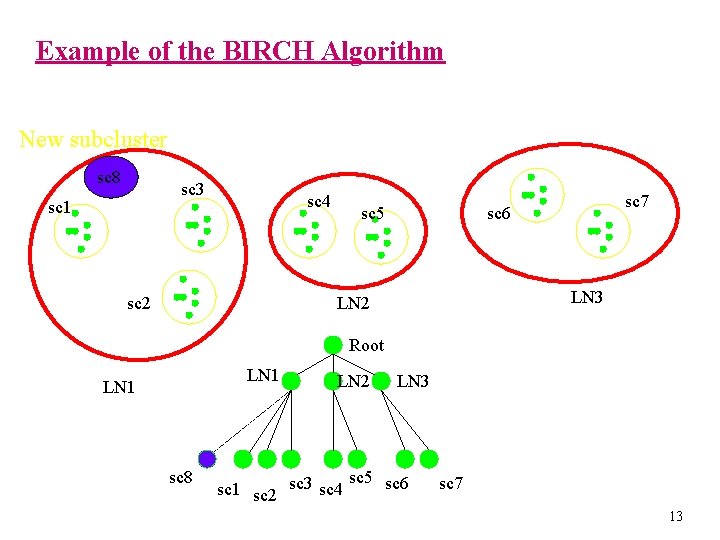
Example of the BIRCH Algorithm New subcluster sc 8 sc 3 sc 1 sc 4 sc 2 sc 5 sc 7 sc 6 LN 3 LN 2 Root LN 1 sc 8 LN 2 LN 3 sc 5 sc 6 sc 1 sc 2 sc 3 sc 4 sc 7 13
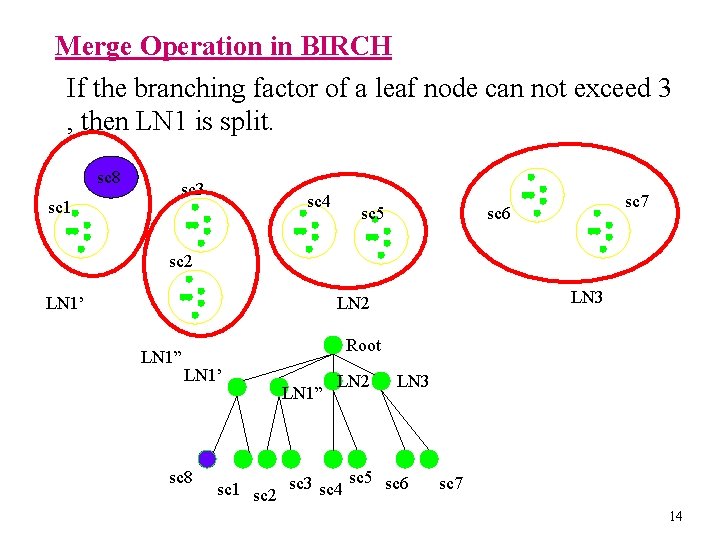
Merge Operation in BIRCH If the branching factor of a leaf node can not exceed 3 , then LN 1 is split. sc 8 sc 1 sc 3 sc 4 sc 5 sc 7 sc 6 sc 2 LN 1’ LN 3 LN 2 LN 1” Root LN 1’ sc 8 LN 1” LN 2 LN 3 sc 5 sc 6 sc 1 sc 2 sc 3 sc 4 sc 7 14

Merge Operation in BIRCH If the branching factor of a non-leaf node can not exceed 3, then the root is split and the height of the CF Tree increases by one. sc 8 sc 1 sc 3 sc 4 sc 5 sc 7 sc 6 sc 2 LN 1’ LN 3 LN 2 Root LN 1” NLN 1’ sc 8 LN 1” sc 2 sc 3 NLN 2 LN 3 sc 5 sc 6 sc 7 15
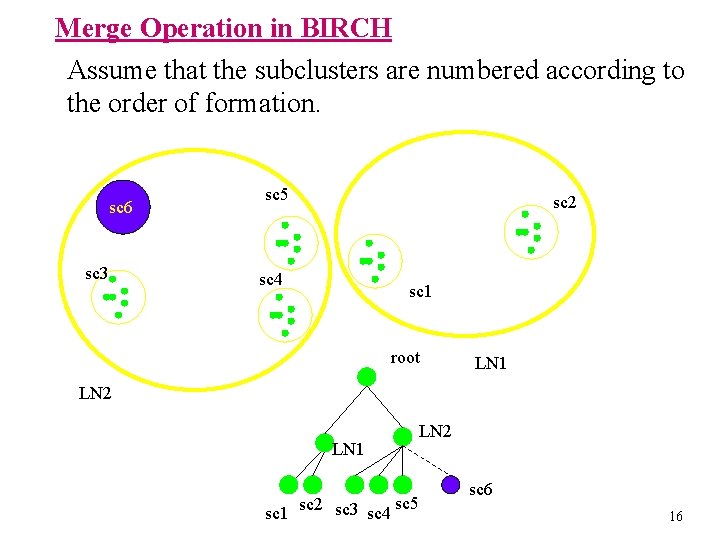
Merge Operation in BIRCH Assume that the subclusters are numbered according to the order of formation. sc 6 sc 3 sc 5 sc 2 sc 4 sc 1 root LN 1 LN 2 LN 1 sc 5 sc 1 sc 2 sc 3 sc 4 LN 2 sc 6 16
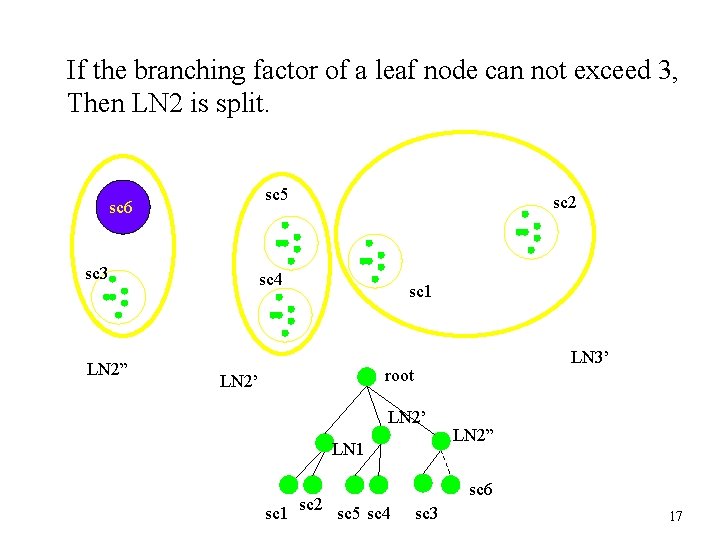
If the branching factor of a leaf node can not exceed 3, Then LN 2 is split. sc 5 sc 6 sc 3 LN 2” sc 2 sc 4 sc 1 LN 3’ root LN 2’ LN 1 sc 2 sc 5 sc 4 LN 2” sc 6 sc 3 17
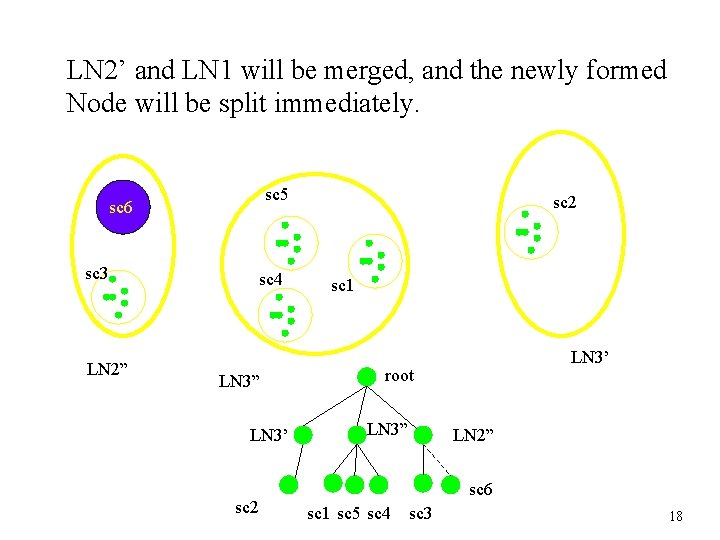
LN 2’ and LN 1 will be merged, and the newly formed Node will be split immediately. sc 5 sc 6 sc 3 LN 2” sc 4 LN 3” LN 3’ sc 2 sc 1 LN 3’ root LN 3” LN 2” sc 6 sc 1 sc 5 sc 4 sc 3 18
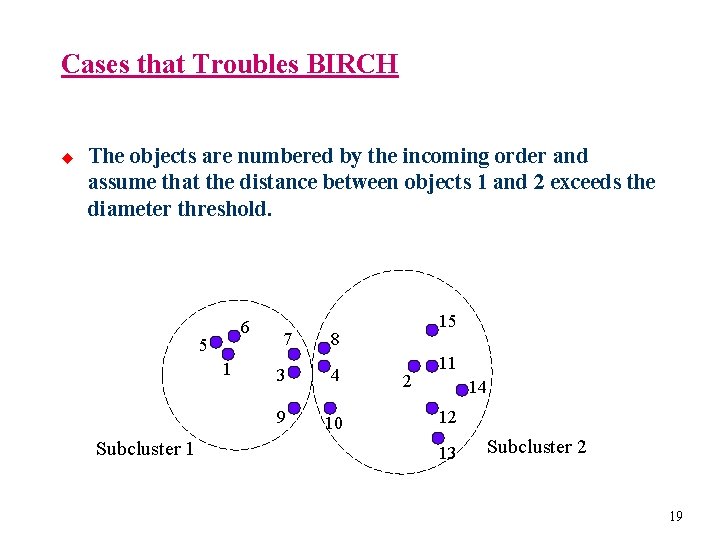
Cases that Troubles BIRCH u The objects are numbered by the incoming order and assume that the distance between objects 1 and 2 exceeds the diameter threshold. 6 5 1 Subcluster 1 7 15 8 3 4 9 10 2 11 14 12 13 Subcluster 2 19
Order Dependence u u Incremental clustering algorithm such as BIRCH suffers order dependence. As the previous example demonstrates, the split and merge operations can alleviate order dependence to certain extent. In the example that demonstrates the merge operation, the split and merge operations together improve clustering quality. However, order dependence can not be completely avoided. If no new objects were added to form subcluster 6, then the clustering quality is not satisfactory. 20
Several Issues with the CF Tree u No of entries in CFT node limited by page size; thus, node may not correspond to natural cluster l l u Two sub-clusters that should be in one cluster are splitted across nodes Two sub-clusters that should not be in one cluster are kept in same node (dependent on input order and skewness) Sensitive to skewed input order l l Data point may end in leaf node where it should not have been If data point is inserted twice at different times, may end up in two copies at two distinct leaf nodes 21
BIRCH Phases X u Phase: Global clustering l l l u Use existing clustering (e. g. , AGNES) algorithm on subclusters at leaf nodes May treat each sub-cluster as a point (its centroid) and perform clustering on these points Clusters produced closer to data distribution pattern Phase: Cluster refinement l l Redistribute (re-label) all data points w. r. t. clusters produced by global clustering This phase may be repeated to improve cluster quality 22
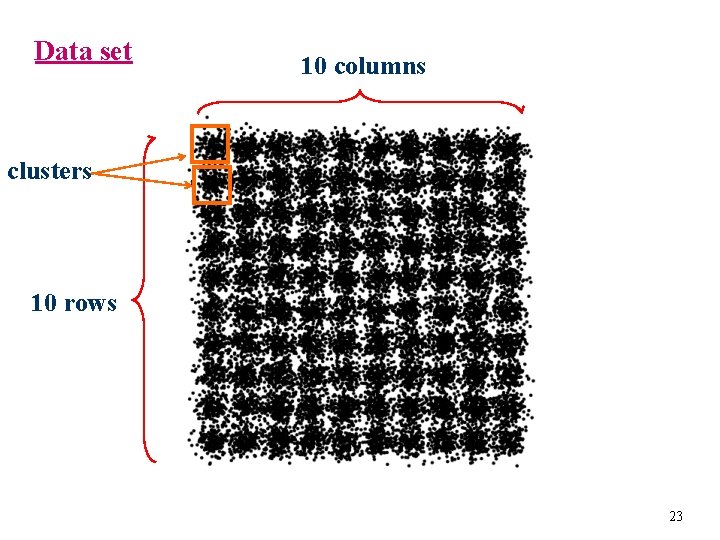
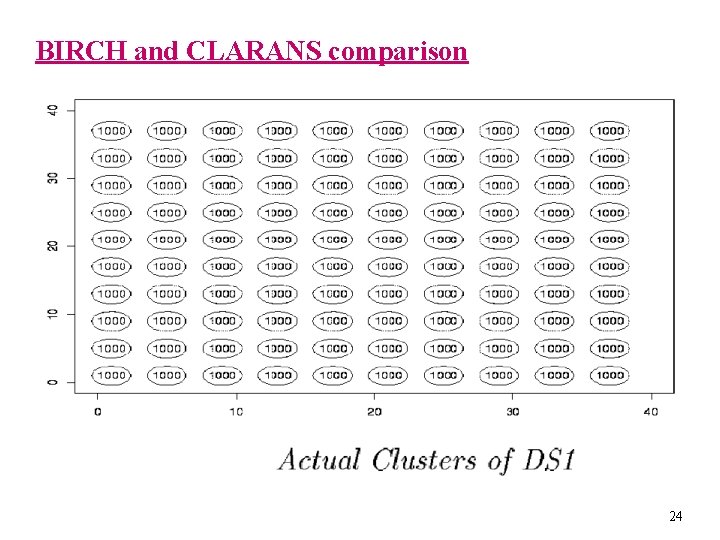
Data set 10 columns clusters 10 rows 23
BIRCH and CLARANS comparison 24
BIRCH and CLARANS comparison 25
BIRCH and CLARANS comparison 26
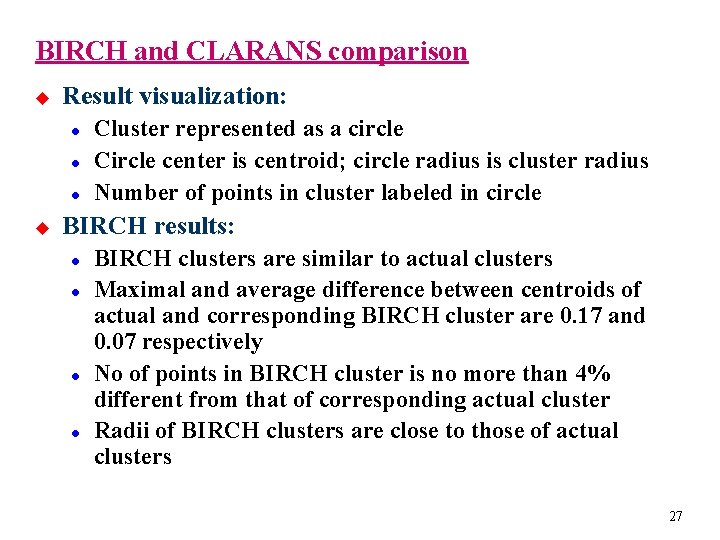
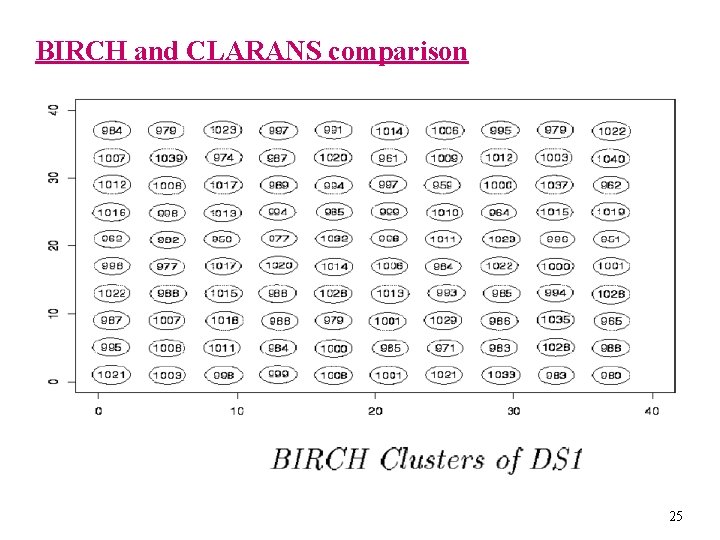
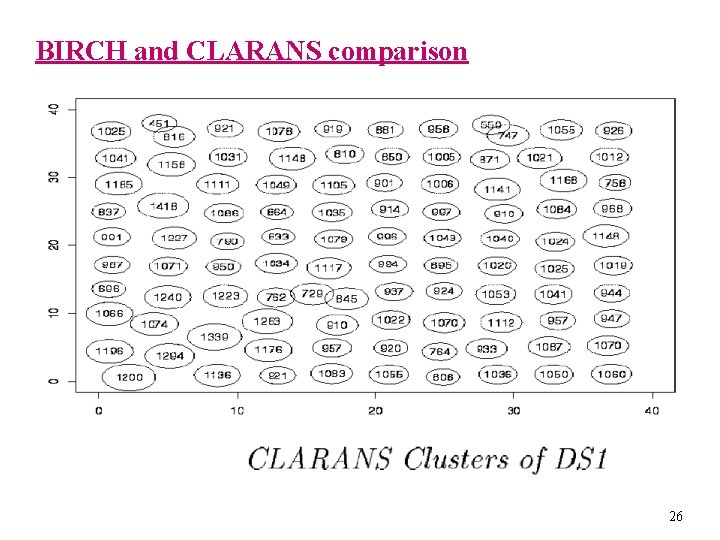
BIRCH and CLARANS comparison u Result visualization: l l l u Cluster represented as a circle Circle center is centroid; circle radius is cluster radius Number of points in cluster labeled in circle BIRCH results: l l BIRCH clusters are similar to actual clusters Maximal and average difference between centroids of actual and corresponding BIRCH cluster are 0. 17 and 0. 07 respectively No of points in BIRCH cluster is no more than 4% different from that of corresponding actual cluster Radii of BIRCH clusters are close to those of actual clusters 27
u CLARANS results: l l l Pattern of location of cluster centers distorted No of data points in a cluster as much as 57% different from that of actual cluster Radii of cluster vary from 1. 15 to 1. 94 w. r. t. avg of 1. 44 28
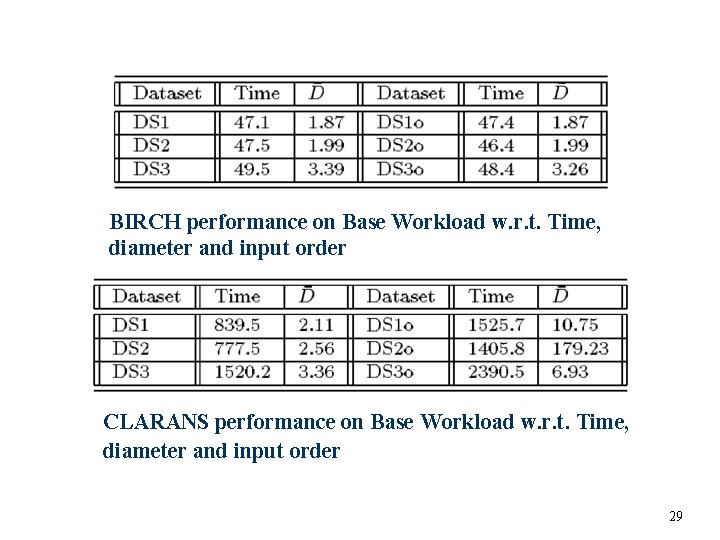
BIRCH performance on Base Workload w. r. t. Time, data set and diameter andinputorder CLARANS performance on Base Workload w. r. t. Time, data set and diameter andinputorder 29
BIRCH and CLARANS comparison u Parameters: l l l u D: average diameter; smaller means better cluster quality Time: time to cluster datasets (in seconds) Order (‘o’): points in the same cluster are placed together in the input data Results: l l l BIRCH took less than 50 secs to cluster 100, 000 data points of each dataset (on an HP 9000 workstation with 80 K memory) Ordering of data points also have no impact CLARANS is at least 15 times slower than BIRCH; when data points are ordered, CLARANS performance degrades 30
- Slides: 30