
Birch An efficient data clustering method for very

Birch: An efficient data clustering method for very large databases By Tian Zhang, Raghu Ramakrishnan Presented by Hung Lai

Outline l l l l What is data clustering Data clustering applications Previous Approaches and problems Birch’s Goal Clustering Feature Birch clustering algorithm Experiment results and conclusion
What is Data Clustering? l l l A cluster is a closely-packed group. A collection of data objects that are similar to one another and treated collectively as a group. Data Clustering is the partitioning of a dataset into clusters

Data Clustering l l Helps understand the natural grouping or structure in a dataset Provided a large set of multidimensional data – – – Data space is usually not uniformly occupied Identify the sparse and crowded places Helps visualization
Some Clustering Applications l l l Biology – building groups of genes with related patterns Marketing – partition the population of consumers to market segments Division of WWW pages into genres. Image segmentations – for object recognition Land use – Identification of areas of similar land use from satellite images Insurance – Identify groups of policy holders with high average claim cost
Data Clustering – previous approaches l l Probability based (Machine learning): make wrong assumption that distributions on attributes are independent on each other Probability representations of clusters are expensive
Approaches Distance Based (statistics) l Must be a distance metric between two items l Assumes that all data points are in memory and can be scanned frequently l Ignores the fact that not all data points are equally important l Close data points are not gathered together l Inspects all data points on multiple iterations These approaches do not deal with dataset and memory size issues!
Clustering parameters l l l Centroid – Euclidian center Radius – average distance to center Diameter – average pair wise difference within a cluster Radius and diameter are measures of the tightness of a cluster around its center. We wish to keep these low.
Clustering parameters l l l Other measurements (like the Euclidean distance of the centroids of two clusters) will measure how far away two clusters are. A good quality clustering will produce high intra-clustering and low interclustering A good quality clustering can help find hidden patterns

Birch’s goals: l l l Minimize running time and data scans, thus formulating the problem for large databases Clustering decisions made without scanning the whole data Exploit the non uniformity of data – treat dense areas as one, and remove outliers (noise)
Clustering Features (CF) l l l CF is a compact storage for data on points in a cluster Has enough information to calculate the intracluster distances Additivity theorem allows us to merge subclusters

Clustering Feature (CF) l l Given N d-dimensional data points in a cluster: {Xi} where i = 1, 2, …, N, CF = (N, LS, SS) N is the number of data points in the cluster, LS is the linear sum of the N data points, SS is the square sum of the N data points.
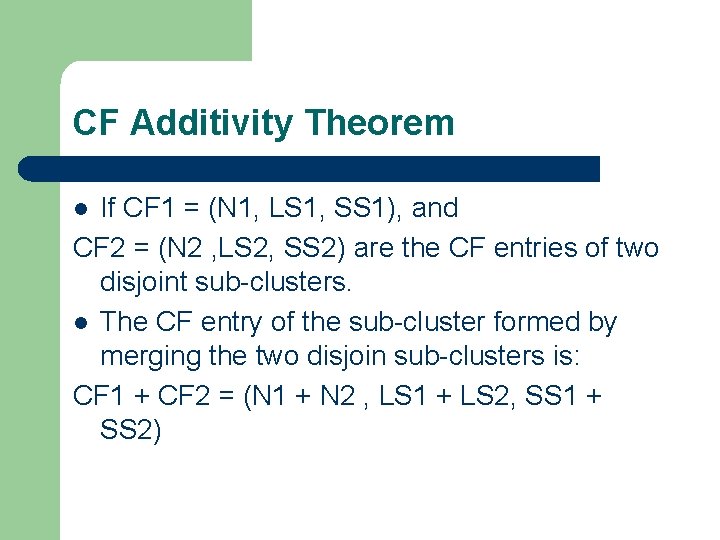
CF Additivity Theorem If CF 1 = (N 1, LS 1, SS 1), and CF 2 = (N 2 , LS 2, SS 2) are the CF entries of two disjoint sub-clusters. l The CF entry of the sub-cluster formed by merging the two disjoin sub-clusters is: CF 1 + CF 2 = (N 1 + N 2 , LS 1 + LS 2, SS 1 + SS 2) l
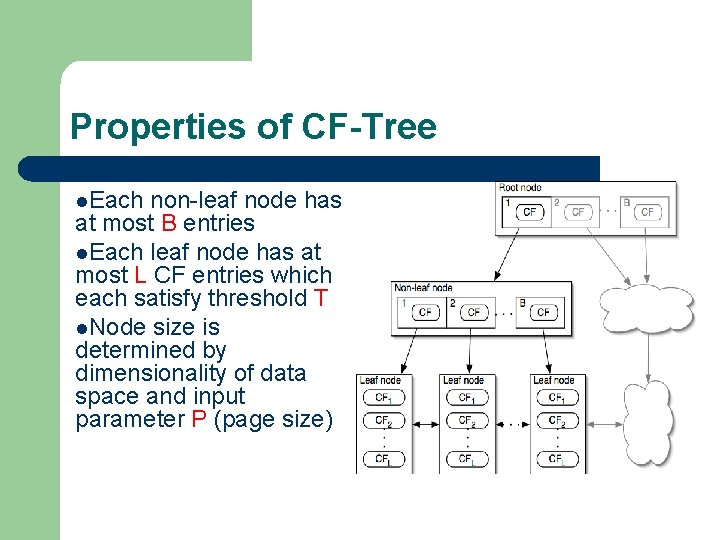
Properties of CF-Tree l. Each non-leaf node has at most B entries l. Each leaf node has at most L CF entries which each satisfy threshold T l. Node size is determined by dimensionality of data space and input parameter P (page size)
CF Tree Insertion l l l Identifying the appropriate leaf: recursively descending the CF tree and choosing the closest child node according to a chosen distance metric Modifying the leaf: test whether the leaf can absorb the node without violating the threshold. If there is no room, split the node Modifying the path: update CF information up the path.
Birch Clustering Algorithm l l Phase 1: Scan all data and build an initial inmemory CF tree. Phase 2: condense into desirable length by building a smaller CF tree. Phase 3: Global clustering Phase 4: Cluster refining – this is optional, and requires more passes over the data to refine the results
Birch – Phase 1 l l Start with initial threshold and insert points into the tree If run out of memory, increase thresholdvalue, and rebuild a smaller tree by reinserting values from older tree and then other values Good initial threshold is important but hard to figure out Outlier removal – when rebuilding tree remove outliers
Birch - Phase 2 l l l Optional Phase 3 sometime have minimum size which performs well, so phase 2 prepares the tree for phase 3. Removes outliers, and grouping clusters.
Birch – Phase 3 l Problems after phase 1: – – l Input order affects results Splitting triggered by node size Phase 3: – – cluster all leaf nodes on the CF values according to an existing algorithm Algorithm used here: agglomerative hierarchical clustering
Birch – Phase 4 l l Optional Do additional passes over the dataset & reassign data points to the closest centroid from phase 3 Recalculating the centroids and redistributing the items. Always converges (no matter how many time phase 4 is repeated)
Experimental Results l Create 3 synthetic data sets for testing – l Also create an ordered copy for testing input order KMEANS and CLARANS require entire data set to be in memory – Initial scan is from disk, subsequent scans are in memory
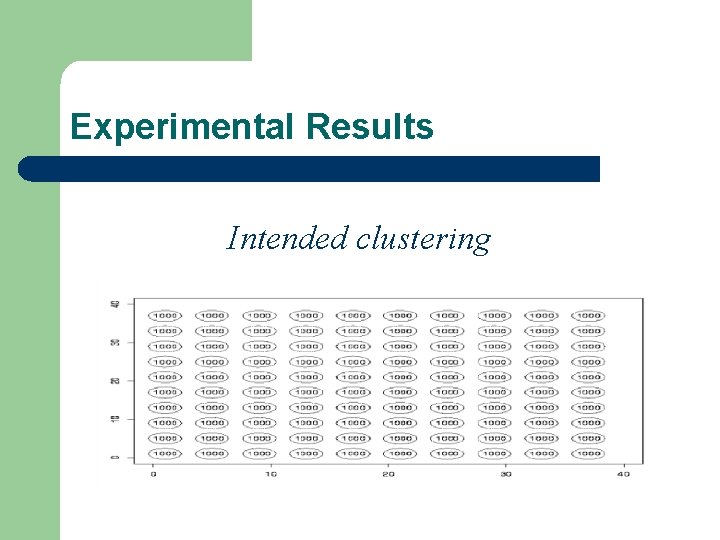
Experimental Results Intended clustering
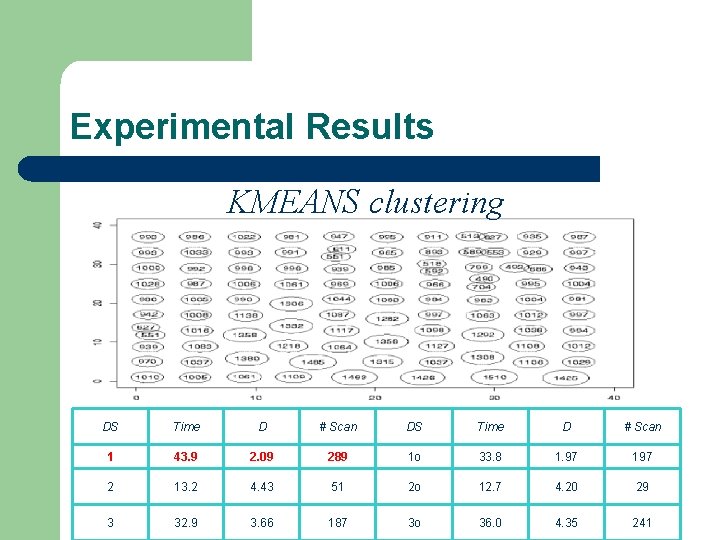
Experimental Results KMEANS clustering DS Time D # Scan 1 43. 9 2. 09 289 1 o 33. 8 1. 97 197 2 13. 2 4. 43 51 2 o 12. 7 4. 20 29 3 32. 9 3. 66 187 3 o 36. 0 4. 35 241
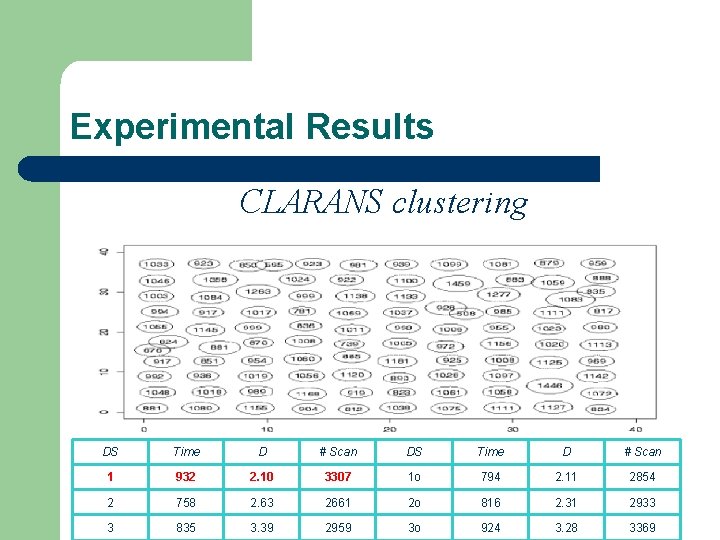
Experimental Results CLARANS clustering DS Time D # Scan 1 932 2. 10 3307 1 o 794 2. 11 2854 2 758 2. 63 2661 2 o 816 2. 31 2933 3 835 3. 39 2959 3 o 924 3. 28 3369
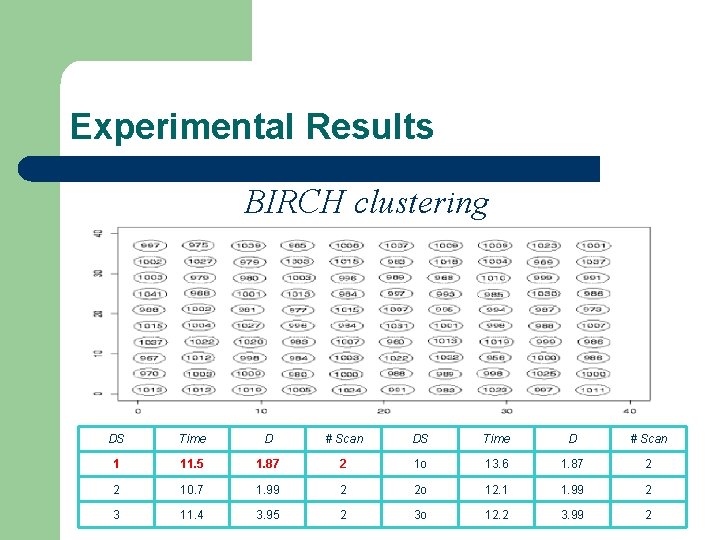
Experimental Results BIRCH clustering DS Time D # Scan 1 11. 5 1. 87 2 1 o 13. 6 1. 87 2 2 10. 7 1. 99 2 2 o 12. 1 1. 99 2 3 11. 4 3. 95 2 3 o 12. 2 3. 99 2
Conclusion l l l Birch performs faster than existing algorithms (CLARANS and KMEANS) on large datasets in Quality, speed, stability and scalability Scans whole data only once Handles outliers better
- Slides: 26