
bipolate A Stata command for bivariate interpolation with
bipolate: A Stata command for bivariate interpolation with particular application to 3 D graphing Joseph Canner, MHS Xuan Hui, MD Sc. M Eric Schneider, Ph. D Johns Hopkins University Stata Conference Boston, MA August 1, 2014
Background • Educational outcome study – Continuous outcome – Two categorical (1 -5) predictors • Panel data – 8 time periods – 285 observations per time period • Researcher desired 3 D plot of outcome versus two predictors
Solution #1: contour
Solution #2: surface*. surface Communication. NEW Edu. NEW COMPSS, xlabel(1/5) ylabel(1/5) * by Adrian Mander, available from SSC

Result
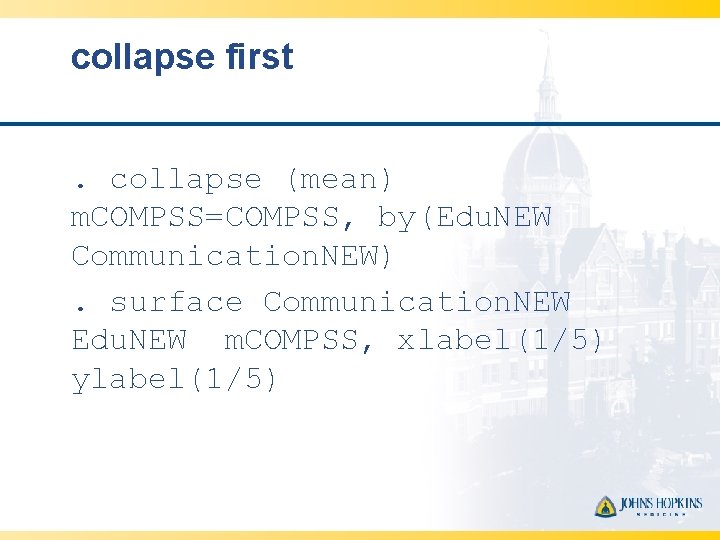
collapse first. collapse (mean) m. COMPSS=COMPSS, by(Edu. NEW Communication. NEW). surface Communication. NEW Edu. NEW m. COMPSS, xlabel(1/5) ylabel(1/5)
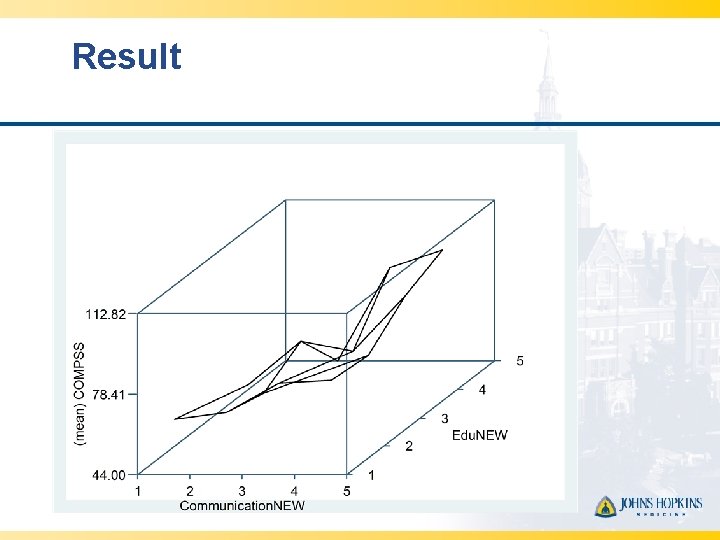
Result
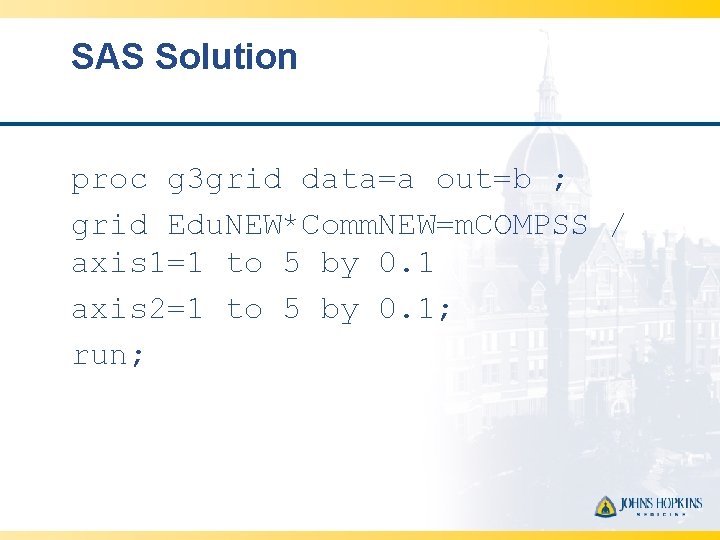
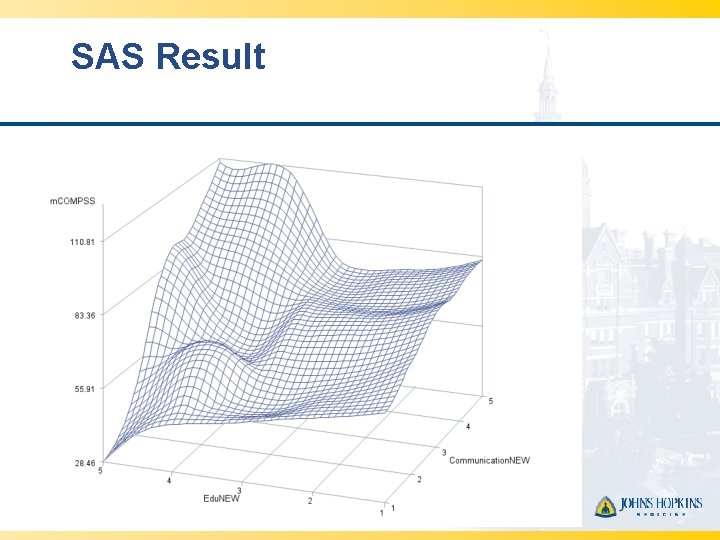
SAS Solution proc g 3 grid data=a out=b ; grid Edu. NEW*Comm. NEW=m. COMPSS / axis 1=1 to 5 by 0. 1 axis 2=1 to 5 by 0. 1; run;
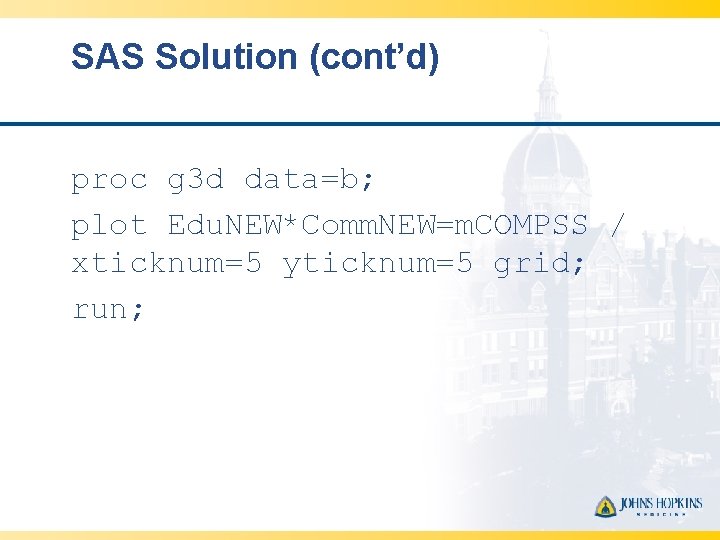
SAS Solution (cont’d) proc g 3 d data=b; plot Edu. NEW*Comm. NEW=m. COMPSS / xticknum=5 yticknum=5 grid; run;
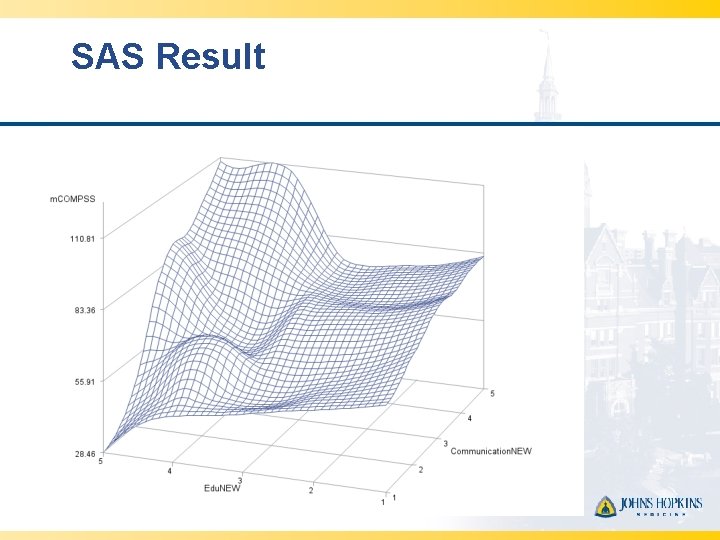
SAS Result
Stata Conference 2013 Wishes and grumbles session: no plans to implement 3 D graphing
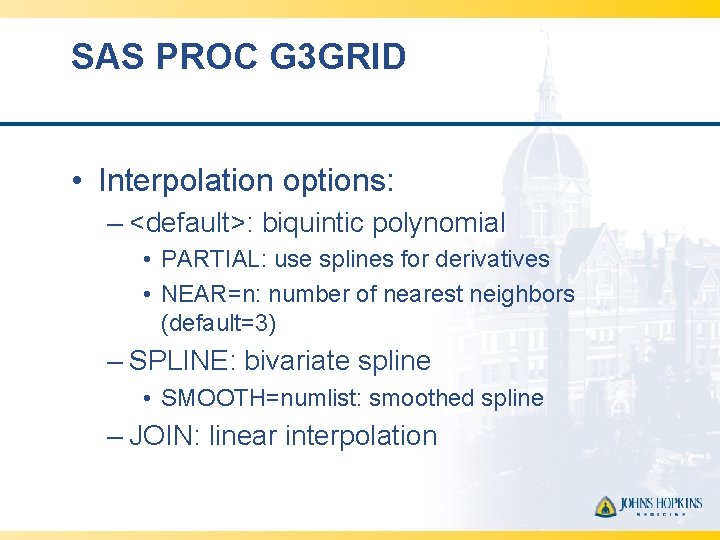
SAS PROC G 3 GRID • Interpolation options: – <default>: biquintic polynomial • PARTIAL: use splines for derivatives • NEAR=n: number of nearest neighbors (default=3) – SPLINE: bivariate spline • SMOOTH=numlist: smoothed spline – JOIN: linear interpolation
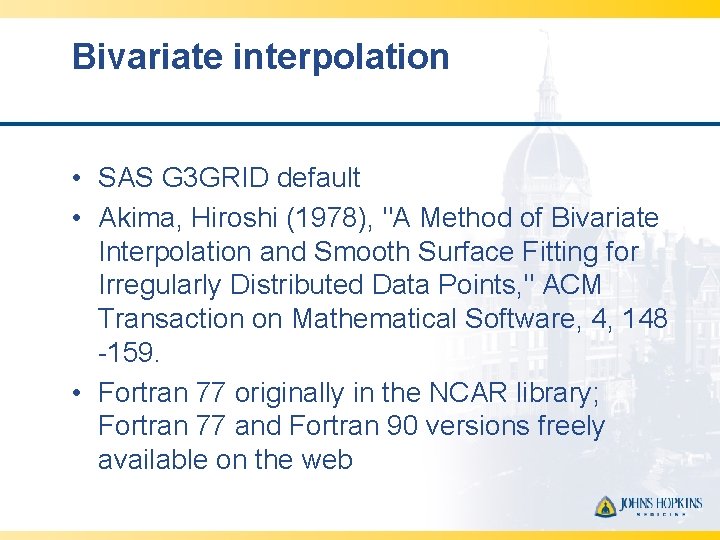
Bivariate interpolation • SAS G 3 GRID default • Akima, Hiroshi (1978), "A Method of Bivariate Interpolation and Smooth Surface Fitting for Irregularly Distributed Data Points, " ACM Transaction on Mathematical Software, 4, 148 -159. • Fortran 77 originally in the NCAR library; Fortran 77 and Fortran 90 versions freely available on the web

History “The original version of BIVAR was written by Hiroshi Akima in August 1975 and rewritten by him in late 1976. It was incorporated into NCAR's public software libraries in January 1977. In August 1984 a new version of BIVAR, incorporating changes described in the Rocky Mountain Journal of Mathematics article cited below, was obtained from Dr. Akima by Michael Pernice of NCAR's Scientific Computing Division, who evaluated it and made it available in February, 1985. ” Ref: Hiroshi Akima, On Estimating Partial Derivatives for Bivariate Interpolation of Scattered Data, Rocky Mountain Journal of Mathematics, Volume 14, Number 1, Winter 1984.
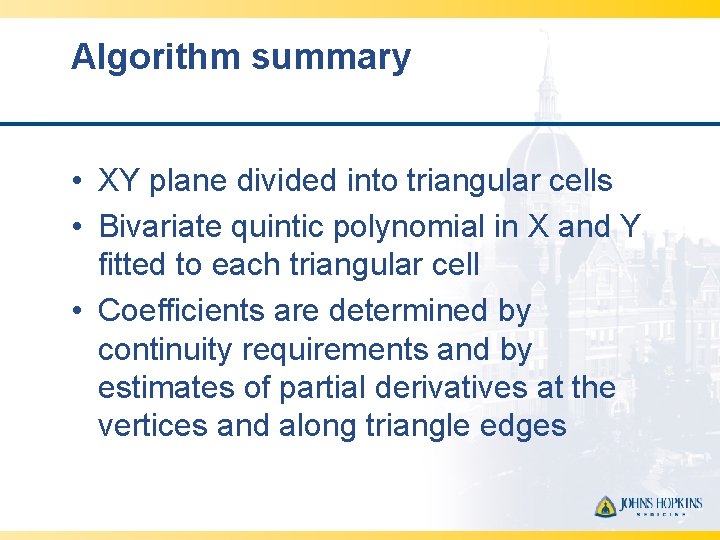
Algorithm summary • XY plane divided into triangular cells • Bivariate quintic polynomial in X and Y fitted to each triangular cell • Coefficients are determined by continuity requirements and by estimates of partial derivatives at the vertices and along triangle edges
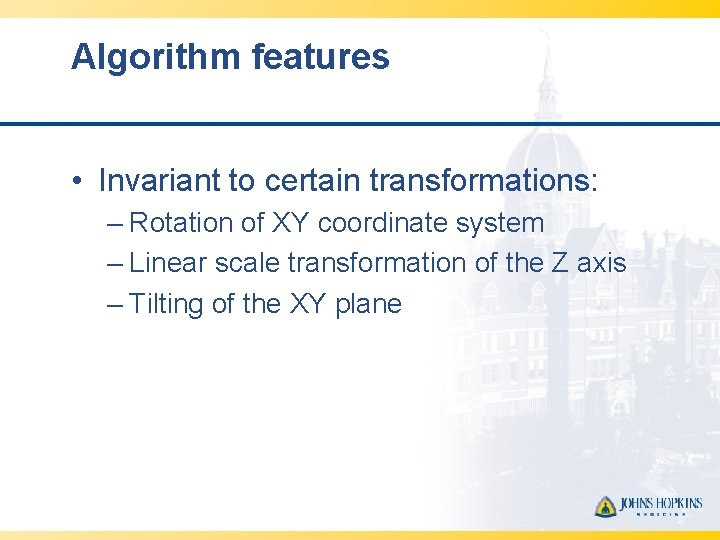
Algorithm features • Invariant to certain transformations: – Rotation of XY coordinate system – Linear scale transformation of the Z axis – Tilting of the XY plane
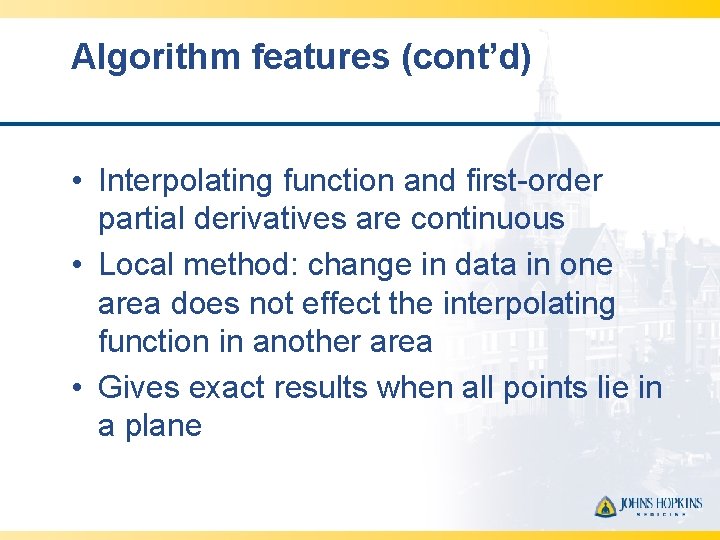
Algorithm features (cont’d) • Interpolating function and first-order partial derivatives are continuous • Local method: change in data in one area does not effect the interpolating function in another area • Gives exact results when all points lie in a plane
![bipolate command Syntax: bipolate xvar yvar zvar [if] [in] [using] [, options]](http://slidetodoc.com/presentation_image_h2/06f5d7a4253978db65adb3ea5d912db4/image-18.jpg "bipolate command Syntax: bipolate xvar yvar zvar [if] [in] [using] [, options]")
bipolate command Syntax: bipolate xvar yvar zvar [if] [in] [using] [, options]
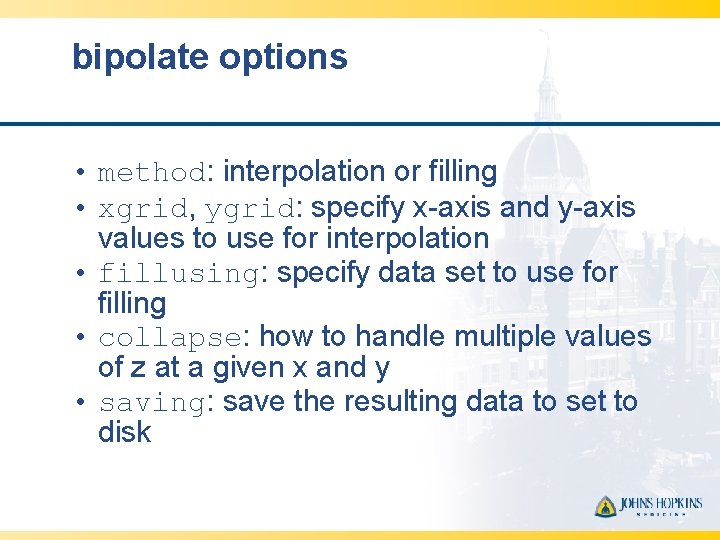
bipolate options • method: interpolation or filling • xgrid, ygrid: specify x-axis and y-axis values to use for interpolation • fillusing: specify data set to use for filling • collapse: how to handle multiple values of z at a given x and y • saving: save the resulting data to set to disk
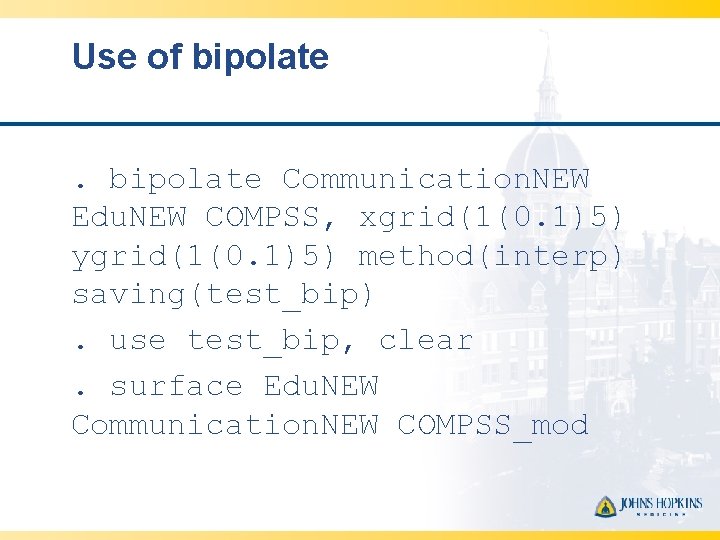
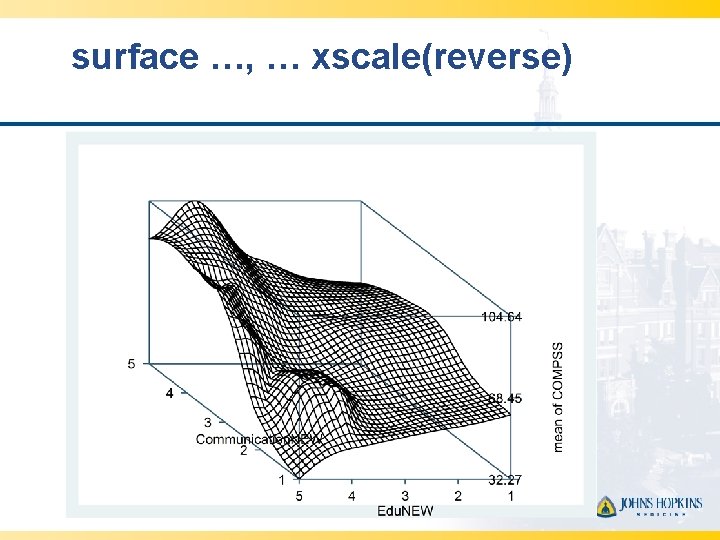
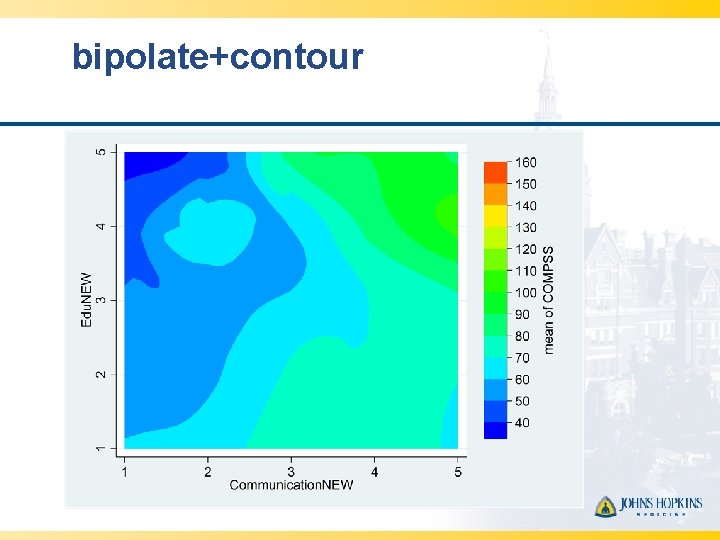
Use of bipolate Communication. NEW Edu. NEW COMPSS, xgrid(1(0. 1)5) ygrid(1(0. 1)5) method(interp) saving(test_bip). use test_bip, clear. surface Edu. NEW Communication. NEW COMPSS_mod
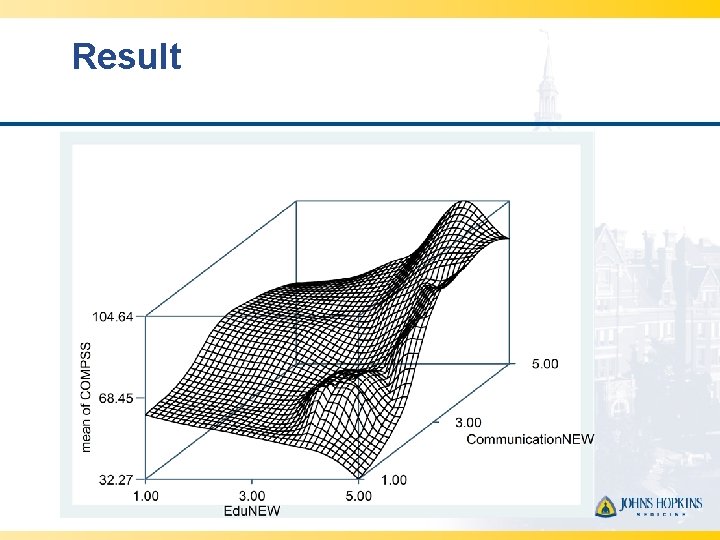
Result
SAS Result
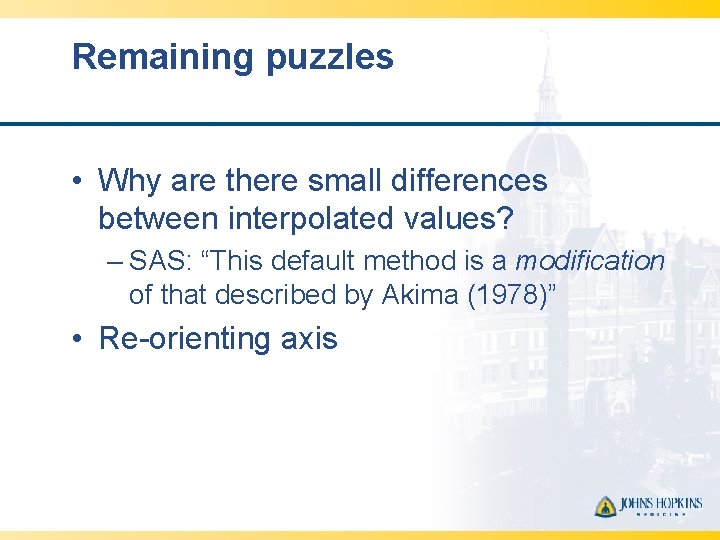
Remaining puzzles • Why are there small differences between interpolated values? – SAS: “This default method is a modification of that described by Akima (1978)” • Re-orienting axis
surface …, … xscale(reverse)
bipolate+contour
Future plans • Make available on SSC within a few weeks • Test other data sets • Testing and debugging by Stata community
Cobar Mine Data
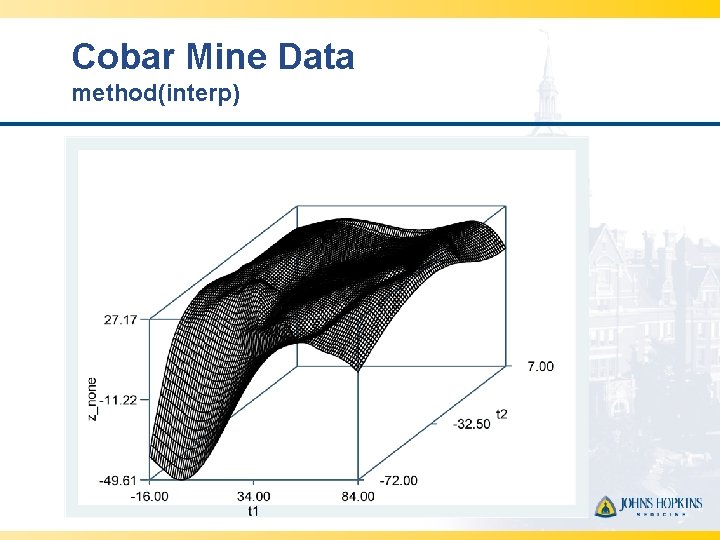
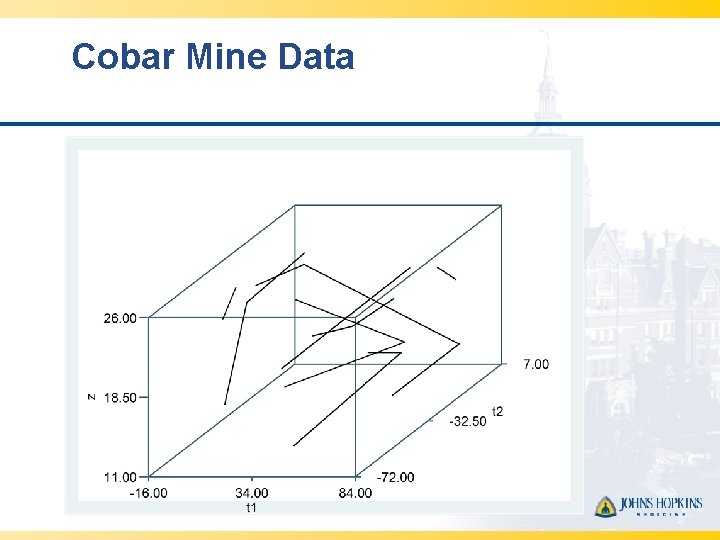
Cobar Mine Data method(interp)
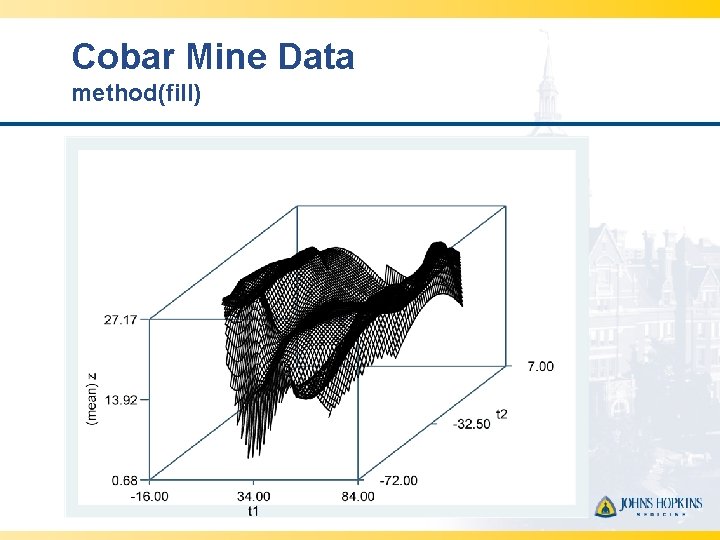
Cobar Mine Data method(fill)
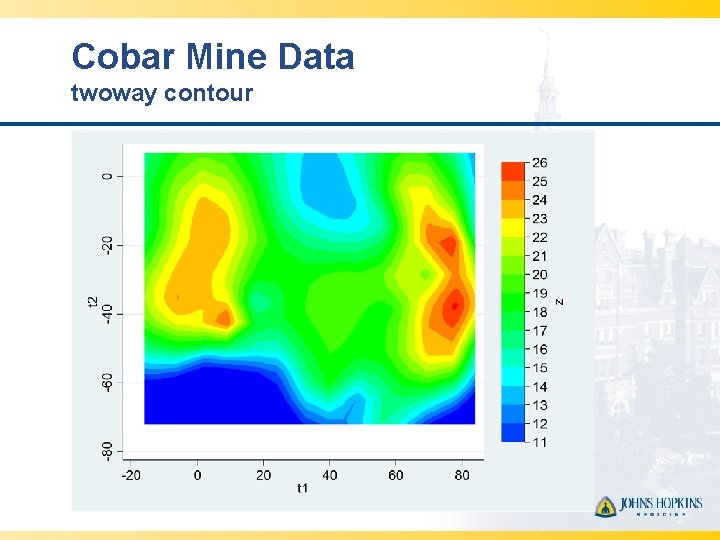
Cobar Mine Data twoway contour
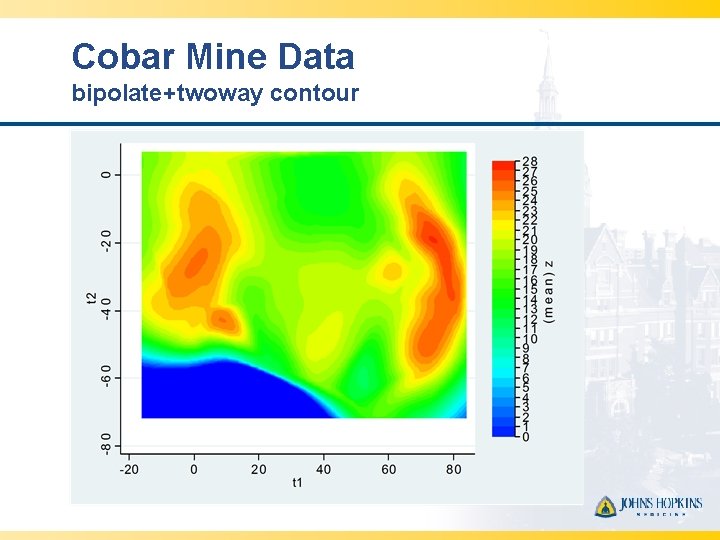
Cobar Mine Data bipolate+twoway contour
Possible Future Enhancements • Implement partial and near options • Implement scale/noscale option • Implement spline and smooth spline interpolation • See if Mata has functions that can reproduce the algorithm more compactly
- Slides: 32