
Bipolar Junction Transistor Presented By Michael Chiartano Nomer

Bipolar Junction Transistor Presented By Michael Chiartano Nomer Alinas Matt Johnson

Introduction Bipolar Junction Transistor Active devices used in amplification, switching etc. DC biasing determines the operating point of the device and its performance characteristics
Objective Design a BJT amplifier to have a gain of 7 Simulate, debug and verify in laboratory experiment Determine the gain, input resistance, output resistance and frequency bandwidth of the amplifier Use Pspice simulation Physical measurement

Required Equipment 2 N 3904 Transistor Resistors Breadboard Multimeter Pulse Generator 10 v Power Supply
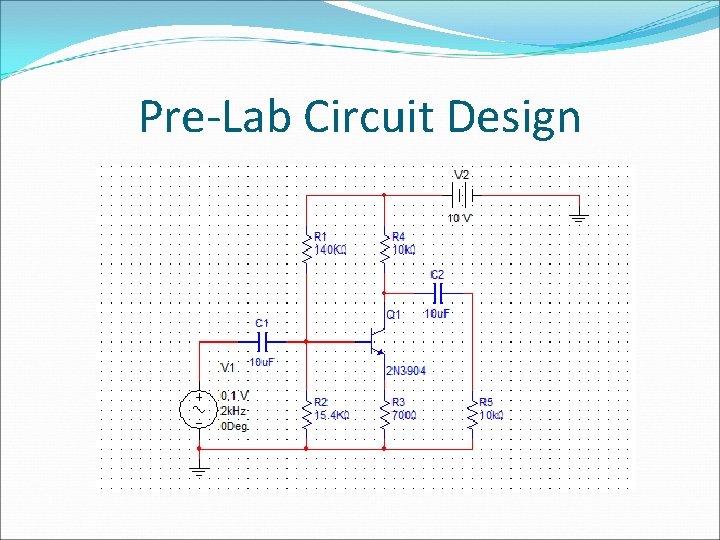
Pre-Lab Circuit Design
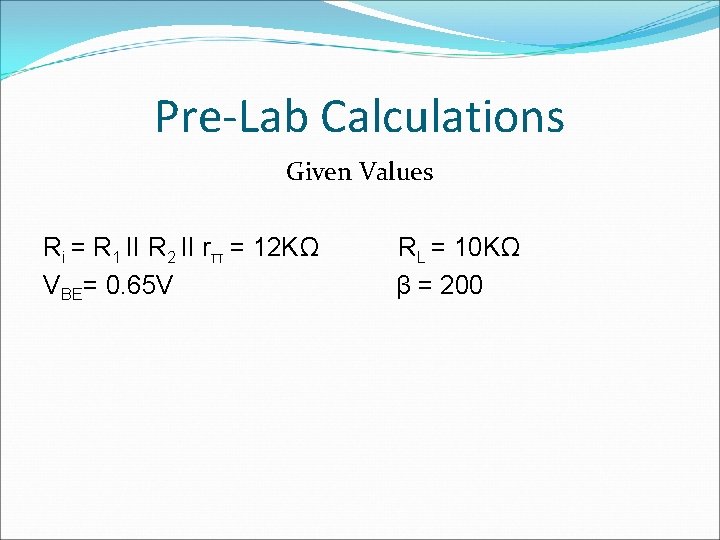
Pre-Lab Calculations Given Values Ri = R 1 II R 2 II rπ = 12 KΩ VBE= 0. 65 V RL = 10 KΩ β = 200
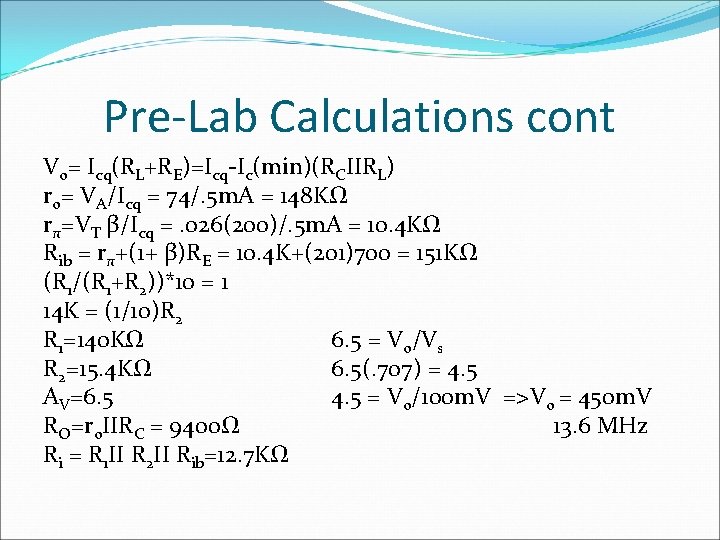
Pre-Lab Calculations cont Vo= Icq(RL+RE)=Icq-Ic(min)(RCIIRL) ro= VA/Icq = 74/. 5 m. A = 148 KΩ rπ=VT β/Icq =. 026(200)/. 5 m. A = 10. 4 KΩ Rib = rπ+(1+ β)RE = 10. 4 K+(201)700 = 151 KΩ (R 1/(R 1+R 2))*10 = 1 14 K = (1/10)R 2 R 1=140 KΩ 6. 5 = Vo/Vs R 2=15. 4 KΩ 6. 5(. 707) = 4. 5 AV=6. 5 4. 5 = Vo/100 m. V =>Vo = 450 m. V RO=ro. IIRC = 9400Ω 13. 6 MHz Ri = R 1 II R 2 II Rib=12. 7 KΩ

Pspice Simulation Results

Pspice Simulation Results

Conclusions How closely did the DC Bias match hand calculations? How closely did the DC Bias match Pspice Simulation? What is the behavior of the circuit as an amplifier? How closely did measurements match specifications?

Conclusions How could you improve the design of the amplifier?
- Slides: 11