
Bipolar Junction Transistor BJT Construction E Emitter Base
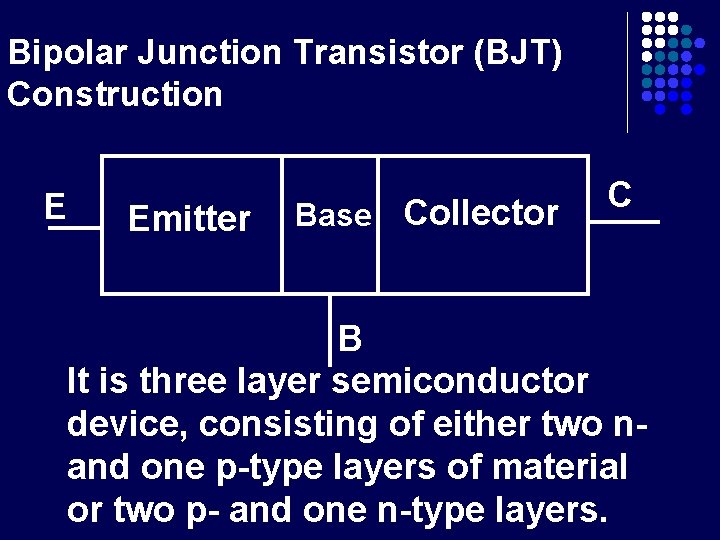
Bipolar Junction Transistor (BJT) Construction E Emitter Base Collector C B It is three layer semiconductor device, consisting of either two nand one p-type layers of material or two p- and one n-type layers.

Bipolar Junction Transistor (BJT) Construction Since three layers are involved in this device, therefore it will have three terminals. These terminals are known as: - 1. Emitter. 2. 2. Base. 3. 3. Collector.

Bipolar Junction Transistor (BJT) Construction Emitter layer is heavily doped. l Base layer is lightly doped. l Collector is very lightly doped. l The base layer is very thin as compared to other two, normally in the range of 150: 1. l
Bipolar Junction Transistor (BJT) Construction The designated terminology for three terminals is as follows: Emitter: This layer emits electrons. Base: It helps minority carriers to transfer rapidly from emitter to collector. Electric field is created in base by non-uniform doping, so that minority carriers are accelerated from emitter to collector. Collector: This layer collects the emitted

Bipolar Junction Transistor Construction Two basic types of BJTs l These types are in equation to constructional arrangement of layers. l The arrangement shown in the figure is called NPN Transistor. l
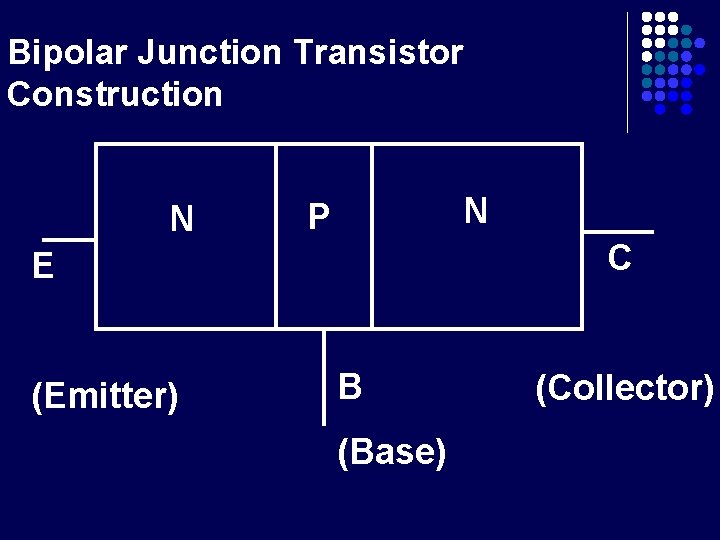
Bipolar Junction Transistor Construction N N P C E (Emitter) B (Base) (Collector)
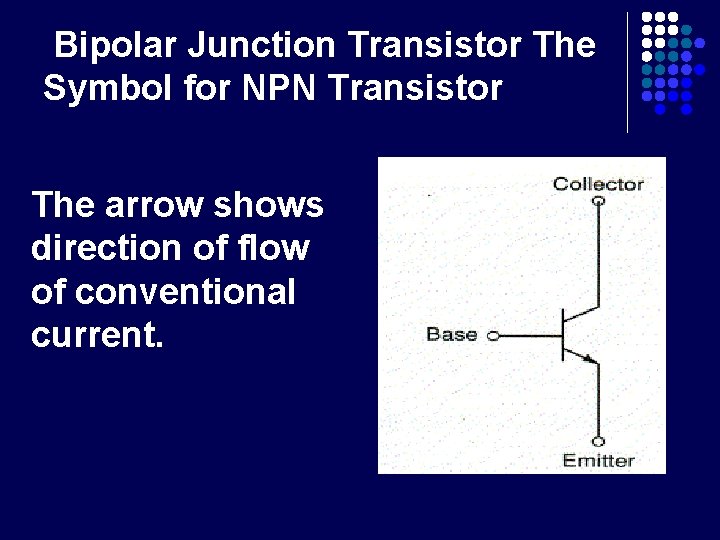
Bipolar Junction Transistor The Symbol for NPN Transistor The arrow shows direction of flow of conventional current.

Bipolar Junction Transistor Construction l E The arrangement is known as PNP transistor. P P N B C

Bipolar Junction Transistor The Symbol for NPN Transistor The arrow shows direction of flow of conventional current.
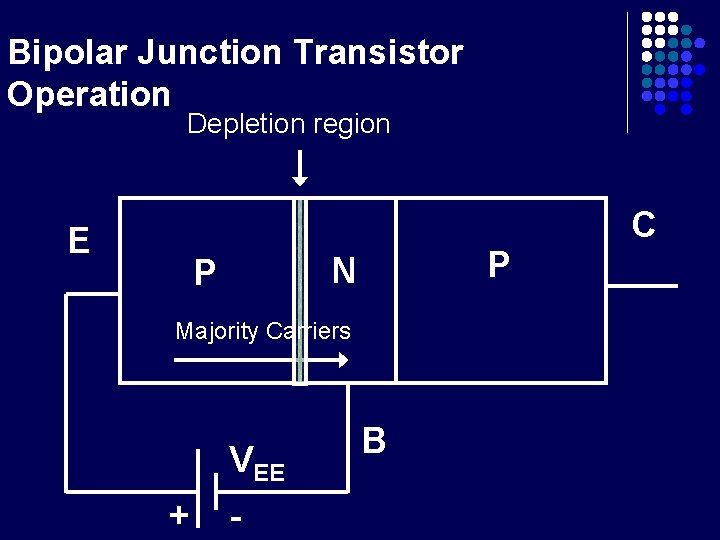
Bipolar Junction Transistor Operation Depletion region E P N P Majority Carriers VEE + - B C
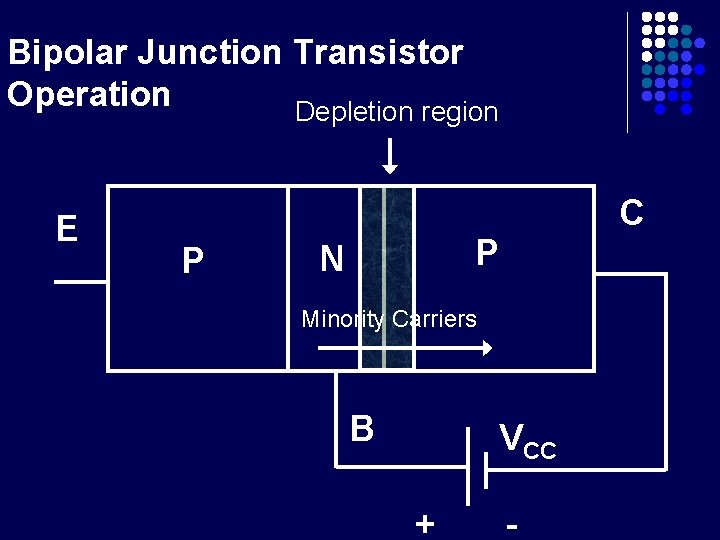
Bipolar Junction Transistor Operation Depletion region E P C P N Minority Carriers B VCC + -

Bipolar Junction Transistor Operation Depletion region E P N P C Minority Carriers IC IE IB B + - VCC + -
OPERATING CONFIGURATIONS OF BJT l 1. 2. 3. There are three basic configurations under which transistor may be operated, these configurations depend upon the situation and requirements. These configurations are called Common Base Configuration. Common Emitter Configuration. Common Collector Configuration.
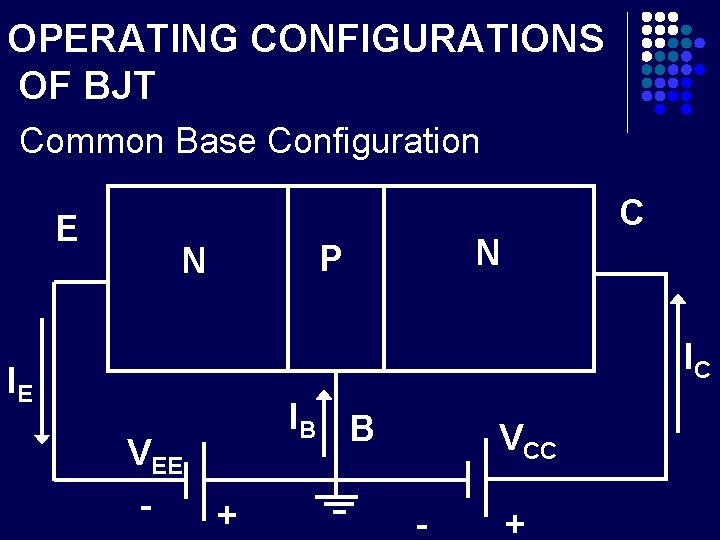
OPERATING CONFIGURATIONS OF BJT Common Base Configuration E N C N P IC IE VEE + IB B VCC - +

OPERATING CONFIGURATIONS OF BJT P N IE IB B VBB - + - E N + Common Emitter Configuration VCC C IC

OPERATING CONFIGURATIONS OF BJT Common Collector Configuration + IE C N P N - E VEE IC IB B VBB + -

Directions of Currents in BJT
MODES OF OPERATION OF BJT l 1. 2. 3. There are three modes of operation for BJT Cut Off Active Saturation
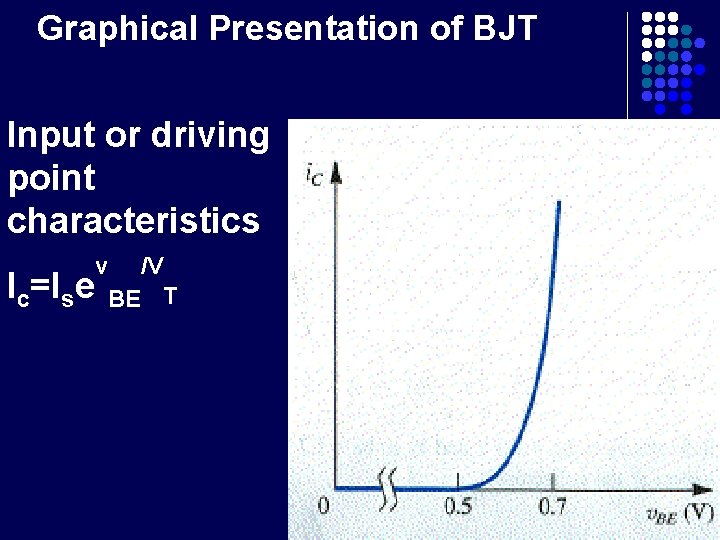
Graphical Presentation of BJT Input or driving point characteristics Ic=Ise v /V BE T
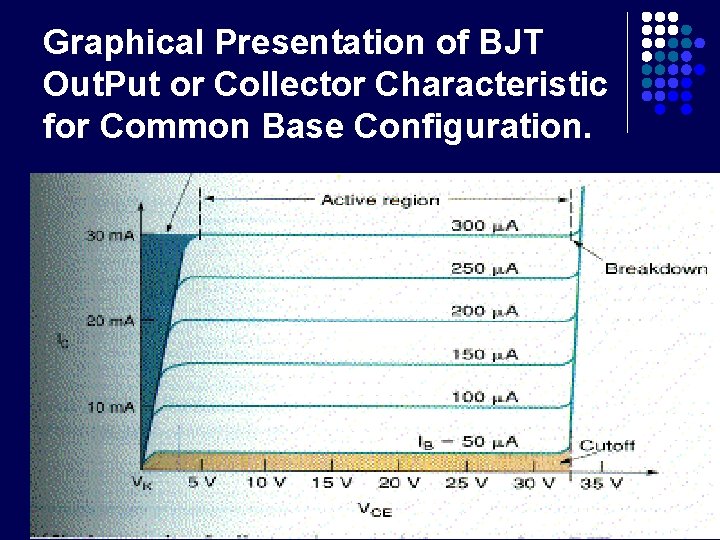
Graphical Presentation of BJT Out. Put or Collector Characteristic for Common Base Configuration.
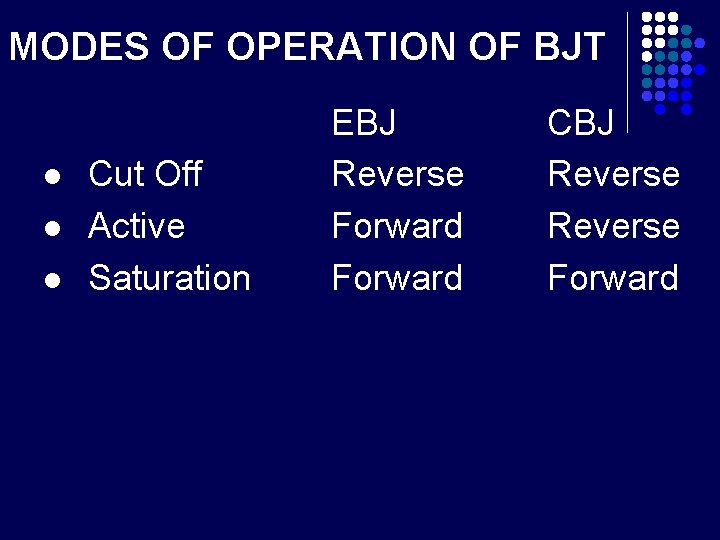
MODES OF OPERATION OF BJT l l l Cut Off Active Saturation EBJ Reverse Forward CBJ Reverse Forward
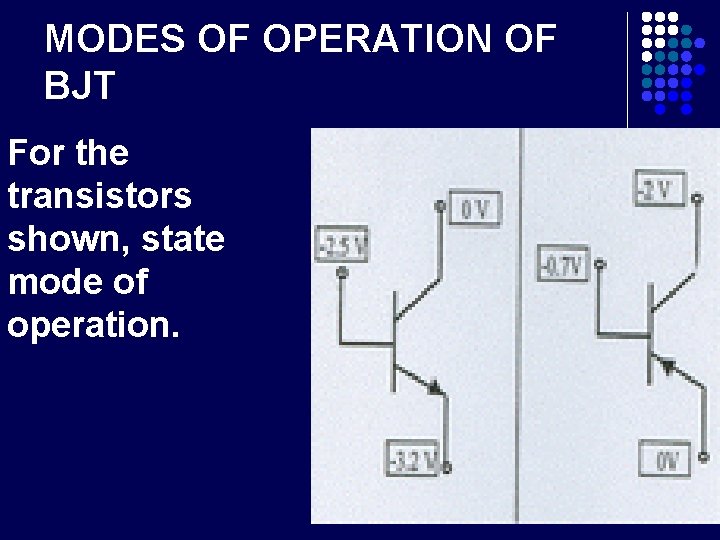
MODES OF OPERATION OF BJT For the transistors shown, state mode of operation.

MODES OF OPERATION OF BJT

MODES OF OPERATION OF BJT
- Slides: 24