
BIPOLAR DISORDER Episodes of mania or hypomania to
BIPOLAR DISORDER Episodes of mania or hypomania to episodes of depression over time. Bipolar disorder type I: at least one manic episode * Forms of Bipolar disorder I: • Single manic episode: no past major depressive or hypomanic episodes • Most recent hypomanic episode : At least one previous manic episode. • Most recent manic episode : at least one previous depressive, hypomanic or manic episode Psychiatric and : Mental Nursing 1 • Most recent depressed episode At. Health least
Onset & Clinical Course of Bipolar 1: - Mean age for the first manic episode is the early 20 years, some experience onset in adolescence & others start older than 50. Manic episodes begin suddenly with rapid escalation of symptoms over a few days, last few weeks to several months. Tend to be briefer and end more suddenly than depressive episodes. Psychiatric and Mental Health Nursing 2
2. Bipolar disorder type II: - At least one hypomanic episode & at least one major depressive episode. - Has never been a manic episode. - Impairment in social, occupational, or other important areas of functioning. **Diagnostic criteria for manic episode: - Period of abnormally and persistently elevated, expansive, or irritable mood, abnormally increased activity or energy. - Lasting at least 1 week (present most of the day) Psychiatric and Mental Health Nursing 3
Diagnostic criteria for manic episode: … cont. * Three (or more) of the following symptoms: 1. Inflated self-esteem or grandiosity. 2. Decreased need for sleep (e. g. , feels rested after only 3 hours of sleep). 3. More talkativeness or pressure to keep talking. 4. Flight of ideas or racing thoughts. 5. Distractibility (loss attention) Psychiatric and Mental Health Nursing 4
6. Increase non goal-directed activity or psychomotor agitation. 7. Excessive involvement in painful activities. (unrestrained buying sprees, or foolish business investments). ** Impairment in social or occupational functioning or necessitate hospitalization or there are psychotic features. * Episode not related to the physiological or medical condition. Psychiatric and Mental Health Nursing 5
**Diagnostic criteria for hypomanic episode: - Distinct period of abnormally and persistently elevated, expansive, or irritable mood, at least 4 consecutive days (most of the day) * Three (or more) of the following symptoms: 1. Inflated self-esteem or grandiosity. 2. Decreased need for sleep (e. g. , feels rested after only 3 sleeping hours). 3. More talkativeness or pressure to Psychiatric and Mental Health Nursing 6
Diagnostic criteria for hypomanic episode: . . cont. 4. Flight of ideas or thoughts are racing. 5. Distractibility (reported or observed). 6. Increase in goal-directed activity, or psychomotor agitation. 7. Excessive involvement in painful activities e. g. unrestrained buying sprees. Psychiatric and Mental Health Nursing 7
Diagnostic criteria for hypomanic episode: . . cont. * Episode is associated with Mood disturbance &functioning changes observable by others. * Episode not severe enough to cause impairment in social or occupational functioning * Episode not necessitate hospitalization. * Episode not related to the physiological effects of a substance or other medical condition. Psychiatric and Mental Health Nursing 8
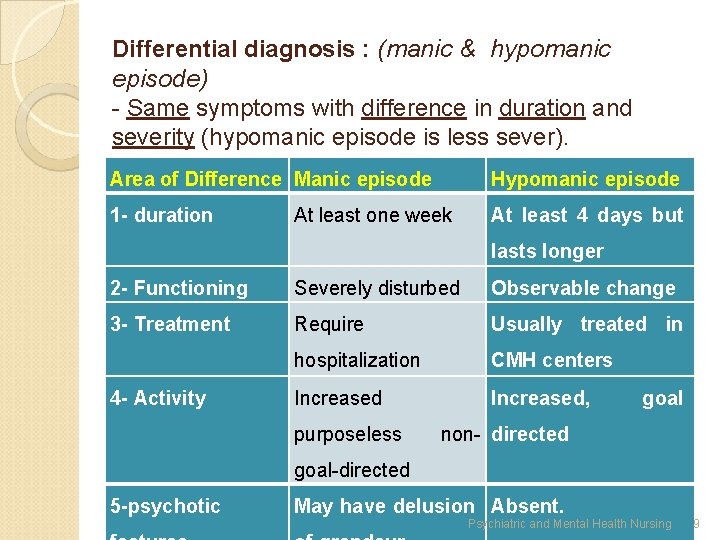
Differential diagnosis : (manic & hypomanic episode) - Same symptoms with difference in duration and severity (hypomanic episode is less sever). Area of Difference Manic episode Hypomanic episode 1 - duration At least 4 days but At least one week lasts longer 2 - Functioning Severely disturbed Observable change 3 - Treatment Require Usually treated in hospitalization CMH centers Increased, 4 - Activity purposeless goal non- directed goal-directed 5 -psychotic May have delusion Absent. Psychiatric and Mental Health Nursing 9
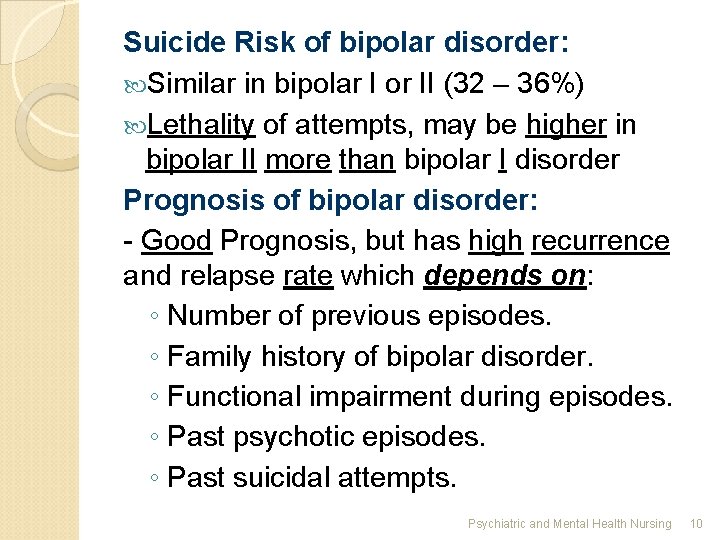
Suicide Risk of bipolar disorder: Similar in bipolar I or II (32 – 36%) Lethality of attempts, may be higher in bipolar II more than bipolar I disorder Prognosis of bipolar disorder: - Good Prognosis, but has high recurrence and relapse rate which depends on: ◦ Number of previous episodes. ◦ Family history of bipolar disorder. ◦ Functional impairment during episodes. ◦ Past psychotic episodes. ◦ Past suicidal attempts. Psychiatric and Mental Health Nursing 10
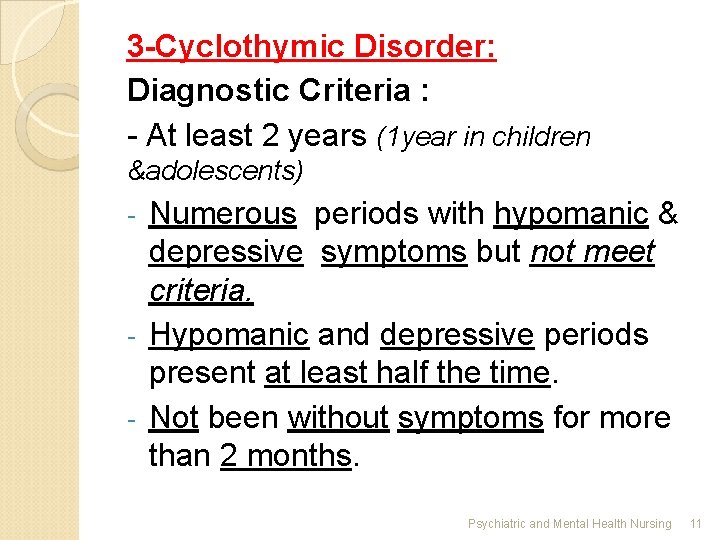
3 -Cyclothymic Disorder: Diagnostic Criteria : - At least 2 years (1 year in children &adolescents) Numerous periods with hypomanic & depressive symptoms but not meet criteria. - Hypomanic and depressive periods present at least half the time. - Not been without symptoms for more than 2 months. - Psychiatric and Mental Health Nursing 11
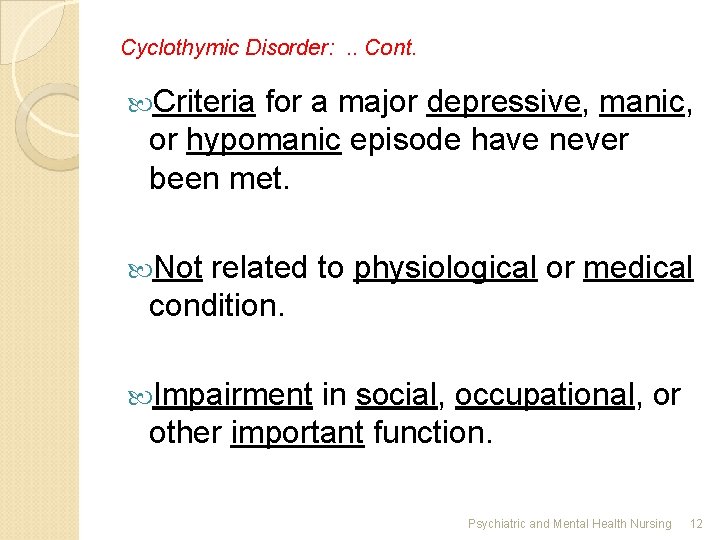
Cyclothymic Disorder: . . Cont. Criteria for a major depressive, manic, or hypomanic episode have never been met. Not related to physiological or medical condition. Impairment in social, occupational, or other important function. Psychiatric and Mental Health Nursing 12
Cyclothymic Disorder: . . Cont. Development and Course: Cyclothymic usually begins in adolescence or early adult life & insidious onset Cyclothymic client has high risk to develop bipolar disorder I or II In Cyclothymic disorder irregular and abrupt mood changes may be within hours. Psychiatric and Mental Health Nursing 13
Bipolar disorder with seasonal pattern Individual may have seasonal manias, but his depressions do not regularly occur at a specific time of year. There has been a regular temporal relationship between onset of manic, or depressive episodes and a particular time of the year (autumn or winter). Psychiatric and Mental Health Nursing 14
Note: Not include seasonally related psychosocial stressors (e. g. being unemployed every winter). Full remissions or change from depression to mania or vice versa, also occur at a characteristic time of the year (e. g. , depression disappears in spring). Psychiatric and Mental Health Nursing 15
*Development/ Course: seasonal pattern In most cases, episodes begin in fall or winter and remit in spring. Seasonal Major depressive episodes often characterized by (high power, hypersomnia, overeating, weight gain, and carbohydrates craving “desire” ). Seasonal pattern appears More in bipolar II disorder than in bipolar I *Manic or hypomanic episodes may be triggered by increased light in Psychiatric and Mental Health Nursing 16
Bipolar disorder with mixed features I. Manic or hypomanic episode, with mixed features: Full criteria of manic or hypomanic episode, & at least three of depression symptoms are present during majority of days of current or most recent mania or hypomania episode. Symptoms for both mania and depression simultaneously, Diagnosis: (manic episode with mixed features), due to marked impairment and clinical severity of full mania. Psychiatric and Mental Health Nursing 17
Bipolar disorder with mixed features. . Cont. 2. Depressive episode, with mixed features: - Major depressive episode, & at least three of manic/hypomanic symptoms are present during majority of days of current or recent depression episode. - Clients have full criteria of mania episode & depression simultaneously. - Diagnosis (manic episode with mixed features). Few of bipolar disorder experience a mixed episode In both, severe Mood disturbance, impair job performance, social activities or relationships, Psychiatric and Mental Health Nursing 18
Treatment of mania A- Pharmacological treatment 1 - Lithium: - Acute mania 1800 -2400, maintenance 900 to 1800 mg/day - Mood stabilizer for mania & depression. - Decreasing norepinephrine and serotonin levels in the body, decreased hyperactivity, and inhibits thyroid hormone release. May take 1– 3 weeks for symptoms to subside, (sedatives required during this period if the client is agitated or Psychiatric and Mental Health Nursing 19
Safety blood level in acute mania (0. 5 - 1. 5 m. Eq/L) Toxicity: levels 2 m. Eq/L (nausea, vomiting, tremors, muscle weakness or twitching, ataxia, drowsiness, confusion, seizures, and coma. - Person must have enough salt and water in his diet to decrease lithium toxicity. - Perspiration, sunbath or flu increase lithium toxicity. Psychiatric and Mental Health Nursing 20
Drug interaction: extreme caution when taking diuretics, ibuprofen & Ikacor because they elevate lithium blood level. Contra indication: can cause birth defects if taken in the first trimester of pregnancy. Side effects: - Tremors and muscle weakness, forgetfulness, nausea, diarrhea, Weight gain, polyuria). Lab tests done to assess functions of (kidneys, heart, thyroid gland Psychiatric and Mental Health Nursing 21
Treatment of mania… cont. 2 - Anticonvulsants: Mood stabilizers in the treatment of bipolar disorder. - Carbamazpine (tegretol), Valporic acid (Depakine), Lamotrigine (Lamictal), Topiramate (Topamax), Gabapentin (Neurontin) Side effects of anticonvulsants: Nausea, vomiting, somnolence, dizziness, diplopia, headache, blood dyscrasias. (abnormal blood constituents structure, - function, or quality as leukemia /hemophilia Psychiatric and Mental Health Nursing 22
Treatment of mania… cont. 3 -Benzodiazpines: - Diazepam (Assival), Clonazepam (Clonex), (sedative for irritability or agitation, & sleep regulation). 4 - Antipsychotics: - (Largactil, Halidol, Liponex): (Relieve delusions, hallucination, agitated or aggressive behavior) Psychiatric and Mental Health Nursing 23
Treatment of Mania. . Cont. B-PSYCHOTHERAPY: - Not useful during acute manic stages because brief attention span and little insight. * Psychotherapy combined with medication can: - reduce risk of homicide, suicide and injury. - provide support to client and family - Help client to accept his diagnosis & treatment plan. - NB. Murder–suicide: an act in which an individual kills one or more other persons immediately before Psychiatric and Mental Health Nursing 24
- Slides: 24