
Bipartite Modular Multiplication Marcelo E Kaihara and Naofumi

Bipartite Modular Multiplication Marcelo E. Kaihara and Naofumi Takagi Department of Information Engineering Nagoya University
Outline Background and Objective Preliminaries Ordinary Modular Multiplication n Montgomery Multiplication n New Method Hardware Implementation Summary

Background and Objective Modular Multiplication n Basic operation in public-key cryptographic applications. Fast method required n n Operation with large integers (huge amount of computation) A fast method enables: The use of larger keys and real time decryption. Develop fast method for calculating modular multiplication
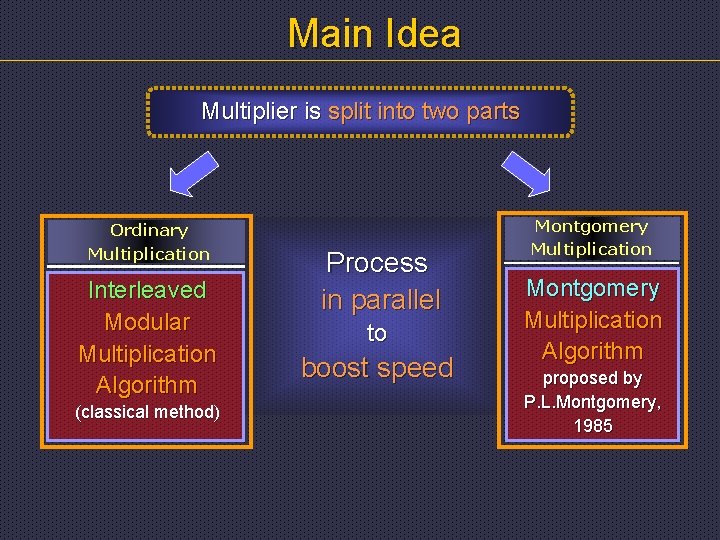
Main Idea Multiplier is split into two parts Ordinary Multiplication Interleaved Modular Multiplication Algorithm (classical method) Process in parallel to boost speed Montgomery Multiplication Algorithm proposed by P. L. Montgomery, 1985
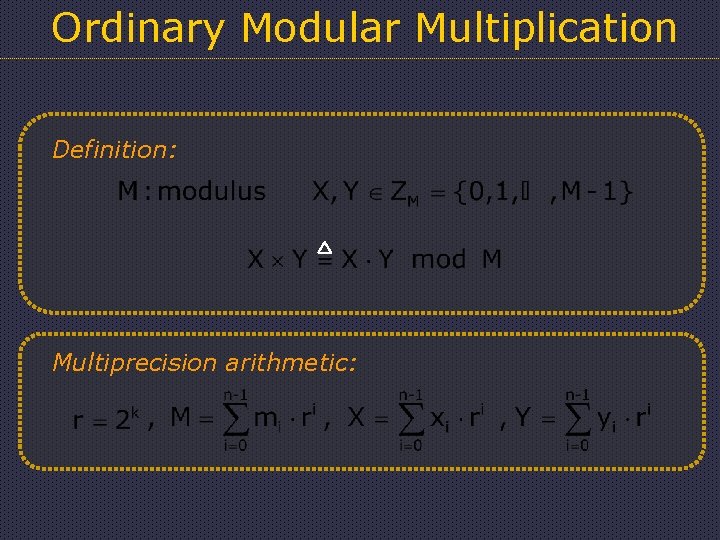
Ordinary Modular Multiplication Definition: Multiprecision arithmetic:
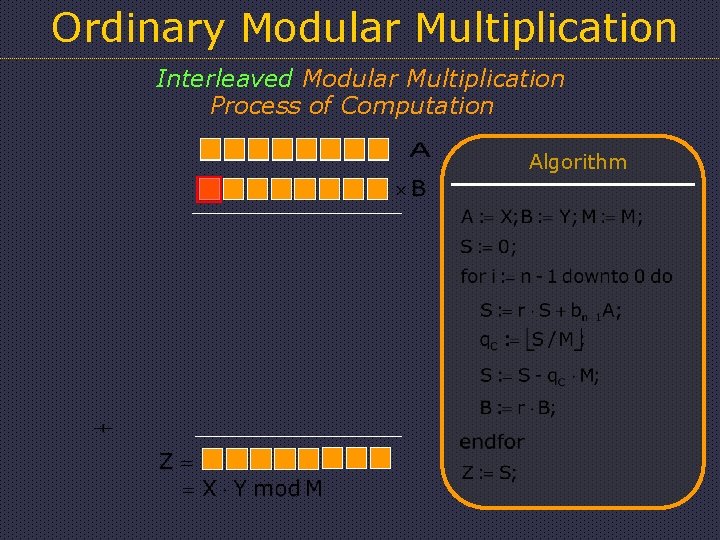
Ordinary Modular Multiplication Interleaved Modular Multiplication Process of Computation Algorithm
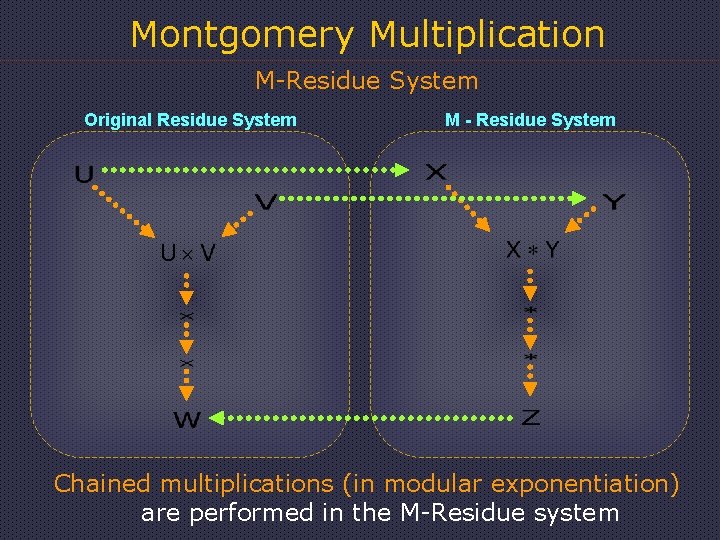
Montgomery Multiplication M-Residue System Original Residue System M - Residue System Chained multiplications (in modular exponentiation) are performed in the M-Residue system
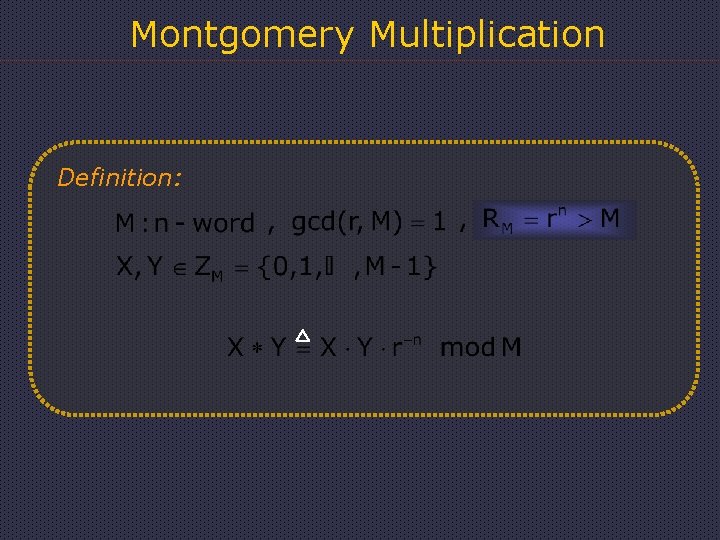
Montgomery Multiplication Definition:
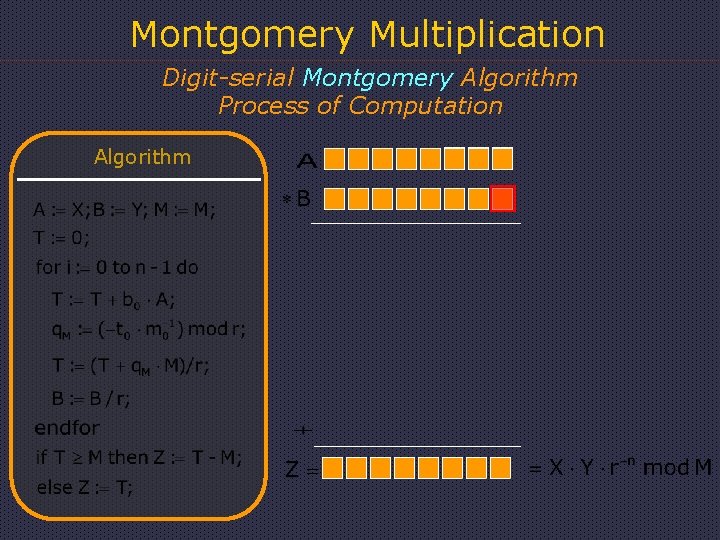
Montgomery Multiplication Digit-serial Montgomery Algorithm Process of Computation Algorithm
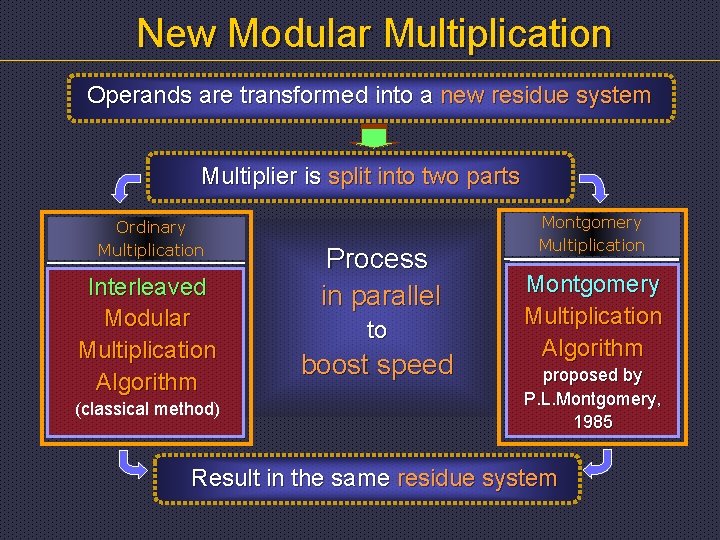
New Modular Multiplication Operands are transformed into a new residue system Multiplier is split into two parts Ordinary Multiplication Interleaved Modular Multiplication Algorithm (classical method) Process in parallel to boost speed Montgomery Multiplication Algorithm proposed by P. L. Montgomery, 1985 Result in the same residue system
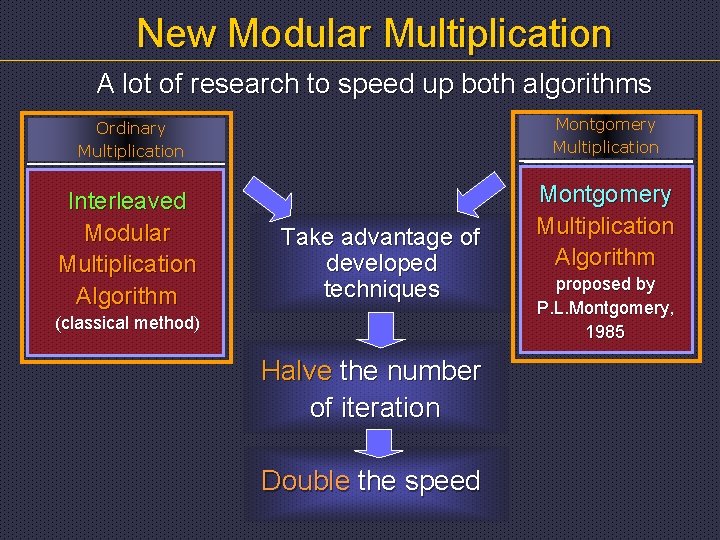
New Modular Multiplication A lot of research to speed up both algorithms Ordinary Multiplication Montgomery Multiplication Interleaved Modular Multiplication Algorithm Montgomery Multiplication Algorithm Take advantage of developed techniques (classical method) Halve the number of iteration Double the speed proposed by P. L. Montgomery, 1985
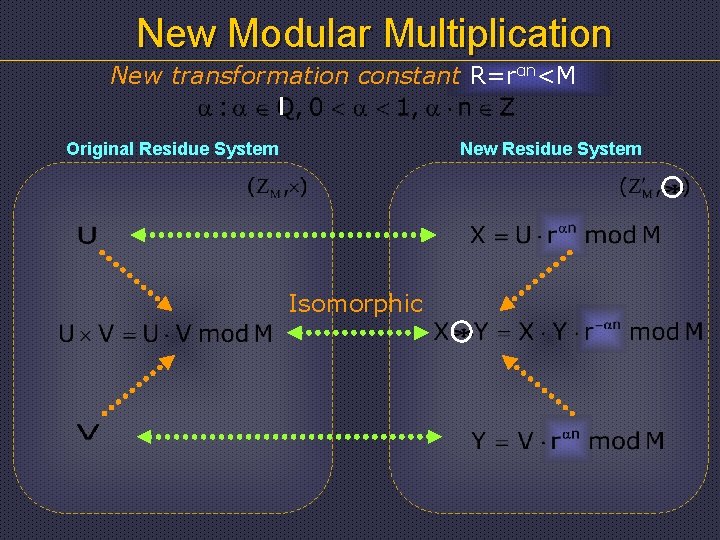
New Modular Multiplication New transformation constant R=rαn<M Original Residue System New Residue System Isomorphic
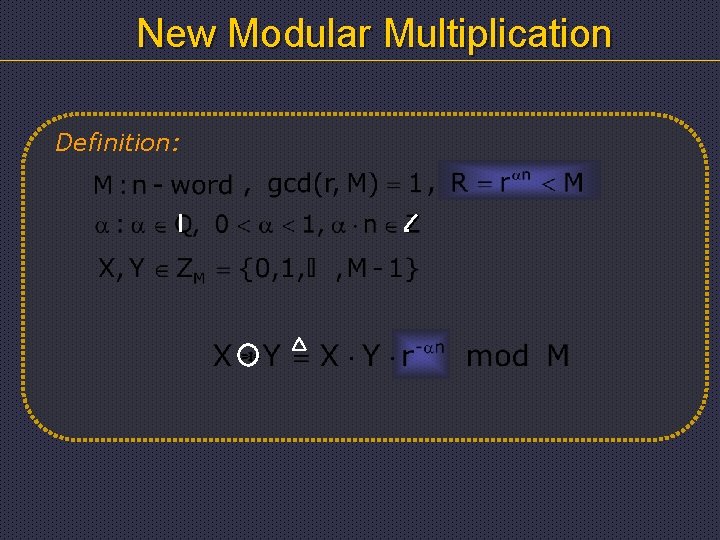
New Modular Multiplication Definition:
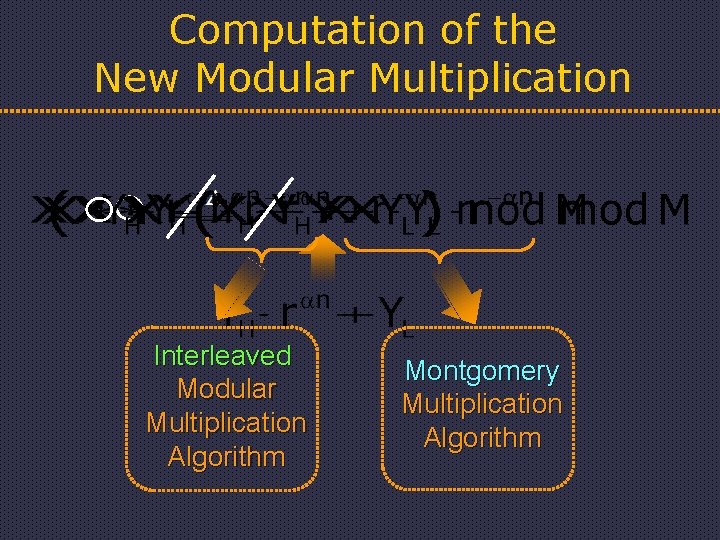
Computation of the New Modular Multiplication Interleaved Modular Multiplication Algorithm Montgomery Multiplication Algorithm
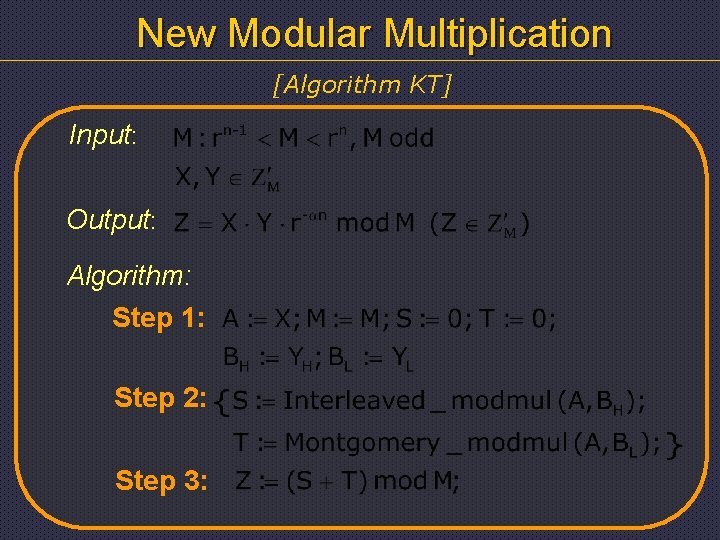
New Modular Multiplication [Algorithm KT] Input: Output: Algorithm: Step 1: Step 2: Step 3:
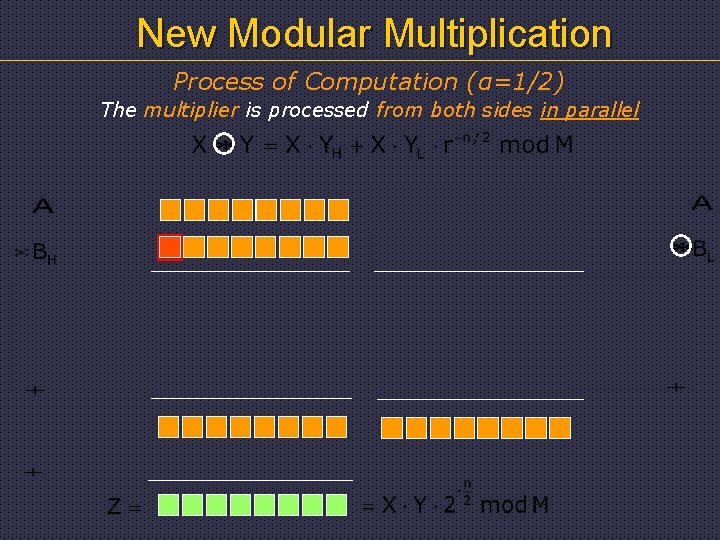
New Modular Multiplication Process of Computation (α=1/2) The multiplier is processed from both sides in parallel
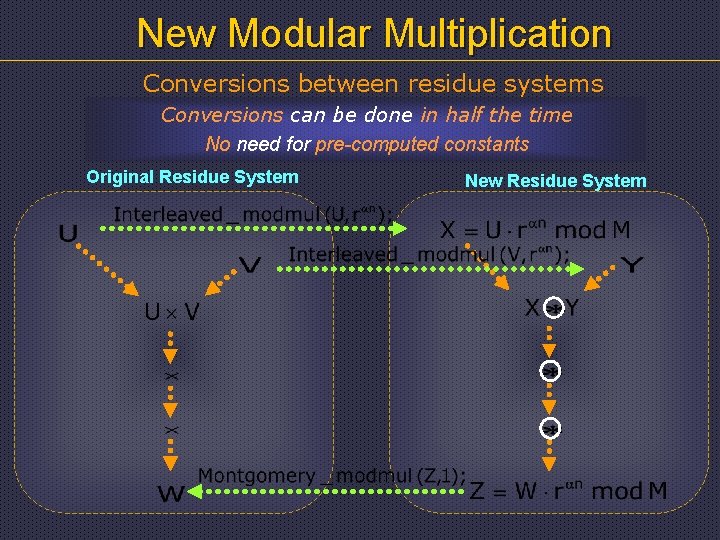
New Modular Multiplication Conversions between residue systems Conversions can be done in half the time No need for pre-computed constants Original Residue System New Residue System
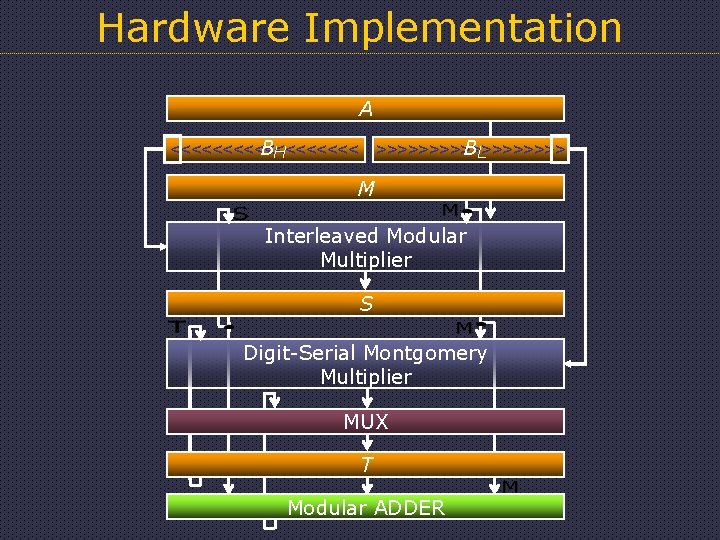
Hardware Implementation A BH BL <<<<<<<<< >>>>>>>>> M Interleaved Modular Multiplier S Digit-Serial Montgomery Multiplier MUX T Modular ADDER
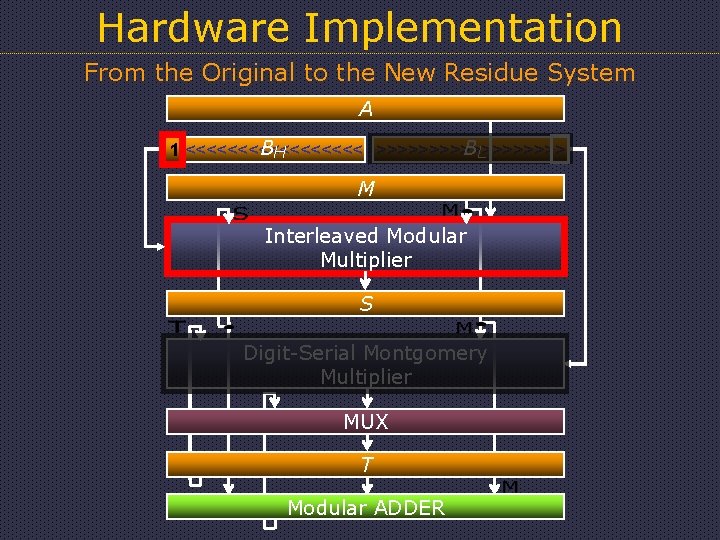
Hardware Implementation From the Original to the New Residue System A BH BL 1 <<<<<<<<< >>>>>>>>> M Interleaved Modular Multiplier S Digit-Serial Montgomery Multiplier MUX T Modular ADDER
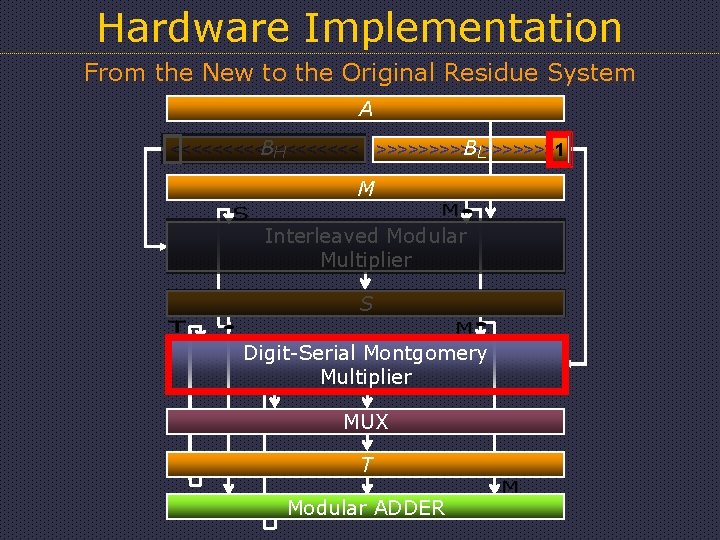
Hardware Implementation From the New to the Original Residue System A BH BL <<<<<<<<< >>>>>>>>>1 M Interleaved Modular Multiplier S Digit-Serial Montgomery Multiplier MUX T Modular ADDER
Hardware Implementation Characteristics of the Circuit Based on the New Algorithm Can be constructed using already designed circuits of lower radix. Amount of hardware proportional to n. When using multipliers of similar performance (α=1/2), execution time n/2+1 clocks, i. e. acceleration twice the speed of the original multipliers.
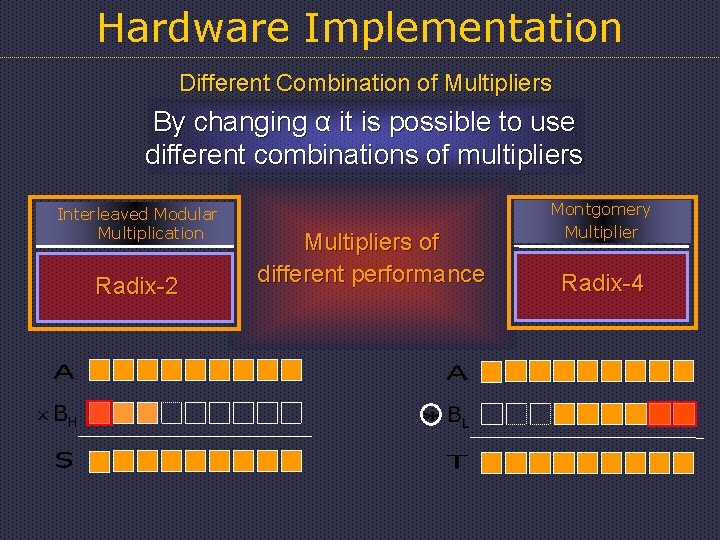
Hardware Implementation Different Combination of Multipliers By changing α it is possible to use different combinations of multipliers Interleaved Modular Multiplication Radix-2 Multipliers of different performance Montgomery Multiplier Radix-4
Summary We proposed a new computation method for speeding up modular multiplication. Multiplier processed from both sides in parallel. With multipliers of similar performance, number of clock cycles halved. By changing α multipliers of different performance can be used. The proposed method can be used to accelerate modular multiplication in hardware implementation and software implementation in a multiprocessor environment. The technique used in the proposed method can be adapted for operation in the binary extended field GF(2 m).
- Slides: 23