
Biotic communities The living organisms in a certain
Biotic communities
• The living organisms in a certain area form the biotic community • Three types of living organisms inhabit a biotic community • Producers (or autotrophs) - plants and bacteria – convert energy into food • Consumers (or heterotrophs) - eat plants and animals to survive • The consumers include herbivores (primary consumers), which eat only plants; • Carnivores (secondary consumers) - eat other animals
• Omnivores - eat both plants and animals • Detrivores -eat plants and animals that are already dead • Examples: some fishes crabs, vultures, and termites • Decomposers - change plants that have died into nutrients that allow them to survive
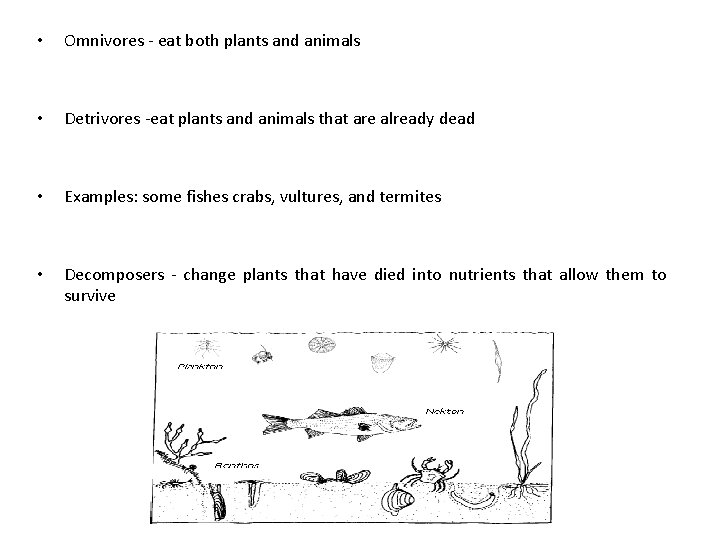
• Aquatic organisms are the referred to as biological components of an ecosystem • They can grouped according to the conditions of their existence – Plankton – Benthos – Nekton – Bacteria – Fungi
BENTHIC COMMUNITIES • Those animals and plants that are attached to, crawl over, or that burrow into the bottom in aquatic ecosystems • Are always associated with benthic floor from litter zone to the deep sea system • They live in the marine sediments distributing from tidal pools along the foreshore to the abyssal depths • The term benthos comes from the Greek word meaning depths of the sea • Benthos also lives in freshwater bodies of water, such as lakes, rivers and streams.

• The distribution occurrence and structure of most benthic organisms are determined by depth of water, temperature dissolved oxygen, salinity soil texture, availability of food and their biological interactions • Filter feeders, such as sponges and bivalves dominate the hard sandy bottoms • Deposit feeders such as polychaetes populate in softer bottoms • Fish, sea stars, snails, cephalopods, and crustaceans are important predators and scavengers
CLASSIFICATION OF BENTHIC ORGANISMS • Macrobenthos- (>500 um) • Meobenthos • Microbenthos - (<60 um) - (60 and 500 um)
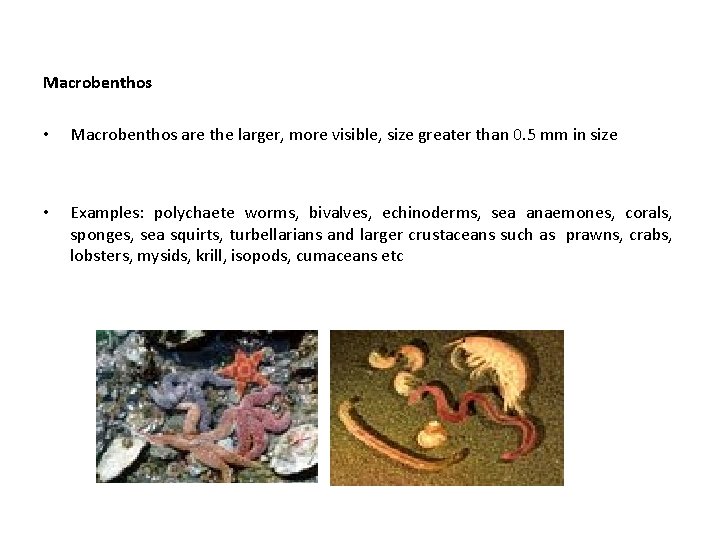
Macrobenthos • Macrobenthos are the larger, more visible, size greater than 0. 5 mm in size • Examples: polychaete worms, bivalves, echinoderms, sea anaemones, corals, sponges, sea squirts, turbellarians and larger crustaceans such as prawns, crabs, lobsters, mysids, krill, isopods, cumaceans etc
Important macro benthoic population • Echinoderms – Star fish, sea urchin, brittle star, sealillies, sea cucumbers • Plants – Sargasssum, Ulva, Gracillaria, Hippnia, Codium • Sponges – Sycon, Grantia • Coelenterate – Sea anemones, Sertularia • Annelids – Nereis, Eunice, Sabellaria • Arthropods – Hermit crabs, Mysids, Gammarus, Isopods, Cumecians • Molluscs – Mytilus, Littorina, Patella, Murex, Teredo, Cyprea, Crossostrea, Ostrea • Prochordata - Ascidia, Botrythus • Fishes - Demersal fishes ; soles, sharks, skates

Meiobenthos • Tiny benthic organisms size less than 0. 5 mm but greater than 60 µm • They are naked, present in large numbers • Important meiobenthos are Protozoans – Radiolarians, ciliates ; Coelenterates – Hydrozoa – obelia ; Annelids – Neries ; Tarligrada ; Rotifera ; Gastrotricha ; Nematode ; Archiannelide; Copepods ; Ostrocods; Mystacocarida etc. Foraminifera Gastrotrich Copepod
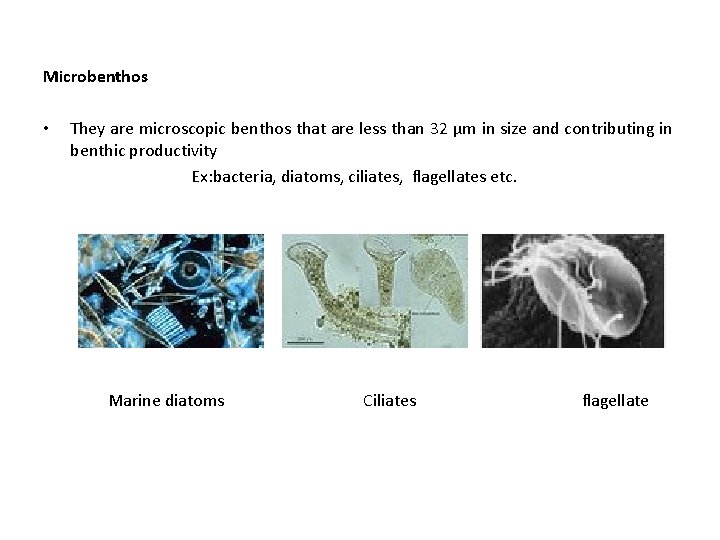
Microbenthos • They are microscopic benthos that are less than 32 µm in size and contributing in benthic productivity Ex: bacteria, diatoms, ciliates, flagellates etc. Marine diatoms Ciliates flagellate
Important microbenthos are – Ciliates – Bacteria – Fungi – Larval forms
NEKTON COMMUNITIES • Nekton - capacity to move around in the water purposively and independently • Active swimming animals, provided with efficient locomotive organs such as lateral fins, caudal fins and stream lined body. Eg. Fishes, cephalopods, mammals etc. • Three living classes of fish: – The primitive jawless fishes (Agnatha); – Shark like fishes (Cartilaginous or Chondrichthyes) – The bony fishes (Osteichthyes).
PLANKTON COMMUNITIES • Plankton and neuston - consists of free floating organisms, both animals and plants whose movements are so feeble that they remain essentially at the mercy of current or other water movement • All Plankton are members of the euplankton (True plankton) as against the pseudoplankton (Nonliving debris or dead plankton)
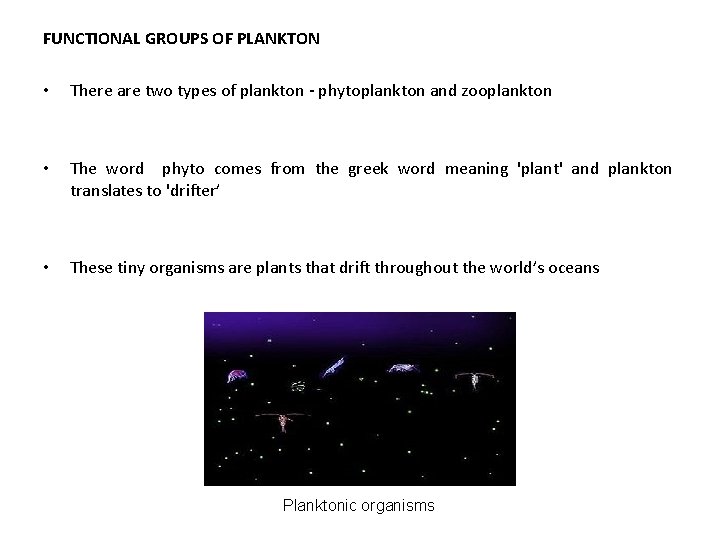
FUNCTIONAL GROUPS OF PLANKTON • There are two types of plankton - phytoplankton and zooplankton • The word phyto comes from the greek word meaning 'plant' and plankton translates to 'drifter’ • These tiny organisms are plants that drift throughout the world’s oceans Planktonic organisms

• Phytoplankton (phyton, or plant), autotrophic, prokaryotic or eukaryotic algae that live near the water surface where there is sufficient light to support photosynthesis Ex: diatoms, cyanobacteria, dinoflagellates and coccolithophores, silicoflagillates, green algae, blue green algae etc • Zooplankton (zoon or animal), small protozoans or metazoans(e. g. crustaceans and other animals ) that feed on other plankton and telonema Ex: eggs and larvae of larger animals, such as fish, crustaceans, and annelids • Bacterioplankton, bacteria and archaea, which play an important role in remineralising organic material down the water column (note that the prokaryotic phytoplankton are also bacterioplankton)

- Slides: 17