
Biotechnology 1 What is Biotechnology Use of organisms
Biotechnology 1 • What is Biotechnology? – Use of organisms, especially microbes, to produce useful products? • Beer, wine, bread, organic solvents, antibiotics • By this definition, very old. – Use of recombinant DNA techniques to harness the power of organisms to make useful products. • Very new technology • Includes herbicide-resistant plants, human proteins produced in yeasts, new vaccines.
Biotechnology has several applications: overview • Agriculture – Herbicide resistant plants – Improved nutritional qualities • Pharmaceuticals – Production of human proteins as drugs – Production of vaccines • Medical, legal, biological – Screening for, treatment of genetic disease – DNA fingerprinting, biological conservation 2
Herbicide resistance 3 • Example: glyphosate resistant plants – More than 2/3 of US soybeans and cotton – Glyphosate inhibits EPSP synthase • Engineered plants have extra copies of gene, make more enzyme, so are more resistant. • Steps in engineering: – Gene from E. coli. Put next to strong promoter – Cloned into Ti plasmid, plasmid put back into tumefaciens which carries plasmid to plant cell. – Grow whole plant from engineered plant cell A.
Why and why not? • Use of herbicide-resistant plants means less herbicide use, no-till farming. – less erosion and less non-point source pollution. • Safe to eat? Why not? – Proteins not automatically destroyed during digestion; allergies possible. Otherwise, what’s the problem? • Environmental concerns – Toxic pollen? Herbicide resistant weeds? • Biotech: same only more targeted and quicker. 4
Ag-2: improved nutrition • Not every food product has complete nutrition – Corn very low in the amino acid lysine – Countries relying on rice have low intake of betacarotene – Some plants have health-improving chemicals • Transgenic plants can provide relief – Daffodil gene inserted into rice to make betacarotene, precursor to Vitamin A = golden rice • Critics say: not enough to make a difference. 5
Pharmaceuticals • Dwarfism, diabetes, cancer can be treated using human proteins – Obtained with difficulty – Insulin from slaughterhouse animals • Recombinant insulin first from E. coli – Required combination of cloning, chemical treatment – Starting point: m. RNA, reverse transcriptase, then insertion into plasmid vector – E. coli or yeast cells used. 6
Future directions • “pharming”: growing of protein drugs in farm plants and animals – Cloning into sheep (etc. ) with mammary specific promoter, only expressed in that tissue. • Released in, collected from milk. – Using tobacco plants, especially for vaccines • Tobacco easy to grow, easy to engineer, easy to harvest • Years of agricultural experience – Use of hairy roots • Cloned genes inserted w/ Ti plasmid 7

Vaccines • Exposing host to antigens found on pathogen – Whole, live, weakened pathogen • Strong immunity, but risk of live pathogen – Whole, dead pathogen • Nucleic acid not “dead”; • cancer or toxic reaction – Subunit vaccine: using a molecule from pathogen • Host reacts, then protects against later exposure to entire pathogen 8
Vaccines-2 • Recombinant vaccines – Clone gene for surface antigen of pathogen – Express gene i. e. get antigenic proteins made • Collect proteins, process into vaccine • Get proteins into harmless virus – Express proteins in food • Because there are food allergies, proteins taken orally can result in immune reactions • Eliminates worries about sterilization, storage, needle-phobia 9

Transgenic vaccine 10
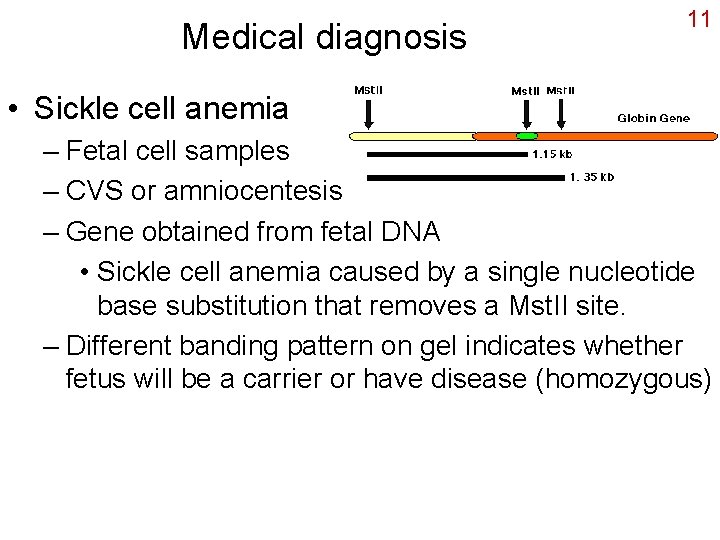
Medical diagnosis 11 • Sickle cell anemia – Fetal cell samples – CVS or amniocentesis – Gene obtained from fetal DNA • Sickle cell anemia caused by a single nucleotide base substitution that removes a Mst. II site. – Different banding pattern on gel indicates whether fetus will be a carrier or have disease (homozygous)
Medical diagnosis -2 12 • Cystic fibrosis – Most cases causes by a specific deletion of DNA – PCR used to make allele-specific oligonucleotides • This DNA hybridizes to region in normal gene that is deleted in faulty allele • Absence of hybridization means deletion is present, person has the Cf allele. • Huntington disease – Because of variable number of trinucleotide repeats, probably PCR or VNTR-type test looking for varying lengths of DNA fragments.
Ethics! 13 • Genetic engineering, medical tests opens up wide range of issues and questions – Environmental and global economic issues – Stem cell research and cloning – Who owns the data? Can someone else patent your genes? Privacy issues. • Should your boss, insurance company, government have access to your data? – We can tell you that you have the disease, but • We can’t do anything about it!
Gene Therapy 14 • Gene therapy: the attempt to cure an underlying genetic problem by insertion of a correct copy of a gene. – Tantalizingly simple and profound in theory, maddeningly difficult to actually achieve. – Easiest targets: access to or retrieval of cells • Respiratory and blood • Engineered virus, infects cells, carries in good gene. • Engineer cell in tube, return to body.
Recent successes 15 • Adenosine Deaminase deficiency – Defect in nucleoside metabolism especially affects white blood cells • X-linked chronic granulomatous disease – Neutrophils fail to make superoxide • General scheme: Retrovirus used to replace gene in bone marrow cells, return cells to patient
Failures 16 • Genes don’t always make into genome – “cure” is short-lived as DNA disappears • Viruses carrying genes insert in bad places – Cause over-expression of genes or DNA deletions • Cancer • Immune system becomes sensitized to vector • Death of patient in clinical trial in 1999.
New development • Sleeping Beauty transposon system – First transposon available in vertebrates? – Originally from inactive fish transposon • Engineer with gene of interest – Transposon inserts with gene, getting it into the chromosome – Inserts in different places from viral vector – Much higher rate of gene insertion 17
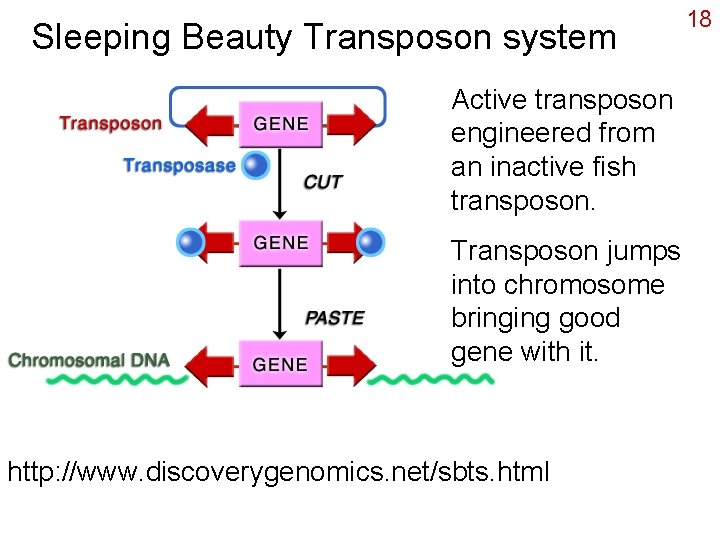
Sleeping Beauty Transposon system Active transposon engineered from an inactive fish transposon. Transposon jumps into chromosome bringing good gene with it. http: //www. discoverygenomics. net/sbts. html 18
- Slides: 18