
Biotechnological potential of new strains of lactic acid
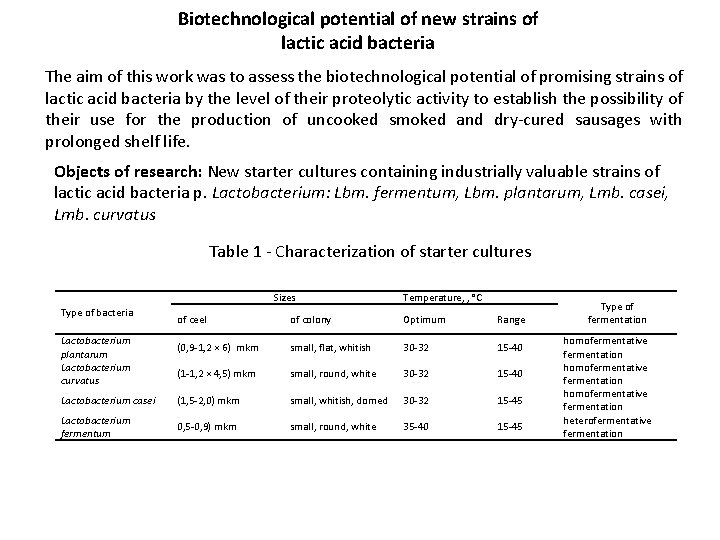
Biotechnological potential of new strains of lactic acid bacteria The aim of this work was to assess the biotechnological potential of promising strains of lactic acid bacteria by the level of their proteolytic activity to establish the possibility of their use for the production of uncooked smoked and dry-cured sausages with prolonged shelf life. Objects of research: New starter cultures containing industrially valuable strains of lactic acid bacteria p. Lactobacterium: Lbm. fermentum, Lbm. plantarum, Lmb. casei, Lmb. curvatus Table 1 - Characterization of starter cultures Sizes Type of bacteria Temperature, , °C of ceel of colony Optimum Range (0, 9 -1, 2 × 6) mkm small, flat, whitish 30 -32 15 -40 (1 -1, 2 × 4, 5) mkm small, round, white 30 -32 15 -40 Lactobacterium casei (1, 5 -2, 0) mkm small, whitish, domed 30 -32 15 -45 Lactobacterium fermentum 0, 5 -0, 9) mkm small, round, white 35 -40 15 -45 Lactobacterium plantarum Lactobacterium curvatus Type of fermentation homofermentative fermentation heterofermentative fermentation
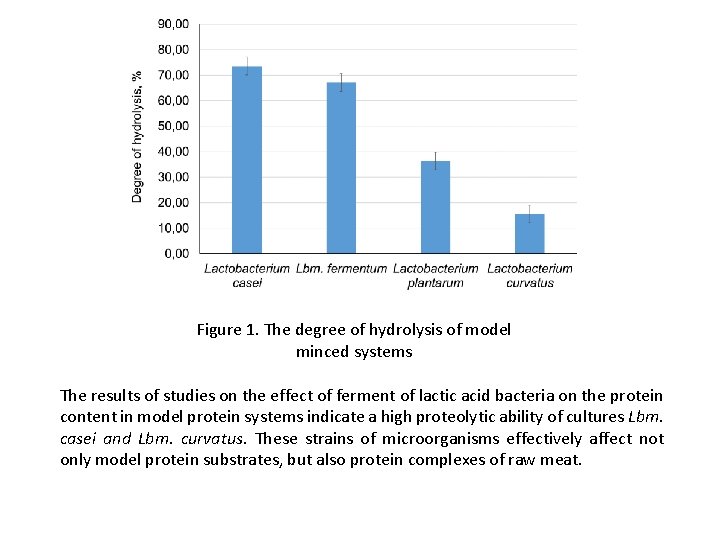
Figure 1. The degree of hydrolysis of model minced systems The results of studies on the effect of ferment of lactic acid bacteria on the protein content in model protein systems indicate a high proteolytic ability of cultures Lbm. casei and Lbm. curvatus. These strains of microorganisms effectively affect not only model protein substrates, but also protein complexes of raw meat.
- Slides: 2