
Biostatistics C F Jeff Lin MD Ph D
Biostatistics 林 建 甫 C. F. Jeff Lin, MD. Ph. D. 台 北 大 學 統 計 系 助 理 教 授 美 國 密 西 根 大 學 生 物 統 計 博 士 cflin@mail. ntpu. edu. tw http: //web. ntpu. edu. tw/~cflin 5/18/2021 1
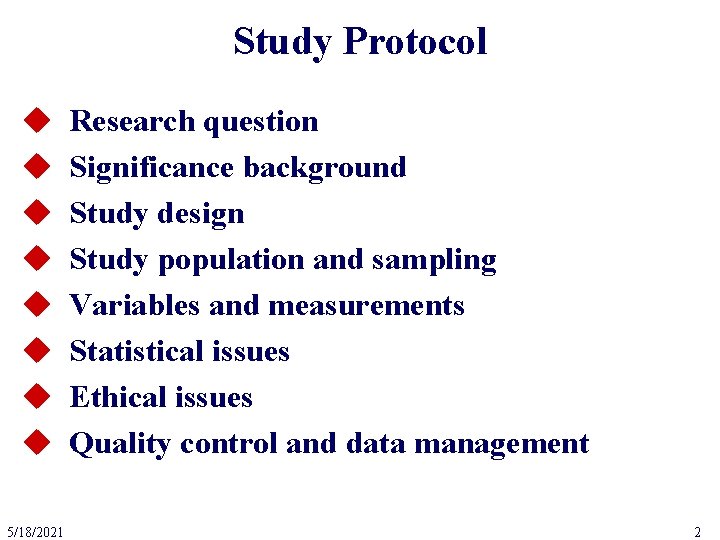
Study Protocol u u u u 5/18/2021 Research question Significance background Study design Study population and sampling Variables and measurements Statistical issues Ethical issues Quality control and data management 2
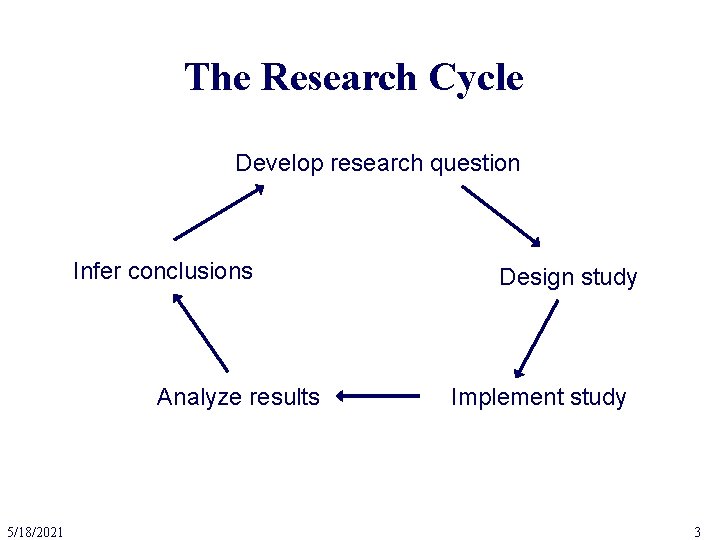
The Research Cycle Develop research question Infer conclusions Analyze results 5/18/2021 Design study Implement study 3
Types of Study Designs: from Descriptive Studies to Randomized Controlled Trials (RCT) Kirsten Bibbins-Domingo, Ph. D, MD Assistant Professor of Medicine and of Epidemiology and Biostatistics University of California, San Francisco 5/18/2021 4
Objectives u To understand the difference between descriptive and analytic studies u To identify the hierarchy of study designs, and the strengths and weakness of each design u To be able to apply different study designs to the same research question 5/18/2021 5
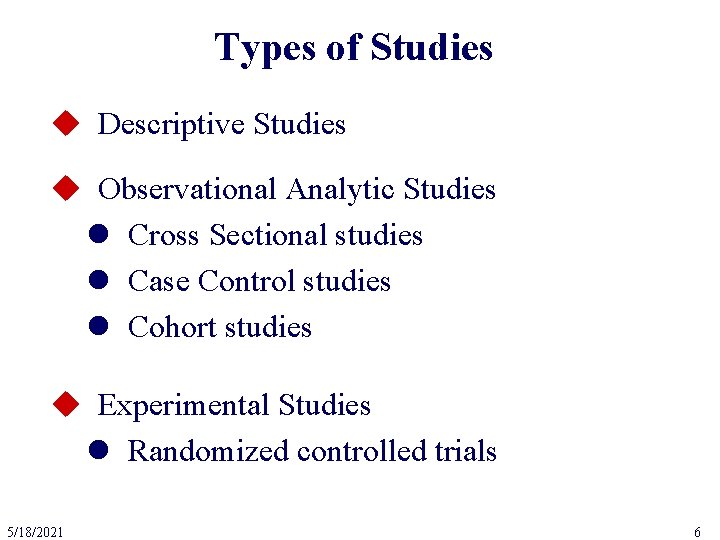
Types of Studies u Descriptive Studies u Observational Analytic Studies l Cross Sectional studies l Case Control studies l Cohort studies u Experimental Studies l Randomized controlled trials 5/18/2021 6
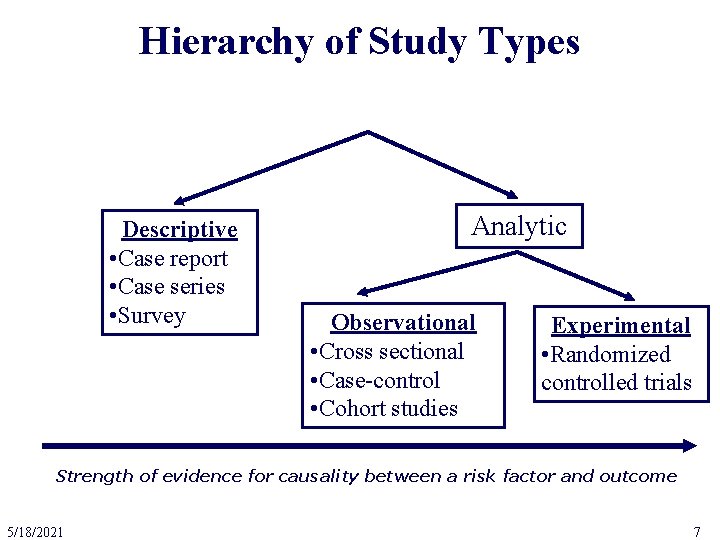
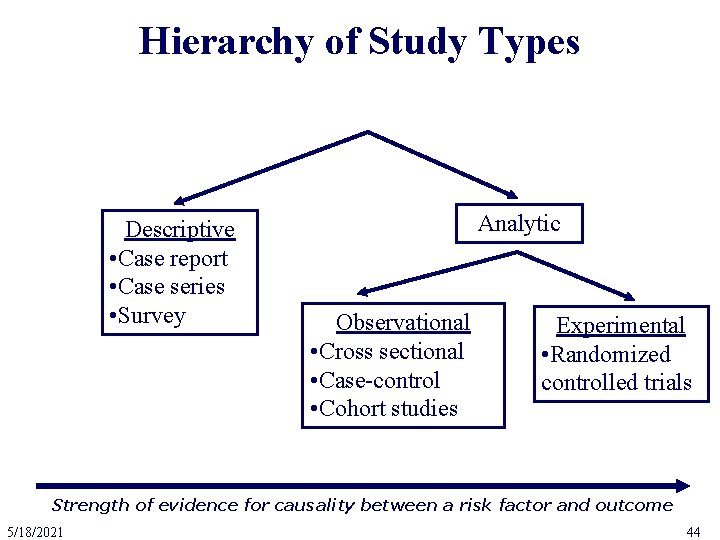
Hierarchy of Study Types Descriptive • Case report • Case series • Survey Analytic Observational • Cross sectional • Case-control • Cohort studies Experimental • Randomized controlled trials Strength of evidence for causality between a risk factor and outcome 5/18/2021 7
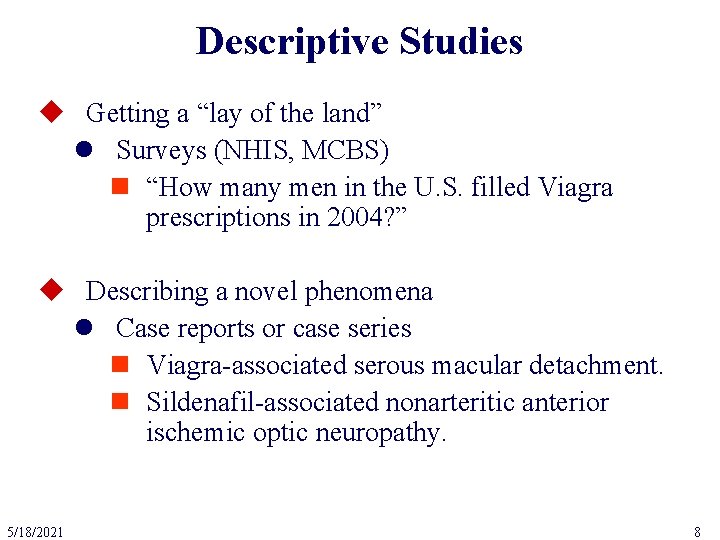
Descriptive Studies u Getting a “lay of the land” l Surveys (NHIS, MCBS) n “How many men in the U. S. filled Viagra prescriptions in 2004? ” u Describing a novel phenomena l Case reports or case series n Viagra-associated serous macular detachment. n Sildenafil-associated nonarteritic anterior ischemic optic neuropathy. 5/18/2021 8
Descriptive Studies u Cannot establish causal relationships u Still play an important role in describing trends and generating hypotheses about novel associations u The start of HIV/AIDS research l Squamous cell carcinoma in sexual partner of Kaposi sarcoma patient. Lancet. 1982 Jan 30; 1(8266): 286. l New outbreak of oral tumors, malignancies and infectious diseases strikes young male homosexuals. CDA J. 1982 Mar; 10(3): 39 -42. l AIDS in the "gay" areas of San Francisco. Lancet. 1983 Apr 23; 1(8330): 923 -4. 5/18/2021 9
Analytic Studies u Attempt to establish a causal link between a predictor/risk factor and an outcome. u You are doing an analytic study if you have any of the following words in your research question: l greater than, less than, causes, leads to, compared with, more likely than, associated with, related to, similar to, correlated with 5/18/2021 10
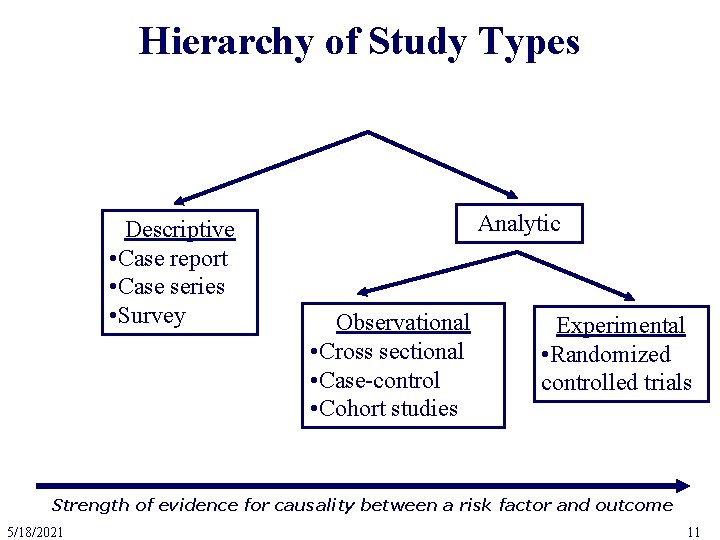
Hierarchy of Study Types Descriptive • Case report • Case series • Survey Analytic Observational • Cross sectional • Case-control • Cohort studies Experimental • Randomized controlled trials Strength of evidence for causality between a risk factor and outcome 5/18/2021 11
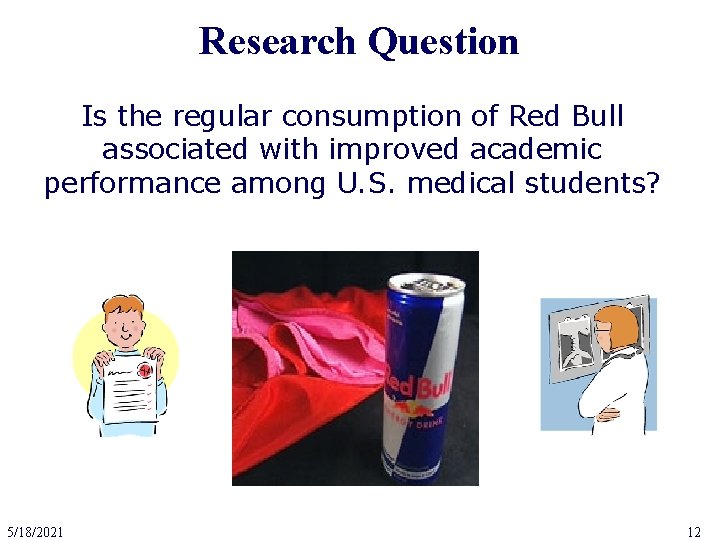
Research Question Is the regular consumption of Red Bull associated with improved academic performance among U. S. medical students? 5/18/2021 12
Rationale u “functional drink” designed for periods of mental and physical exertion. l performance, concentration, memory, reaction time, vigilance, and emotional balance u Taurine + glucuronolactone + caffeine 5/18/2021 13
Background u Alford C, Cox H, Wescott R. The effects of red bull energy drink on human performance and mood. Amino Acids. 2001; 21(2): 139 -50. u Warburton DM, Bersellini E, Sweeney E. An evaluation of a caffeinated taurine drink on mood, memory and information processing in healthy volunteers without caffeine abstinence. Psychopharmacology (Berl). 2001 Nov; 158(3): 322 -8. u Seidl R, Peyrl A, Nicham R, Hauser E. A taurine and caffeinecontaining drink stimulates cognitive performance and wellbeing. Amino Acids. 2000; 19(3 -4): 635 -42. u Horne JA, Reyner LA. Beneficial effects of an "energy drink" given to sleepy drivers. Amino Acids. 2001; 20(1): 83 -9. u Kennedy DO, Scholey AB. A glucose-caffeine 'energy drink' ameliorates subjective and performancedeficits during prolonged cognitive demand. Appetite. 2004 Jun; 42(3): 331 -3. 5/18/2021 14
Great idea, but how do you get started…. u Interesting, novel, and relevant, but… u You only have 25, 000 dollars to start investigating this question. u What is feasible? 5/18/2021 15
Study Design #1 u Cross-sectional study of UCSF medical students taking USMLE Step 2 u Questionnaire administered when registering for USMLE 2 l Primary predictor: self-report of >3 cans Red Bull per week for the previous year l Covariates: Age, sex, undergraduate university, place of birth u Outcome: Score on USMLE Step 2 5/18/2021 16
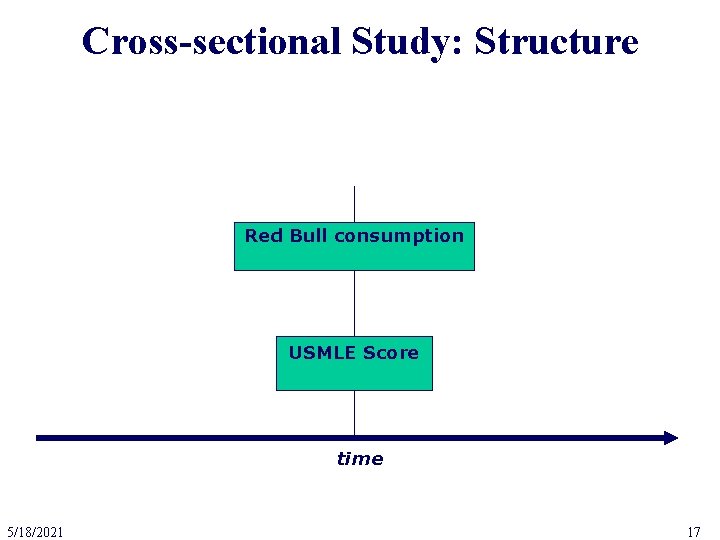
Cross-sectional Study: Structure Red Bull consumption USMLE Score time 5/18/2021 17
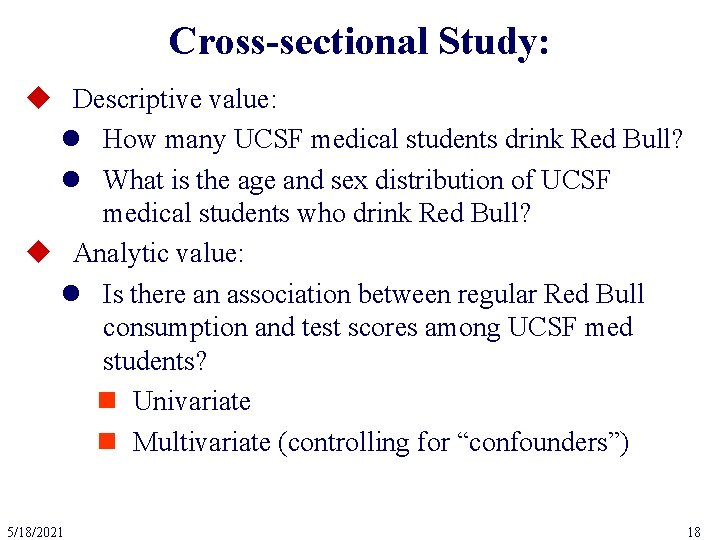
Cross-sectional Study: u Descriptive value: l How many UCSF medical students drink Red Bull? l What is the age and sex distribution of UCSF medical students who drink Red Bull? u Analytic value: l Is there an association between regular Red Bull consumption and test scores among UCSF med students? n Univariate n Multivariate (controlling for “confounders”) 5/18/2021 18
Cross-sectional Study: u Other cross-sectional surveys: l AAMC l California Health Interview Survey (NHIS, CHIS) l National Health and Nutrition Exam Survey (NHANES) 5/18/2021 19
Cross-sectional Study: Pluses + Prevalence (not incidence) + Fast/Inexpensive - no waiting! + No loss to follow up + Associations can be studied 5/18/2021 20
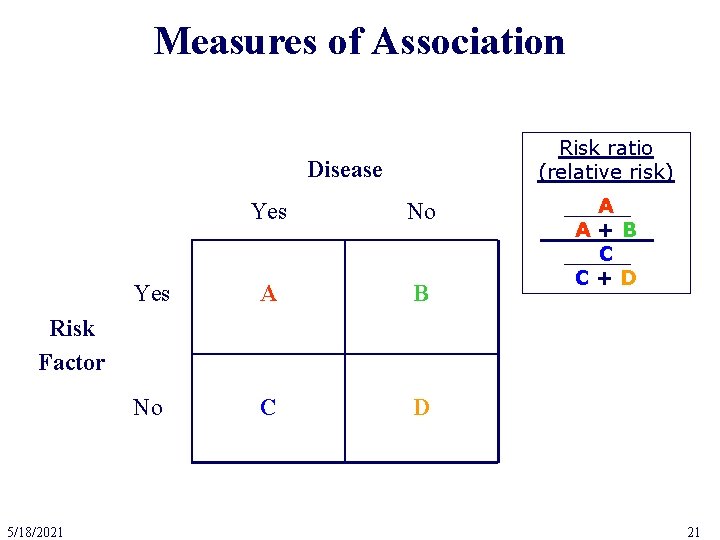
Measures of Association Risk ratio (relative risk) Disease Yes No Yes A B No C D A A+B C C+D Risk Factor 5/18/2021 21
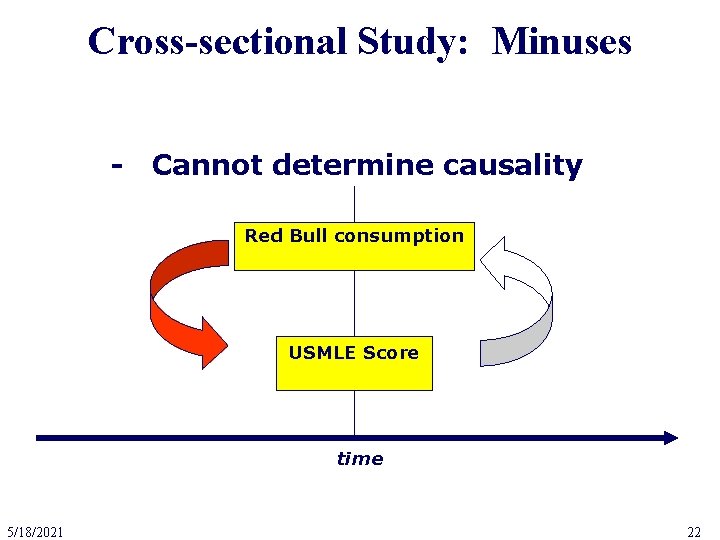
Cross-sectional Study: Minuses - Cannot determine causality Red Bull consumption USMLE Score time 5/18/2021 22
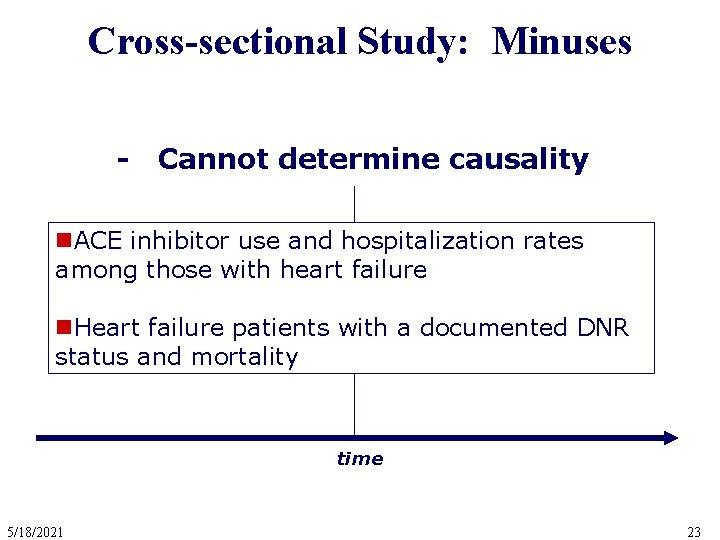
Cross-sectional Study: Minuses - Cannot determine causality n. ACE inhibitor use and hospitalization rates among those with heart failure n. Heart failure patients with a documented DNR status and mortality time 5/18/2021 23
Cross-sectional Study: Minuses 5/18/2021 - Cannot determine causality - Cannot study rare outcomes 24
What if you are interested in the rare outcome? u The association between regular Red Bull consumption and… l A perfect score on the USMLE – Step 2 l Graduating top 1% of the medical school class l Acceptance into a highly selective residency ANSWER: A Case-Control study 5/18/2021 25
Study Design #2 u A case-control study u Cases: 4 th year med students accepted to residency in “highly selective specialty X”. u Controls: 4 th year med students who applied but were not accepted. u Predictor: self-reported regular Red Bull consumption l Additional covariates (age, sex, medical school, undergraduate institution) 5/18/2021 26
Case Control Studies u Investigator works “backward” (from outcome to predictor) u Sample chosen on the basis of outcome (cases), plus comparison group (controls) 5/18/2021 27
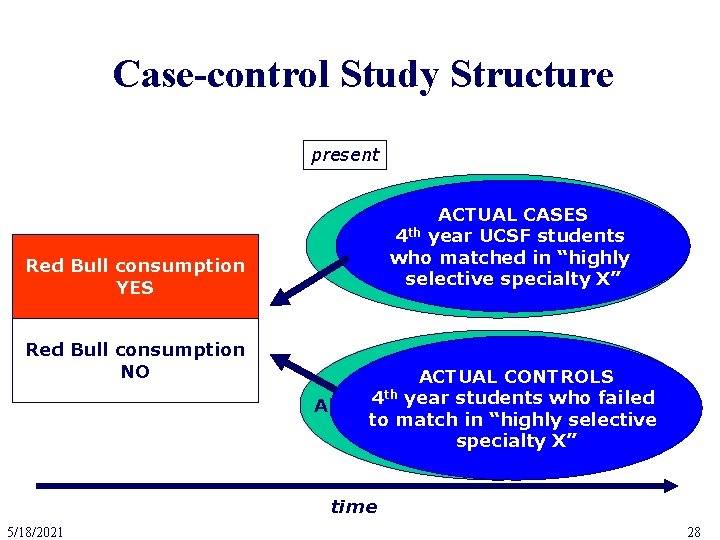
Case-control Study Structure present Red Bull consumption YES Red Bull consumption NO ACTUAL CASES TARGET CASES 4 th year UCSF students Medical students accepted to who matched in “highly selective residencies selective specialty X” ACTUAL CONTROLS TARGET CONTROLS th year students who failed 4 All unsuccessful applicants to highly to match in “highly selective residency programs specialty X” time 5/18/2021 28
Case Control Studies u Determines the strength of the association between each predictor variable and the presence or absence of disease u Cannot yield estimates of incidence or prevalence of disease in the population (why? ) u Odds Ratio is statistics 5/18/2021 29
Case-control Study: Pluses + Rare outcome/Long latent period + Inexpensive and efficient: may be only feasible option + Establishes association (Odds ratio) + Useful for generating hypotheses (multiple risk factors can be explored) 5/18/2021 30
Case-control Study - Minuses u Causality still difficult to establish u Selection bias (appropriate controls) l Caffeine and Pancreatic cancer in the GI clinic n Recall bias: sampling (retrospective) l Abortion and risk of breast cancer in Sweden n Cannot tell about incidence or prevalence l Studies of diagnostic tests: - Sensitivity, specificity - Positive predictive value, negative predictive value 5/18/2021 31
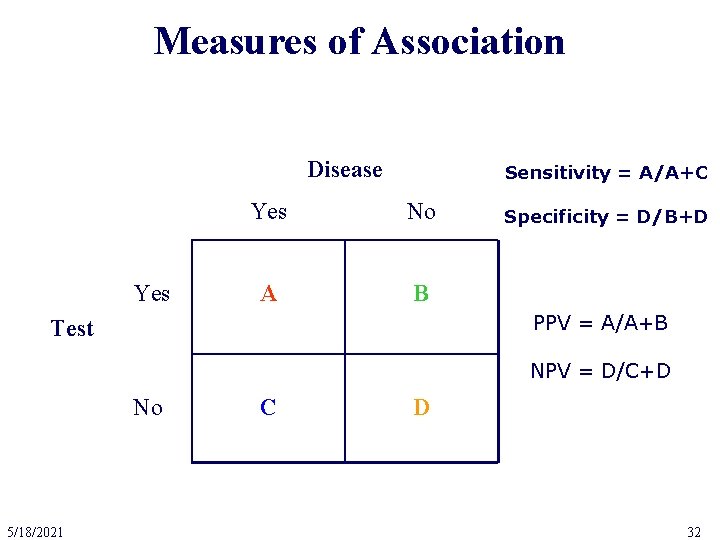
Measures of Association Disease Yes Sensitivity = A/A+C Yes No A B Specificity = D/B+D PPV = A/A+B Test NPV = D/C+D No 5/18/2021 C D 32
Case -- Control - “the House Red” u “RELY” tampons and toxic shock syndrome (TSS): l High rates of toxic shock syndrome in menstruating women l Suspected OCPs or meds for PMS l Cases: 180 women with TSS in 6 geographic areas l Controls: 180 female friends of these patients and 180 females in the same telephone code l Tampon associated with TSS (OR = 29!) l Super absorbency associated with TSS (OR 1. 34 per gm increase in absorbency) l Led to “RELY” brand tampons being taken off the market. 5/18/2021 33
Where are we? u Preliminary results from our cross-sectional and casecontrol study suggest an association between Red Bull consumption and improved academic performance among medical students u What’s missing? - strengthening evidence for a causal link between Red Bull consumption and academic performance u Use results from our previous studies to apply for funding for a prospective cohort study! 5/18/2021 34
Study Design #3 u Prospective cohort study of UCSF medical students Class of 2009 u All entering medical students surveyed regarding beverage consumption and variety of other potential covariates u Survey updated annually to record changes in Red Bull consumption u Outcomes: USMLE Step 1 score, USMLE Step 2 score, match in first choice residency 5/18/2021 35
Cohort Studies n A cohort (follow-up, longitudinal) study is a comparative, observational study in which subjects are grouped by their exposure status, i. e. , whether or not the subject was exposed to a suspected risk factor n The subjects, exposed and unexposed to the risk factor, are followed forward in time to determine if one or more new outcomes (diseases) occur l Subjects should not have outcome variable on entry l No new subjects allowed in after initial recruitment n The rates of disease incidence among the exposed and unexposed groups are determined and compared. 5/18/2021 36
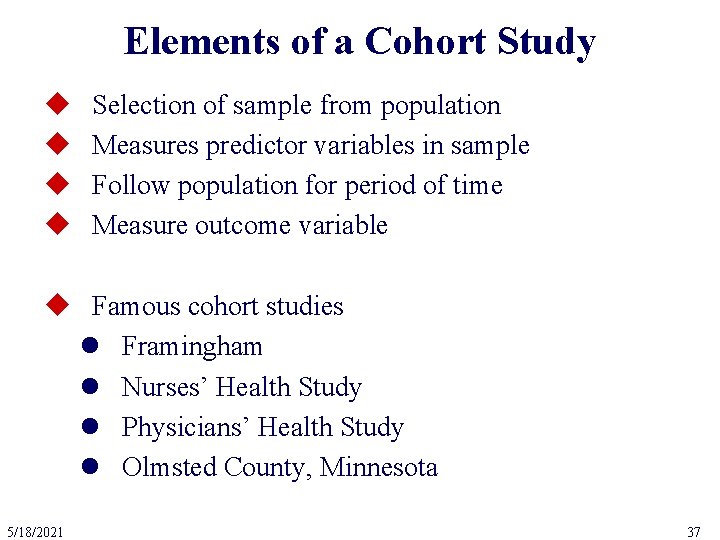
Elements of a Cohort Study u u Selection of sample from population Measures predictor variables in sample Follow population for period of time Measure outcome variable u Famous cohort studies l Framingham l Nurses’ Health Study l Physicians’ Health Study l Olmsted County, Minnesota 5/18/2021 37
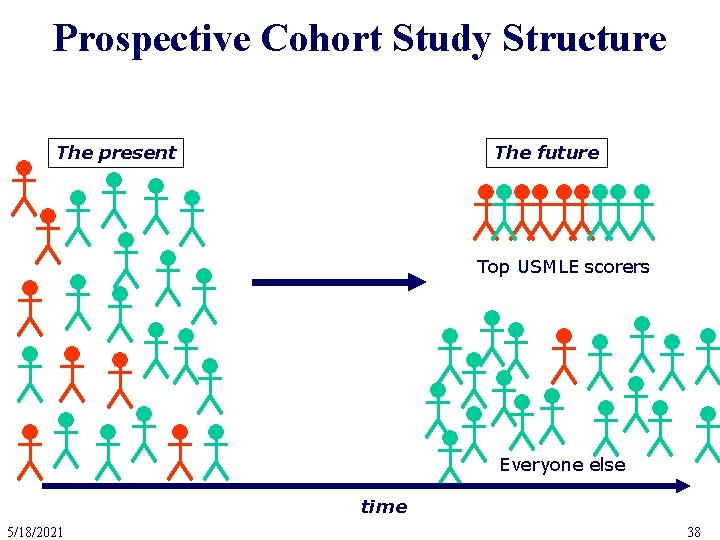
Prospective Cohort Study Structure The present The future Top USMLE scorers Everyone else time 5/18/2021 38
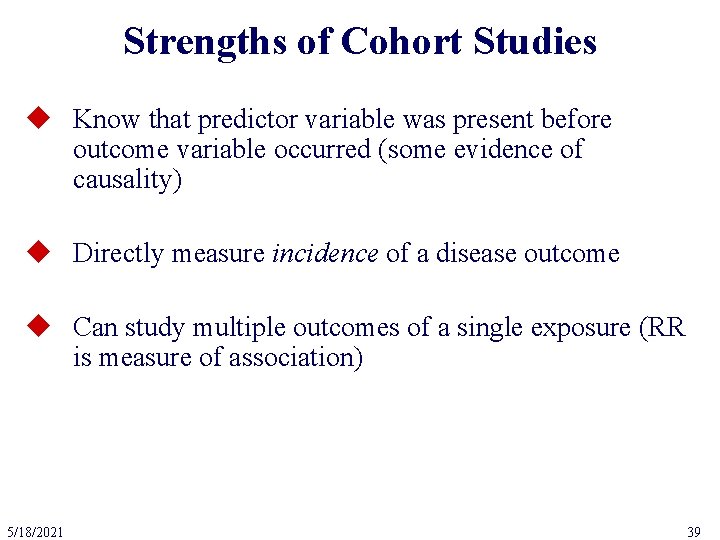
Strengths of Cohort Studies u Know that predictor variable was present before outcome variable occurred (some evidence of causality) u Directly measure incidence of a disease outcome u Can study multiple outcomes of a single exposure (RR is measure of association) 5/18/2021 39
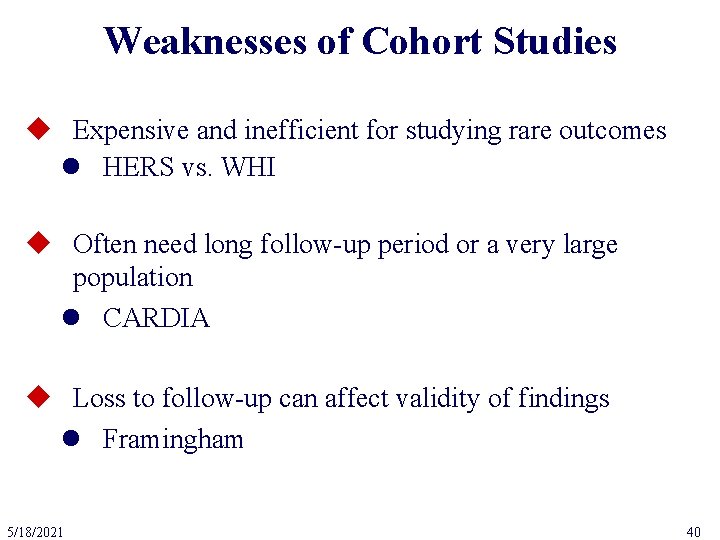
Weaknesses of Cohort Studies u Expensive and inefficient for studying rare outcomes l HERS vs. WHI u Often need long follow-up period or a very large population l CARDIA u Loss to follow-up can affect validity of findings l Framingham 5/18/2021 40
Other Types of Cohort Studies Retrospective Cohort u Identification of cohort, measurement of predictor variables, follow-up and measurement of outcomes have all occurred in the past u Much less costly than prospective cohorts u Investigator has minimal control over study design 5/18/2021 41
Other Types of Cohort Studies u Nested Case-control Study l Case-control study embedded in a cohort study l Controls are drawn randomly from study sample u Double Cohort l Used to compare two separate cohorts with different levels of exposure to predictor variable (e. g. , occupational groups) 5/18/2021 42
What Type of Study is This? u Among individuals with coronary disease, what is the association between baseline levels of B-type natriuretic peptide and subsequent risk of heart failure? u Among individuals presenting to heart failure clinic, what is the association between self-reported symptoms and risk of hospitalization for heart failure? u Using data from HERS (RCT of HRT in women with coronary disease): l Determine the risk factors for developing incident heart failure among women without heart failure at baseline. l Determine whether HRT is associated with mortality among women with heart failure. l Determine genetic markers for development of 5/18/2021 43
Hierarchy of Study Types Descriptive • Case report • Case series • Survey Analytic Observational • Cross sectional • Case-control • Cohort studies Experimental • Randomized controlled trials Strength of evidence for causality between a risk factor and outcome 5/18/2021 44
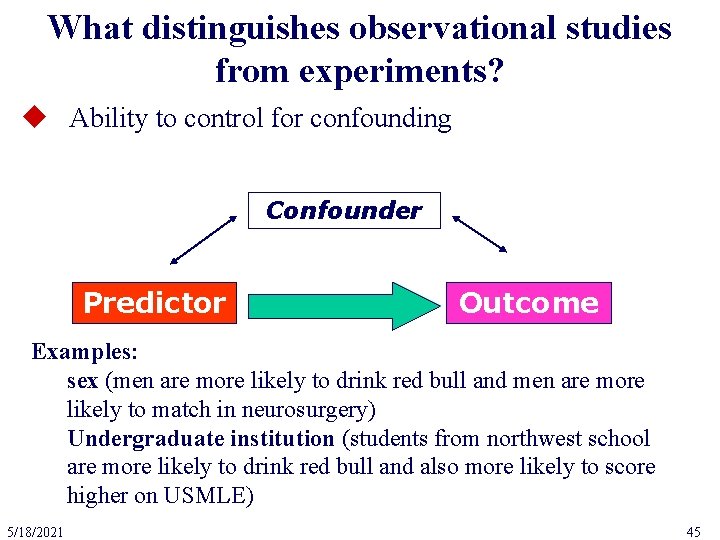
What distinguishes observational studies from experiments? u Ability to control for confounding Confounder Predictor Outcome Examples: sex (men are more likely to drink red bull and men are more likely to match in neurosurgery) Undergraduate institution (students from northwest school are more likely to drink red bull and also more likely to score higher on USMLE) 5/18/2021 45
But we measured all of the potential confounders……. u In a prospective cohort study you can (maybe) measure all potential known confounders, but… u You can’t control for unanticipated or unmeasured confounders 5/18/2021 46
Study Design # 4 u Randomized controlled trial of daily Red Bull consumption among entering UCSF medical students Class 2009 u Randomized to daily consumption of Red Bull vs. daily consumption of placebo u Outcomes: USMLE Step 1 score, USMLE Step 2 score, match in first choice residency 5/18/2021 47
Randomized Controlled Trials u Investigator controls the predictor variable (intervention or treatment) u Major advantage over observational studies is ability to demonstrate causality u Randomization controls unmeasured confounding u Only for mature research questions 5/18/2021 48
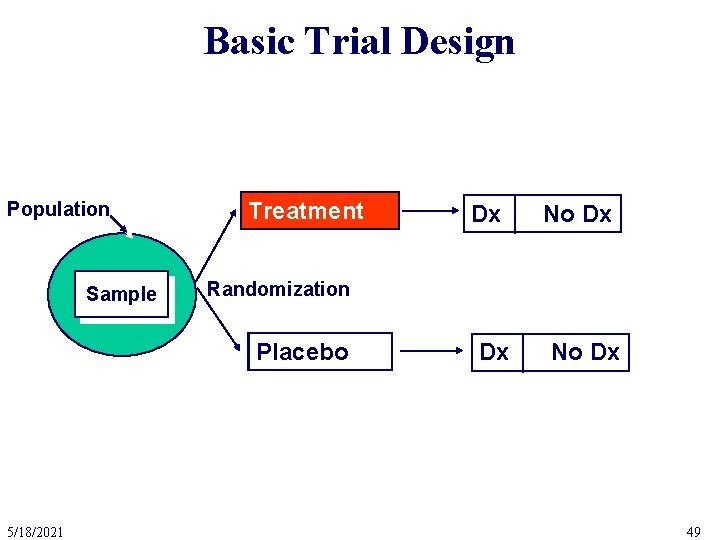
Basic Trial Design Population Sample Treatment No Dx Randomization Control Placebo 5/18/2021 Dx Dx No Dx 49
Steps in a Randomized Controlled Trial 1. Select participants l high-risk for outcome (high incidence) l Likely to benefit and not be harmed l Likely to adhere 2. Measure baseline variables 3. Randomize l Eliminates baseline confounding l Types (simple, stratified, block) 5/18/2021 50
Steps in a Randomized Controlled Trial 4. Blinding the intervention l As important as randomization l Eliminates n co intervention n biased outcome ascertainment n biased measurement of outcome 5. Follow subjects l Adherence to protocol l Lost to follow up 6. Measure outcome l Clinically important measures l Adverse events 5/18/2021 51
What is Blinding? u. Single blind - participants are not aware of treatment group u. Double blind - both participants and investigators unaware u. Triple blind - various meanings l persons who perform tests l outcome adjudicators l safety monitoring group 5/18/2021 52
Why blind? : Co-Interventions u Unintended effective interventions l participants use otherapy or change behavior l study staff, medical providers, family or friends treat participants differently u Nondifferential - decreases power u Differential - causes bias 5/18/2021 53
Why blind? : Biased Outcome Ascertainment or Adjudication u. If group assignment is known l participants may report symptoms or outcomes differently l physicians or investigators may elicit symptoms or outcomes differently l Study staff or adjudicators may classify similar events differently in treatment groups u. Problematic with “soft” outcomes l investigator judgment l participant reported symptoms, scales 5/18/2021 54
Analysis of Randomized Controlled Trial u Analyzed like cohort study with RR (risk ratio) u Intention to treat analysis l Most conservative interpretation l Include all persons assigned to intervention group (including those who did not get treatment or dropped out) u Subgroup analysis l Groups identified pre-randomization 5/18/2021 55
High Quality Randomized Trials u Tamper-proof randomization u Blinding of participants, study staff, lab staff, outcome ascertainment and adjudication u Adherence to study intervention and protocol u Complete follow-up 5/18/2021 56
Are Observational Studies Useless? u NO l generate important hypotheses l provide only answer if trial not feasible l generally produce correct answer u But bias and confounding always worrisome u Particularly problematic for interventions that require selection and adherence 5/18/2021 57
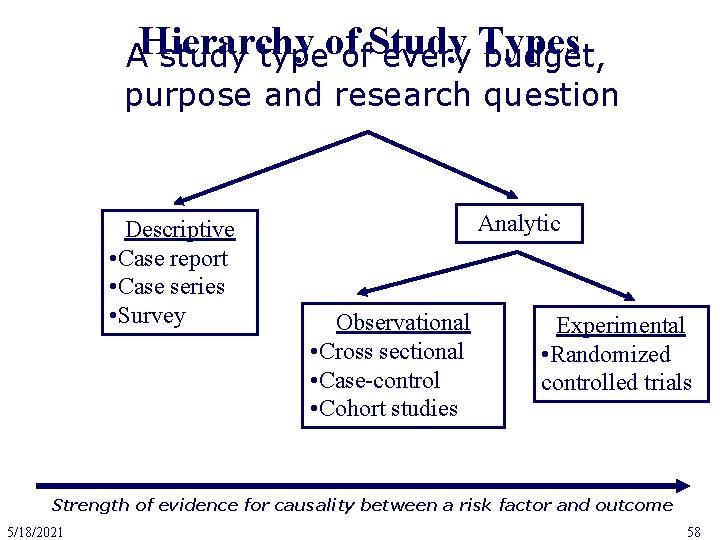
AHierarchy study typeof of. Study every Types budget, purpose and research question Descriptive • Case report • Case series • Survey Analytic Observational • Cross sectional • Case-control • Cohort studies Experimental • Randomized controlled trials Strength of evidence for causality between a risk factor and outcome 5/18/2021 58
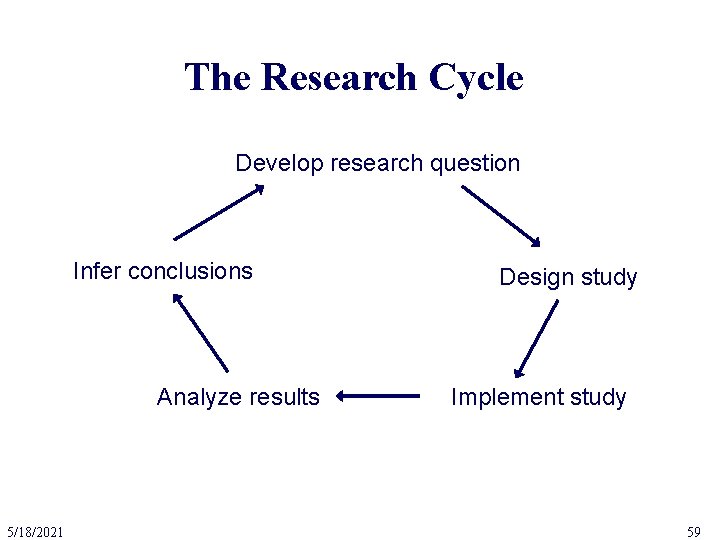
The Research Cycle Develop research question Infer conclusions Analyze results 5/18/2021 Design study Implement study 59

Thanks ! 5/18/2021 60
- Slides: 60