
Biosensor for Detecting Mycotoxins in Grains Sundaram Gunasekaran
Biosensor for Detecting Mycotoxins in Grains Sundaram Gunasekaran University of Wisconsin-Madison In collaboration with Senay Simsek North Dakota State University Funding from The Andersons
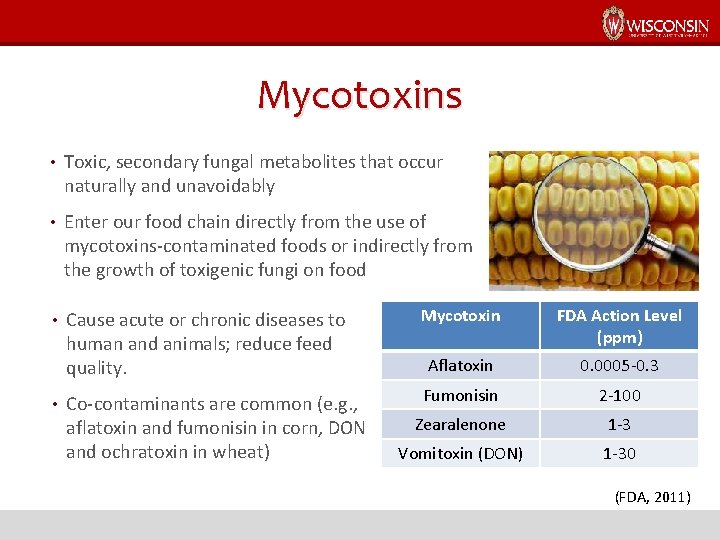
Mycotoxins • Toxic, secondary fungal metabolites that occur naturally and unavoidably • Enter our food chain directly from the use of mycotoxins-contaminated foods or indirectly from the growth of toxigenic fungi on food • Cause acute or chronic diseases to human and animals; reduce feed quality. • Co-contaminants are common (e. g. , aflatoxin and fumonisin in corn, DON and ochratoxin in wheat) Mycotoxin FDA Action Level (ppm) Aflatoxin 0. 0005 -0. 3 Fumonisin 2 -100 Zearalenone 1 -3 Vomitoxin (DON) 1 -30 (FDA, 2011)
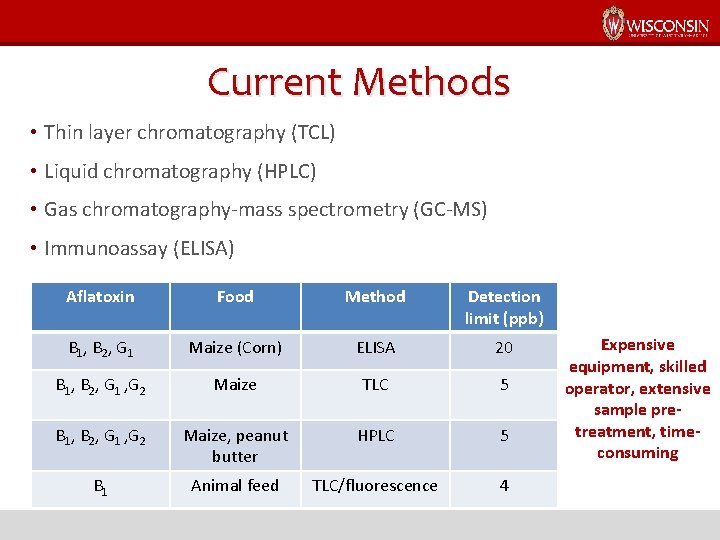
Current Methods • Thin layer chromatography (TCL) • Liquid chromatography (HPLC) • Gas chromatography-mass spectrometry (GC-MS) • Immunoassay (ELISA) Aflatoxin Food Method Detection limit (ppb) B 1, B 2, G 1 Maize (Corn) ELISA 20 B 1, B 2, G 1 , G 2 Maize TLC 5 B 1, B 2, G 1 , G 2 Maize, peanut butter HPLC 5 B 1 Animal feed TLC/fluorescence 4 Expensive equipment, skilled operator, extensive sample pretreatment, timeconsuming
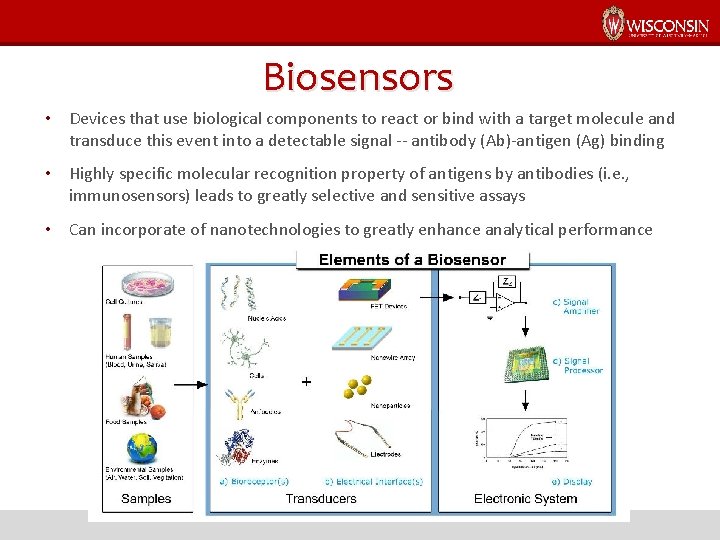
Biosensors • Devices that use biological components to react or bind with a target molecule and transduce this event into a detectable signal -- antibody (Ab)-antigen (Ag) binding • Highly specific molecular recognition property of antigens by antibodies (i. e. , immunosensors) leads to greatly selective and sensitive assays • Can incorporate of nanotechnologies to greatly enhance analytical performance
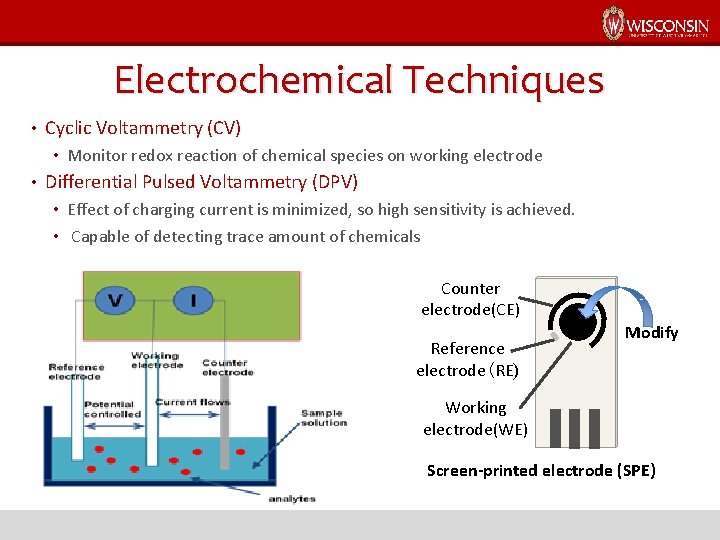
Electrochemical Techniques • Cyclic Voltammetry (CV) • Monitor redox reaction of chemical species on working electrode • Differential Pulsed Voltammetry (DPV) • Effect of charging current is minimized, so high sensitivity is achieved. • Capable of detecting trace amount of chemicals Counter electrode(CE) Reference electrode(RE) Modify Working electrode(WE) Screen-printed electrode (SPE)
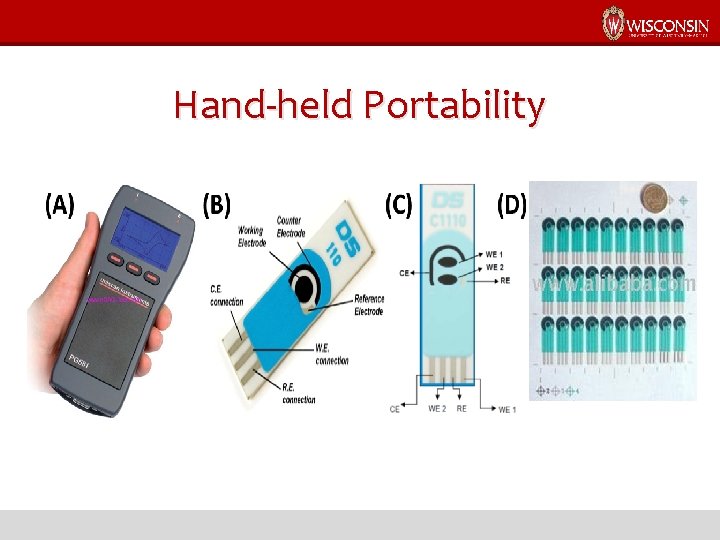
Hand-held Portability
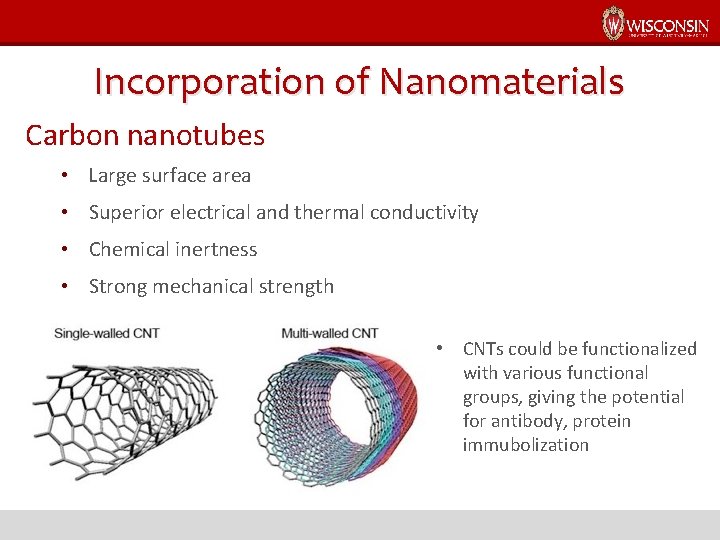
Incorporation of Nanomaterials Carbon nanotubes • Large surface area • Superior electrical and thermal conductivity • Chemical inertness • Strong mechanical strength • CNTs could be functionalized with various functional groups, giving the potential for antibody, protein immubolization
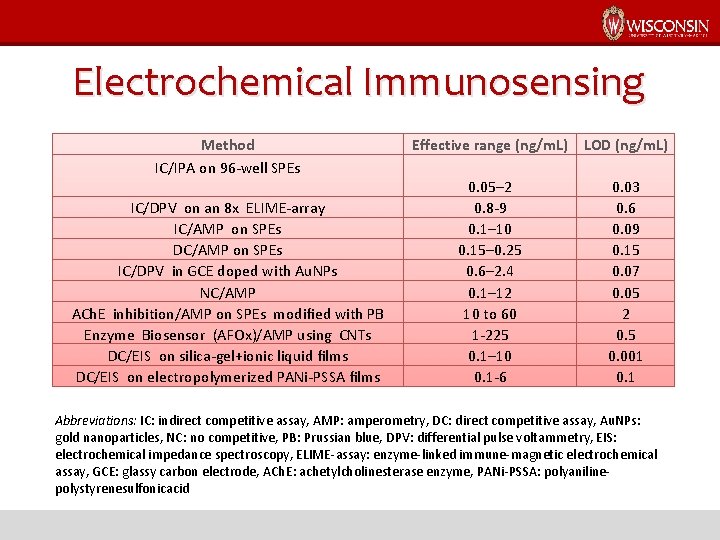
Electrochemical Immunosensing Method IC/IPA on 96 -well SPEs IC/DPV on an 8 x ELIME-array IC/AMP on SPEs DC/AMP on SPEs IC/DPV in GCE doped with Au. NPs NC/AMP ACh. E inhibition/AMP on SPEs modified with PB Enzyme Biosensor (AFOx)/AMP using CNTs DC/EIS on silica-gel+ionic liquid films DC/EIS on electropolymerized PANi-PSSA films Effective range (ng/m. L) LOD (ng/m. L) 0. 05– 2 0. 8 -9 0. 1– 10 0. 15– 0. 25 0. 6– 2. 4 0. 1– 12 10 to 60 1 -225 0. 1– 10 0. 1 -6 0. 03 0. 6 0. 09 0. 15 0. 07 0. 05 2 0. 5 0. 001 0. 1 Abbreviations: IC: indirect competitive assay, AMP: amperometry, DC: direct competitive assay, Au. NPs: gold nanoparticles, NC: no competitive, PB: Prussian blue, DPV: differential pulse voltammetry, EIS: electrochemical impedance spectroscopy, ELIME-assay: enzyme-linked immune-magnetic electrochemical assay, GCE: glassy carbon electrode, ACh. E: achetylcholinesterase enzyme, PANi-PSSA: polyanilinepolystyrenesulfonicacid
Motivation • Due to widespread co-occurrence of multiple toxins in food matrices and their possible additive or synergistic adverse effects, we need a system to sensitively and simultaneously detect multiple toxins. • Currently, such multi-toxin detection methods are not available on a rapid, easy-to-use and portable biosensor platform.
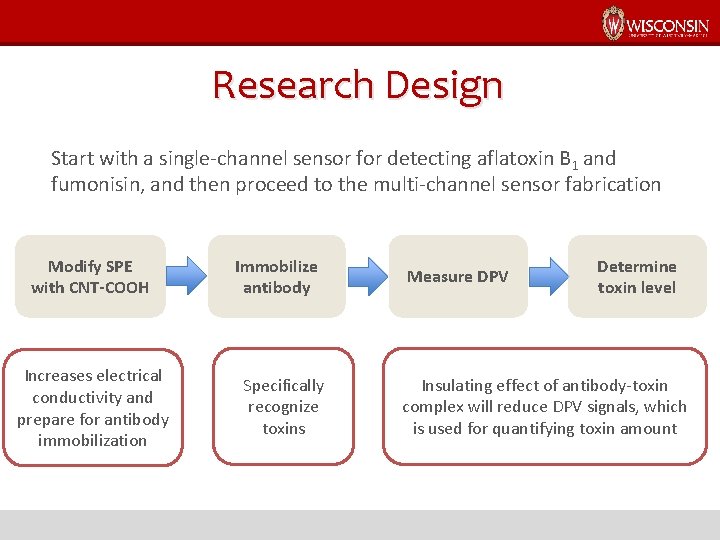
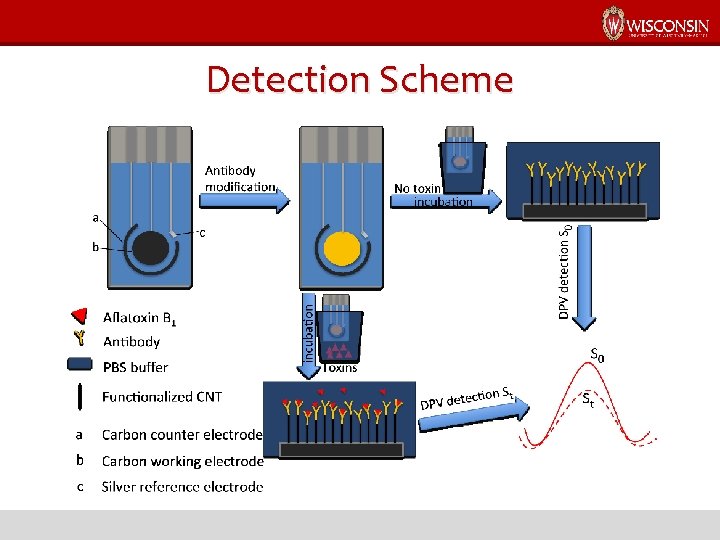
Research Design Start with a single-channel sensor for detecting aflatoxin B 1 and fumonisin, and then proceed to the multi-channel sensor fabrication Modify SPE with CNT-COOH Increases electrical conductivity and prepare for antibody immobilization Immobilize antibody Specifically recognize toxins Measure DPV Determine toxin level Insulating effect of antibody-toxin complex will reduce DPV signals, which is used for quantifying toxin amount
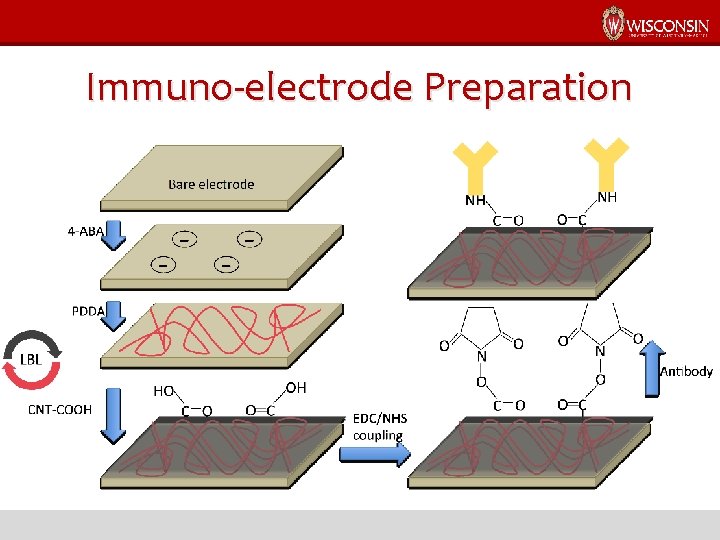
Immuno-electrode Preparation
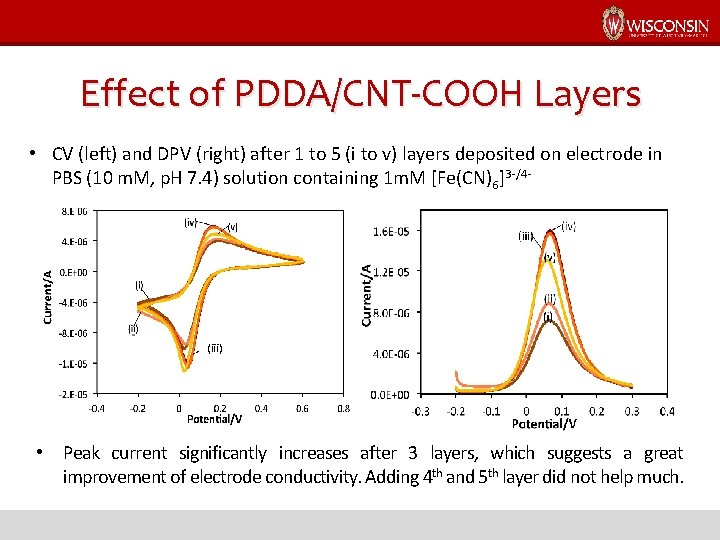
Effect of PDDA/CNT-COOH Layers • CV (left) and DPV (right) after 1 to 5 (i to v) layers deposited on electrode in PBS (10 m. M, p. H 7. 4) solution containing 1 m. M [Fe(CN)6]3 -/4 - (iii) • Peak current significantly increases after 3 layers, which suggests a great improvement of electrode conductivity. Adding 4 th and 5 th layer did not help much.
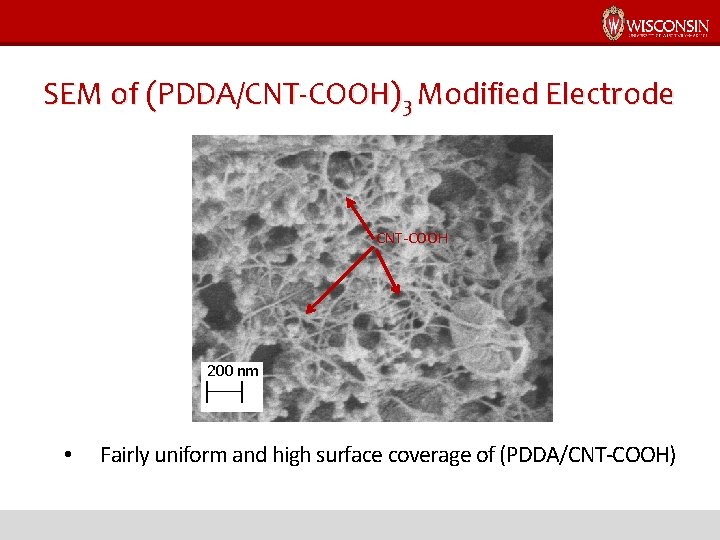
SEM of (PDDA/CNT-COOH)3 Modified Electrode CNT-COOH • Fairly uniform and high surface coverage of (PDDA/CNT-COOH)
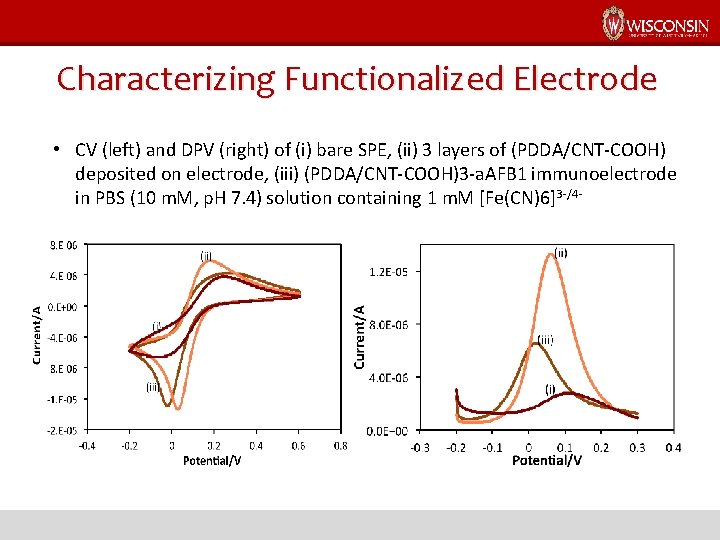
Characterizing Functionalized Electrode • CV (left) and DPV (right) of (i) bare SPE, (ii) 3 layers of (PDDA/CNT-COOH) deposited on electrode, (iii) (PDDA/CNT-COOH)3 -a. AFB 1 immunoelectrode in PBS (10 m. M, p. H 7. 4) solution containing 1 m. M [Fe(CN)6]3 -/4 -
Detection Scheme
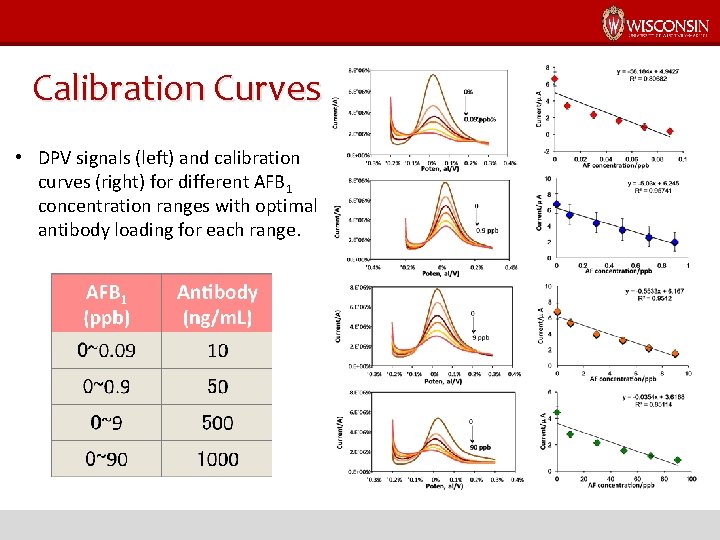
Calibration Curves • DPV signals (left) and calibration curves (right) for different AFB 1 concentration ranges with optimal antibody loading for each range.
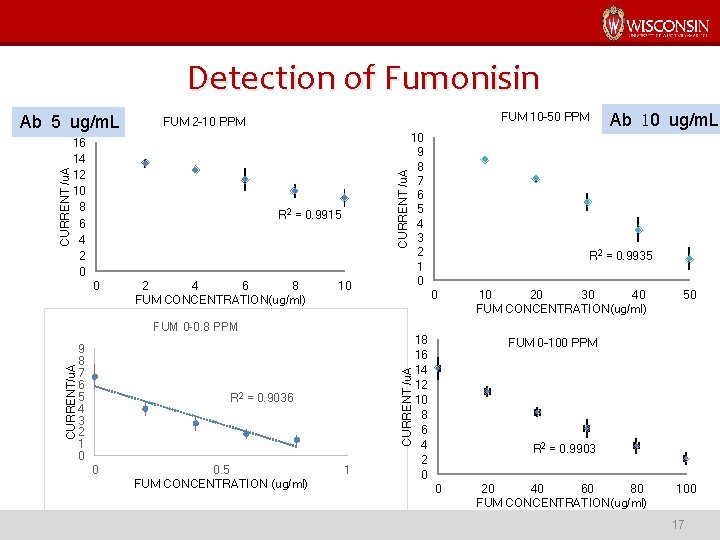
Detection of Fumonisin FUM 10 -50 PPM FUM 2 -10 PPM 16 14 12 10 8 6 4 2 0 CURRENT /u. A Ab 5 ug/m. L R 2 = 0. 9915 0 2 4 6 8 FUM CONCENTRATION(ug/ml) 10 10 9 8 7 6 5 4 3 2 1 0 CURRENT /u. A CURRENT/u. A 9 8 7 6 5 4 3 2 1 0 R 2 = 0. 9036 0 0. 5 FUM CONCENTRATION (ug/ml) 1 R 2 = 0. 9935 0 FUM 0 -0. 8 PPM Ab 10 ug/m. L 18 16 14 12 10 8 6 4 2 0 10 20 30 40 FUM CONCENTRATION(ug/ml) 50 FUM 0 -100 PPM R 2 = 0. 9903 0 20 40 60 80 FUM CONCENTRATION(ug/ml) 100 17
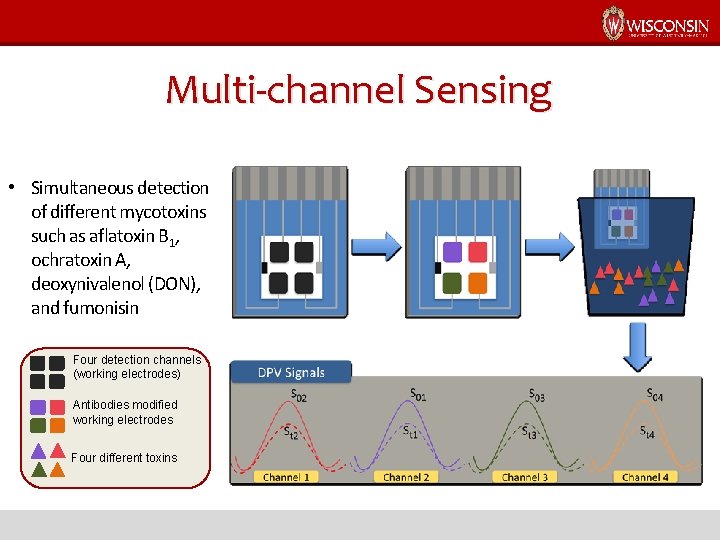
Multi-channel Sensing • Simultaneous detection of different mycotoxins such as aflatoxin B 1, ochratoxin A, deoxynivalenol (DON), and fumonisin Four detection channels (working electrodes) Antibodies modified working electrodes Four different toxins

Thank you!
- Slides: 19