
Biosecurity How Export Controls impact the Life Sciences
Biosecurity: How Export Controls impact the Life Sciences Betty Lee, Ph. D. Chemical and Biological Controls Division Bureau of Industry and Security Department of Commerce 2 nd International Conference on Systems and Synthetic Biology, Aug 18 -20, 2016 London, UK
TOPICS • Definition of Biosecurity, Dual Use Research, Multi. Lateral Regimes • Export Control as a tool for Biosecurity • Summary
Biosecurity • Defined as measures taken to limit the threats posed by • Pandemic outbreaks • Theft of biological agents • Bioterrorism • Biosecurity is important for public health and the agriculture industry

Dual Use Research ‘Encompasses biological research with legitimate scientific purpose, the results of which may be misused to pose a biologic threat to public health and/or national security’ www. biosecurityboard. gov/faq. asp#14.

Publications of Dual Use Research natural template. Science. 297(5583): 1016 -1018. • In 2002, researchers published the results of the synthetic reconstruction of poliovirus (J. Cello, et al Science 297(5583): 10161018) • Life Sciences is interdisciplinary-includes computational biology, systems biology, nanotechnology and synthetic biology • Dual use research can produce biological organisms and knowledge to improve health or harm others • Such research should not be prohibited but it requires increased scrutiny (Biotechnology Research in an Age of Terrorism, National Research Council, 2004)

Biosecurity and Non-Proliferation Multilateral Regimes Control Lists Dual Use Research Controlled Technology Export Control Biosecurity and Non. Proliferation
Multilateral Regimes and Export Control • Australia Group (AG)-41 members and the EU • Missile Technology Control Regime (MTCR)-35 members • Nuclear Suppliers Group (NSG)-48 members • Wassenaar Arrangement (WA)-41 members
Emerging Technologies • New Technologies may have dual use implications e. g. Synthetic Biology, Gene Editing (CRISPR) , etc • Biosecurity and Biosafety could be affected by nefarious use of such technologies by terrorists
Export Control as a Tool • Impede the proliferation of Dual Use Technologies by terrorists • Enhance Biosecurity by controlling listed pathogens and genetic elements for legitimate uses • Ensure that entities are vetted and not on Denied Parties or Sanctions lists
Chemical and Biological Controls • AG Common Control List-updated to include emerging technologies • US Commerce Control List-updated according to the AG List
Mission of BIS Advance U. S. national security, foreign policy, and economic objectives by ensuring an effective export control and treaty compliance system and promoting continued U. S. strategic technology leadership.
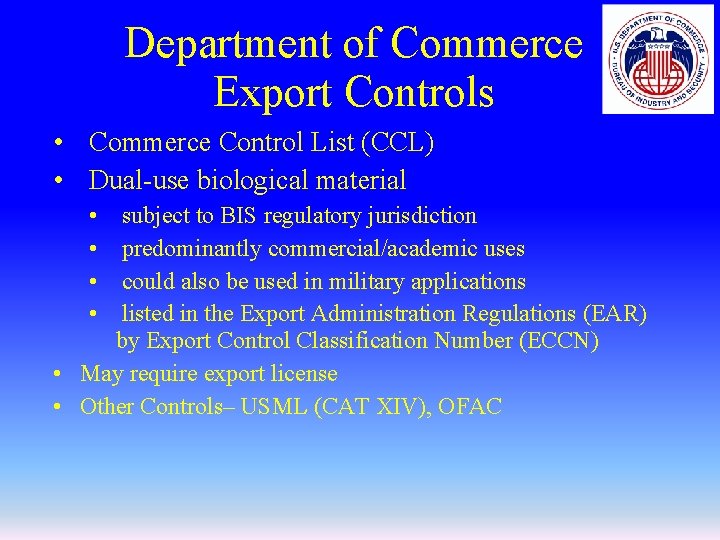
Department of Commerce Export Controls • Commerce Control List (CCL) • Dual-use biological material • • subject to BIS regulatory jurisdiction predominantly commercial/academic uses could also be used in military applications listed in the Export Administration Regulations (EAR) by Export Control Classification Number (ECCN) • May require export license • Other Controls– USML (CAT XIV), OFAC
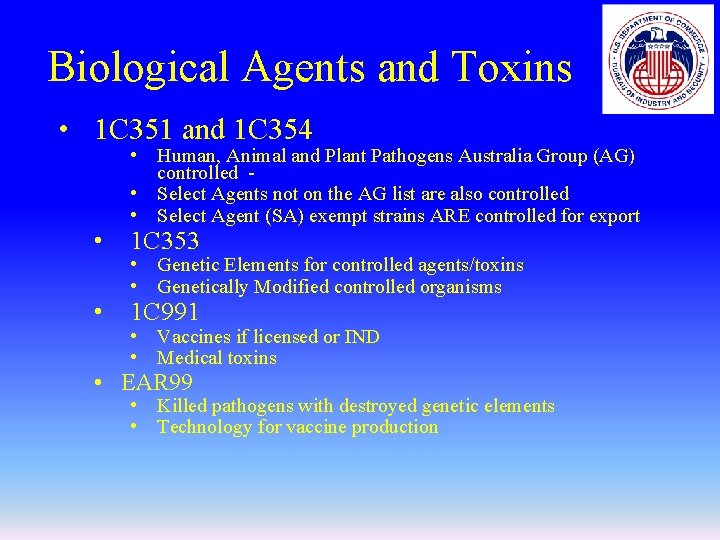
Biological Agents and Toxins • 1 C 351 and 1 C 354 • • • Human, Animal and Plant Pathogens Australia Group (AG) controlled • Select Agents not on the AG list are also controlled • Select Agent (SA) exempt strains ARE controlled for export 1 C 353 • Genetic Elements for controlled agents/toxins • Genetically Modified controlled organisms 1 C 991 • Vaccines if licensed or IND • Medical toxins • EAR 99 • Killed pathogens with destroyed genetic elements • Technology for vaccine production
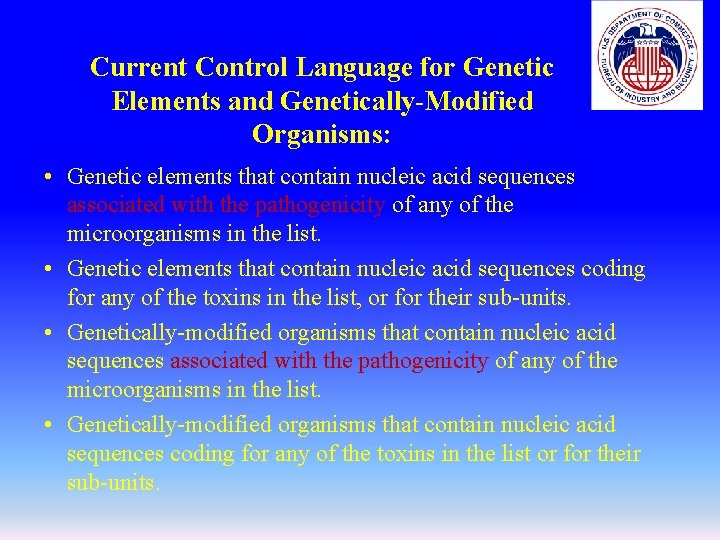
Current Control Language for Genetic Elements and Genetically-Modified Organisms: • Genetic elements that contain nucleic acid sequences associated with the pathogenicity of any of the microorganisms in the list. • Genetic elements that contain nucleic acid sequences coding for any of the toxins in the list, or for their sub-units. • Genetically-modified organisms that contain nucleic acid sequences associated with the pathogenicity of any of the microorganisms in the list. • Genetically-modified organisms that contain nucleic acid sequences coding for any of the toxins in the list or for their sub-units.
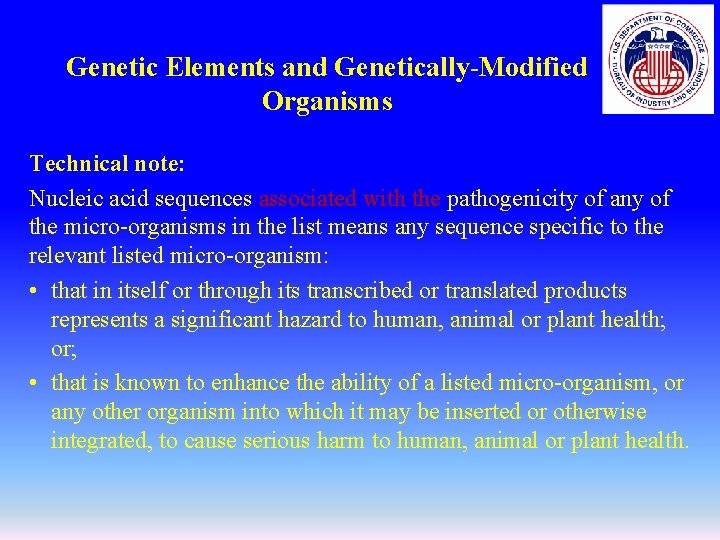
Genetic Elements and Genetically-Modified Organisms Technical note: Nucleic acid sequences associated with the pathogenicity of any of the micro-organisms in the list means any sequence specific to the relevant listed micro-organism: • that in itself or through its transcribed or translated products represents a significant hazard to human, animal or plant health; or; • that is known to enhance the ability of a listed micro-organism, or any other organism into which it may be inserted or otherwise integrated, to cause serious harm to human, animal or plant health.
Genetic Element Exports • Whole Nucleic acids – not controlled if • Certified non-infective and chemically treated to be non -recoverable • Chimeric Viruses- controlled if • Based on a controlled virus • Has controlled virus element in non-controlled virus • Plasmids - controlled if • Promoter present • Complete gene or Viral Particle • Replication competent
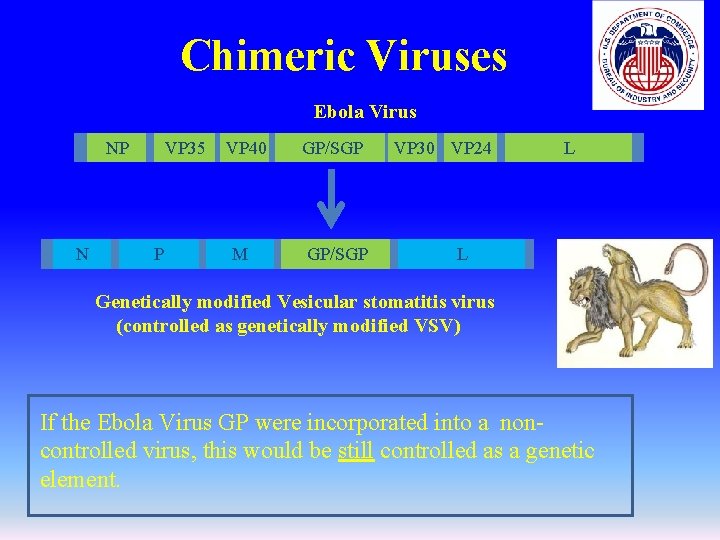
Chimeric Viruses Ebola Virus NP N VP 35 P VP 40 M GP/SGP G GP/SGP VP 30 VP 24 L L Genetically modified Vesicular stomatitis virus (controlled as genetically modified VSV) If the Ebola Virus GP were incorporated into a noncontrolled virus, this would be still controlled as a genetic element.
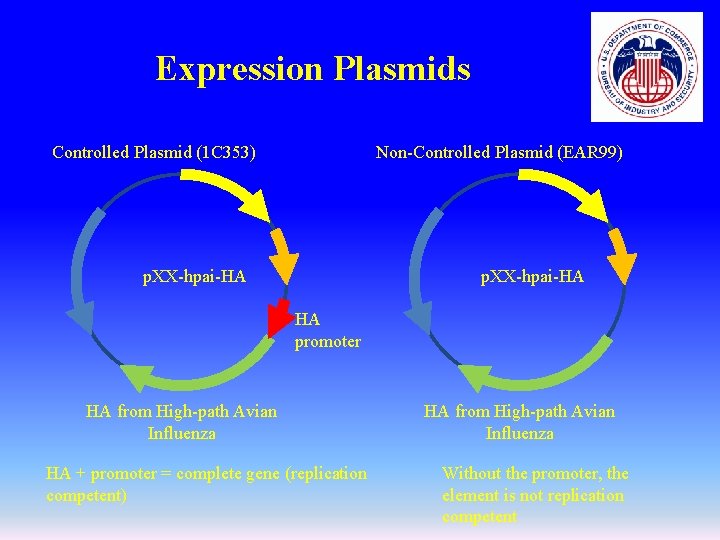
Expression Plasmids Controlled Plasmid (1 C 353) Non-Controlled Plasmid (EAR 99) p. XX-hpai-HA HA promoter HA from High-path Avian Influenza HA + promoter = complete gene (replication competent) HA from High-path Avian Influenza Without the promoter, the element is not replication competent
Intangible Technology Transfer (ITT) and The Commerce Control List(CCL)
Technology Definitions • Definitions used in the EAR are consistent with the control language used by the multilateral export control regimes. • Intangible Technology Transfer (ITT): Controlled technology that is transferred by -Electronic means, email, telephone conversation, cloud access, etc. -Technical assistance-instruction : training, working knowledge, consulting services.
Technology Considerations • Is the technology related to controlled biological processing equipment? • “Development” • “Production” • “Use” • Is the technology related to manipulation of controlled biologicals that is not public domain or fundamental research? • Where is the transfer taking place? • Deemed export vs. tech transfer
SUMMARY • Export Control is one tool for maintaining Biosecurity and Non-Proliferation • Control lists are updated on an annual basis-items can be added or deleted • Multilateral regimes review emerging technologies for their potential dual use implications
Additional Information BIS Biological Controls: www. bis. doc. gov/index. php/policy-guidance/product-guidance/chemical-andbiological-controls Deemed Export: www. bis. doc. gov/index. php/policy-guidance/deemed-exports-faqs NIH DURC: http: //osp. od. nih. gov/office-biotechnology-activities/biosecurity/dual-use-research-concern Regulation updates: 6/7/2016 81 FR 36458 Implementation of the February 2015 Australia Group (AG) Intersessional Decisions and the June 2015 AG Plenary Understandings 6/3/2016 81 FR 35586 Revisions to Definitions in the Export Administration Regulations
THANK YOU Questions ? Contact Information: Betty. Lee@bis. doc. gov
Scenario 1 • Researcher working with Yellow Fever Virus • Exports strain to colleague in Kenya for use in vaccine production • Foreign student in lab on different project • Research increases Yellow Fever virulence generating a monovalent vaccine candidate
Scenario 2 • Researcher ships new YF strain to Kenya • Foreign student (from Malaysia) is learning to increase YF virus pathogenicity • Colleague in Kenya asks for unpublished methodology on increasing Yellow Fever virulence
Scenario 3 • Malaysian student becomes a permanent resident. Additional student from Canada joins lab learning manipulation techniques • Paper on research is published. Researcher gets request from multiple countries for the YF strain
- Slides: 27