
Bioremediation Dr T Sivasudha Associate Professor Dept of
Bioremediation Dr. T. Sivasudha Associate Professor Dept. of Environmental Biotechnology Bharathidasan University Tiruchirappalli- 24
Bioremediation Definitions: Bioremediation is any process that uses organisms (microorganism, algae and plant) or their enzymes to return the polluted environment to its original condition. Biodegradation is the use of these organisms in the degradation of different pollutants. Xenobiotic compounds are chemical compounds found in an organism but it are not normally produced or expected to be present in it. Cometabolism: in this process the microorganism produces an enzyme to utilizes its nutrients, but by chance this enzyme can degrade a pollutant.
Bioremediation Definitions: • Using subsurface microorganisms to transform hazardous contaminants into relatively harmless byproducts, such as Co 2 and water – Biodegradation – Mineralization – Biotransformation • Techniques or types of bioremediation: – Natural Attenuation – Enhanced Bioremediation – Bioaugmentation

Background Natural Attenuation is slower process, to be broadly used for some compounds, especially chlorinated solvents The current trend is to stimulate/enhance a site’s indigenous subsurface microorganisms by the addition of nutrients and electron donor Bioaugmentation/Biostimulation is necessary when metabolic capabilities are not naturally present.
Historical Perspectives ~1900 Advent of biological processes to treat organics derived from human or animal wastes (and the sludges produced) ~1950 Approaches to extend wastewater treatment to industrial wastes ~1960 Investigations into the bioremediation of synthetic chemicals in wastewaters ~1970 Application in hydrocarbon contamination such as oil spills and petroleum in groundwater ~1980 Investigations of bioremediation applications for substituted organics ~1990 Natural Attenuation of ’ 70 and ’ 90, and the development of barrier approaches ~2000 High-rate in situ bioremediation; source zone reduction; bioaugmentation
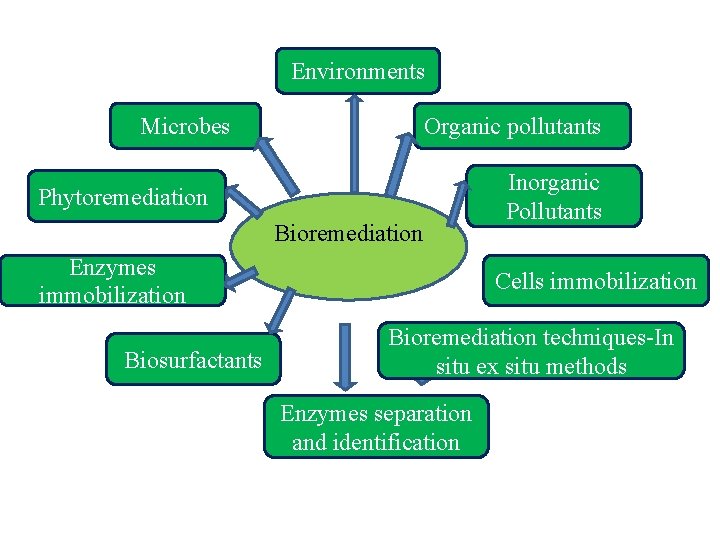
Environments Microbes Organic pollutants Phytoremediation Bioremediation Enzymes immobilization Biosurfactants Inorganic Pollutants Cells immobilization Bioremediation techniques-In situ ex situ methods Enzymes separation and identification
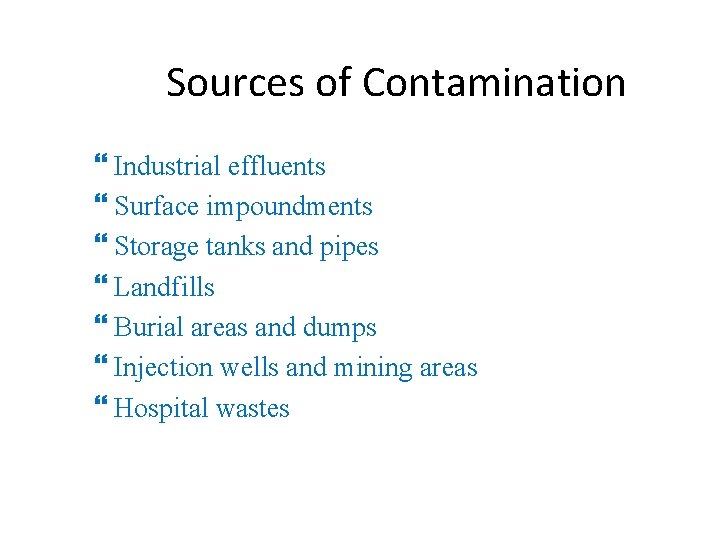
Sources of Contamination Industrial effluents Surface impoundments Storage tanks and pipes Landfills Burial areas and dumps Injection wells and mining areas Hospital wastes
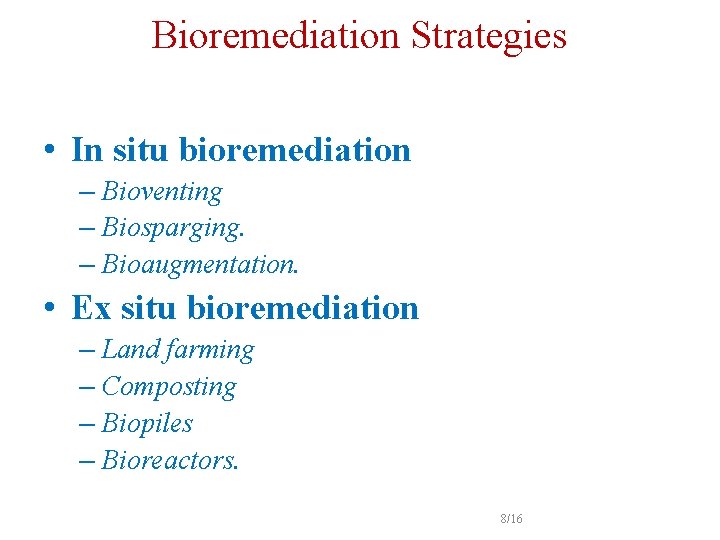
Bioremediation Strategies • In situ bioremediation – Bioventing – Biosparging. – Bioaugmentation. • Ex situ bioremediation – Land farming – Composting – Biopiles – Bioreactors. 8/16
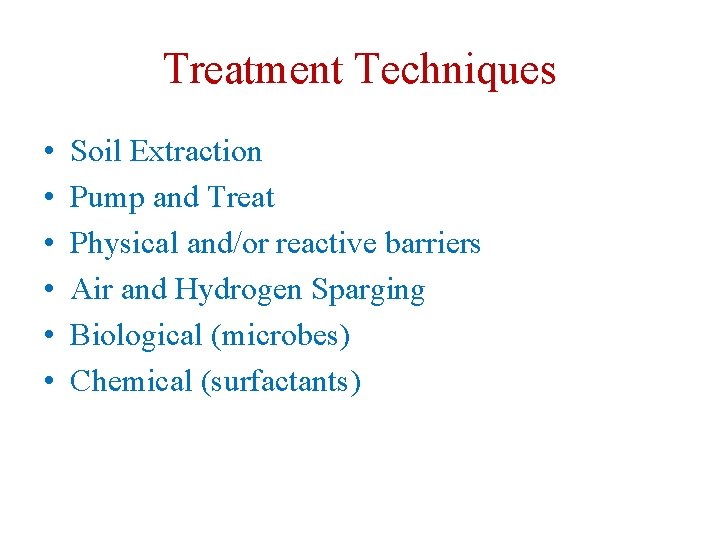
Treatment Techniques • • • Soil Extraction Pump and Treat Physical and/or reactive barriers Air and Hydrogen Sparging Biological (microbes) Chemical (surfactants)
Aerobic v. Anaerobic • If oxygen is the terminal electron acceptor, the process is called aerobic biodegradation • All other biological degradation processes are classified as anaerobic biodegradation • In most cases, bacteria can only use one terminal electron acceptor • Facultative aerobes use oxygen, but can switch to nitrate in the absence of oxygen
• Most of the time oxygen is the primary factor limiting in situ biodegradation • In most cases if adequate oxygen can be supplied then biodegradation rates are adequate for remediation • Other limiting factors exist, but are usually secondary to oxygen
Biosurfactants The biosurfactants are chemical compounds characterized by hydrophobic and hydrophilic (nonpolar and polar) regions in one molecule (amphipathic molecules). Biosurfactants from bacteria, cyanobacteria, fungi and yeast are classified into: 1) Glycolipids. 2) Lipopeptides. 3) Phospholipids. 4) Glycoproteins. 5) Polymeric biosurfactants.
Phytoremediation • The mobilization of heavy metals by man through extraction from ores and processing for different applications has led to the release of these elements into the environment. • Since heavy metals are nonbiodegradable, they accumulate in the environment and subsequently contaminate the food chain. • This contamination poses a risk to environmental and human health. Some heavy metals are carcinogenic, mutagenic, teratogenic and endocrine disruptors while others cause neurological and behavioral changes especially in children. • Thus remediation of heavy metal pollution deserves due attention
Phytoremediation • Phytoremediation is an area of active current research. • New efficient metal hyperaccumulators are being explored for applications in phytoremediation and phytomining. • Molecular tools are being used to better understand the mechanisms of metal uptake, translocation, sequestration and tolerance in plants. • Ref: https: //doi. org/10. 1016/j. chemosphere. 2013. 01. 075
- Slides: 14