
Biopsychology Localisation of function The human brain l
Biopsychology Localisation of function
The human brain l The brain is separated into 2 hemispheres. l These hemispheres are the newly evolved sections of the brain and are involved in higher cognitive functions such as vision, memory and thought. l The left and right hemispheres are symmetrical in shape and are divided into 2 separate halves joined by a bundle of fibres called the corpus callosum.
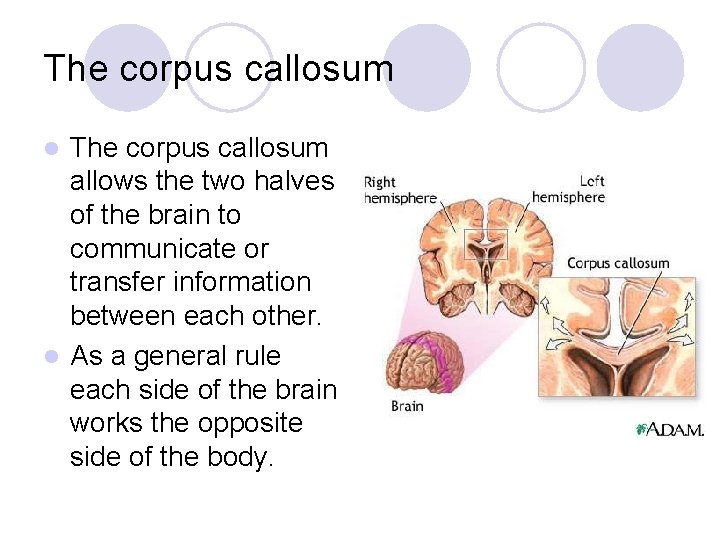
The corpus callosum allows the two halves of the brain to communicate or transfer information between each other. l As a general rule each side of the brain works the opposite side of the body. l
Key Study Krupa et al. (1993) Aim – They conducted a series of experiments on rabbits to investigate the role of the cerebellum in memory. Method – Rabbits were conditioned to blink their eyes in response to a certain sound. Once the rabbit had been conditioned to make this response, a drug was administered which temporarily stopped the action of the cerebellum.
Results – The rabbits failed to blink to the sound that had been conditioned while the drug was active; however, as the drug wore off, the conditioned response returned. Conclusion – The results show that the cerebellum is involved in simple memory tasks.
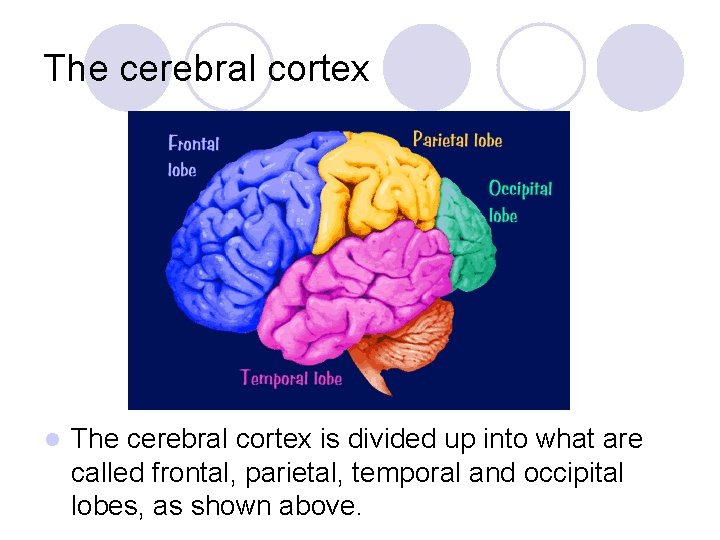
The cerebral cortex l The cerebral cortex is divided up into what are called frontal, parietal, temporal and occipital lobes, as shown above.
The functions The frontal lobe: motor processing (body movement); higher thought processes such as abstract reasoning. l Parietal Lobe : processing of sensations from the skin and the muscles in the body. l Temporal Lobe: mainly involved in processing auditory information; sometimes called the auditory cortex. l Occipital Lobe : mainly responsible for processing visual information; sometimes called the visual cortex. l
Localisation of Function Different parts of the brain are involved with different parts of the body. l This idea dates back to Joseph Gall (1758 -1828). Gall was an anatomist who thought that different areas of the brain related to different aspects of personality. Gall created the pseudo-science of Phrenology, which claimed that the bumps or contours of the skull revealed different psychological characteristics of the person. l
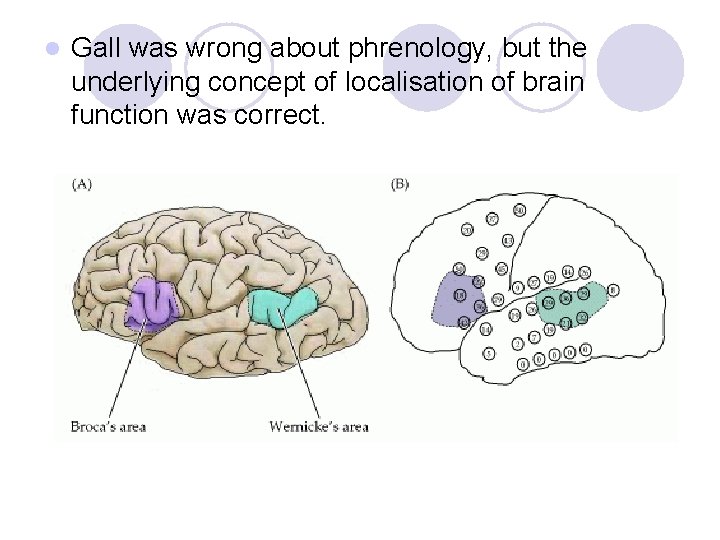
l Gall was wrong about phrenology, but the underlying concept of localisation of brain function was correct.
- Slides: 9