
BioProcess Kinetics Process Biotechnology Anondho WIJANARKO University of
Bio-Process Kinetics Process Biotechnology Anondho WIJANARKO University of Indonesia Simplified Lecture Notes For Instructor

To Dwi Imanti and Adam Aulia, Musa Maulana, Isa Dzulqarnain and Lovely Muhammad Al Muhammad
CONTENTS § Microbial Growth – Microbial Cell Growth – Classical & Empirical Growth Kinetics § Environmental Alteration Studies – Light Illumination Effect – Temperature Effect § Microbial Kinetic Studies – Non Elementer Reaction – Microbial Growth Reaction Kinetics

Microbial Growth
Microbial Cell Growth § Mode of Growth – Selective assimilation of nutrients and convert into and also include Chemical rearrangement of protoplasmic material characteristic of the particular organism – Production of an increased amount of nuclear substance and cell division
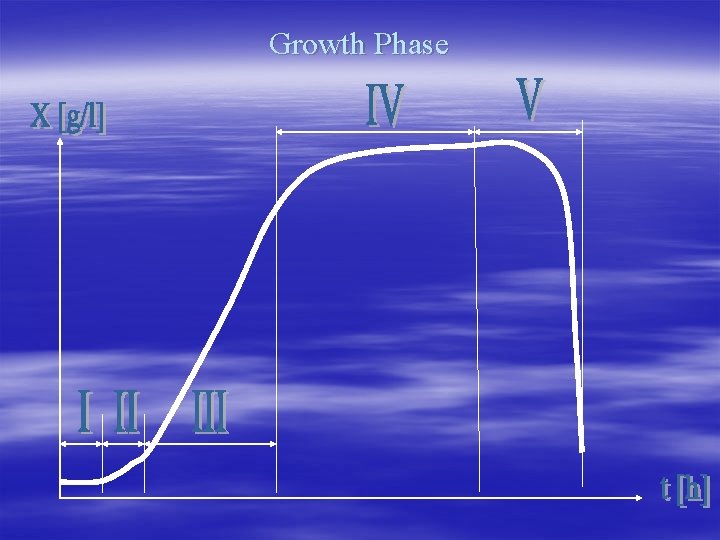
Growth Phase
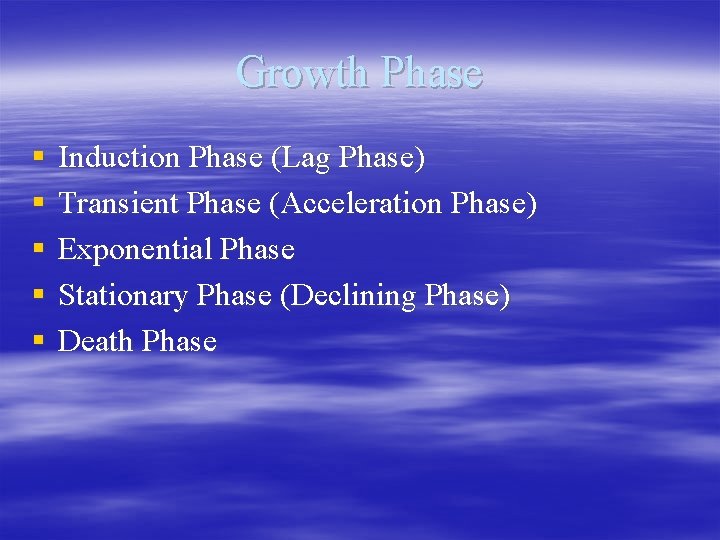
Growth Phase § § § Induction Phase (Lag Phase) Transient Phase (Acceleration Phase) Exponential Phase Stationary Phase (Declining Phase) Death Phase
Question Sheet § Why microbial growth have an lag phase? § Why death phase could be occurred in microbial growth? § What is essential nutrient for growth of organism especially prokaryotes? § What is important factor for cell division?
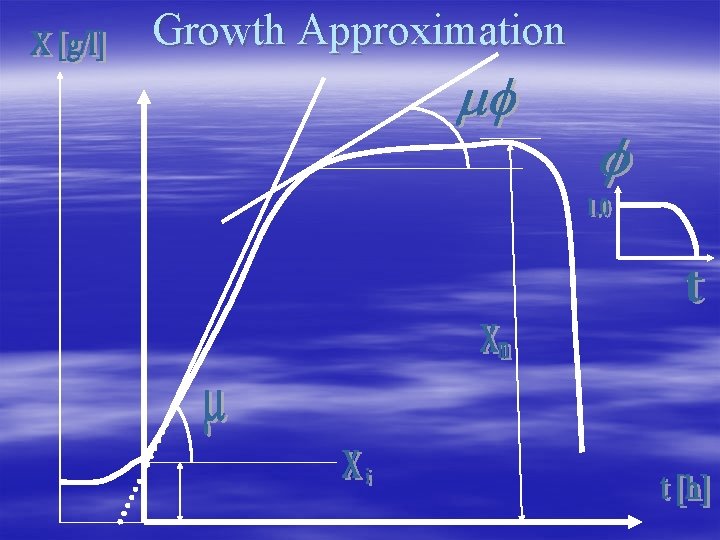
Growth Approximation
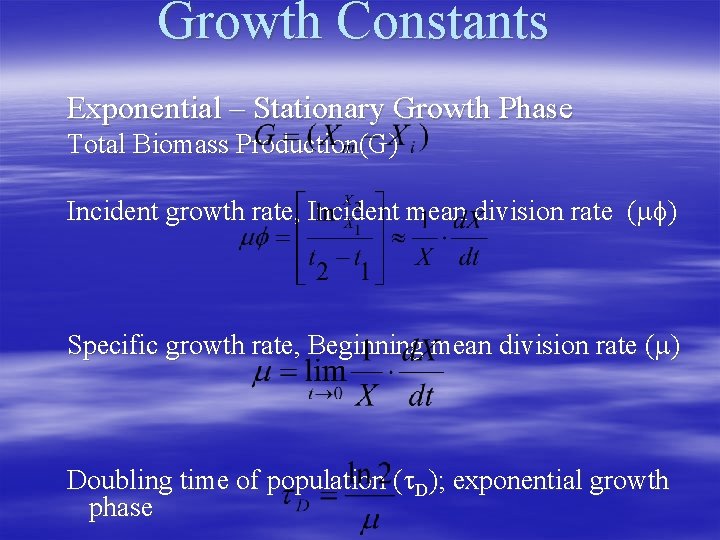
Growth Constants Exponential – Stationary Growth Phase Total Biomass Production(G) Incident growth rate, Incident mean division rate (mf) Specific growth rate, Beginning mean division rate (m) Doubling time of population (t. D); exponential growth phase

Classical Growth Kinetics Empirical Approximation § Monod Growth Kinetic § Tessier Growth Kinetic § Moser Growth Kinetic § Contois Growth Kinetic
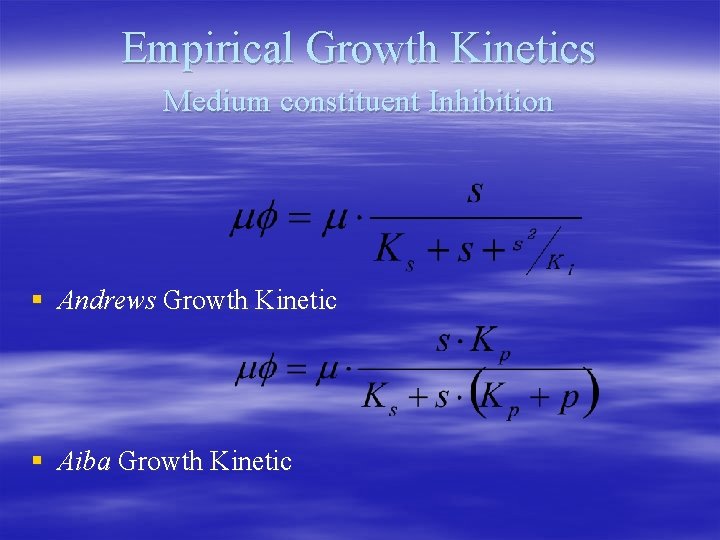
Empirical Growth Kinetics Medium constituent Inhibition § Andrews Growth Kinetic § Aiba Growth Kinetic

Growth Kinetics Multiple essential nutrient § Bailey Growth Kinetic
Home Work § Which kinetic approximation do you choose in case of microbial growth of Hepatotoxin produced Oscilatoria Agardhii NIVA CYA 97 in low temperature? § Which empirical equation that you choose of inoculation of microorganism in case of multiple content limitation of nutrients, such as Mg 2+, phosphate, Nitrate and organic compound? § Which kinetic approximation do you choose of cultivation photosynthetic microorganism that did not grew up in p. H above 7. 8?
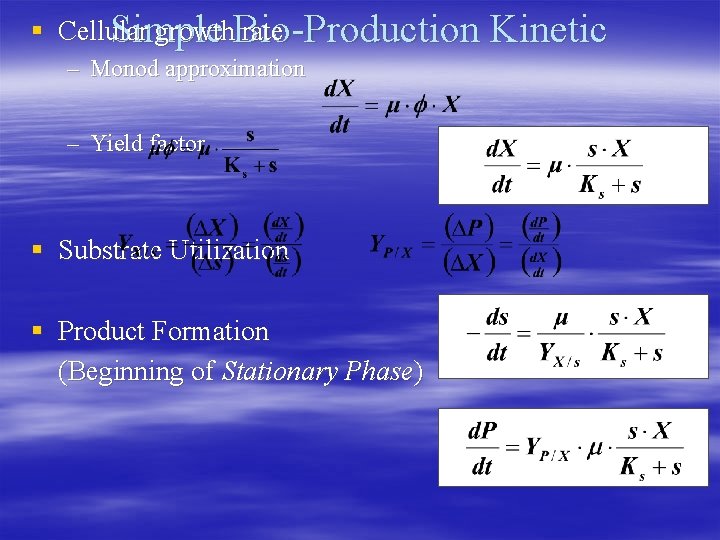
§ Cellular growth. Bio-Production rate Simple Kinetic – Monod approximation – Yield factor § Substrate Utilization § Product Formation (Beginning of Stationary Phase)

Environmental Alteration Studies
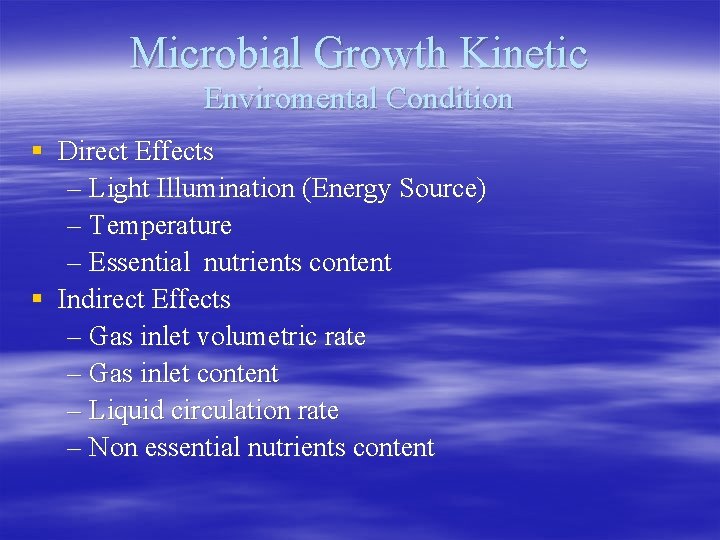
Microbial Growth Kinetic Enviromental Condition § Direct Effects – Light Illumination (Energy Source) – Temperature – Essential nutrients content § Indirect Effects – Gas inlet volumetric rate – Gas inlet content – Liquid circulation rate – Non essential nutrients content
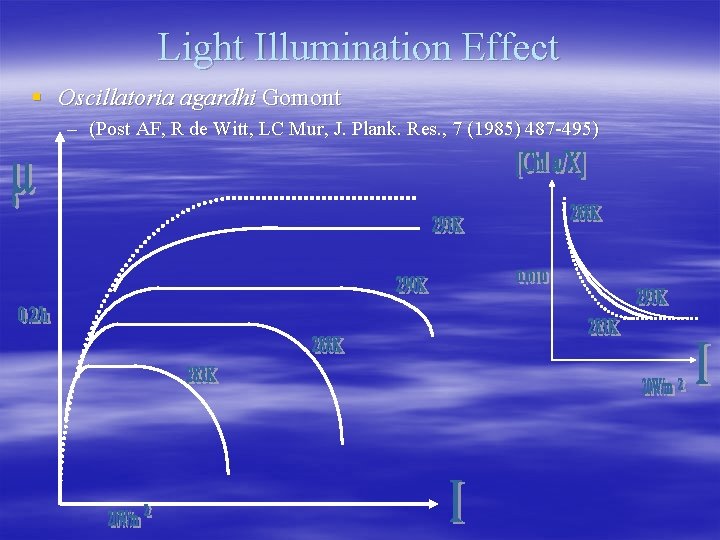
Light Illumination Effect § Oscillatoria agardhi Gomont – (Post AF, R de Witt, LC Mur, J. Plank. Res. , 7 (1985) 487 -495)
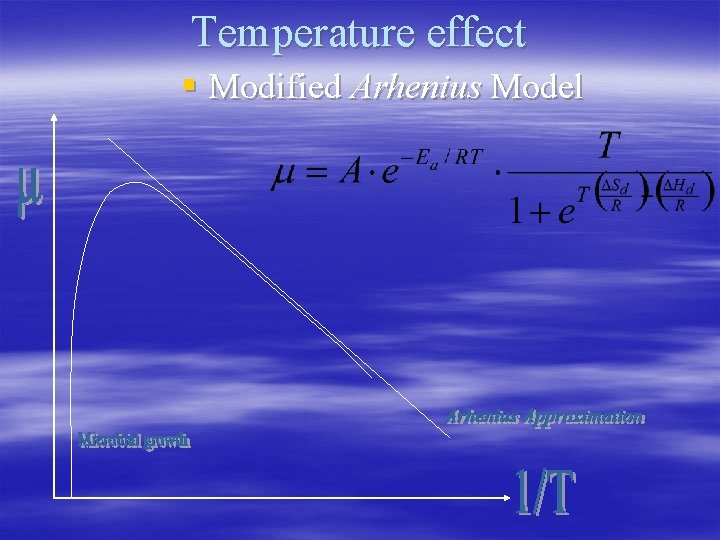
Temperature effect § Modified Arhenius Model
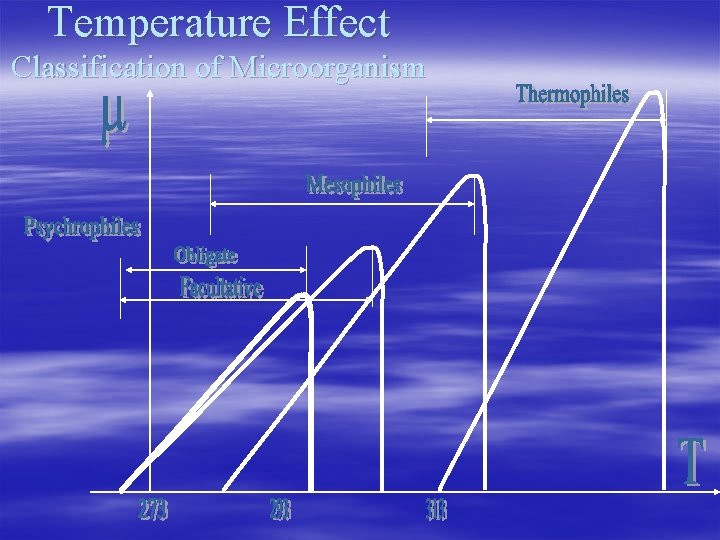
Temperature Effect Classification of Microorganism
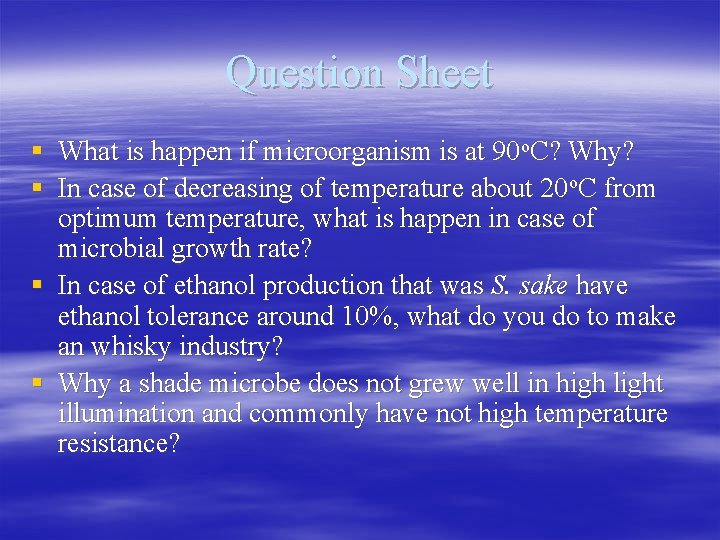
Question Sheet § What is happen if microorganism is at 90 o. C? Why? § In case of decreasing of temperature about 20 o. C from optimum temperature, what is happen in case of microbial growth rate? § In case of ethanol production that was S. sake have ethanol tolerance around 10%, what do you do to make an whisky industry? § Why a shade microbe does not grew well in high light illumination and commonly have not high temperature resistance?
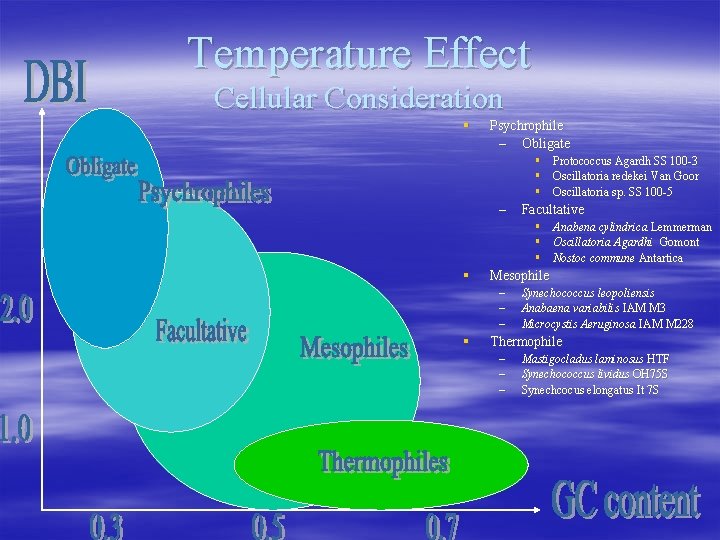
Temperature Effect Cellular Consideration § Psychrophile – Obligate § Protococcus Agardh SS 100 -3 § Oscillatoria redekei Van Goor § Oscillatoria sp. SS 100 -5 – Facultative § Anabena cylindrica Lemmerman § Oscillatoria Agardhi Gomont § Nostoc commune Antartica § Mesophile – – – § Synechococcus leopoliensis Anabaena variabilis IAM M 3 Microcystis Aeruginosa IAM M 228 Thermophile – – – Mastigocladus laminosus HTF Synechococcus lividus OH 75 S Synechcocus elongatus It 7 S
Home Work § Why optimum specific growth rate values of psychrophile factually, lower than thermophile? § Why GC content of microbial DNA is important for classification of organism in terms of growth rate dependence on temperature? § What is DBI?

Microbial Kinetic Studies
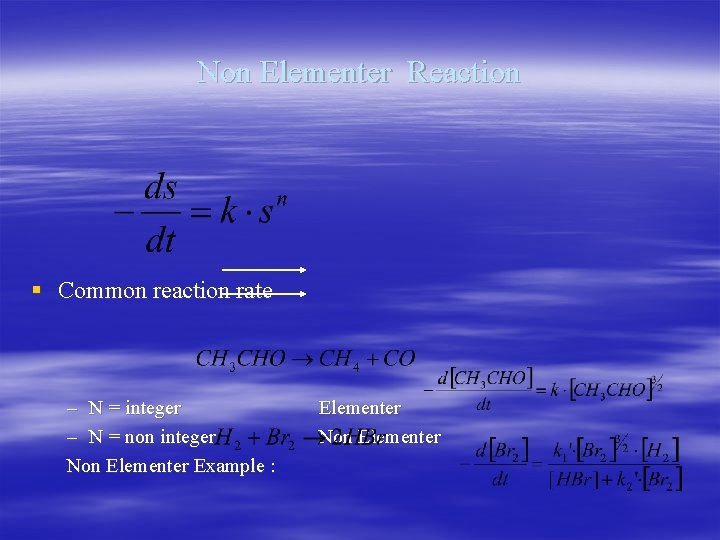
Non Elementer Reaction § Common reaction rate – N = integer – N = non integer Non Elementer Example : Elementer Non Elementer
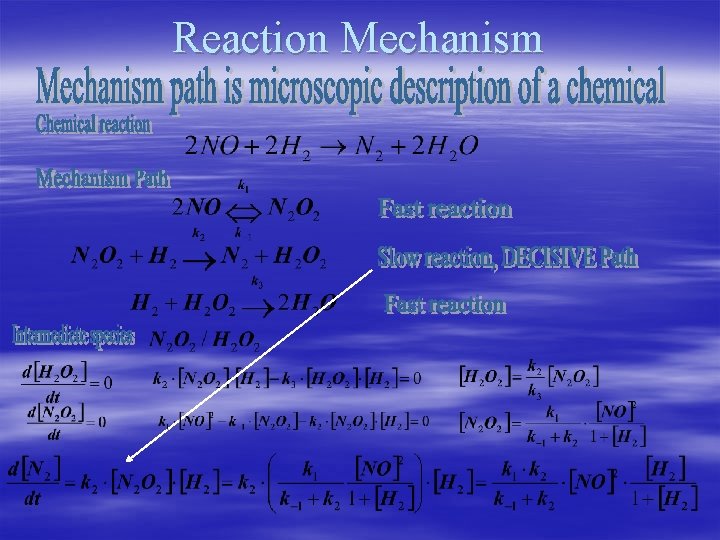
Reaction Mechanism

Question Sheet § What is mechanism path? § What definition of intermediate species? § What was become determining factor of reaction rate?
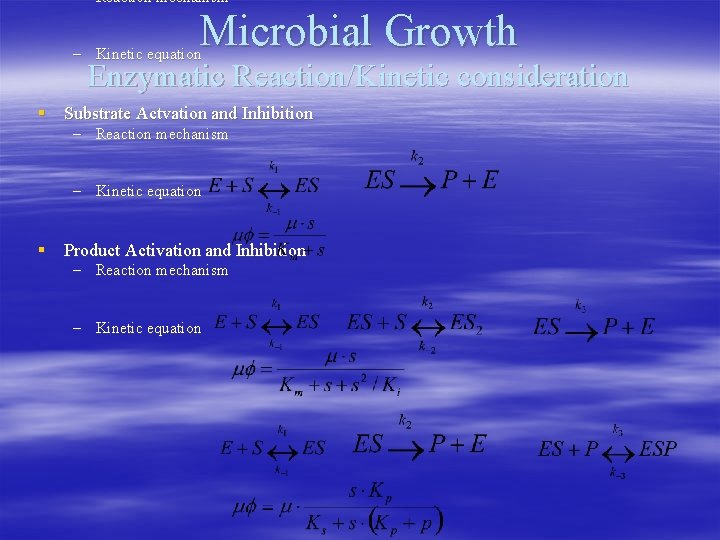
– Reaction mechanism Microbial Growth – Kinetic equation Enzymatic Reaction/Kinetic consideration § Substrate Actvation and Inhibition – Reaction mechanism – Kinetic equation § Product Activation and Inhibition – Reaction mechanism – Kinetic equation
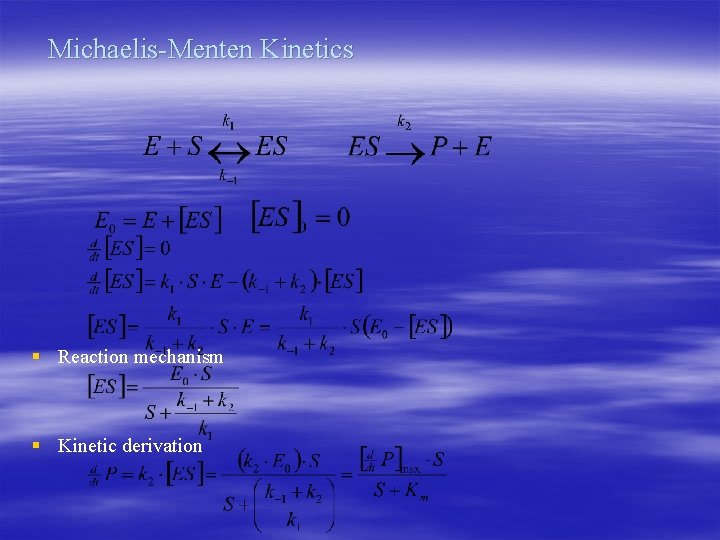
Michaelis-Menten Kinetics § Reaction mechanism § Kinetic derivation
Home Work § Please exhibit kinetic derivation of substrate activation and inhibition? § Please exhibit kinetic derivation of product activation and inhibition? § What do you think about reaction kinetic if Km is high that was indicated in bioremediation of toluene by C. nivalis?
Literature 1. 2. 3. 4. 5. 6. 7. Aruga Y. , Ecological Studies of Photosynthesis and Matter Production of Phytoplankton I: Seasonal Changes in Photosynthesis of Natural Phytoplankton, Bot. Mag. Tokyo, 78 (1965) 280 -288 Bailey JE and DF Ollis, Biochemical Engineering Fundamentals, Mc. Graw. Hill Book Co. , New York, 1986 Boney AD, Phytoplankton, Edward Arnold Publ. Ltd. , London, 1975 Contois DE, Kinetics of Bacterial Growth: Relationship between Population Density and Specific Growth Rate of Continuous Cultures, J. Gen. Microbiol. , 21 (1959) 40 -50 Castenholz RW, Laboratory Cultures of Thermophilic Cyanophyte, Symposium uber Cyanophytensystematik, 32 (1970) 538551 Foy RH, CE Gibson and RV Smith, The Influence of Day-length, Light Intensity and Temperature, on the Growth of Planktonic Blue-Green Algae, J Phycol. , 11 (1976) 151 -163 Frohlich BT, IA Webster, MM Ataai and ML Shuler, Photobioreactors: Model of Interaction of Light Intensity, Reactor Design and Algal Physiology, Biotechnol. Bioeng. Symp. , 13 (1983) 331 -350
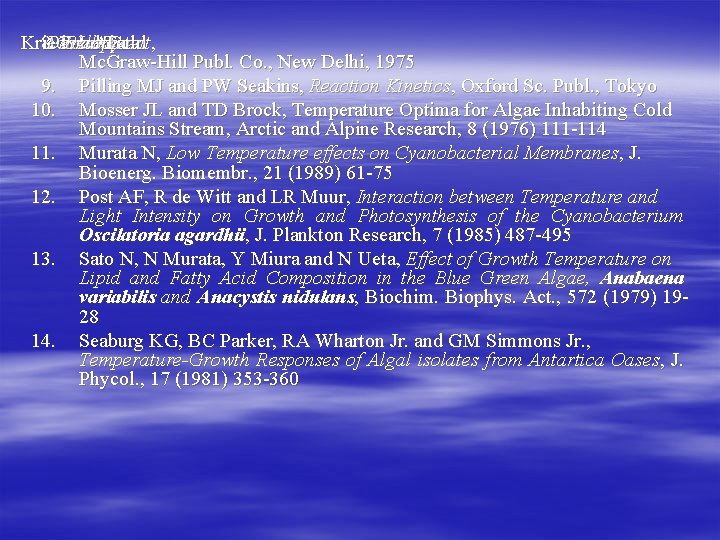
Kriedmann 8. Development PE Growth Plant and Leopold AC Tata , , Mc. Graw-Hill Publ. Co. , New Delhi, 1975 9. Pilling MJ and PW Seakins, Reaction Kinetics, Oxford Sc. Publ. , Tokyo 10. Mosser JL and TD Brock, Temperature Optima for Algae Inhabiting Cold Mountains Stream, Arctic and Alpine Research, 8 (1976) 111 -114 11. Murata N, Low Temperature effects on Cyanobacterial Membranes, J. Bioenerg. Biomembr. , 21 (1989) 61 -75 12. Post AF, R de Witt and LR Muur, Interaction between Temperature and Light Intensity on Growth and Photosynthesis of the Cyanobacterium Oscilatoria agardhii, J. Plankton Research, 7 (1985) 487 -495 13. Sato N, N Murata, Y Miura and N Ueta, Effect of Growth Temperature on Lipid and Fatty Acid Composition in the Blue Green Algae, Anabaena variabilis and Anacystis nidulans, Biochim. Biophys. Act. , 572 (1979) 1928 14. Seaburg KG, BC Parker, RA Wharton Jr. and GM Simmons Jr. , Temperature-Growth Responses of Algal isolates from Antartica Oases, J. Phycol. , 17 (1981) 353 -360
- Slides: 32