
Biophysics Masters Course 2002 1 Photosynthetic Membranes 2
Biophysics Masters Course 2002 1. Photosynthetic Membranes 2. Jan P. Dekker
Contents 1 a. Tubular membranes in Rb. Sphaeroides 1 b. Grana membranes in green plants

Biophysics Masters Course 2002 1 b. Grana membranes in green plants
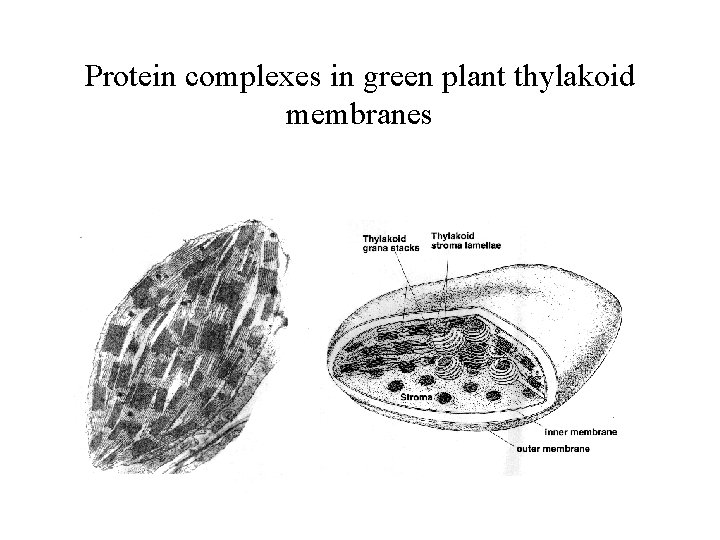
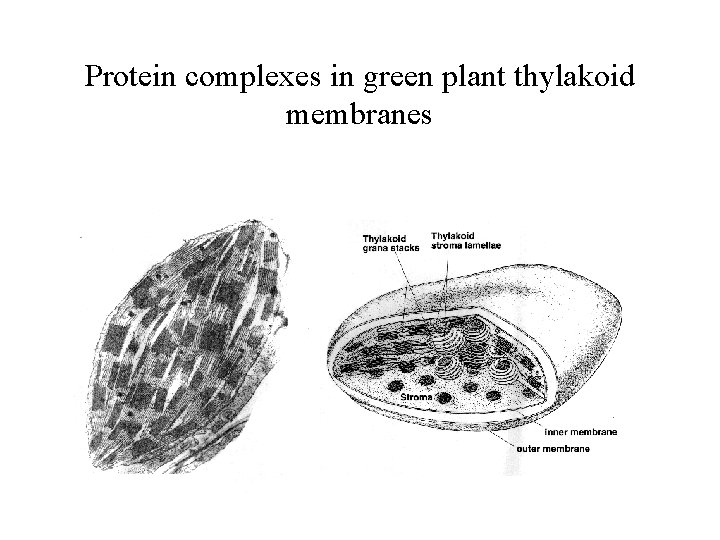
Protein complexes in green plant thylakoid membranes
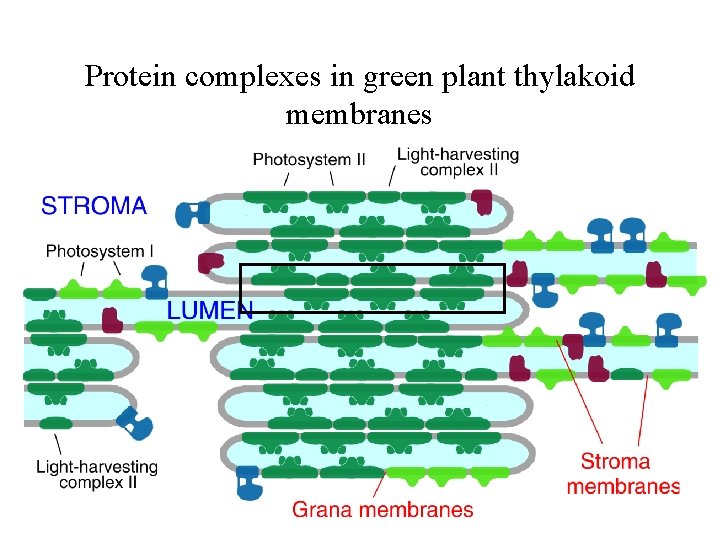
Protein complexes in green plant thylakoid membranes
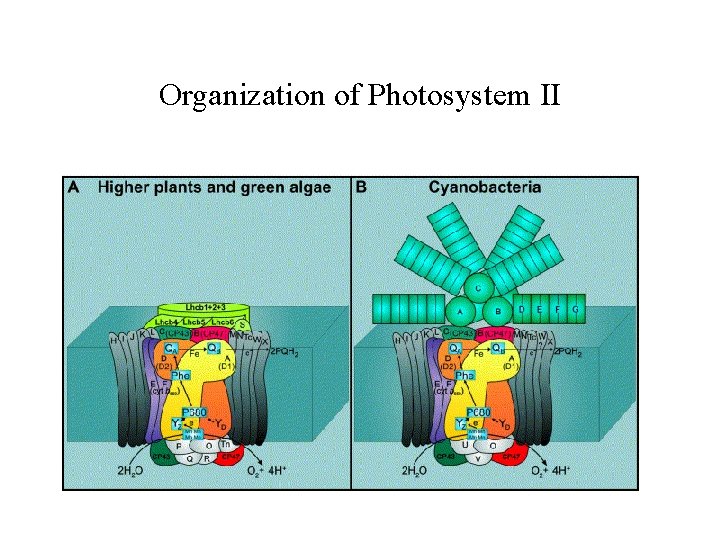
Organization of Photosystem II
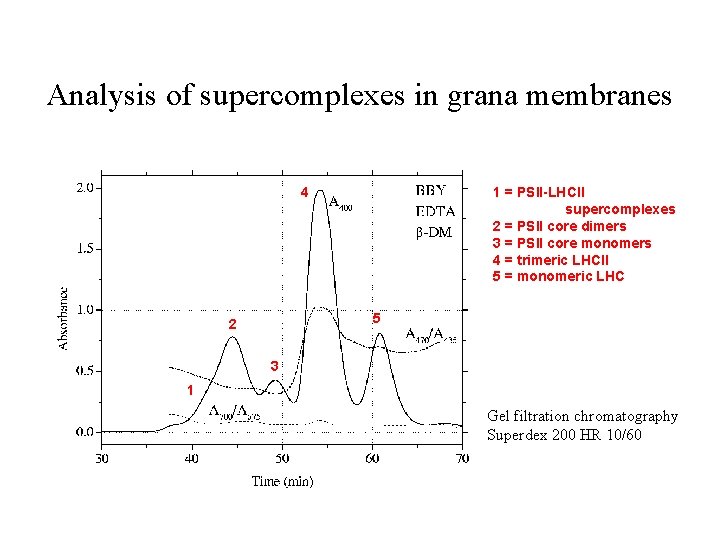
Analysis of supercomplexes in grana membranes 4 1 = PSII-LHCII supercomplexes 2 = PSII core dimers 3 = PSII core monomers 4 = trimeric LHCII 5 = monomeric LHC PSII-LHCII supercomplex 5 2 3 1 Gel filtration chromatography Superdex 200 HR 10/60
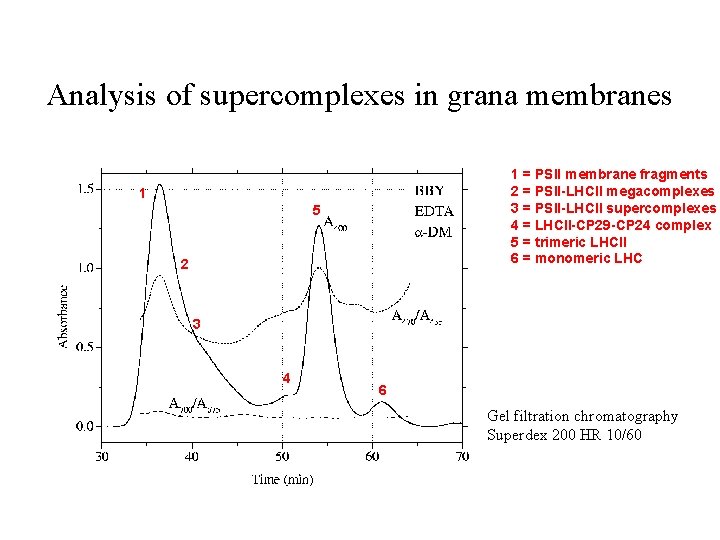
Analysis of supercomplexes in grana membranes 1 = PSII membrane fragments 2 = PSII-LHCII megacomplexes 3 = PSII-LHCII supercomplexes 4 = LHCII-CP 29 -CP 24 complex 5 = trimeric LHCII 6 = monomeric LHC 1 5 2 PSII-LHCII supercomplex 3 4 6 Gel filtration chromatography Superdex 200 HR 10/60

Biophysical Technique: Transmission Electron Microscopy
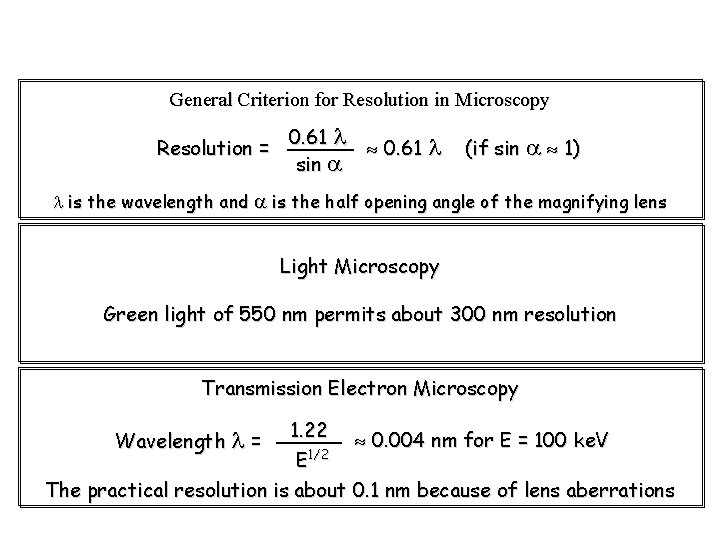
General Criterion for Resolution in Microscopy Resolution = 0. 61 sin (if sin 1) is the wavelength and is the half opening angle of the magnifying lens Light Microscopy Green light of 550 nm permits about 300 nm resolution Transmission Electron Microscopy 1. 22 0. 004 nm for E = 100 ke. V 1/2 E The practical resolution is about 0. 1 nm because of lens aberrations Wavelength =
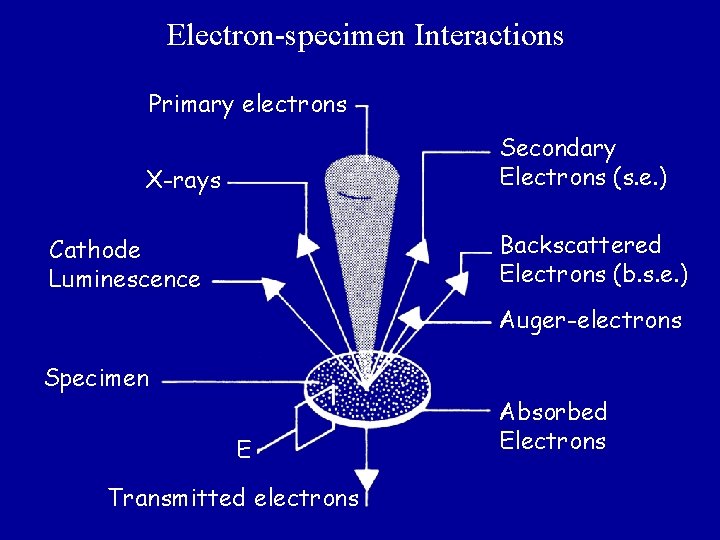
Electron-specimen Interactions Primary electrons Secondary Electrons (s. e. ) X-rays Backscattered Electrons (b. s. e. ) Cathode Luminescence Auger-electrons Specimen E Transmitted electrons Absorbed Electrons
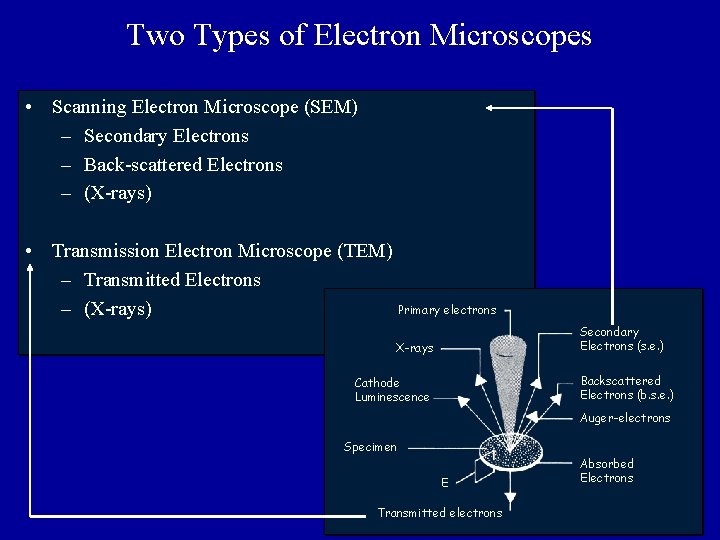
Two Types of Electron Microscopes • Scanning Electron Microscope (SEM) – Secondary Electrons – Back-scattered Electrons – (X-rays) • Transmission Electron Microscope (TEM) – Transmitted Electrons Primary electrons – (X-rays) Secondary Electrons (s. e. ) X-rays Backscattered Electrons (b. s. e. ) Cathode Luminescence Auger-electrons Specimen E Transmitted electrons Absorbed Electrons
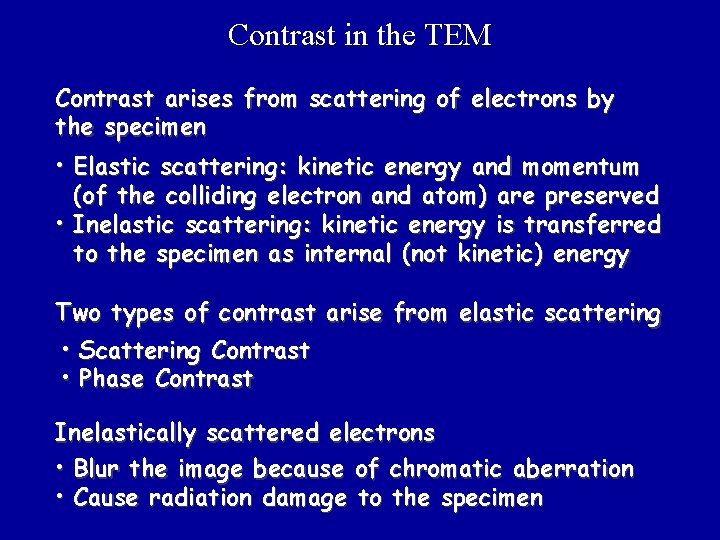
Contrast in the TEM Contrast arises from scattering of electrons by the specimen • Elastic scattering: kinetic energy and momentum (of the colliding electron and atom) are preserved • Inelastic scattering: kinetic energy is transferred to the specimen as internal (not kinetic) energy Two types of contrast arise from elastic scattering • Scattering Contrast • Phase Contrast Inelastically scattered electrons • Blur the image because of chromatic aberration • Cause radiation damage to the specimen
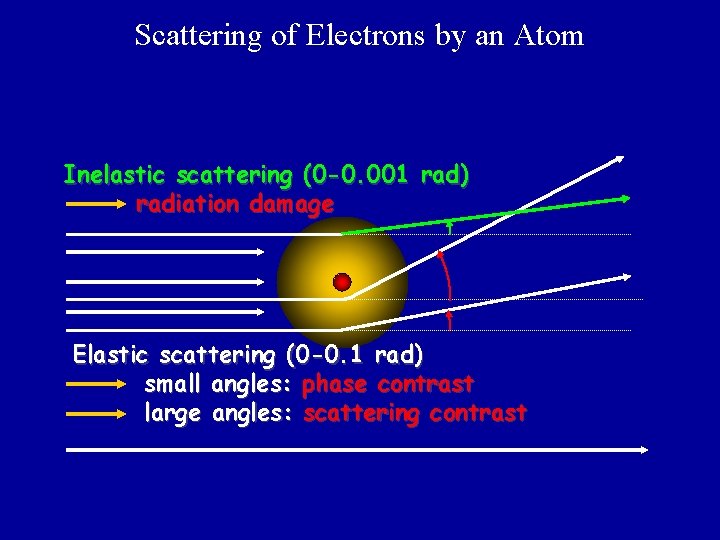
Scattering of Electrons by an Atom Inelastic scattering (0 -0. 001 rad) radiation damage Elastic scattering (0 -0. 1 rad) small angles: phase contrast large angles: scattering contrast
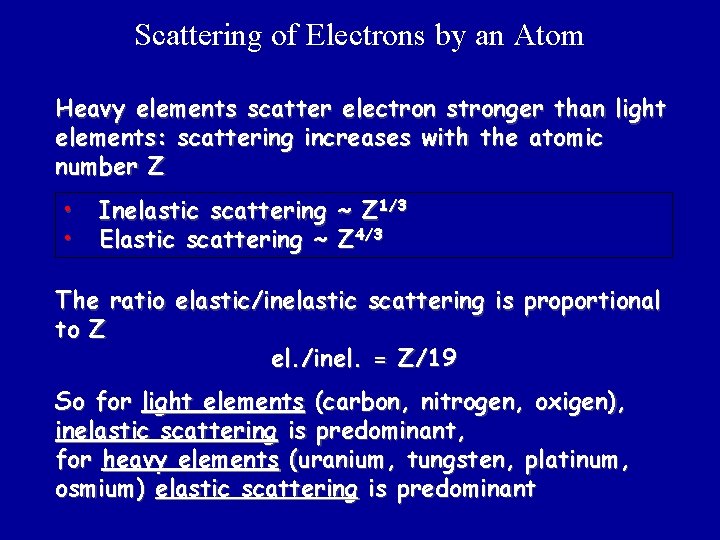
Scattering of Electrons by an Atom Heavy elements scatter electron stronger than light elements: scattering increases with the atomic number Z • • Inelastic scattering ~ Z 1/3 Elastic scattering ~ Z 4/3 The ratio elastic/inelastic scattering is proportional to Z el. /inel. = Z/19 So for light elements (carbon, nitrogen, oxigen), inelastic scattering is predominant, for heavy elements (uranium, tungsten, platinum, osmium) elastic scattering is predominant
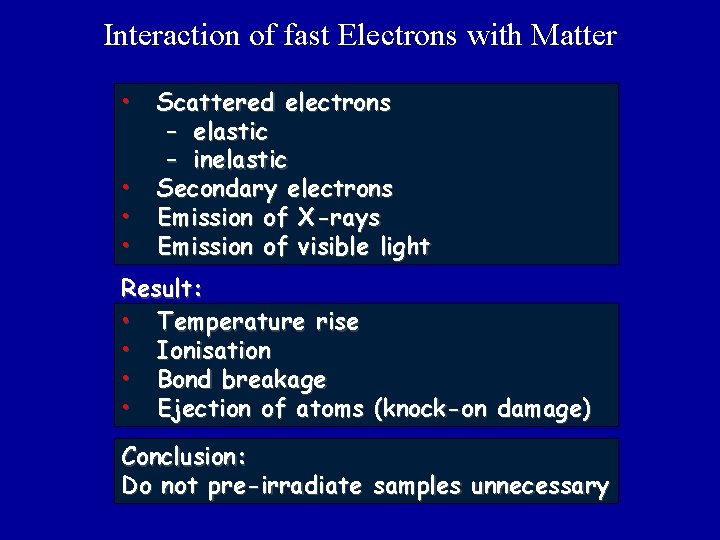
Interaction of fast Electrons with Matter • • Scattered electrons – elastic – inelastic Secondary electrons Emission of X-rays Emission of visible light Result: • Temperature rise • Ionisation • Bond breakage • Ejection of atoms (knock-on damage) Conclusion: Do not pre-irradiate samples unnecessary
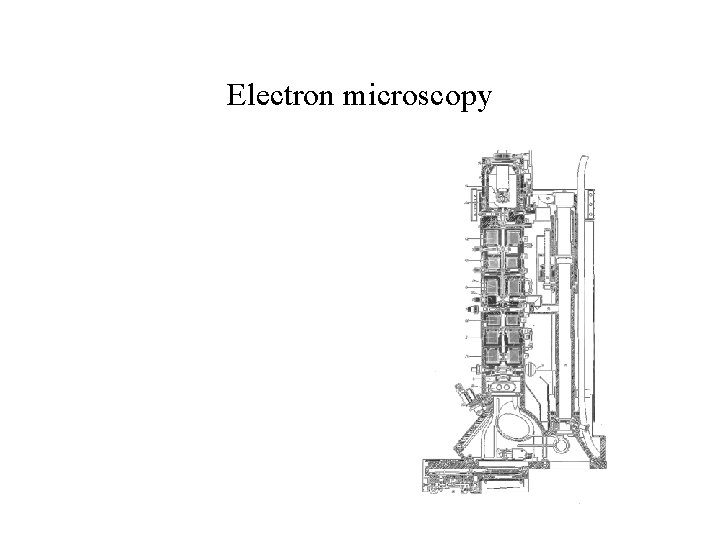
Electron microscopy
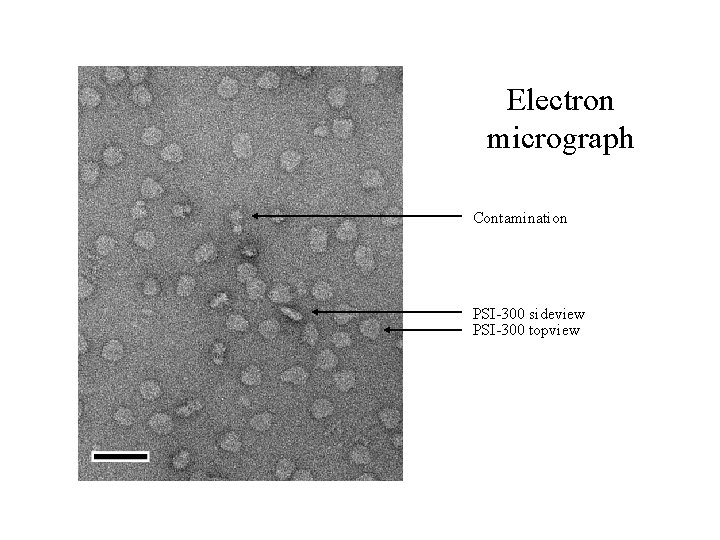
Electron micrograph Contamination PSI-300 sideview PSI-300 topview

Biophysical Technique: Image Analysis
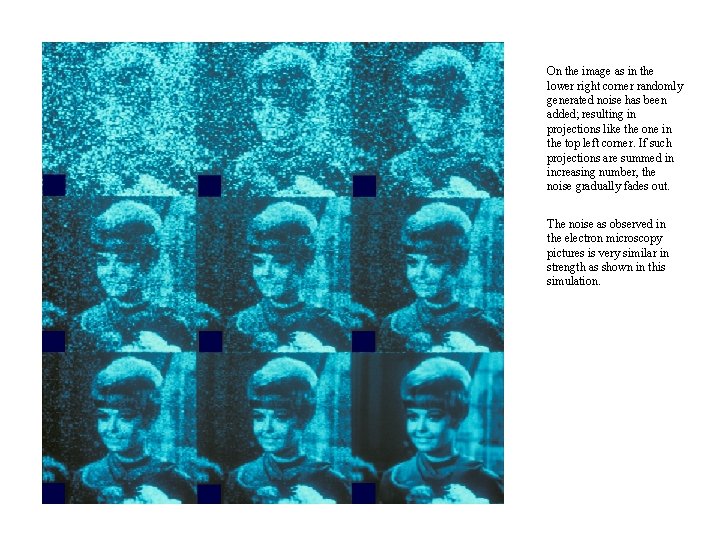
On the image as in the lower right corner randomly generated noise has been added; resulting in projections like the one in the top left corner. If such projections are summed in increasing number, the noise gradually fades out. The noise as observed in the electron microscopy pictures is very similar in strength as shown in this simulation.
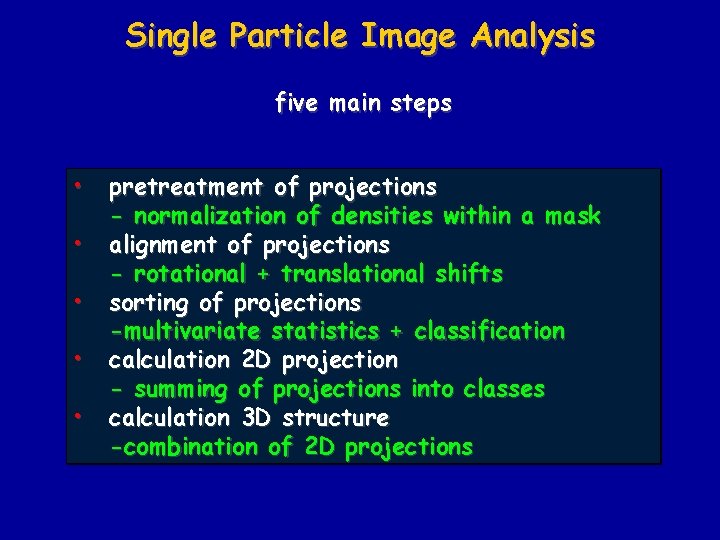
Single Particle Image Analysis five main steps • • • pretreatment of projections - normalization of densities within a mask alignment of projections - rotational + translational shifts sorting of projections -multivariate statistics + classification calculation 2 D projection - summing of projections into classes calculation 3 D structure -combination of 2 D projections
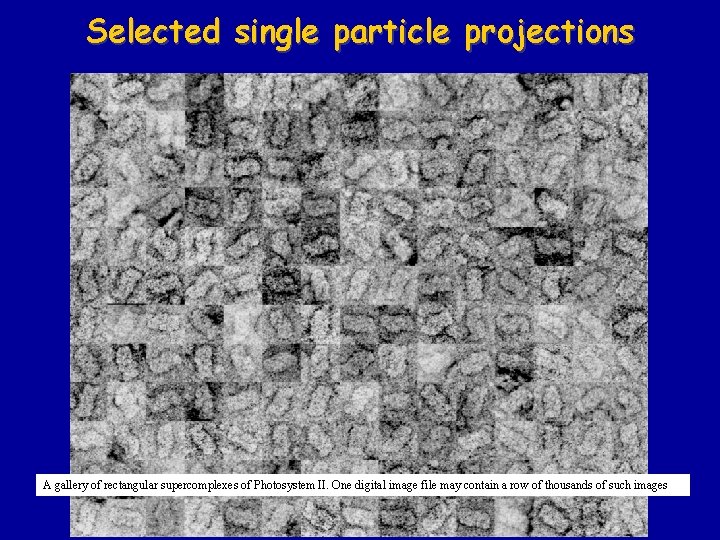
Selected single particle projections A gallery of rectangular supercomplexes of Photosystem II. One digital image file may contain a row of thousands of such images
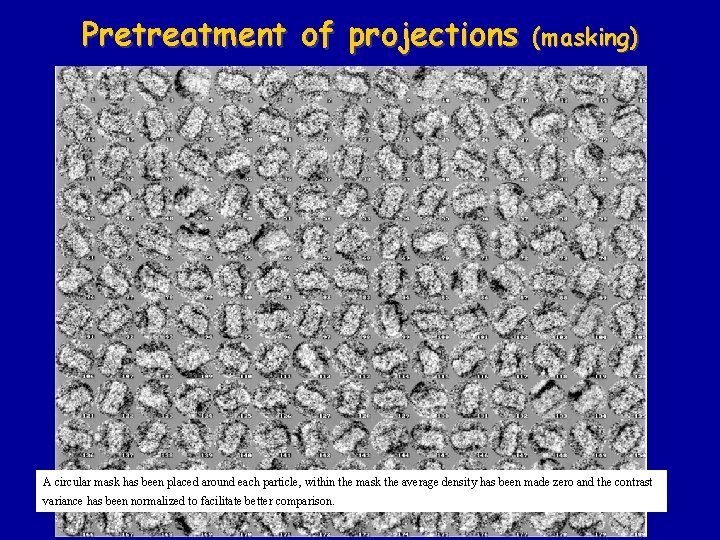
Pretreatment of projections (masking) A circular mask has been placed around each particle, within the mask the average density has been made zero and the contrast variance has been normalized to facilitate better comparison.

Alignment procedure for randomly oriented objects FFT image Rotational correlation function FFT rotationally aligned image FFT reference rotational alignment FFT Cross correlation function reference translational alignment
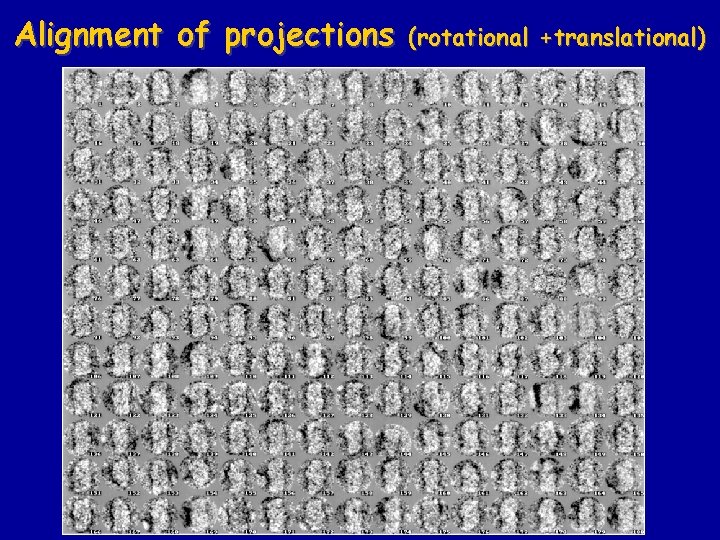
Alignment of projections (rotational +translational)
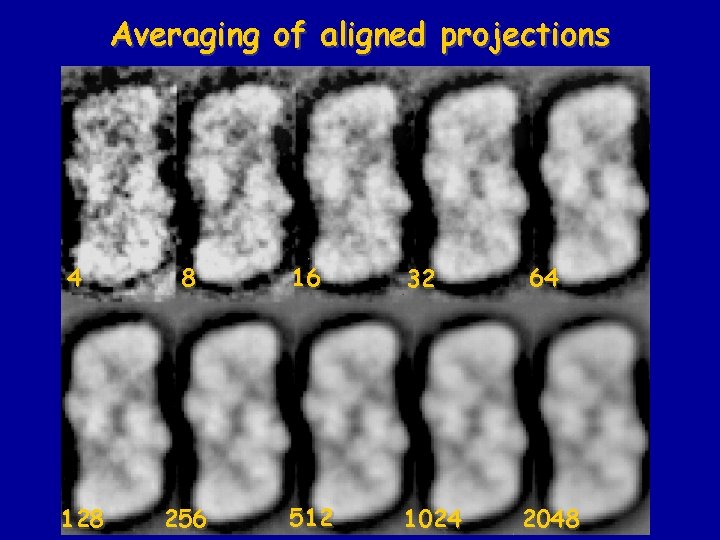
Averaging of aligned projections 4 128 8 16 32 256 512 1024 64 2048

Description of image variation finding trends in density patterns example: a 2 -pixel image
technique: Multivariate Statistical Analysis Eigenvector-Eigenimage decomposition determination of image variation by compression of raw (“noisy”) data results: description of individual mages by a linear combination of a limited number (“couple of dozen”) of eigenimages can be presented in a multidimensional vector space close relatedness in space = close similarity
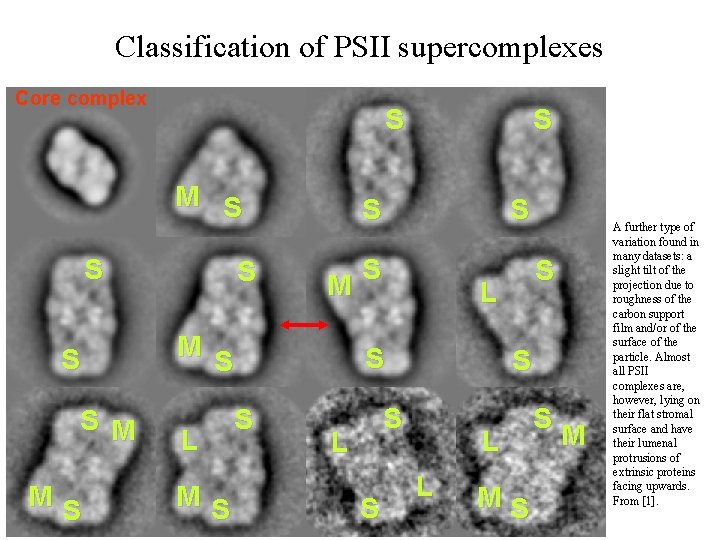
Classification of PSII supercomplexes Core complex S M S S M MS S S M M S L M S S S L L MS S M A further type of variation found in many datasets: a slight tilt of the projection due to roughness of the carbon support film and/or of the surface of the particle. Almost all PSII complexes are, however, lying on their flat stromal surface and have their lumenal protrusions of extrinsic proteins facing upwards. From [1].
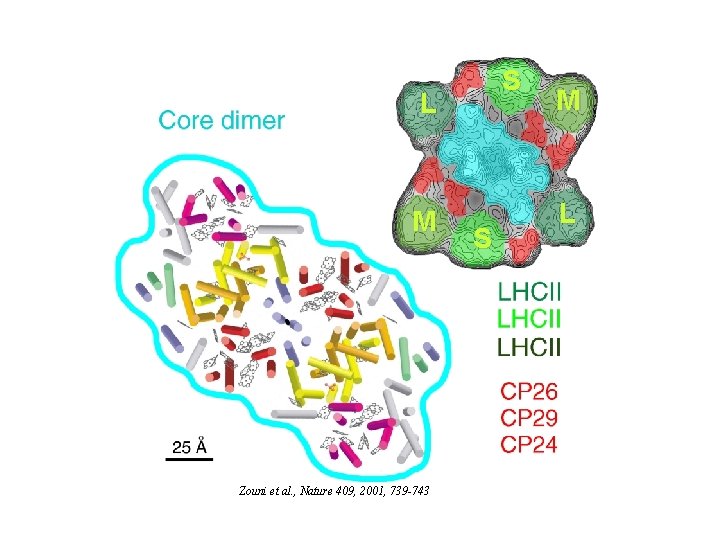
S L M Zouni et al. , Nature 409, 2001, 739 -743 S M L
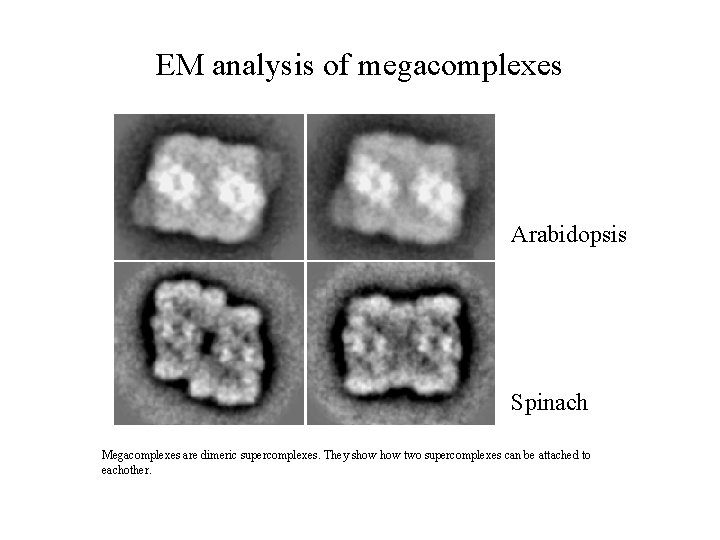
EM analysis of megacomplexes Arabidopsis Spinach Megacomplexes are dimeric supercomplexes. They show two supercomplexes can be attached to eachother.
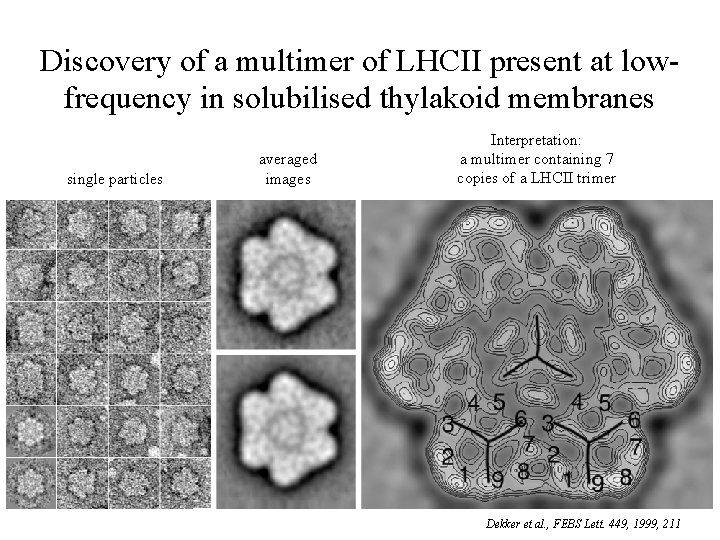
Discovery of a multimer of LHCII present at lowfrequency in solubilised thylakoid membranes single particles averaged images Interpretation: a multimer containing 7 copies of a LHCII trimer Dekker et al. , FEBS Lett. 449, 1999, 211
Protein complexes in green plant thylakoid membranes
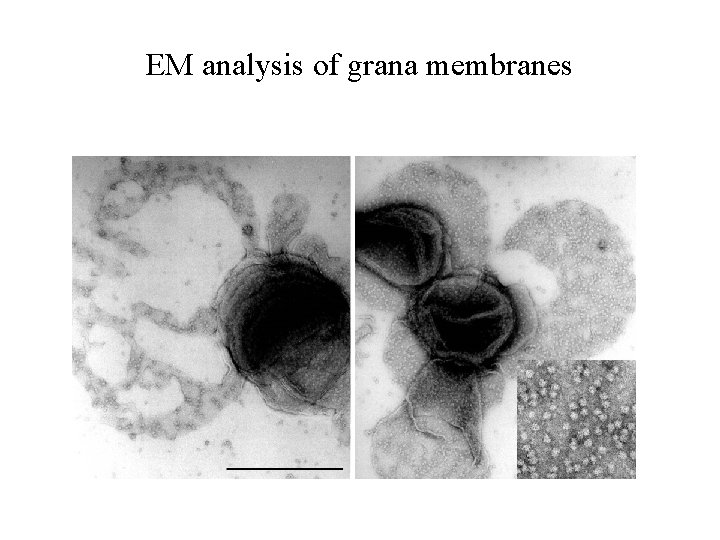
EM analysis of grana membranes
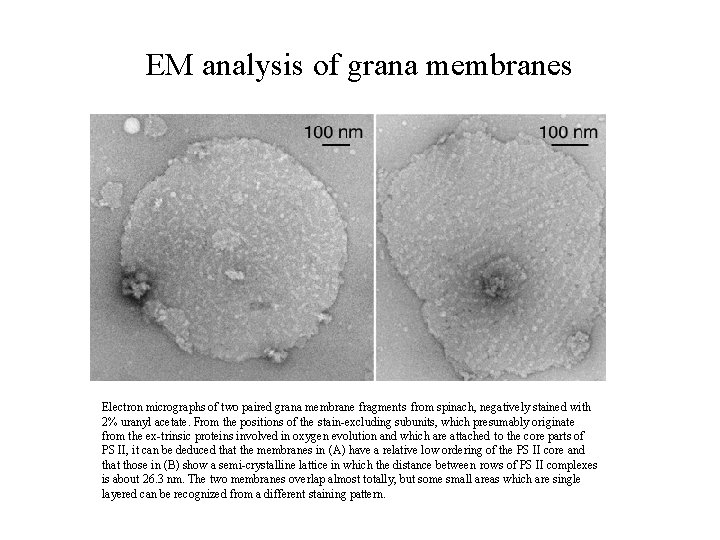
EM analysis of grana membranes Electron micrographs of two paired grana membrane fragments from spinach, negatively stained with 2% uranyl acetate. From the positions of the stain-excluding subunits, which presumably originate from the ex-trinsic proteins involved in oxygen evolution and which are attached to the core parts of PS II, it can be deduced that the membranes in (A) have a relative low ordering of the PS II core and that those in (B) show a semi-crystalline lattice in which the distance between rows of PS II complexes is about 26. 3 nm. The two membranes overlap almost totally, but some small areas which are single layered can be recognized from a different staining pattern.
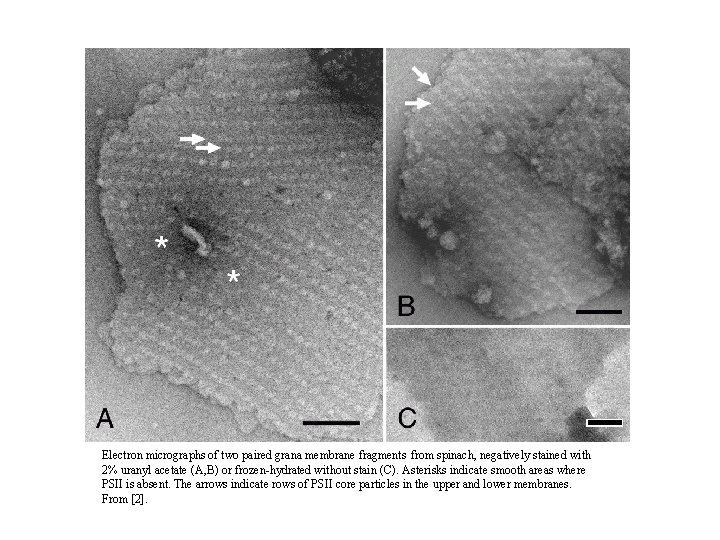
Electron micrographs of two paired grana membrane fragments from spinach, negatively stained with 2% uranyl acetate (A, B) or frozen-hydrated without stain (C). Asterisks indicate smooth areas where PSII is absent. The arrows indicate rows of PSII core particles in the upper and lower membranes. From [2].
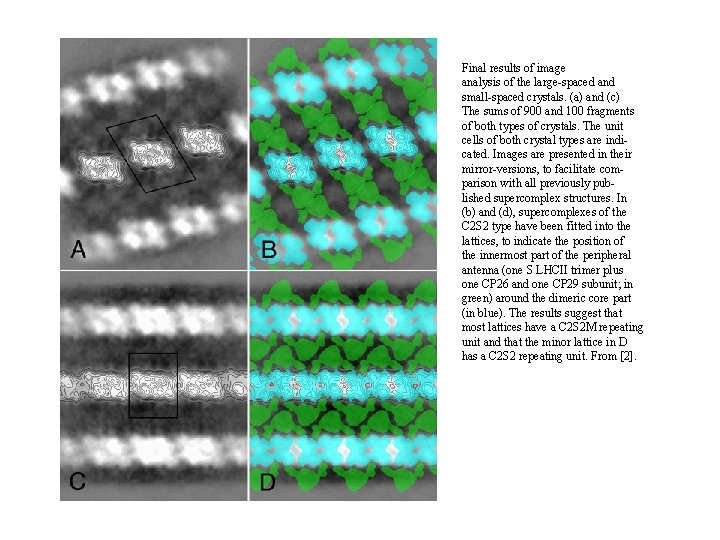
Final results of image analysis of the large-spaced and small-spaced crystals. (a) and (c) The sums of 900 and 100 fragments of both types of crystals. The unit cells of both crystal types are indicated. Images are presented in their mirror-versions, to facilitate comparison with all previously published supercomplex structures. In (b) and (d), supercomplexes of the C 2 S 2 type have been fitted into the lattices, to indicate the position of the innermost part of the peripheral antenna (one S LHCII trimer plus one CP 26 and one CP 29 subunit; in green) around the dimeric core part (in blue). The results suggest that most lattices have a C 2 S 2 M repeating unit and that the minor lattice in D has a C 2 S 2 repeating unit. From [2].
![Model of the main repeating unit in spinach. From [2].](http://slidetodoc.com/presentation_image/1209dd76f121d7c373c07c28126c9cee/image-38.jpg "Model of the main repeating unit in spinach. From [2].")
Model of the main repeating unit in spinach. From [2].
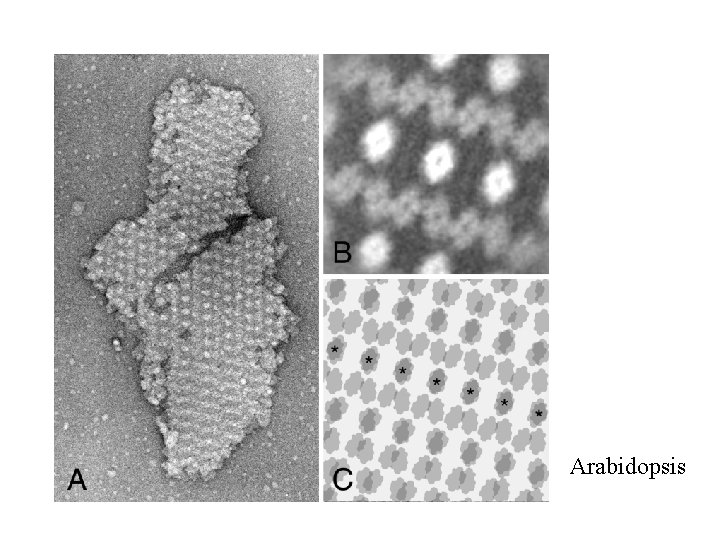
Arabidopsis
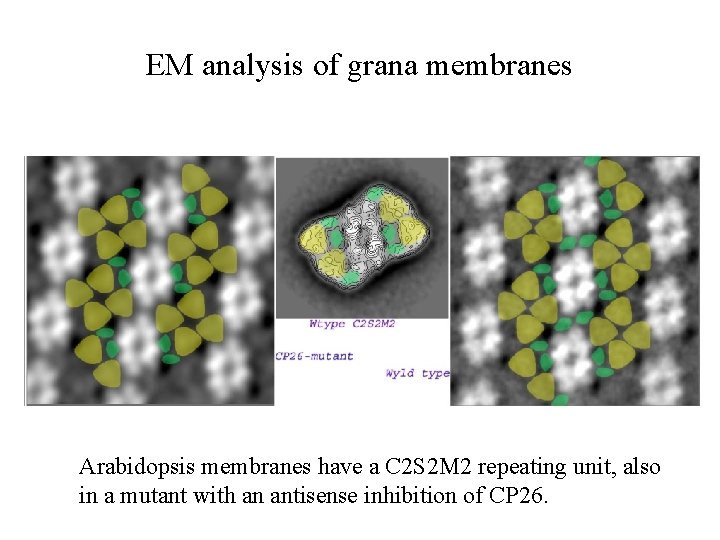
EM analysis of grana membranes Arabidopsis membranes have a C 2 S 2 M 2 repeating unit, also in a mutant with an antisense inhibition of CP 26.
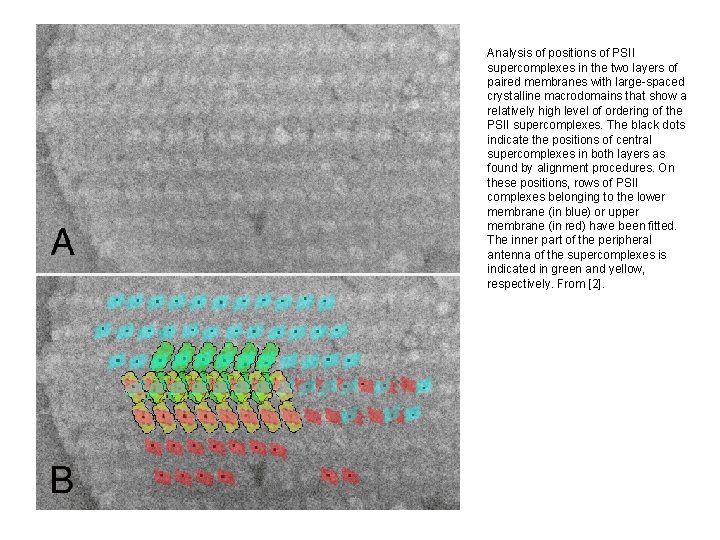
Analysis of positions of PSII supercomplexes in the two layers of paired membranes with large-spaced crystalline macrodomains that show a relatively high level of ordering of the PSII supercomplexes. The black dots indicate the positions of central supercomplexes in both layers as found by alignment procedures. On these positions, rows of PSII complexes belonging to the lower membrane (in blue) or upper membrane (in red) have been fitted. The inner part of the peripheral antenna of the supercomplexes is indicated in green and yellow, respectively. From [2].

1 b. Grana membranes in green plants Literature: 1. E. J. Boekema, H. van Roon, F. Calkoen, R. Bassi, J. P. Dekker (1999) Multiple types of association of photosystem II and its light-harvesting antenna in partially solubilized photosystem II membranes. Biochemistry 38, 2233 -2239 2. E. J. Boekema, J. F. L. van Breemen, H. van Roon, J. P. Dekker (2000) Arrangement of photosystem II supercomplexes in crystalline macrodomains within the thylakoid membranes of green plants. J. Mol. Biol. 301, 1123 -1133
- Slides: 42