
Biopharming and Beyond GMOs on Steroids Martin Donohoe
Biopharming and Beyond GMOs on Steroids Martin Donohoe
Biopharming n The engineering of plants to produce pharmaceuticals such as enzymes, antibiotics, contraceptives, abortifacients, antibodies, chemotherapeutic agents, other medications, vaccines, and industrial and research chemicals
Biopharming Rationale: n Farmers/farms cheaper than technicians/manufacturing plants n Seeds/silos may be cheap storage system n ? Cheaper drugs? – doubtful given history of pharmaceutical industry pricing patterns; also, multiple externalized costs n Approximately 400 field tests worldwide since 1991 (over 100 in U. S. ) n
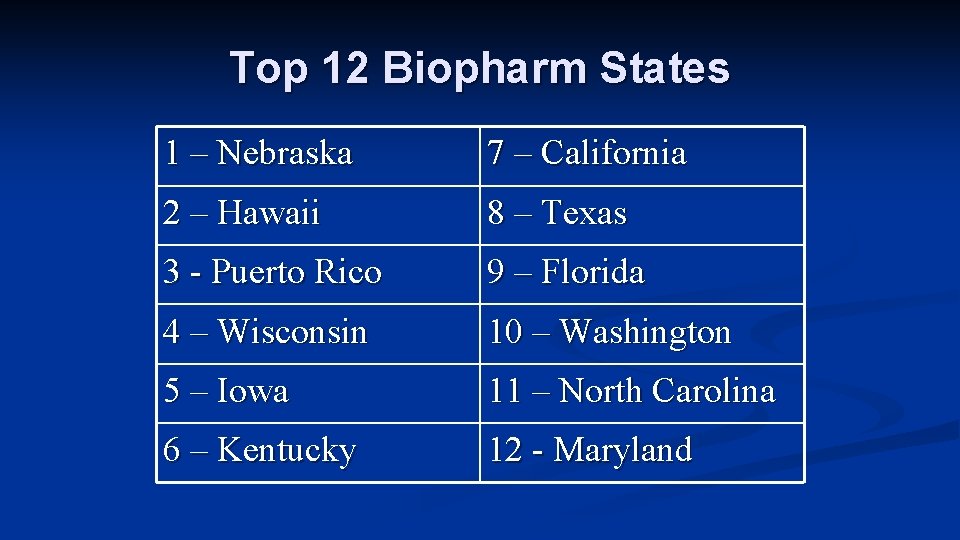
Top 12 Biopharm States 1 – Nebraska 7 – California 2 – Hawaii 8 – Texas 3 - Puerto Rico 9 – Florida 4 – Wisconsin 10 – Washington 5 – Iowa 11 – North Carolina 6 – Kentucky 12 - Maryland
Biopharming n More than 15 companies involved in US (75 companies worldwide) n USDA conceals crop locations from public and neighboring farmers, in most cases hides identity of drug or chemical being tested, citing trade secrets n Even state agriculture regulators often unaware of info re drug or chemical involved
Major Biopharm Crops n Corn n Soybeans n Tobacco n Rice
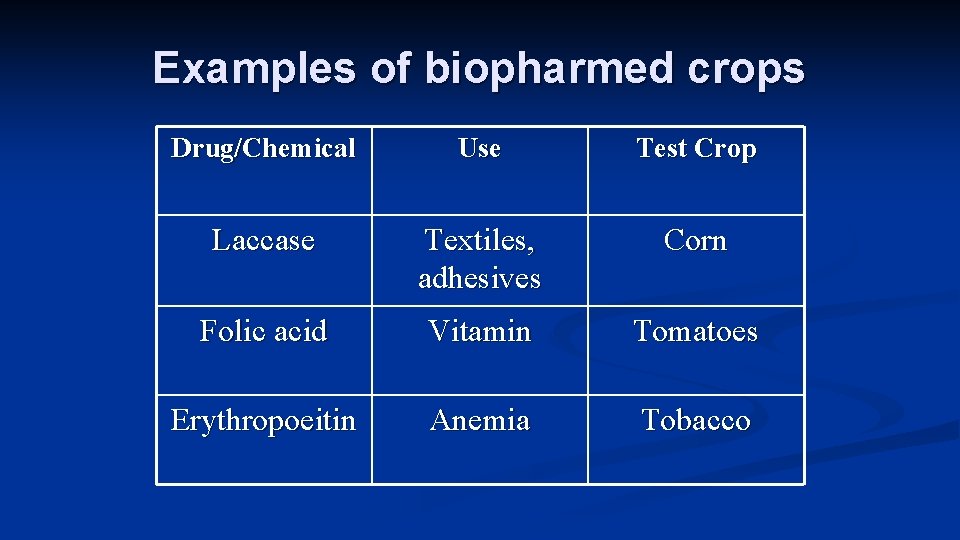
Examples of biopharmed crops Drug/Chemical Use Test Crop Laccase Textiles, adhesives Corn Folic acid Vitamin Tomatoes Erythropoeitin Anemia Tobacco
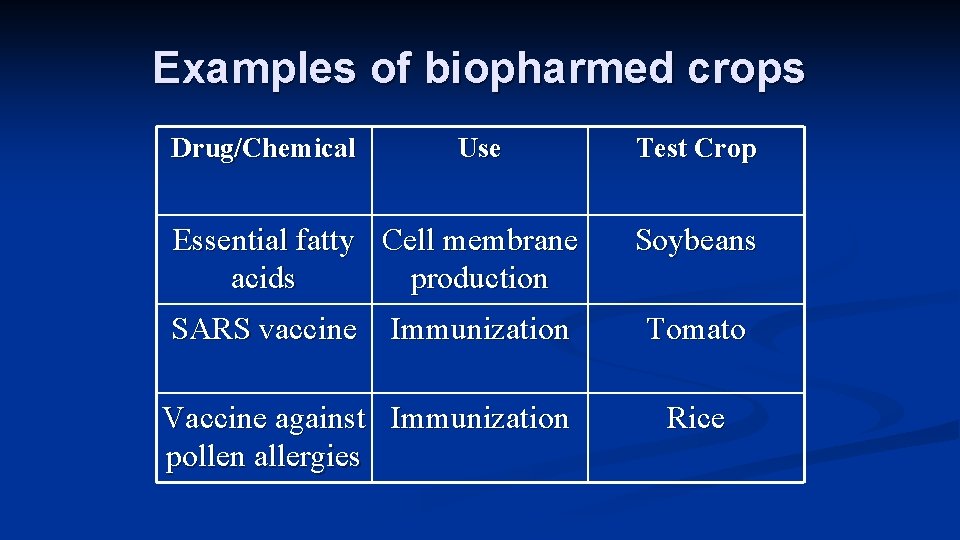
Examples of biopharmed crops Drug/Chemical Use Essential fatty Cell membrane acids production SARS vaccine Immunization Vaccine against Immunization pollen allergies Test Crop Soybeans Tomato Rice
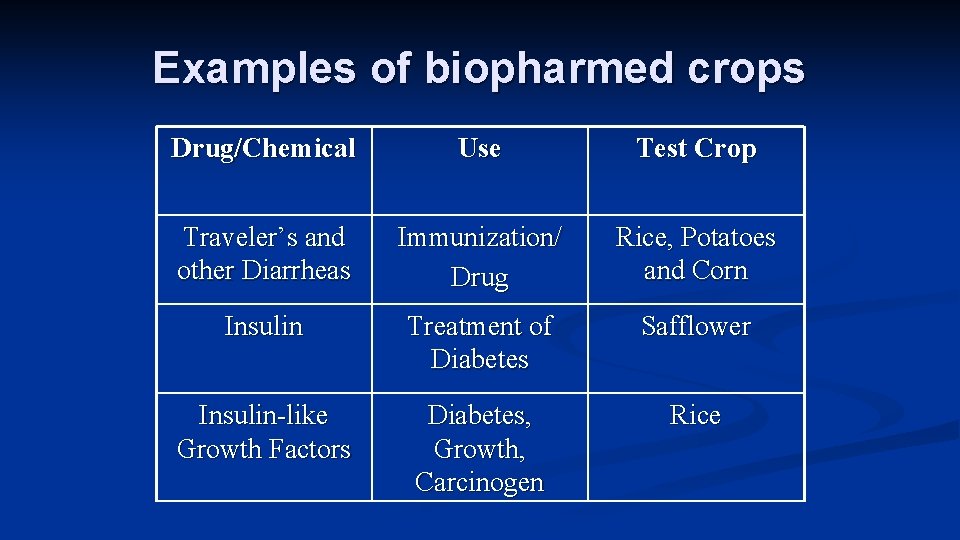
Examples of biopharmed crops Drug/Chemical Use Test Crop Traveler’s and other Diarrheas Immunization/ Drug Rice, Potatoes and Corn Insulin Treatment of Diabetes Safflower Insulin-like Growth Factors Diabetes, Growth, Carcinogen Rice
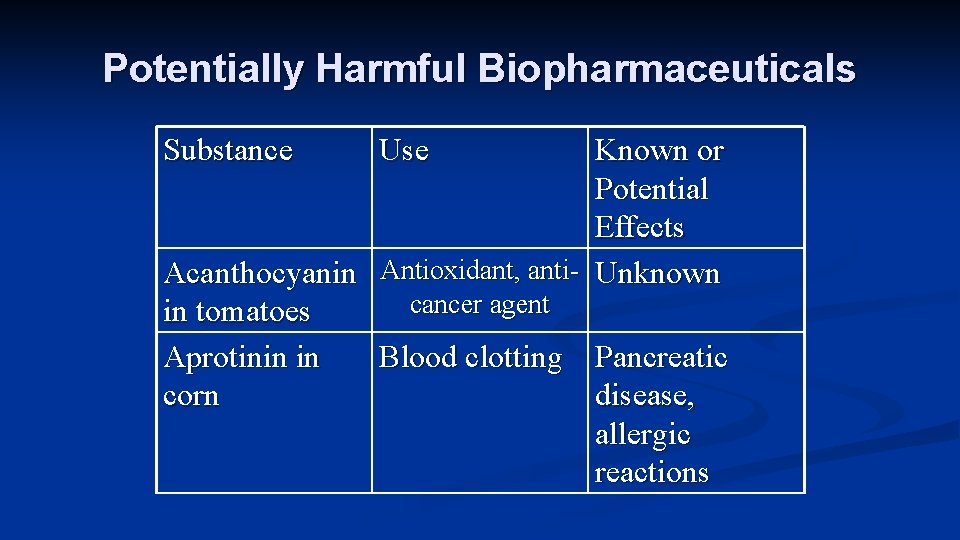
Potentially Harmful Biopharmaceuticals Substance Use Known or Potential Effects Acanthocyanin Antioxidant, anti- Unknown cancer agent in tomatoes Aprotinin in Blood clotting Pancreatic corn disease, allergic reactions
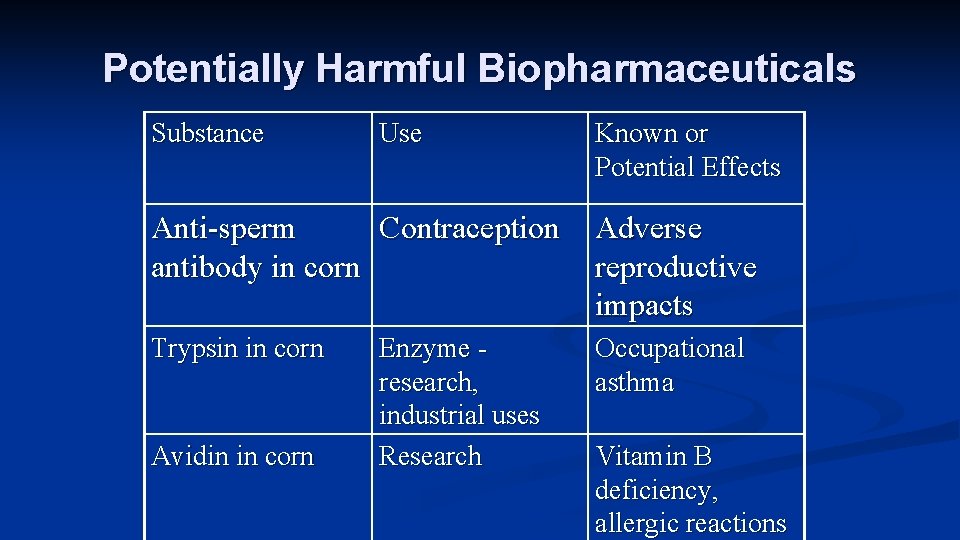
Potentially Harmful Biopharmaceuticals Substance Use Known or Potential Effects Anti-sperm Contraception antibody in corn Adverse reproductive impacts Trypsin in corn Occupational asthma Avidin in corn Enzyme research, industrial uses Research Vitamin B deficiency, allergic reactions
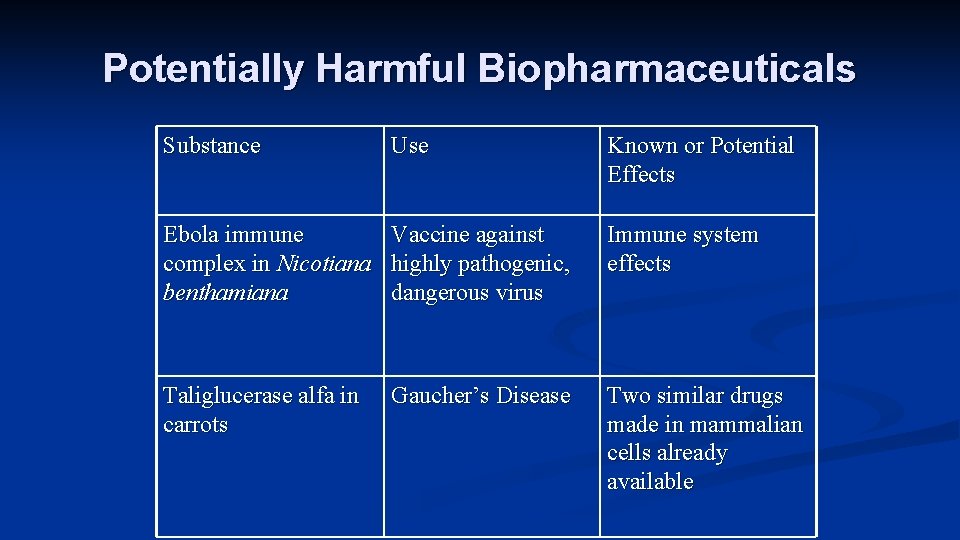
Potentially Harmful Biopharmaceuticals Substance Use Known or Potential Effects Ebola immune complex in Nicotiana benthamiana Vaccine against highly pathogenic, dangerous virus Immune system effects Taliglucerase alfa in carrots Gaucher’s Disease Two similar drugs made in mammalian cells already available
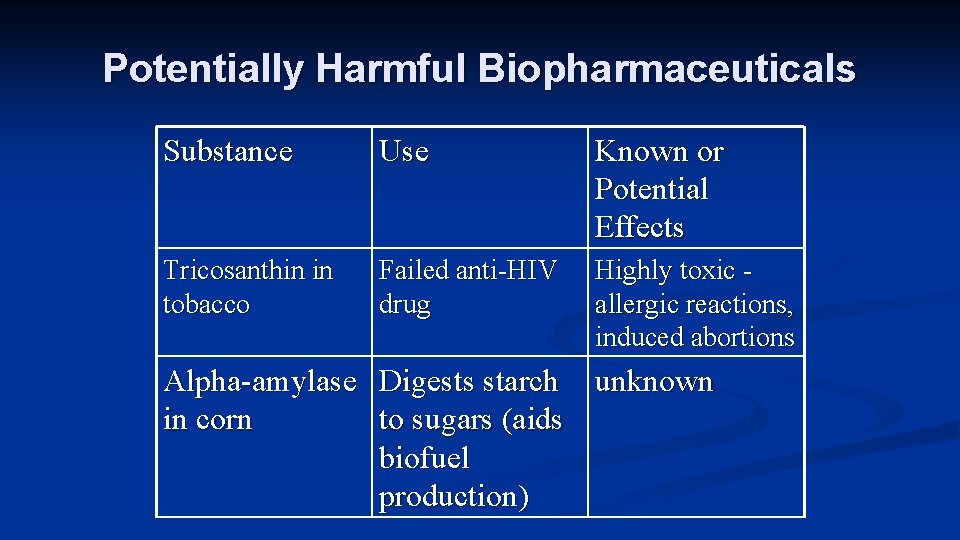
Potentially Harmful Biopharmaceuticals Substance Use Known or Potential Effects Tricosanthin in tobacco Failed anti-HIV drug Highly toxic allergic reactions, induced abortions Alpha-amylase Digests starch unknown in corn to sugars (aids biofuel production)
Opposition to Biopharming n National Academy of Sciences n Union of Concerned Scientists n British Medical Association (favors moratorium on all GM foods) n Consumers Union
Opposition to Biopharming n Grocery Manufacturers of America n National Food Processors Association n Organic Consumers Association n Friends of the Earth n Others
Biopharm Proponents Claims Inflated/Unrealistic n Farmers are unlikely to be major beneficiaries: n Market forces, including foreign competition, will drive down farmer compensation n Acreage required very small compared with commodity crop acreage, such that only a small number of growers will be needed
Genetic Modification of Algae and Trees GE algae (for use as fuel): dangers include worldwide spread and possible weaponization to destroy fish stocks n Mercury-splicing bacteria for soil cleanup n Removes Hg 2+ ions from contaminated soil and converts it into volatile elemental mercury, which is released into the atmosphere n Problem - converted by phytoplankton to organic mercury, dispersed widely, and then works its way up the food chain n
Genetic Modification of Vertebrates n Aquabounty Technology’s GE salmon (contains growth hormone gene from chinook salmon and genetic on-switch from the ocean pout) n Designed for more rapid growth n Aquabounty states it will only produce sterile females n Up to 15% may escape pens and interbreed with wild stocks, decreasing the species’ reproductive fitness n GE salmon have higher levels of IGF-1 (carcinogen)
Genetic Modification of Vertebrates Tilapia/clotting factor VII n “Ruppy” (Ruby Puppy) n Glows red under UV light n Developed using red fluorescent gene from sea anemones n Artist Eduard Kac: n Glow-in-the-dark rabbit n “Plantimal” (petunia-human hybrid) n
Genetic Modification of Vertebrates n “Popeye Pig” – Pig GM with spinach gene, designed to have less saturated fat n Pigs modified with roundworm gene to make their own (heart healthy) omega-3 fatty acids n Accidentally turned up in poutry feed sold throughout Ontario(2004) n Goats GM to make anti-nerve gas agent
Biopharming of Vertebrates n “Enviropig” – GM modified with E. coli and mouse DNA to digest phytates, decrease phosphate in excrement n Phytase (pig feed supplement) does same thing n Pig feed can already be supplemented with phytase n Idea shelved
Genetic Modification of Vertebrates n Cows modified to produce “human” milk n Proposal to genetically modify human embryos to make all humans intolerant to red meat (to combat global warming and overuse of water)
Genetic Modification of Vertebrates n USDA Office of the Inspector General has criticized USDA for lacking coordinated oversight of regulations behind R and D of GE animals and insects
Human-Animal Hybrids n Inter-species breeding n Ape-man, Ilya Ivanovich Ivanov, Guinea, 1927 n Stalin attempted to create interspecies (halfmen/half-apes) “super-warriors” n 2011: Chimeric monkey created from 6 different parents
Human-Animal Hybrids and More n UK scientists have created over 150 human-animal hybrid embryos to develop embyronic stem cells n De-extincting Neanderthal using human womb n Cloning of extinct species, “Pleistocene rewilding”
Synthetic Biology (Synbio) n Creation of DNA and organisms from scratch n Applications: n Biofuels n Industrial chemicals n Natural product substitutes - Rubber, vanilla, palm oil n Biomedical applications - Vaccine production
Synthetic Biology (Synbio) n 2002: Polio virus created at SUNY Stony Brook over two years n 2005: Mt Sinai, CDC researchers resurrect lethal 1918 flu virus and publish details of complete genome sequence n 2012: Nature published instructions on how to create plague virus
Risks of Synbio n Accidental release into wild n Displacement of wild populations n Ecosystem disruption n Extinction
Synbio and Beyond n DARPA Project to create living, breathing creatures with possible military applications n Bio hackers (home and community laboratory creation of GM organisms)
Martin Donohoe http: //www. publichealthandsocialjustice. org http: //www. phsj. org martindonohoe@phsj. org
- Slides: 30