
BIOPHARMACEUTICS Significance of the Volumes of Distribution In

BIOPHARMACEUTICS
Significance of the Volumes of Distribution In a study involving a cardiotonic drug given intravenously to a group of normal and congestive heart failure (CHF) patients, n the average AUC for CHF was 40% higher than in the normal subjects. n The b elimination constant was 40% less in CHF patients, whereas the average (VD) β remained essentially the same. n In spite of the edematous conditions of these patients, the volume of distribution apparently remained constant. Because the dose was the same, the (V D) β would not change unless the increase in AUC is not accompanied by a change in b elimination constant.
n n n The clearance of the drug in CHF patients was reduced by 40% and accompanied by a corresponding decrease in the b elimination constant, possibly due to a reduction in renal blood flow as a result of reduced cardiac output in CHF patients. In physiologic pharmacokinetics, clearance (Cl) and volume of distribution (V D) are assumed to be independent parameters that explain the impact of disease factors on drug disposition. Thus, an increase in AUC of a cardiotonic in a CHF patient was assumed to be due to a reduction in drug clearance, since the volume of distribution was unchanged.

Drug in the Tissue Compartment n The apparent volume of the tissue compartment (V t) is a conceptual volume only and does not represent true anatomic volumes. The V t may be calculated from knowledge of the transfer rate constants and V p: n This information is vital in estimating chronic toxicity and relating the duration of pharmacologic activity to dose. Tissue compartment drug concentration is an average estimate of the tissue pool and does not mean that all tissues have this concentration.
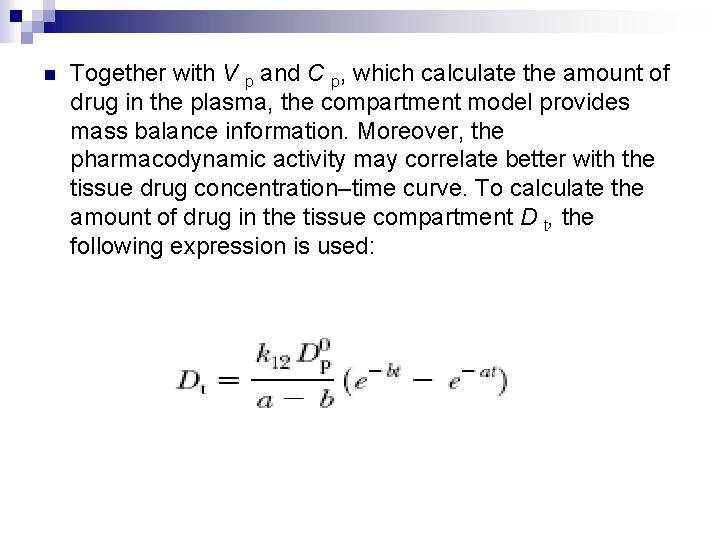
n Together with V p and C p, which calculate the amount of drug in the plasma, the compartment model provides mass balance information. Moreover, the pharmacodynamic activity may correlate better with the tissue drug concentration–time curve. To calculate the amount of drug in the tissue compartment D t, the following expression is used:
n n Drug Clearance The definition of clearance of a drug that follows a two-compartment model is similar to that of the one-compartment model. Clearance is the volume of plasma that is cleared of drug per unit time. Clearance may be calculated without consideration of the compartment model. Thus, clearance may be viewed as a physiologic concept for drug removal, even though the development of clearance is rooted in classical pharmacokinetics.

n n n Elimination Rate Constant In the two-compartment model (IV administration), the elimination rate constant, k, represents the elimination of drug from the central compartment, whereas b represents drug elimination during the beta or elimination phase, when distribution is mostly complete. Because of redistribution of drug out of the tissue compartment, the plasma–drug level curve declines more slowly in the b phase. Hence b is smaller than k; thus k is a true elimination constant, whereas b is a hybrid elimination rate constant that is influenced by the rate of transfer of drug in and out of the tissue compartment. .
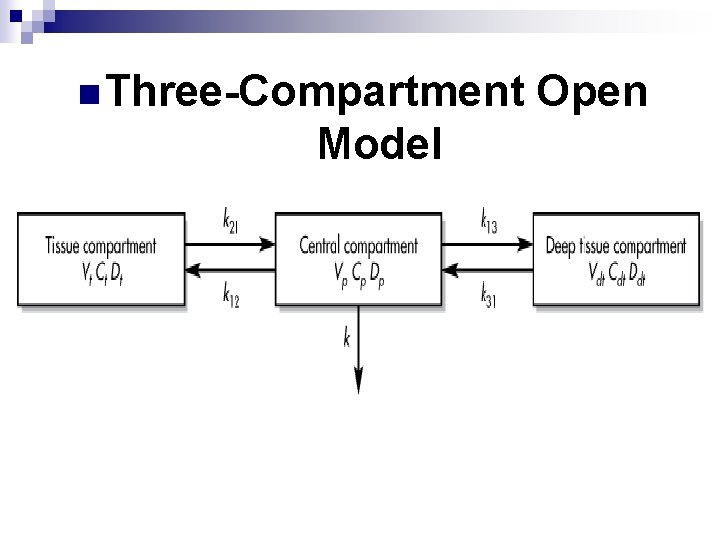
n Three-Compartment Model Open
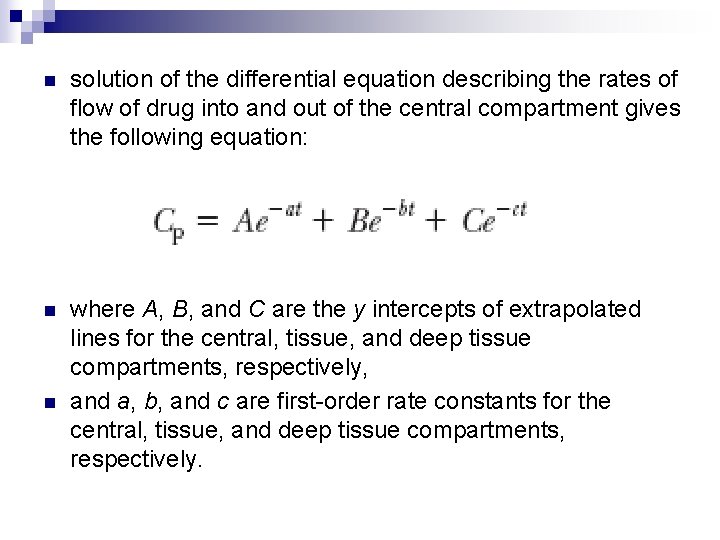
n solution of the differential equation describing the rates of flow of drug into and out of the central compartment gives the following equation: n where A, B, and C are the y intercepts of extrapolated lines for the central, tissue, and deep tissue compartments, respectively, and a, b, and c are first-order rate constants for the central, tissue, and deep tissue compartments, respectively. n

Determination of Compartment Models n n (1) the route of drug administration, (2) the rate of drug absorption, If drug distribution is rapid, then, after oral administration, the drug will become distributed during absorption, and the distribution phase will not be observed. For example, theophylline follows the kinetics of a one-compartment model after oral absorption, but after intravenous bolus (given as aminophylline), theophylline follows the kinetics of a two-compartment model.

Determination of Compartment Models n n (1) the route of drug administration, (2) the rate of drug absorption, Furthermore, if theophylline is given by a slow intravenous infusion rather than by intravenous bolus, the distribution phase will not be observed. Hydromorphone (Dilaudid), which follows a three-compartment model, also follows a one-compartment model after oral administration, since the first two distribution phases are rapid.
Determination of Compartment Models n (3) the total time for blood sampling, n (4) the assay sensitivity The total time for collection of blood samples is usually estimated from the terminal elimination half-life of the drug. However, lower drug concentrations may not be measured if the sensitivity of the assay is not adequate. As the assay for the drug becomes more sensitive in its ability to measure lower drug concentrations, then another compartment with a smaller first-order rate constant may be observed.
Determination of Compartment Models n (5) the number of samples taken within the collection period, Depending on the sampling intervals, a compartment may be missed because samples may be taken too late after administration of the dose to observe a possible distributive phase.
Determination of Compartment Models For example, the data plotted in could easily be mistaken for those of a one-compartment model, because the distributive phase has been missed and extrapolation of the data to C p 0 will give a lower value than was actually the case. Slower drug elimination compartments may also be missed if sampling is not performed at later sampling times, when the dose or the assay for the drug cannot measure very low plasma drug concentrations.
Determination of Compartment Models In describing compartments, each new compartment requires an additional first-order plot. Compartment models having more than three compartments are rarely of pharmacologic significance. In certain cases, it is possible to "lump" a few compartments together to get a smaller number of compartments, which, together, will describe the data adequately.
- Slides: 15