
BIOPHARMACEUTICS Multicompartment Models Intravenous Bolus Administration The inability

BIOPHARMACEUTICS

Multicompartment Models: Intravenous Bolus Administration
The inability to measure all the rate processes in the body, including the lack of access to biological samples from the interior of the body, limits the sophistication of a model. Compartmental models are classical pharmacokinetic models that simulate the kinetic processes of drug absorption, distribution, and elimination with little physiologic detail. .
Multicompartment models were developed to explain this observation that, after a rapid IV injection, the plasma level–time curve does not declinearly as a single, first-order rate process. The plasma level–time curve reflects firstorder elimination of the drug from the body only after distribution equilibrium, or plasma drug equilibrium with peripheral tissues occurs. Drug kinetics after distribution is characterized by the first-order rate constant, b (β or beta).
Nonlinear plasma level–time curves occur because some drugs distribute at various rates into different tissue groups. Multicompartment models were developed to explain and predict plasma and tissue concentrations for the behavior of these drugs. While this initial drug distribution is taking place, multicompartment drugs are delivered concurrently to one or more peripheral compartments composed of groups of tissues with lower blood perfusion and different affinity for the drug.
Tissue sampling is invasive, and the drug concentration in the tissue sample may not represent the drug concentration in the entire organ. The nonlinear profile of plasma drug concentration versus time is the result of many factors interacting together, including: -blood flow to the tissues, -the permeability of the drug into the tissues, -the capacity of the tissues to accumulate drug, -the effect of disease factors on these processes.

Two-Compartment Open Model

A drug that follows the pharmacokinetics of a twocompartment model does not equilibrate rapidly throughout the body, as is assumed for a onecompartment model. In this model, the drug distributes into two compartments, the central compartment and the tissue, or peripheral compartment. n - The central compartment represents the blood, extracellular fluid, and highly perfused tissues. The drug distributes rapidly and uniformly in the central compartment. n - A second compartment, known as the tissue or peripheral compartment, contains tissues in which the drug equilibrates more slowly. Drug transfer between the two compartments is assumed to take place by first-order processes.
n n However, the drug concentration in the tissue compartment represents the average drug concentration in a group of tissues rather than any real anatomic tissue drug concentration. In reality, drug concentrations may vary among different tissues and possibly within an individual tissue. These varying tissue drug concentrations are due to differences in the partitioning of drug into the tissues.
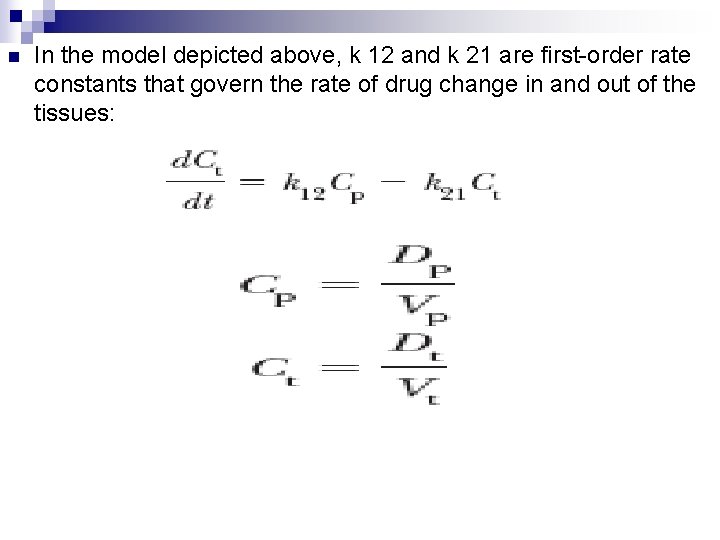
n In the model depicted above, k 12 and k 21 are first-order rate constants that govern the rate of drug change in and out of the tissues:
Volume of the Central Compartment The volume of the central compartment is useful for determining the drug concentration directly after an IV injection into the body. In clinical pharmacy, this volume is also referred to as V i or the initial volume of distribution as the drug distributes within the plasma and other accessible body fluids. This volume is generally smaller than the terminal volume of distribution after drug distribution to tissue is completed. The volume of the central compartment is generally greater than 3 L, which is the volume of the plasma fluid for an average adult.
For many polar drugs, an initial volume of 7– 10 L may be interpreted as rapid drug distribution within the plasma and some extracellular fluids. For example, the V p of moxalactam ranges from 0. 12 to 0. 15 L/kg, corresponding to about 8. 4 to 10. 5 L for a typical 70 -kg patient. In contrast, V p of hydromorphone is about 24 L, possibly because of its rapid exit from the plasma into tissues even during the initial phase.
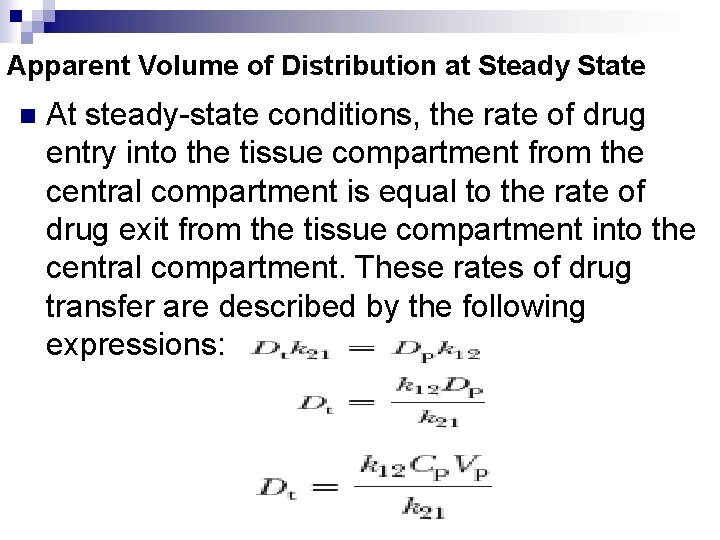
Apparent Volume of Distribution at Steady State n At steady-state conditions, the rate of drug entry into the tissue compartment from the central compartment is equal to the rate of drug exit from the tissue compartment into the central compartment. These rates of drug transfer are described by the following expressions:
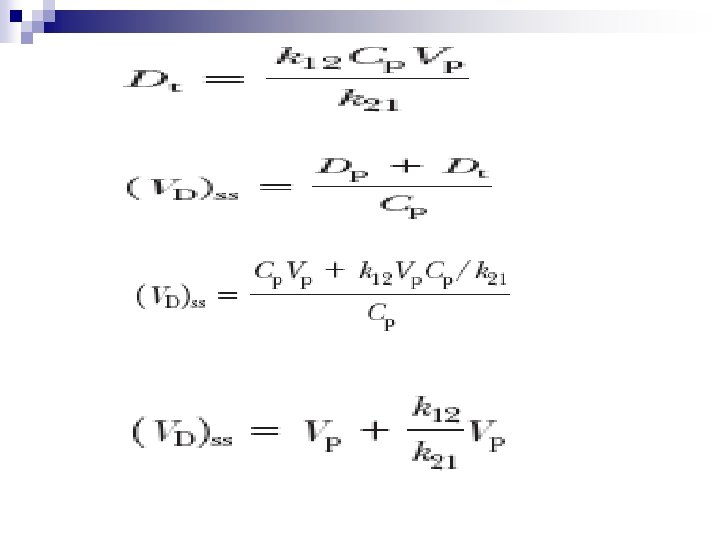
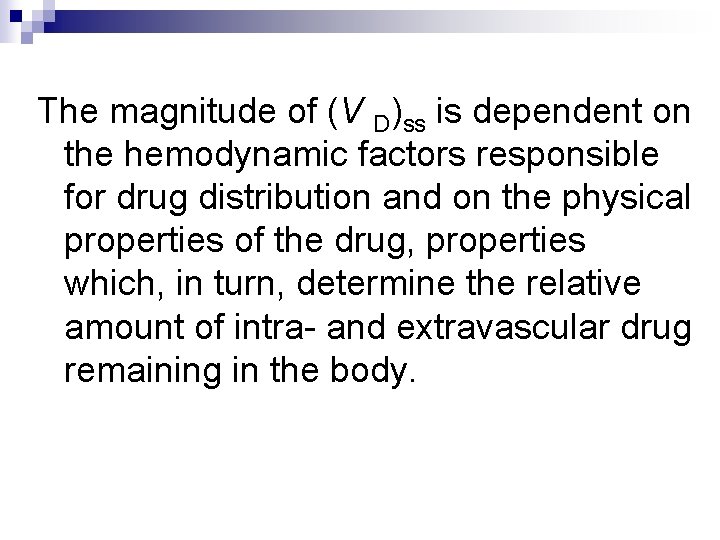
The magnitude of (V D)ss is dependent on the hemodynamic factors responsible for drug distribution and on the physical properties of the drug, properties which, in turn, determine the relative amount of intra- and extravascular drug remaining in the body.
- Slides: 15