
BioOrthogonal Reactions for Metabolic labelling Christmas day of
Bio-Orthogonal Reactions for Metabolic labelling Christmas day of science 2014 Ben Martyn
Bio-Orthogonal Reactions for Metabolic labelling • • What is Metabolic Labelling? What is bio-orthogonal chemistry? Staudinger Ligation Azide Alkyne Coupling Inverse Electron Demand Diels Alder Problems Looking ahead
Metabolic Labelling • Metabolic labelling: Using internal cell processes to incorporate labels into biomolecules.
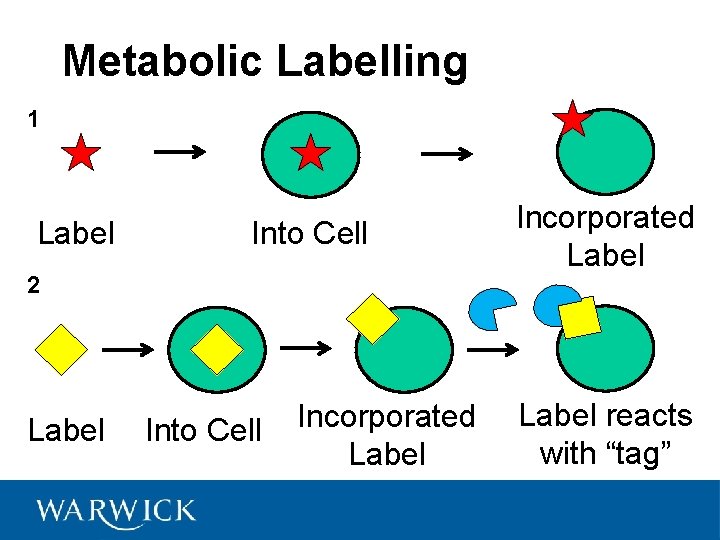
Metabolic Labelling 1 Label Into Cell 2 Label Into Cell Incorporated Label reacts with “tag”
What sort of labels? • Isotope Labelling – Requires careful experiment planning and complex analysis. • Green Fluorescent Protein – May perturb the system. • “Tagging” – Requires Bio-orthogonal chemistry. 1) R. J. Beynon and J. M. Pratt, Mol. Cell. Proteomics, 2005, 4, 857– 72
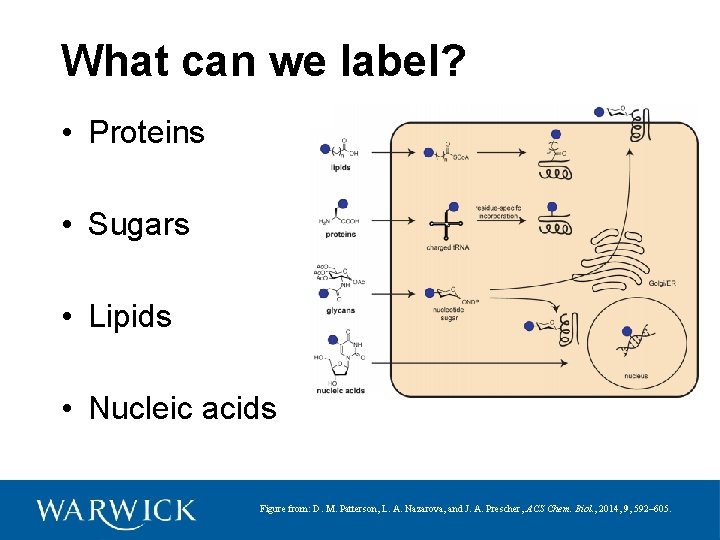
What can we label? • Proteins • Sugars • Lipids • Nucleic acids Figure from: D. M. Patterson, L. A. Nazarova, and J. A. Prescher, ACS Chem. Biol. , 2014, 9, 592– 605.
Bio-Orthogonality • What is a bio-orthogonal reaction? “Click chemistry in a biological setting” – Selective – Biologically inert – Chemically inert – Kinetics – Accessible engineering
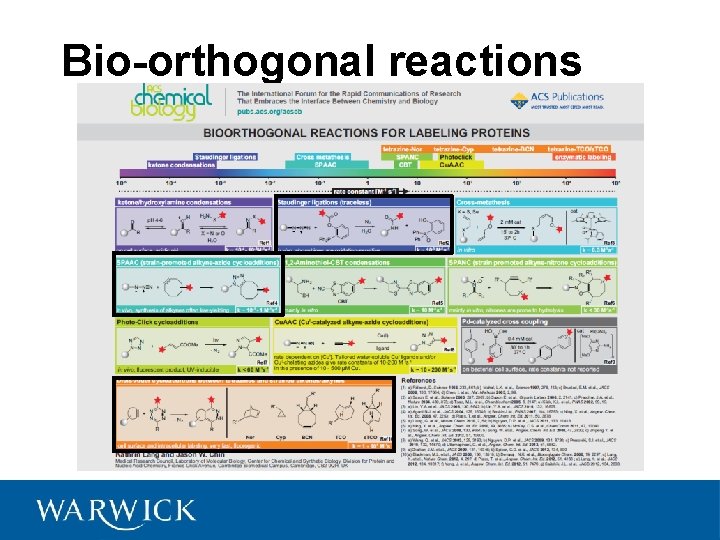
Bio-orthogonal reactions
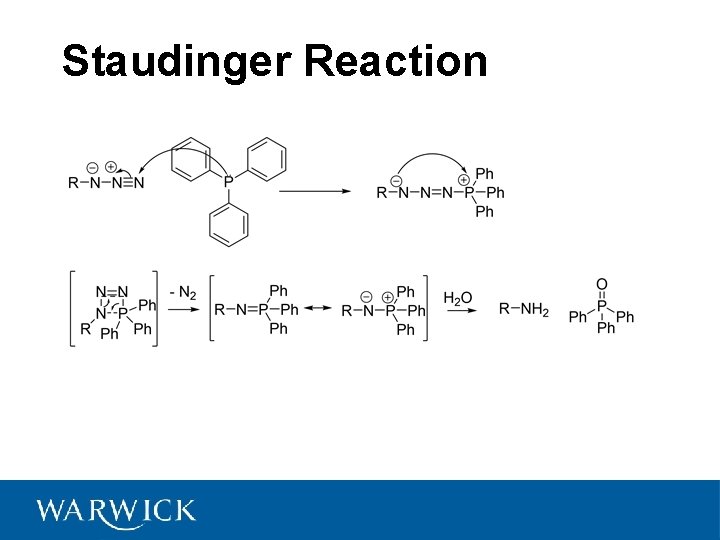
Staudinger Reaction
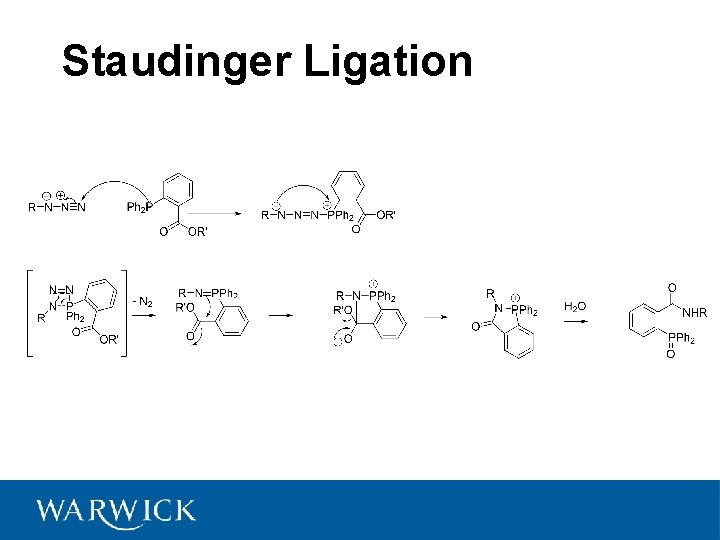
Staudinger Ligation
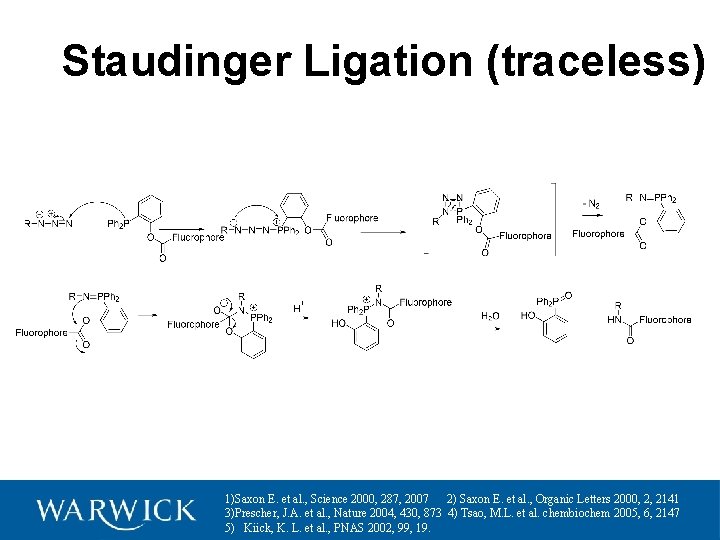
Staudinger Ligation (traceless) 1)Saxon E. et al. , Science 2000, 287, 2007 2) Saxon E. et al. , Organic Letters 2000, 2, 2141 3)Prescher, J. A. et al. , Nature 2004, 430, 873 4) Tsao, M. L. et al. chembiochem 2005, 6, 2147 5) Kiick, K. L. et al. , PNAS 2002, 99, 19.
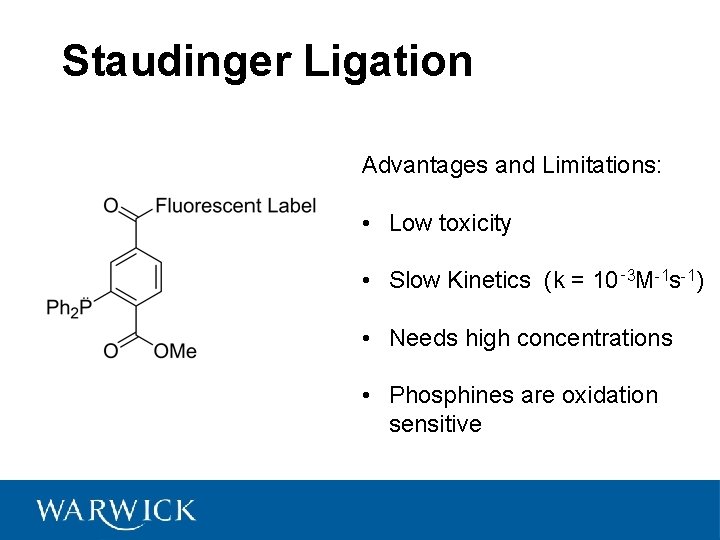
Staudinger Ligation Advantages and Limitations: • Low toxicity • Slow Kinetics (k = 10‑ 3 M-1 s-1) • Needs high concentrations • Phosphines are oxidation sensitive
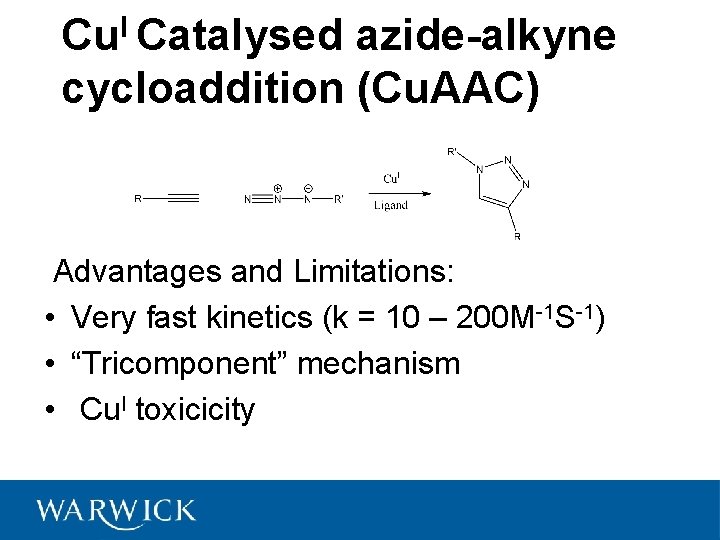
Cu. I Catalysed azide-alkyne cycloaddition (Cu. AAC) Advantages and Limitations: • Very fast kinetics (k = 10 – 200 M-1 S-1) • “Tricomponent” mechanism • Cu. I toxicicity
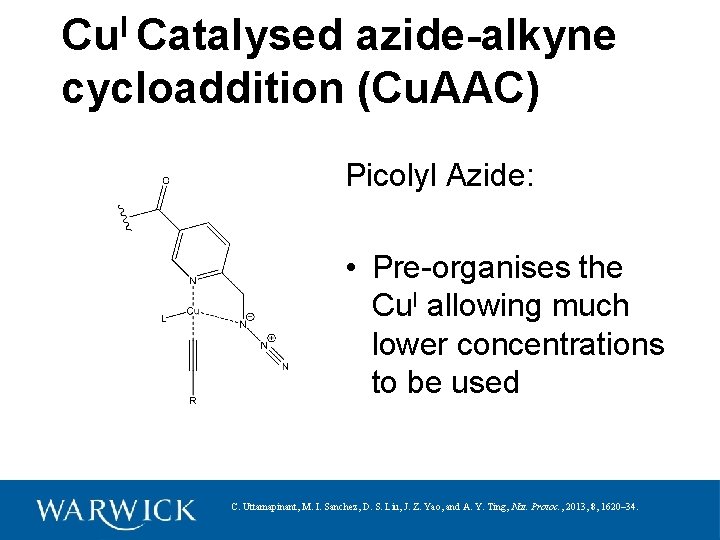
Cu. I Catalysed azide-alkyne cycloaddition (Cu. AAC) Picolyl Azide: • Pre-organises the Cu. I allowing much lower concentrations to be used C. Uttamapinant, M. I. Sanchez, D. S. Liu, J. Z. Yao, and A. Y. Ting, Nat. Protoc. , 2013, 8, 1620– 34.
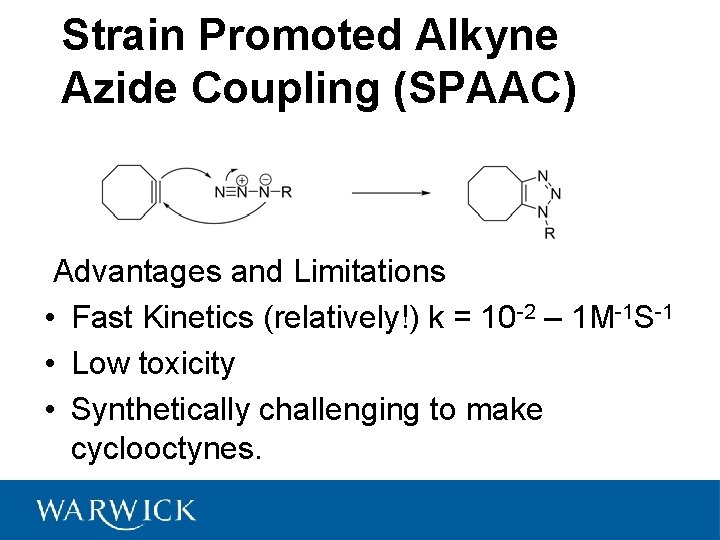
Strain Promoted Alkyne Azide Coupling (SPAAC) Advantages and Limitations • Fast Kinetics (relatively!) k = 10 -2 – 1 M-1 S-1 • Low toxicity • Synthetically challenging to make cyclooctynes.
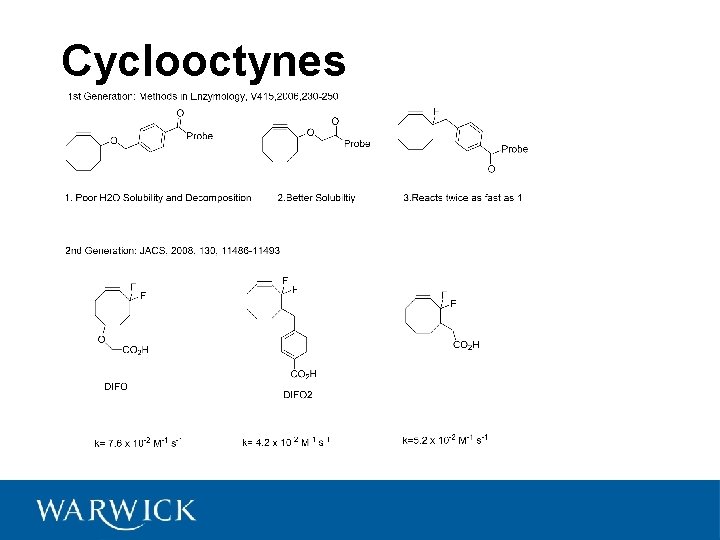
Cyclooctynes
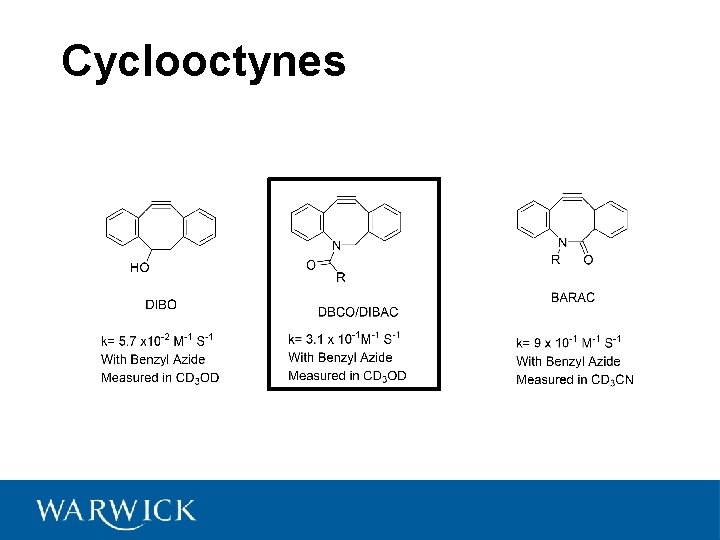
Cyclooctynes
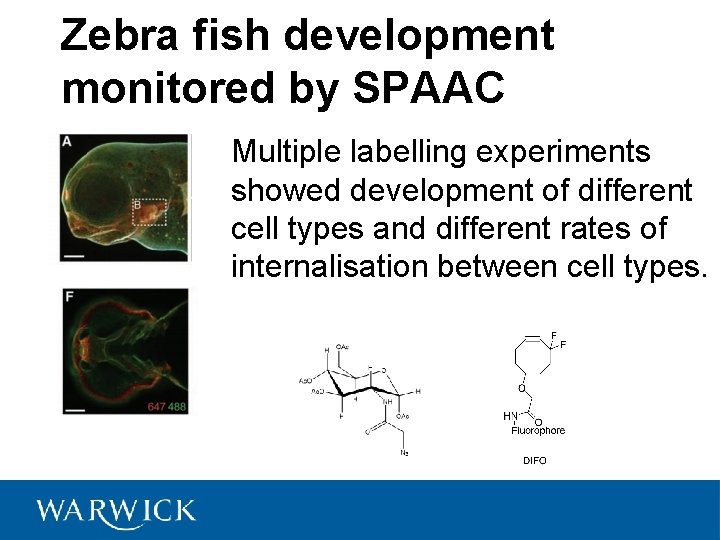
Zebra fish development monitored by SPAAC Multiple labelling experiments showed development of different cell types and different rates of internalisation between cell types.
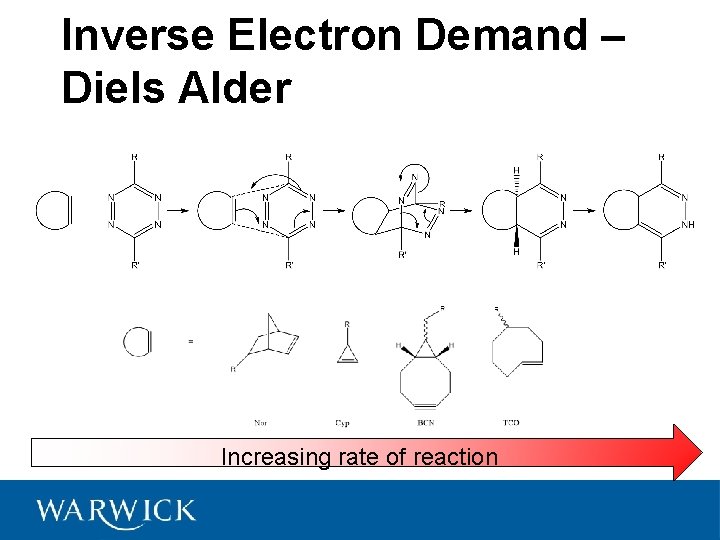
Inverse Electron Demand – Diels Alder Increasing rate of reaction
Inverse Electron Demand – Diels Alder Advantages and limitations: • Very fast Kinetics (k = 1 -104 M-1 s-1) • TCO is fastest but isomerises to unreactive cis-isomer. • Tetrazenes EWG makes them susceptible to hydrolysis and thiols.
Problems in the field • No standardised comparisons • Few places with collated strengths and weaknesses • Solubilities and stabilities often not stated
Looking forward • New bio-orthogonal reactions • Tuning of current reagents: Photoactivated reagents Pro-fluorescence • Mutually orthogonal reactions
Thanks for listening! • Further Reading: • D. M. Patterson et al, ACS Chem. Biol. , 2014, 9, 592– 605. • E. M. Sletten and C. R. Bertozzi, Angew. Chem. Int. Ed. Engl. , 2009, 48, 6974– 98. • M. D. Best, Biochemistry, 2009, 48, 6571– 84.
- Slides: 23