
Biomolecules and Photosynthesis Biology Essential Standard 4 1
Biomolecules and Photosynthesis Biology Essential Standard 4. 1 and 4. 2
Background Biomolecules, commonly referred to as “organic molecules” or “biological molecules” all contain carbon. They are the four molecules of life. The Miller-Urey Experiment discovered that these molecules (especially) amino acids existed in the early conditions of Earth

carbohydrates Building Blocks: Monosaccharides (simple sugars) Function: Energy production Examples are: starches, sugar, breads, pasta Glucose, sucrose, fructose, dextrose, maltose The suffix “--ose” means sugar Monosaccharides (simple sugars) join together to make disaccharides and polysaccharides.
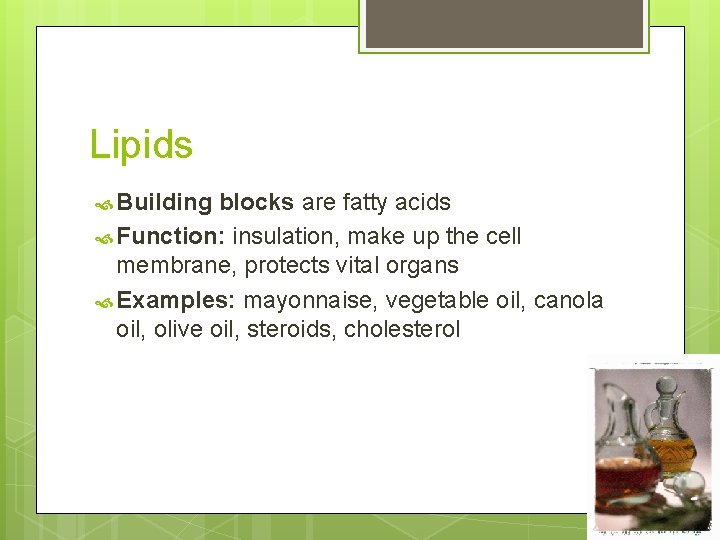
Lipids Building blocks are fatty acids Function: insulation, make up the cell membrane, protects vital organs Examples: mayonnaise, vegetable oil, canola oil, olive oil, steroids, cholesterol
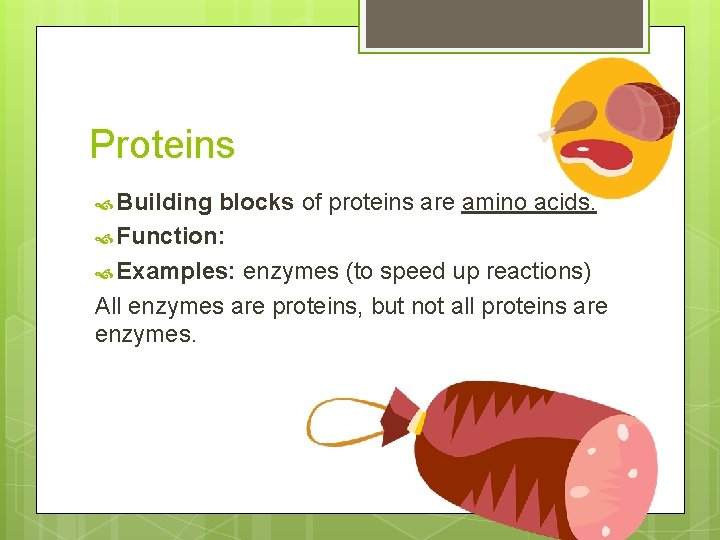
Proteins Building blocks of proteins are amino acids. Function: Examples: enzymes (to speed up reactions) All enzymes are proteins, but not all proteins are enzymes.
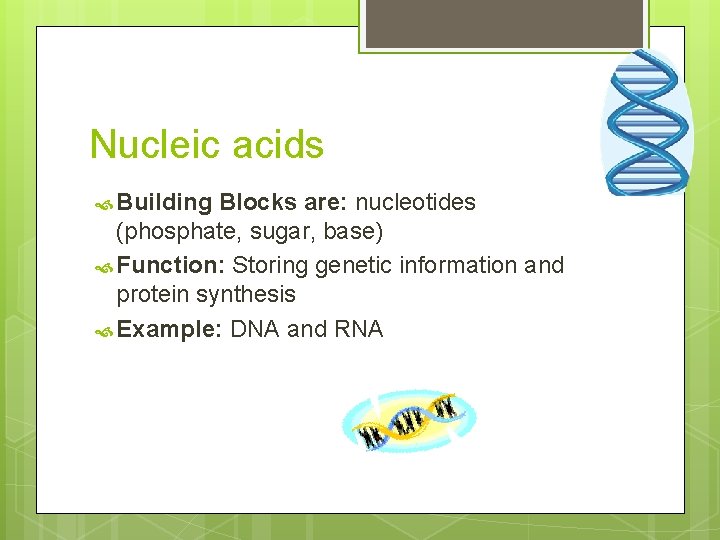
Nucleic acids Building Blocks are: nucleotides (phosphate, sugar, base) Function: Storing genetic information and protein synthesis Example: DNA and RNA
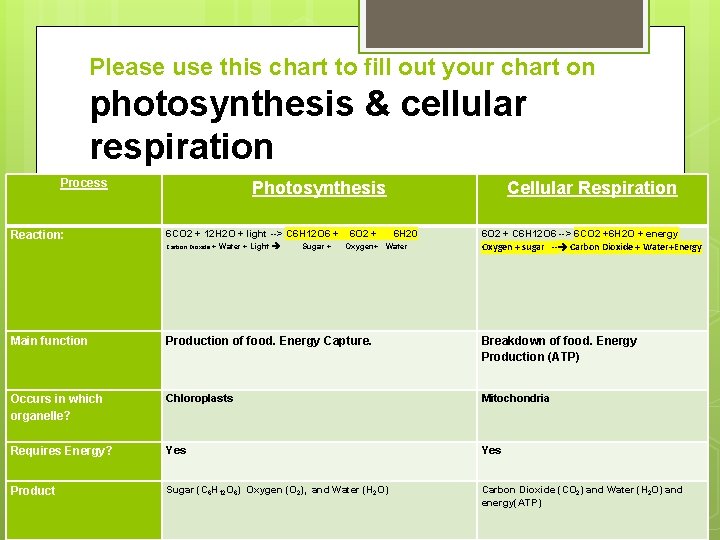
Please use this chart to fill out your chart on photosynthesis & cellular respiration Process Photosynthesis Reaction: 6 CO 2 + 12 H 2 O + light --> C 6 H 12 O 6 + Main function Production of food. Energy Capture. Breakdown of food. Energy Production (ATP) Occurs in which organelle? Chloroplasts Mitochondria Requires Energy? Yes Product Sugar (C 6 H 12 O 6) Oxygen (O 2), and Water (H 2 O) Carbon Dioxide (CO 2) and Water (H 2 O) and energy(ATP) Carbon Dioxide + Water + Light Sugar + 6 O 2 + Cellular Respiration 6 H 20 Oxygen+ Water 6 O 2 + C 6 H 12 O 6 --> 6 CO 2 +6 H 2 O + energy Oxygen + sugar -- Carbon Dioxide + Water+Energy
- Slides: 7