
Biomolecular Modeling Applications of GPUs and GPUAccelerated Clusters
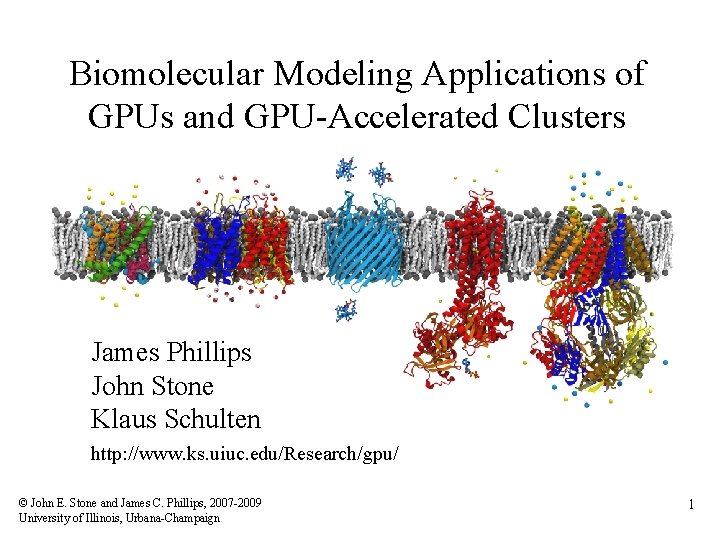
Biomolecular Modeling Applications of GPUs and GPU-Accelerated Clusters James Phillips John Stone Klaus Schulten http: //www. ks. uiuc. edu/Research/gpu/ © John E. Stone and James C. Phillips, 2007 -2009 University of Illinois, Urbana-Champaign 1
Outline • Electrostatic potential map calculation via direct Coulomb summation (DCS) in VMD • Interactive display of molecular orbitals in VMD • NAMD and message-driven programming • Adapting NAMD to GPU-accelerated clusters © John E. Stone and James C. Phillips, 2007 -2009 University of Illinois, Urbana-Champaign 2
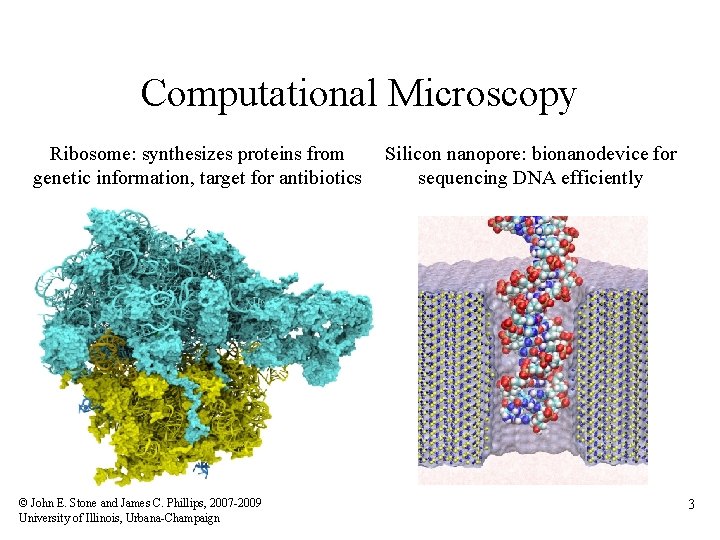
Computational Microscopy Ribosome: synthesizes proteins from genetic information, target for antibiotics © John E. Stone and James C. Phillips, 2007 -2009 University of Illinois, Urbana-Champaign Silicon nanopore: bionanodevice for sequencing DNA efficiently 3
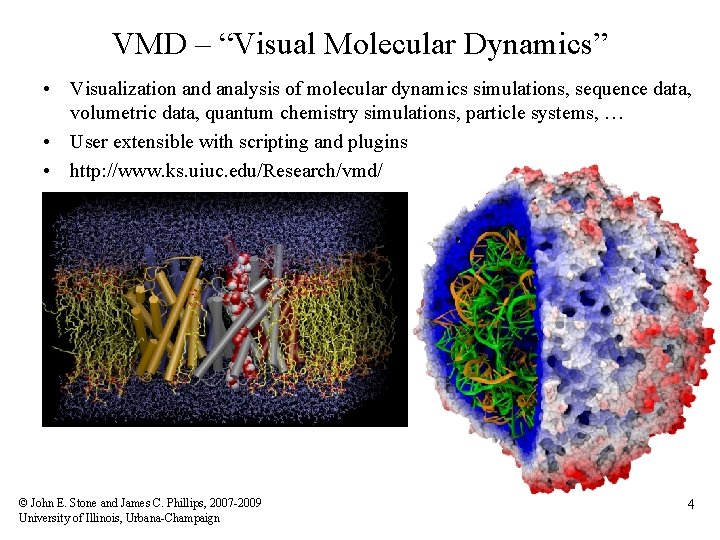
VMD – “Visual Molecular Dynamics” • Visualization and analysis of molecular dynamics simulations, sequence data, volumetric data, quantum chemistry simulations, particle systems, … • User extensible with scripting and plugins • http: //www. ks. uiuc. edu/Research/vmd/ © John E. Stone and James C. Phillips, 2007 -2009 University of Illinois, Urbana-Champaign 4
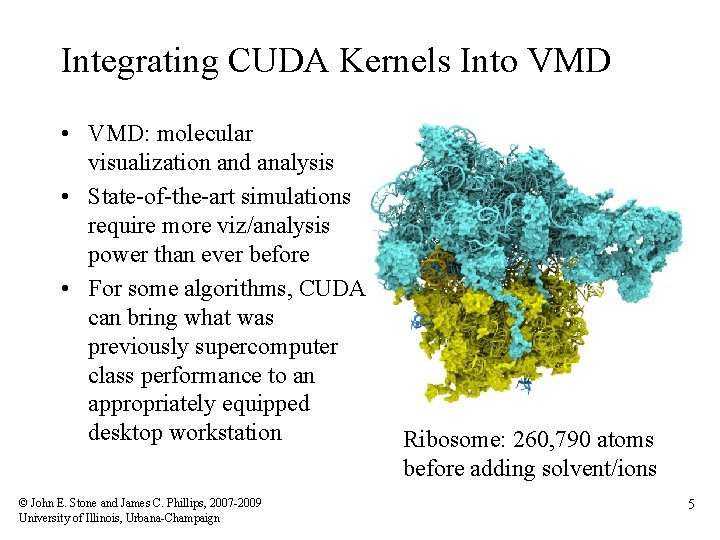
Integrating CUDA Kernels Into VMD • VMD: molecular visualization and analysis • State-of-the-art simulations require more viz/analysis power than ever before • For some algorithms, CUDA can bring what was previously supercomputer class performance to an appropriately equipped desktop workstation © John E. Stone and James C. Phillips, 2007 -2009 University of Illinois, Urbana-Champaign Ribosome: 260, 790 atoms before adding solvent/ions 5
Range of VMD Usage Scenarios • Users run VMD on a diverse range of hardware: laptops, desktops, clusters, and supercomputers • Typically used as a desktop science application, for interactive 3 D molecular graphics and analysis • Can also be run in pure text mode for numerically intensive analysis tasks, batch mode movie rendering, etc… • GPU acceleration provides an opportunity to make some slow, or batch calculations capable of being run interactively, or on-demand… © John E. Stone and James C. Phillips, 2007 -2009 University of Illinois, Urbana-Champaign 6
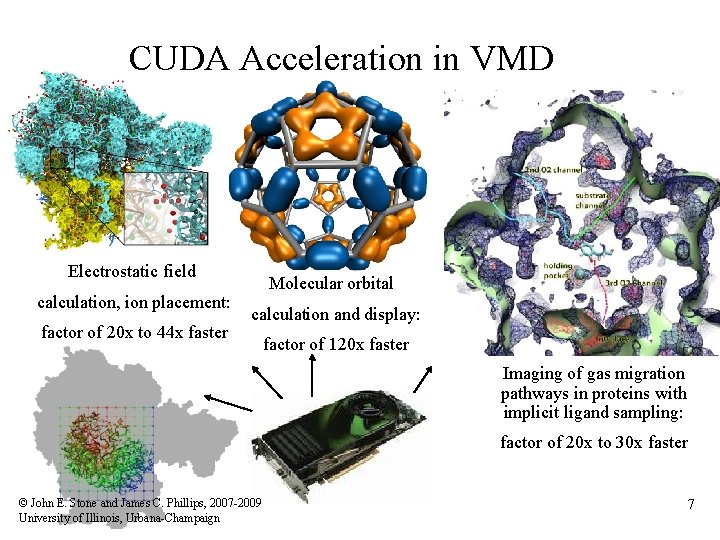
CUDA Acceleration in VMD Electrostatic field calculation, ion placement: factor of 20 x to 44 x faster Molecular orbital calculation and display: factor of 120 x faster Imaging of gas migration pathways in proteins with implicit ligand sampling: factor of 20 x to 30 x faster © John E. Stone and James C. Phillips, 2007 -2009 University of Illinois, Urbana-Champaign 7
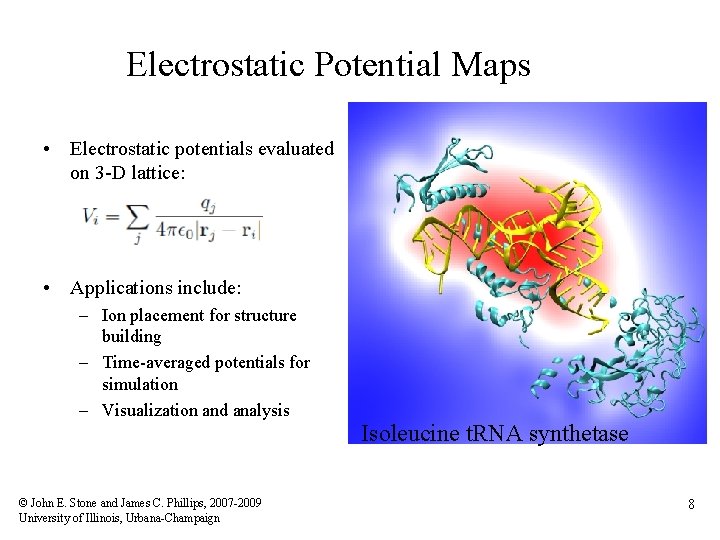
Electrostatic Potential Maps • Electrostatic potentials evaluated on 3 -D lattice: • Applications include: – Ion placement for structure building – Time-averaged potentials for simulation – Visualization and analysis © John E. Stone and James C. Phillips, 2007 -2009 University of Illinois, Urbana-Champaign Isoleucine t. RNA synthetase 8
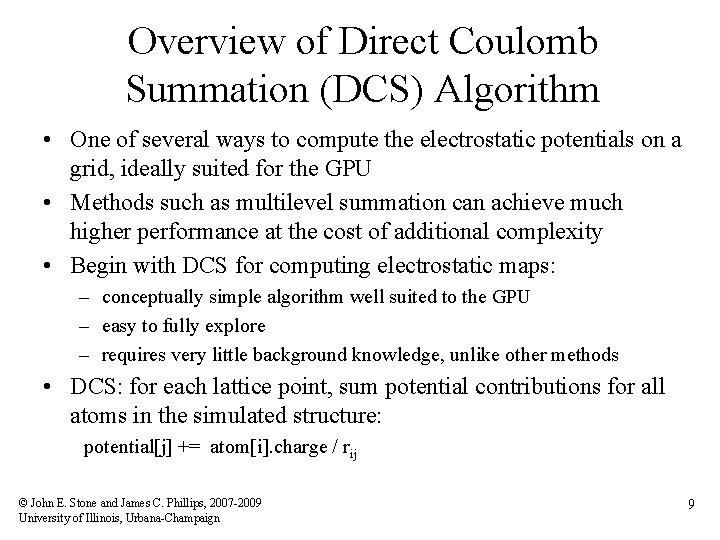
Overview of Direct Coulomb Summation (DCS) Algorithm • One of several ways to compute the electrostatic potentials on a grid, ideally suited for the GPU • Methods such as multilevel summation can achieve much higher performance at the cost of additional complexity • Begin with DCS for computing electrostatic maps: – conceptually simple algorithm well suited to the GPU – easy to fully explore – requires very little background knowledge, unlike other methods • DCS: for each lattice point, sum potential contributions for all atoms in the simulated structure: potential[j] += atom[i]. charge / rij © John E. Stone and James C. Phillips, 2007 -2009 University of Illinois, Urbana-Champaign 9
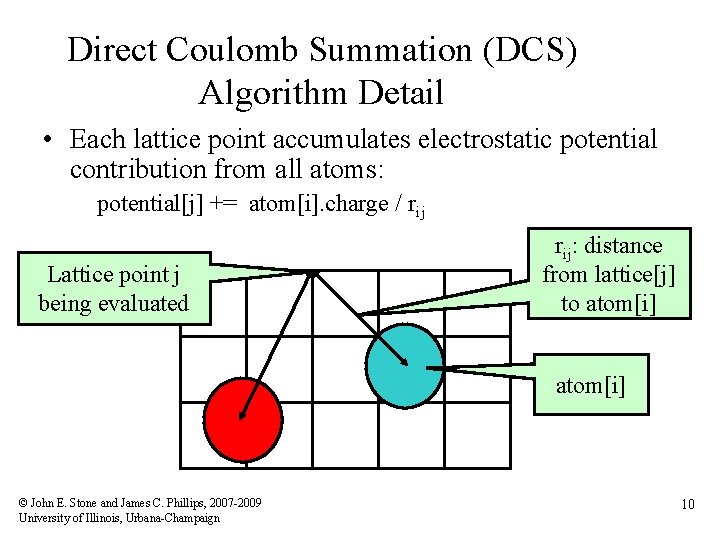
Direct Coulomb Summation (DCS) Algorithm Detail • Each lattice point accumulates electrostatic potential contribution from all atoms: potential[j] += atom[i]. charge / rij Lattice point j being evaluated rij: distance from lattice[j] to atom[i] © John E. Stone and James C. Phillips, 2007 -2009 University of Illinois, Urbana-Champaign 10
DCS Computational Considerations • Attributes of DCS algorithm for computing electrostatic maps: – – Highly data parallel Starting point for more sophisticated algorithms Single-precision FP arithmetic is adequate for intended uses Numerical accuracy can be further improved by compensated summation, spatially ordered summation groupings, or with the use of double-precision accumulation – Interesting test case since potential maps are useful for various visualization and analysis tasks • Forms a template for related spatially evaluated function summation algorithms in CUDA © John E. Stone and James C. Phillips, 2007 -2009 University of Illinois, Urbana-Champaign 11
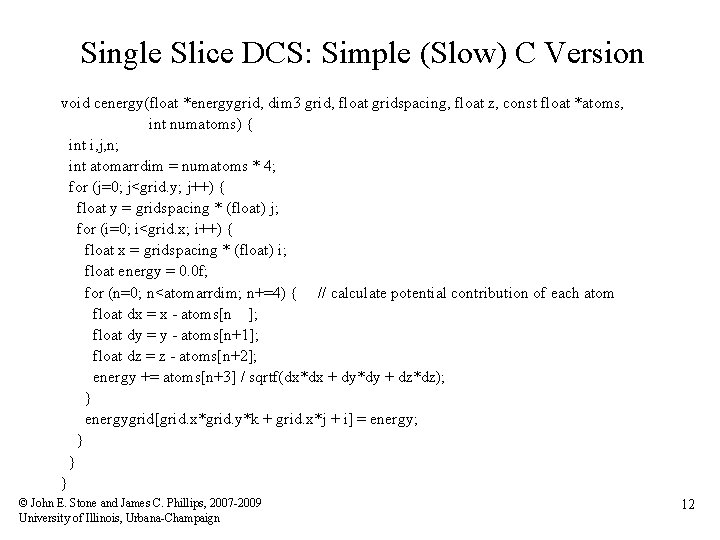
Single Slice DCS: Simple (Slow) C Version void cenergy(float *energygrid, dim 3 grid, float gridspacing, float z, const float *atoms, int numatoms) { int i, j, n; int atomarrdim = numatoms * 4; for (j=0; j<grid. y; j++) { float y = gridspacing * (float) j; for (i=0; i<grid. x; i++) { float x = gridspacing * (float) i; float energy = 0. 0 f; for (n=0; n<atomarrdim; n+=4) { // calculate potential contribution of each atom float dx = x - atoms[n ]; float dy = y - atoms[n+1]; float dz = z - atoms[n+2]; energy += atoms[n+3] / sqrtf(dx*dx + dy*dy + dz*dz); } energygrid[grid. x*grid. y*k + grid. x*j + i] = energy; } } } © John E. Stone and James C. Phillips, 2007 -2009 University of Illinois, Urbana-Champaign 12
DCS Algorithm Design Observations • Electrostatic maps used for ion placement require evaluation of ~20 potential lattice points per atom for a typical biological structure • Atom list has the smallest memory footprint, best choice for the inner loop (both CPU and GPU) • Lattice point coordinates are computed on-the-fly • Atom coordinates are made relative to the origin of the potential map, eliminating redundant arithmetic • Arithmetic can be significantly reduced by precalculating and reusing distance components, e. g. create a new array containing X, Q, and dy^2 + dz^2, updated on-the-fly for each row (CPU) • Vectorized CPU versions benefit greatly from SSE instructions © John E. Stone and James C. Phillips, 2007 -2009 University of Illinois, Urbana-Champaign 13
An Approach to Writing CUDA Kernels • Find an algorithm that can expose substantial parallelism, we’ll ultimately need thousands of independent threads… • Identify appropriate GPU memory or texture subsystems used to store data used by kernel • Are there trade-offs that can be made to exchange computation for more parallelism? – Though counterintuitive, past successes resulted from this strategy – “Brute force” methods that expose significant parallelism do surprisingly well on current GPUs • Analyze the real-world use case for the problem and select the kernel for the problem sizes that will be heavily used © John E. Stone and James C. Phillips, 2007 -2009 University of Illinois, Urbana-Champaign 14
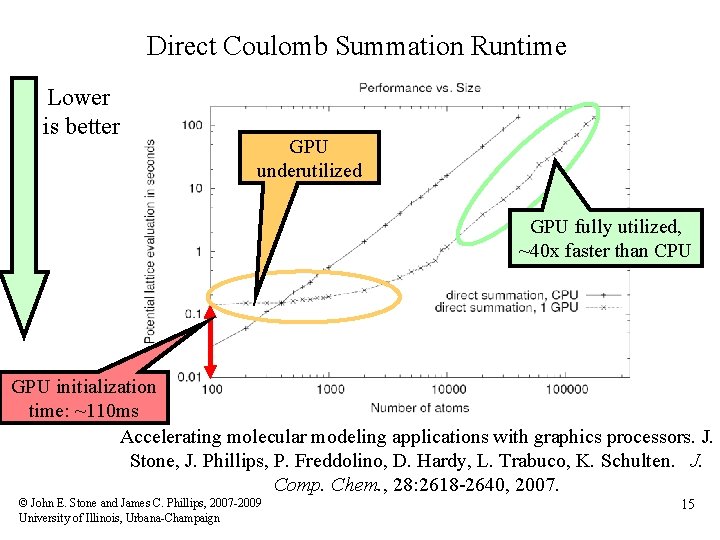
Direct Coulomb Summation Runtime Lower is better GPU underutilized GPU fully utilized, ~40 x faster than CPU GPU initialization time: ~110 ms Accelerating molecular modeling applications with graphics processors. J. Stone, J. Phillips, P. Freddolino, D. Hardy, L. Trabuco, K. Schulten. J. Comp. Chem. , 28: 2618 -2640, 2007. © John E. Stone and James C. Phillips, 2007 -2009 University of Illinois, Urbana-Champaign 15
DCS Observations for GPU Implementation • Naive implementation has a low ratio of FP arithmetic operations to memory transactions (at least for a GPU…) • The innermost loop will consume operands VERY quickly • Since atoms are read-only, they are ideal candidates for texture memory or constant memory • GPU implementations must access constant memory efficiently, avoid shared memory bank conflicts, coalesce global memory accesses, and overlap arithmetic with global memory latency • Map is padded out to a multiple of the thread block size: – Eliminates conditional handling at the edges, thus also eliminating the possibility of branch divergence – Assists with memory coalescing © John E. Stone and James C. Phillips, 2007 -2009 University of Illinois, Urbana-Champaign 16
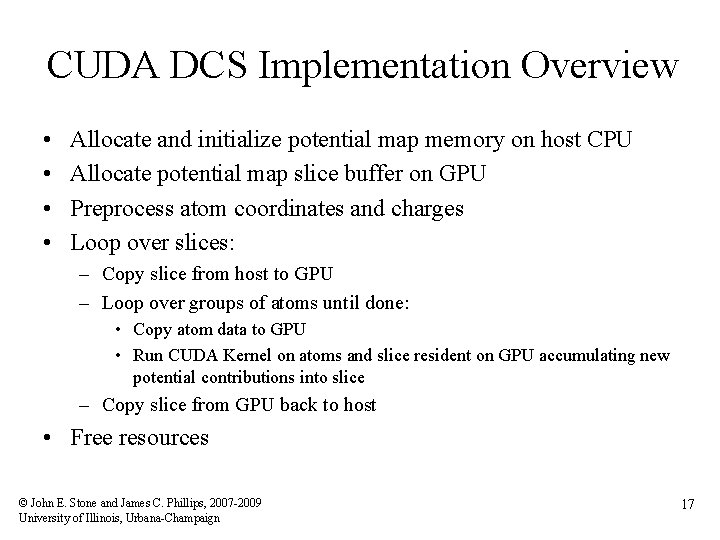
CUDA DCS Implementation Overview • • Allocate and initialize potential map memory on host CPU Allocate potential map slice buffer on GPU Preprocess atom coordinates and charges Loop over slices: – Copy slice from host to GPU – Loop over groups of atoms until done: • Copy atom data to GPU • Run CUDA Kernel on atoms and slice resident on GPU accumulating new potential contributions into slice – Copy slice from GPU back to host • Free resources © John E. Stone and James C. Phillips, 2007 -2009 University of Illinois, Urbana-Champaign 17
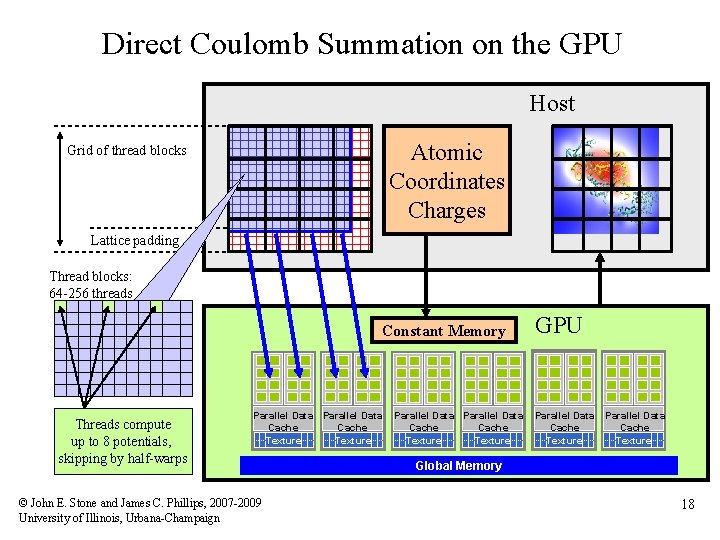
Direct Coulomb Summation on the GPU Host Atomic Coordinates Charges Grid of thread blocks Lattice padding Thread blocks: 64 -256 threads Constant Memory Threads compute up to 8 potentials, skipping by half-warps Parallel Data Cache Texture © John E. Stone and James C. Phillips, 2007 -2009 University of Illinois, Urbana-Champaign Parallel Data Cache Texture GPU Parallel Data Cache Texture Global Memory 18
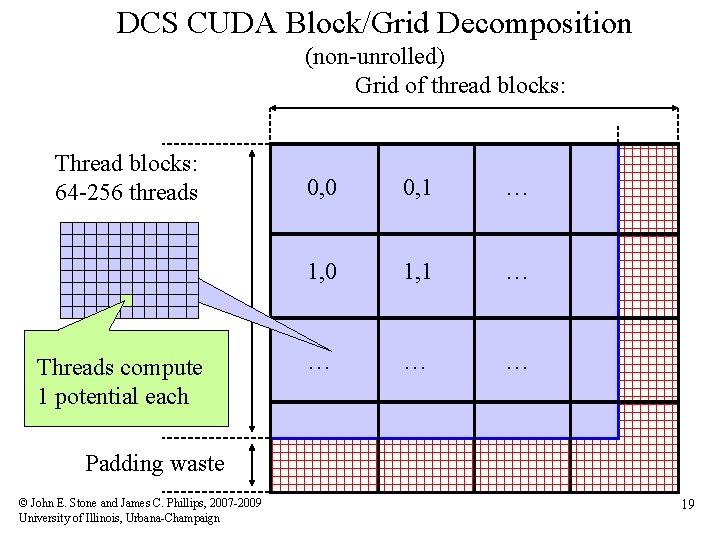
DCS CUDA Block/Grid Decomposition (non-unrolled) Grid of thread blocks: Thread blocks: 64 -256 threads Threads compute 1 potential each 0, 0 0, 1 … 1, 0 1, 1 … … Padding waste © John E. Stone and James C. Phillips, 2007 -2009 University of Illinois, Urbana-Champaign 19
DCS CUDA Block/Grid Decomposition (non-unrolled) • 16 x 16 CUDA thread blocks are a nice starting size with a satisfactory number of threads • Small enough that there’s not much waste due to padding at the edges © John E. Stone and James C. Phillips, 2007 -2009 University of Illinois, Urbana-Champaign 20
Notes on Benchmarking CUDA Kernels: Initialization Overhead • When a host thread initially binds to a CUDA context, there is a small (~100 ms) delay during the first CUDA runtime call that touches state on the device • The first time each CUDA kernel is executed, there’s a small delay while the driver compiles the device-independent PTX intermediate code for the physical device associated with the current context • In most real codes, these sources of one-time initialization overhead would occur at application startup and should not be a significant factor. • The exception to this is that newly-created host threads incur overhead when they bind to their device, so it’s best to re-use existing host threads than to generate them repeatedly © John E. Stone and James C. Phillips, 2007 -2009 University of Illinois, Urbana-Champaign 21
Notes on Benchmarking CUDA Kernels: Power Management, Async Operations • Modern GPUs (and of course CPUs) incorporate power management hardware that reduces clock rates and/or powers down functional units when idle • In order to benchmark peak performance of CUDA kernels, both the GPU(s) and CPU(s) must be awoken from their respective low-power modes • In order to get accurate and repeatable timings, do a “warm up” pass prior to running benchmark timings on your kernel and any associated I/O • Call cuda. Thread. Synchronize() prior to stopping timers to verify that any outstanding kernels and I/Os have completed © John E. Stone and James C. Phillips, 2007 -2009 University of Illinois, Urbana-Champaign 22
DCS Version 1: Const+Precalc 187 GFLOPS, 18. 6 Billion Atom Evals/Sec • Pros: – Pre-compute dz^2 for entire slice – Inner loop over read-only atoms, const memory ideal – If all threads read the same const data at the same time, performance is similar to reading a register • Cons: – Const memory only holds ~4000 atom coordinates and charges – Potential summation must be done in multiple kernel invocations per slice, with const atom data updated for each invocation – Host must shuffle data in/out for each pass © John E. Stone and James C. Phillips, 2007 -2009 University of Illinois, Urbana-Champaign 23
![DCS Version 1: Kernel Structure … Start global memory reads float curenergy = energygrid[outaddr];](http://slidetodoc.com/presentation_image_h/1ce1f8526feaa5286247abbd09a6ca01/image-24.jpg "DCS Version 1: Kernel Structure … Start global memory reads float curenergy = energygrid[outaddr];")
DCS Version 1: Kernel Structure … Start global memory reads float curenergy = energygrid[outaddr]; early. Kernel hides some of float coorx = gridspacing * xindex; its own latency. float coory = gridspacing * yindex; int atomid; float energyval=0. 0 f; for (atomid=0; atomid<numatoms; atomid++) { float dx = coorx - atominfo[atomid]. x; float dy = coory - atominfo[atomid]. y; energyval += atominfo[atomid]. w * rsqrtf(dx*dx + dy*dy + atominfo[atomid]. z); Only dependency on global } memory read is at the end of energygrid[outaddr] = curenergy + energyval; the kernel… © John E. Stone and James C. Phillips, 2007 -2009 University of Illinois, Urbana-Champaign 24
DCS CUDA Block/Grid Decomposition (unrolled) • Reuse atom data and partial distance components multiple times • Use “unroll and jam” to unroll the outer loop into the inner loop • Uses more registers, but increases arithmetic intensity significantly • Kernels that unroll the inner loop calculate more than one lattice point per thread result in larger computational tiles: – Thread count per block must be decreased to reduce computational tile size as unrolling is increased – Otherwise, tile size gets bigger as threads do more than one lattice point evaluation, resulting on a significant increase in padding and wasted computations at edges © John E. Stone and James C. Phillips, 2007 -2009 University of Illinois, Urbana-Champaign 25
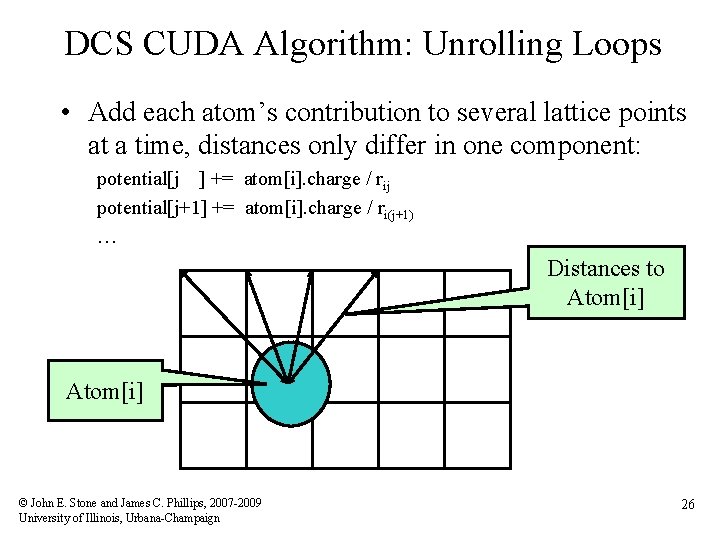
DCS CUDA Algorithm: Unrolling Loops • Add each atom’s contribution to several lattice points at a time, distances only differ in one component: potential[j ] += atom[i]. charge / rij potential[j+1] += atom[i]. charge / ri(j+1) … Distances to Atom[i] © John E. Stone and James C. Phillips, 2007 -2009 University of Illinois, Urbana-Champaign 26
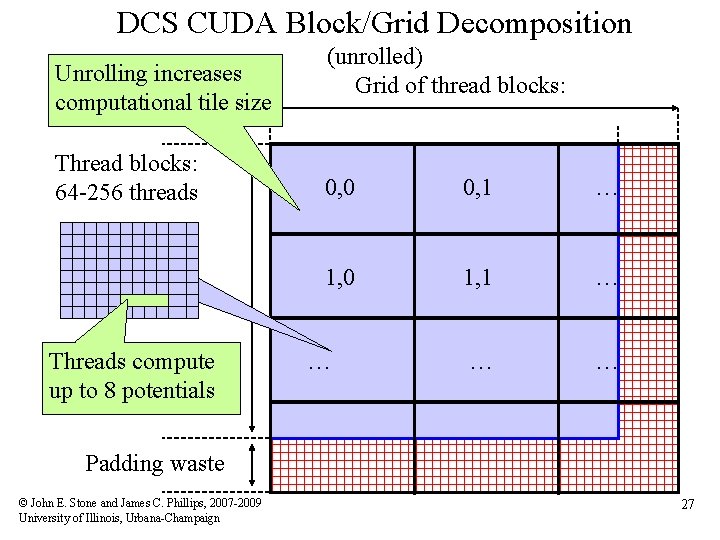
DCS CUDA Block/Grid Decomposition Unrolling increases computational tile size Thread blocks: 64 -256 threads Threads compute up to 8 potentials (unrolled) Grid of thread blocks: 0, 0 0, 1 … 1, 0 1, 1 … … Padding waste © John E. Stone and James C. Phillips, 2007 -2009 University of Illinois, Urbana-Champaign 27
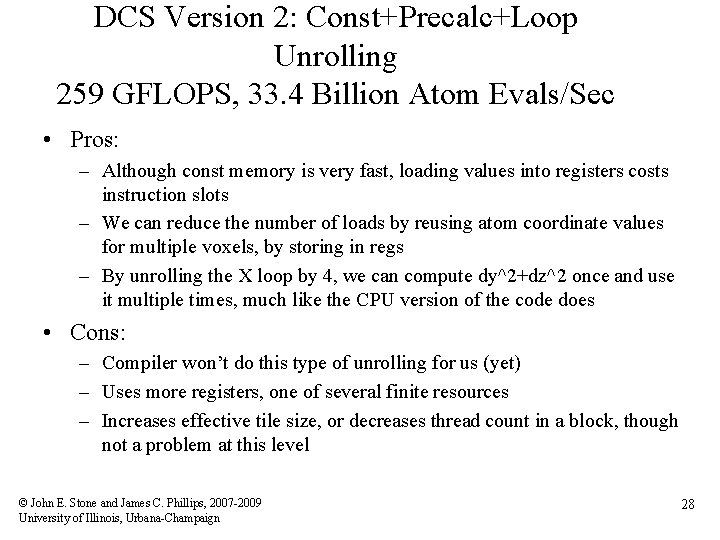
DCS Version 2: Const+Precalc+Loop Unrolling 259 GFLOPS, 33. 4 Billion Atom Evals/Sec • Pros: – Although const memory is very fast, loading values into registers costs instruction slots – We can reduce the number of loads by reusing atom coordinate values for multiple voxels, by storing in regs – By unrolling the X loop by 4, we can compute dy^2+dz^2 once and use it multiple times, much like the CPU version of the code does • Cons: – Compiler won’t do this type of unrolling for us (yet) – Uses more registers, one of several finite resources – Increases effective tile size, or decreases thread count in a block, though not a problem at this level © John E. Stone and James C. Phillips, 2007 -2009 University of Illinois, Urbana-Champaign 28
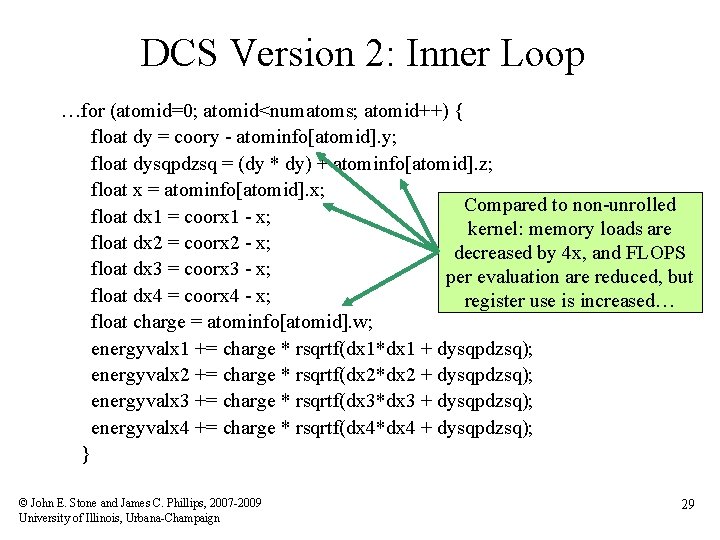
DCS Version 2: Inner Loop …for (atomid=0; atomid<numatoms; atomid++) { float dy = coory - atominfo[atomid]. y; float dysqpdzsq = (dy * dy) + atominfo[atomid]. z; float x = atominfo[atomid]. x; Compared to non-unrolled float dx 1 = coorx 1 - x; kernel: memory loads are float dx 2 = coorx 2 - x; decreased by 4 x, and FLOPS float dx 3 = coorx 3 - x; per evaluation are reduced, but float dx 4 = coorx 4 - x; register use is increased… float charge = atominfo[atomid]. w; energyvalx 1 += charge * rsqrtf(dx 1*dx 1 + dysqpdzsq); energyvalx 2 += charge * rsqrtf(dx 2*dx 2 + dysqpdzsq); energyvalx 3 += charge * rsqrtf(dx 3*dx 3 + dysqpdzsq); energyvalx 4 += charge * rsqrtf(dx 4*dx 4 + dysqpdzsq); } © John E. Stone and James C. Phillips, 2007 -2009 University of Illinois, Urbana-Champaign 29
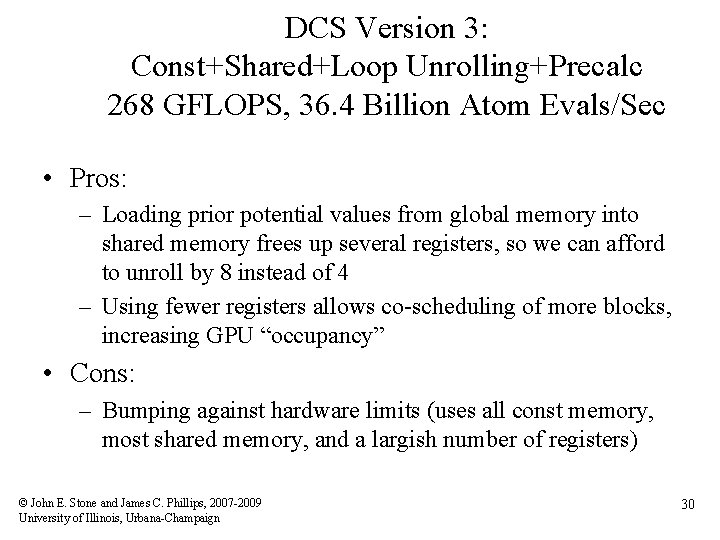
DCS Version 3: Const+Shared+Loop Unrolling+Precalc 268 GFLOPS, 36. 4 Billion Atom Evals/Sec • Pros: – Loading prior potential values from global memory into shared memory frees up several registers, so we can afford to unroll by 8 instead of 4 – Using fewer registers allows co-scheduling of more blocks, increasing GPU “occupancy” • Cons: – Bumping against hardware limits (uses all const memory, most shared memory, and a largish number of registers) © John E. Stone and James C. Phillips, 2007 -2009 University of Illinois, Urbana-Champaign 30
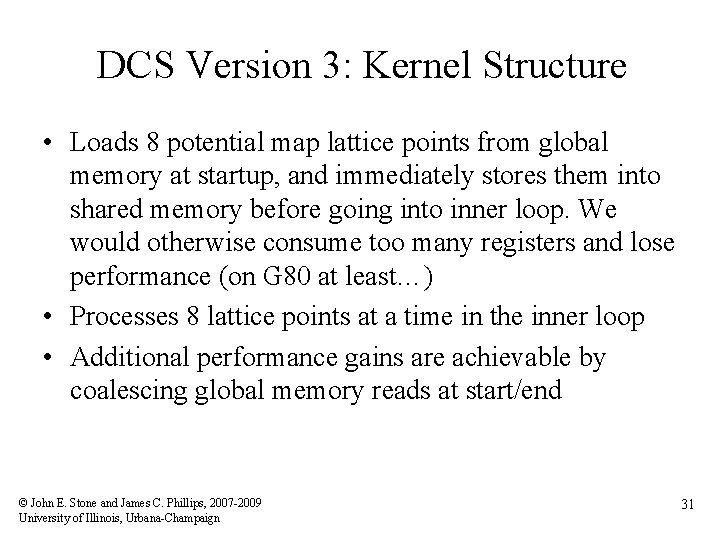
DCS Version 3: Kernel Structure • Loads 8 potential map lattice points from global memory at startup, and immediately stores them into shared memory before going into inner loop. We would otherwise consume too many registers and lose performance (on G 80 at least…) • Processes 8 lattice points at a time in the inner loop • Additional performance gains are achievable by coalescing global memory reads at start/end © John E. Stone and James C. Phillips, 2007 -2009 University of Illinois, Urbana-Champaign 31
![DCS Version 3: Inner Loop …for (v=0; v<8; v++) curenergies[tid + nthr * v]](http://slidetodoc.com/presentation_image_h/1ce1f8526feaa5286247abbd09a6ca01/image-32.jpg "DCS Version 3: Inner Loop …for (v=0; v<8; v++) curenergies[tid + nthr * v]")
DCS Version 3: Inner Loop …for (v=0; v<8; v++) curenergies[tid + nthr * v] = energygrid[outaddr + v]; float coorx = gridspacing * xindex; float coory = gridspacing * yindex; float energyvalx 1=0. 0 f; [……. ] float energyvalx 8=0. 0 f; for (atomid=0; atomid<numatoms; atomid++) { float dy = coory - atominfo[atomid]. y; float dysqpdzsq = (dy * dy) + atominfo[atomid]. z; float dx = coorx - atominfo[atomid]. x; energyvalx 1 += atominfo[atomid]. w * rsqrtf(dx*dx + dysqpdzsq); dx += gridspacing; […] energyvalx 8 += atominfo[atomid]. w * rsqrtf(dx*dx + dysqpdzsq); } __syncthreads(); // guarantee that shared memory values are ready for reading by all threads energygrid[outaddr ] = energyvalx 1 + curenergies[tid ]; […] energygrid[outaddr + 7] = energyvalx 2 + curenergies[tid + nthr * 7]; © John E. Stone and James C. Phillips, 2007 -2009 University of Illinois, Urbana-Champaign 32
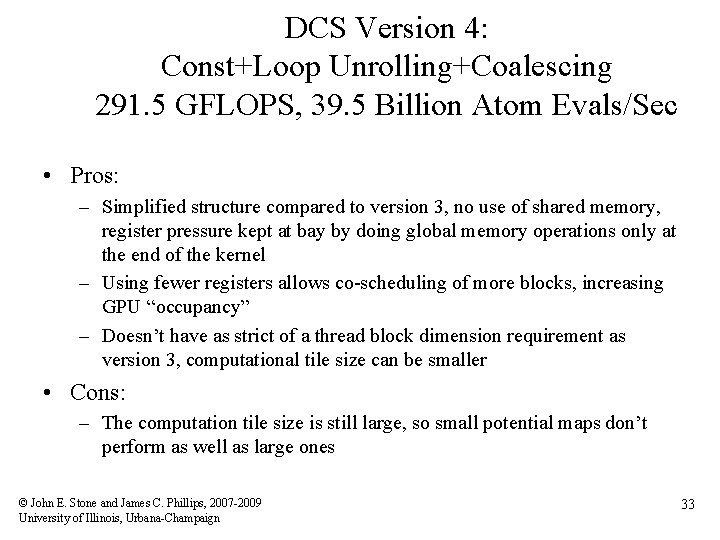
DCS Version 4: Const+Loop Unrolling+Coalescing 291. 5 GFLOPS, 39. 5 Billion Atom Evals/Sec • Pros: – Simplified structure compared to version 3, no use of shared memory, register pressure kept at bay by doing global memory operations only at the end of the kernel – Using fewer registers allows co-scheduling of more blocks, increasing GPU “occupancy” – Doesn’t have as strict of a thread block dimension requirement as version 3, computational tile size can be smaller • Cons: – The computation tile size is still large, so small potential maps don’t perform as well as large ones © John E. Stone and James C. Phillips, 2007 -2009 University of Illinois, Urbana-Champaign 33
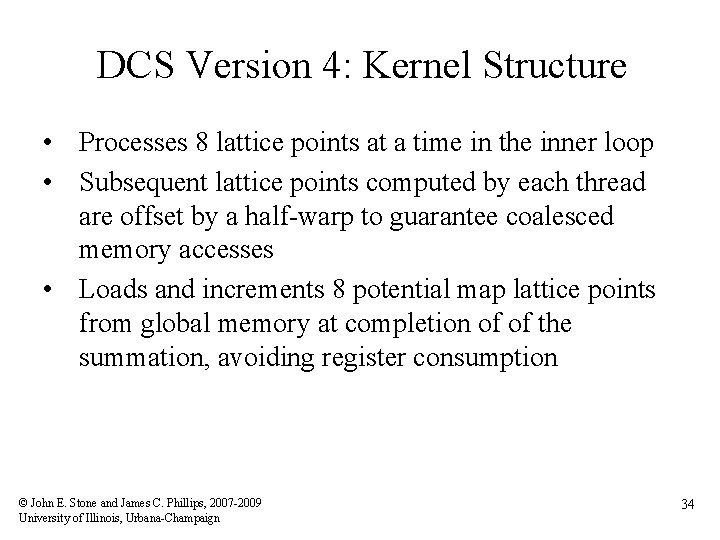
DCS Version 4: Kernel Structure • Processes 8 lattice points at a time in the inner loop • Subsequent lattice points computed by each thread are offset by a half-warp to guarantee coalesced memory accesses • Loads and increments 8 potential map lattice points from global memory at completion of of the summation, avoiding register consumption © John E. Stone and James C. Phillips, 2007 -2009 University of Illinois, Urbana-Champaign 34
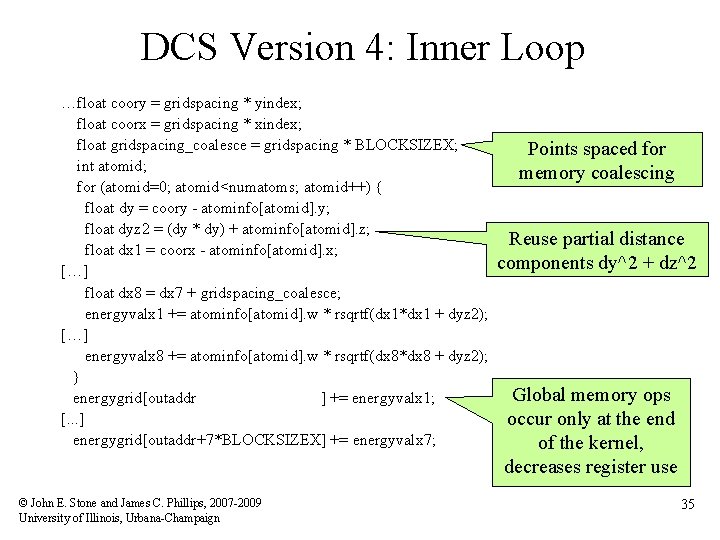
DCS Version 4: Inner Loop …float coory = gridspacing * yindex; float coorx = gridspacing * xindex; float gridspacing_coalesce = gridspacing * BLOCKSIZEX; int atomid; for (atomid=0; atomid<numatoms; atomid++) { float dy = coory - atominfo[atomid]. y; float dyz 2 = (dy * dy) + atominfo[atomid]. z; float dx 1 = coorx - atominfo[atomid]. x; […] float dx 8 = dx 7 + gridspacing_coalesce; energyvalx 1 += atominfo[atomid]. w * rsqrtf(dx 1*dx 1 + dyz 2); […] energyvalx 8 += atominfo[atomid]. w * rsqrtf(dx 8*dx 8 + dyz 2); } energygrid[outaddr ] += energyvalx 1; [. . . ] energygrid[outaddr+7*BLOCKSIZEX] += energyvalx 7; © John E. Stone and James C. Phillips, 2007 -2009 University of Illinois, Urbana-Champaign Points spaced for memory coalescing Reuse partial distance components dy^2 + dz^2 Global memory ops occur only at the end of the kernel, decreases register use 35
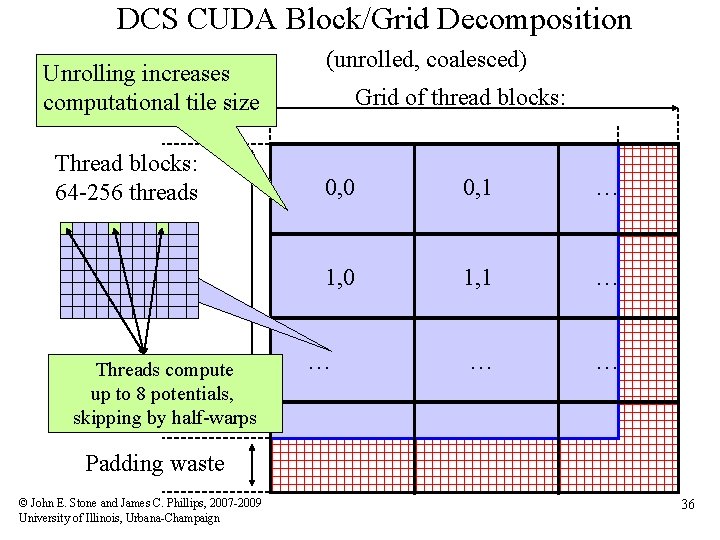
DCS CUDA Block/Grid Decomposition Unrolling increases computational tile size Thread blocks: 64 -256 threads Threads compute up to 8 potentials, skipping by half-warps (unrolled, coalesced) Grid of thread blocks: 0, 0 0, 1 … 1, 0 1, 1 … … Padding waste © John E. Stone and James C. Phillips, 2007 -2009 University of Illinois, Urbana-Champaign 36
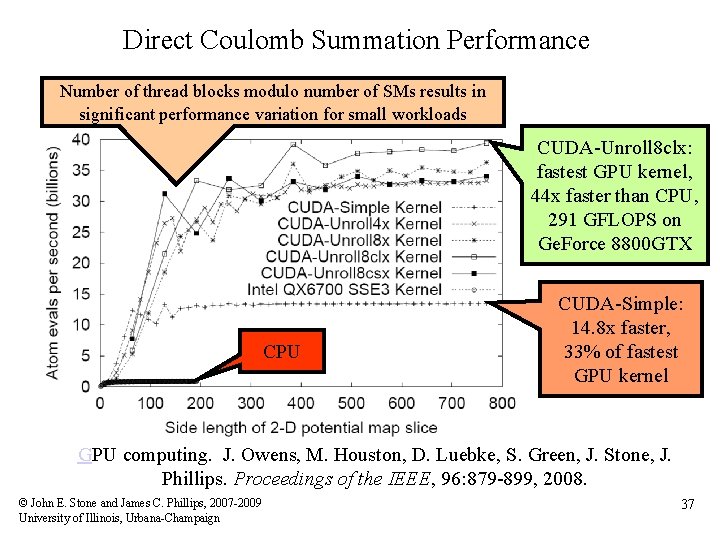
Direct Coulomb Summation Performance Number of thread blocks modulo number of SMs results in significant performance variation for small workloads CUDA-Unroll 8 clx: fastest GPU kernel, 44 x faster than CPU, 291 GFLOPS on Ge. Force 8800 GTX CPU CUDA-Simple: 14. 8 x faster, 33% of fastest GPU kernel GPU computing. J. Owens, M. Houston, D. Luebke, S. Green, J. Stone, J. Phillips. Proceedings of the IEEE, 96: 879 -899, 2008. © John E. Stone and James C. Phillips, 2007 -2009 University of Illinois, Urbana-Champaign 37
Multi-GPU DCS Potential Map Calculation • Both CPU and GPU versions of the code are easily parallelized by decomposing the 3 -D potential map into slices, and computing them concurrently • Potential maps often have 50 -500 slices in the Z direction, so plenty of coarse grain parallelism is still available via the DCS algorithm © John E. Stone and James C. Phillips, 2007 -2009 University of Illinois, Urbana-Champaign 38
Multi-GPU DCS Algorithm: • One host thread is created for each CUDA GPU, attached according to host thread ID: – First CUDA call binds that thread’s CUDA context to that GPU for life – Map slices are decomposed cyclically onto the available GPUs – Handling error conditions within child threads is dependent on the thread library and, makes dealing with any CUDA errors somewhat tricky. Easiest way to deal with this is with a shared exception queue/stack for all of the worker threads. • Map slices are usually larger than the host memory page size, so false sharing and related effects are not a problem for this application © John E. Stone and James C. Phillips, 2007 -2009 University of Illinois, Urbana-Champaign 39
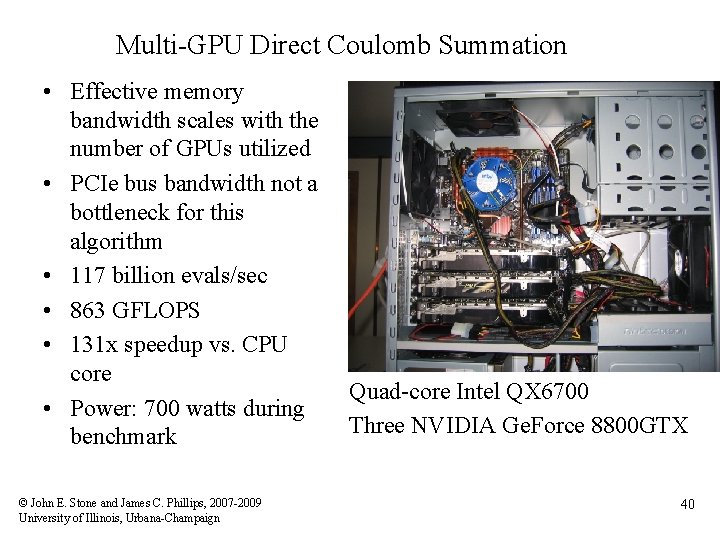
Multi-GPU Direct Coulomb Summation • Effective memory bandwidth scales with the number of GPUs utilized • PCIe bus bandwidth not a bottleneck for this algorithm • 117 billion evals/sec • 863 GFLOPS • 131 x speedup vs. CPU core • Power: 700 watts during benchmark © John E. Stone and James C. Phillips, 2007 -2009 University of Illinois, Urbana-Champaign Quad-core Intel QX 6700 Three NVIDIA Ge. Force 8800 GTX 40
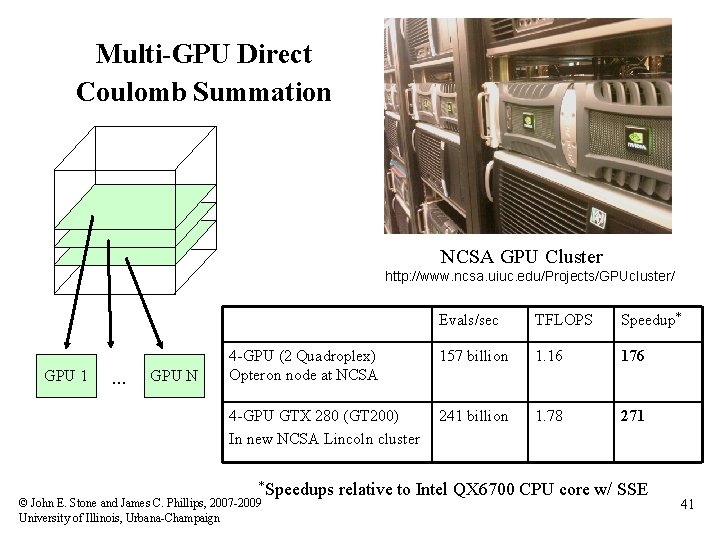
Multi-GPU Direct Coulomb Summation NCSA GPU Cluster http: //www. ncsa. uiuc. edu/Projects/GPUcluster/ GPU 1 … GPU N Evals/sec TFLOPS Speedup* 4 -GPU (2 Quadroplex) Opteron node at NCSA 157 billion 1. 16 176 4 -GPU GTX 280 (GT 200) In new NCSA Lincoln cluster 241 billion 1. 78 271 *Speedups © John E. Stone and James C. Phillips, 2007 -2009 University of Illinois, Urbana-Champaign relative to Intel QX 6700 CPU core w/ SSE 41
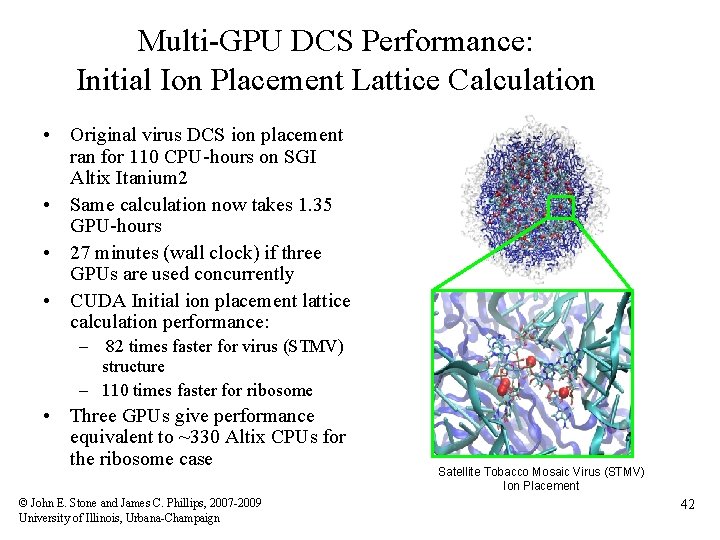
Multi-GPU DCS Performance: Initial Ion Placement Lattice Calculation • Original virus DCS ion placement ran for 110 CPU-hours on SGI Altix Itanium 2 • Same calculation now takes 1. 35 GPU-hours • 27 minutes (wall clock) if three GPUs are used concurrently • CUDA Initial ion placement lattice calculation performance: – 82 times faster for virus (STMV) structure – 110 times faster for ribosome • Three GPUs give performance equivalent to ~330 Altix CPUs for the ribosome case © John E. Stone and James C. Phillips, 2007 -2009 University of Illinois, Urbana-Champaign Satellite Tobacco Mosaic Virus (STMV) Ion Placement 42
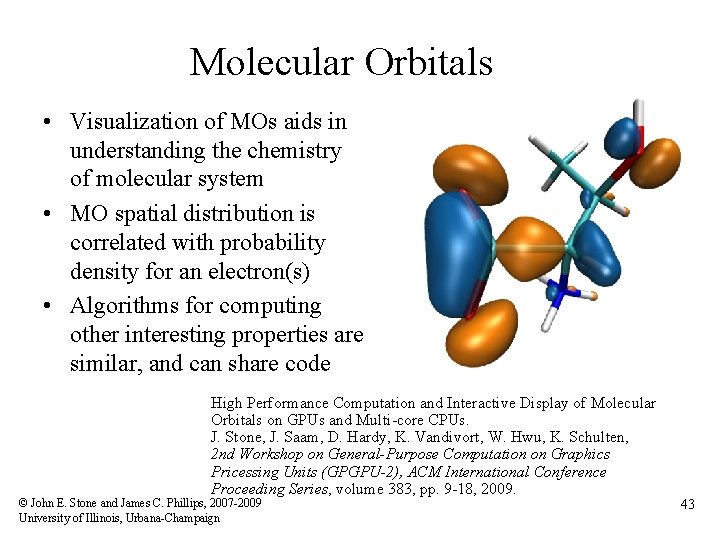
Molecular Orbitals • Visualization of MOs aids in understanding the chemistry of molecular system • MO spatial distribution is correlated with probability density for an electron(s) • Algorithms for computing other interesting properties are similar, and can share code High Performance Computation and Interactive Display of Molecular Orbitals on GPUs and Multi-core CPUs. J. Stone, J. Saam, D. Hardy, K. Vandivort, W. Hwu, K. Schulten, 2 nd Workshop on General-Purpose Computation on Graphics Pricessing Units (GPGPU-2), ACM International Conference Proceeding Series, volume 383, pp. 9 -18, 2009. © John E. Stone and James C. Phillips, 2007 -2009 University of Illinois, Urbana-Champaign 43
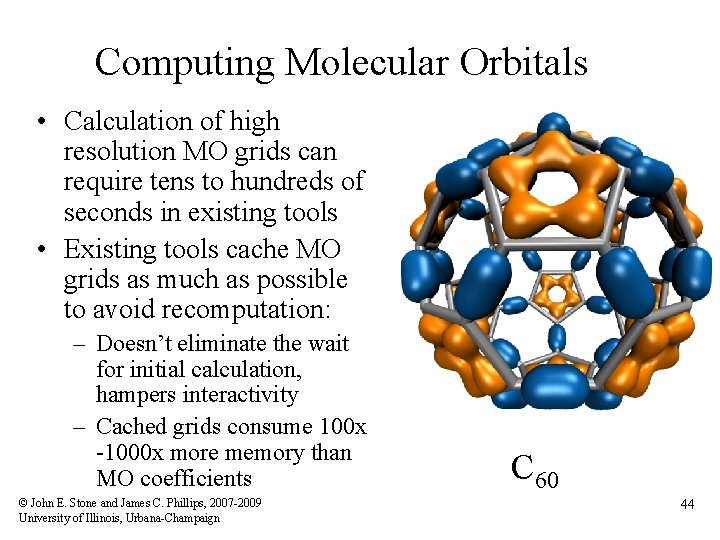
Computing Molecular Orbitals • Calculation of high resolution MO grids can require tens to hundreds of seconds in existing tools • Existing tools cache MO grids as much as possible to avoid recomputation: – Doesn’t eliminate the wait for initial calculation, hampers interactivity – Cached grids consume 100 x -1000 x more memory than MO coefficients © John E. Stone and James C. Phillips, 2007 -2009 University of Illinois, Urbana-Champaign C 60 44
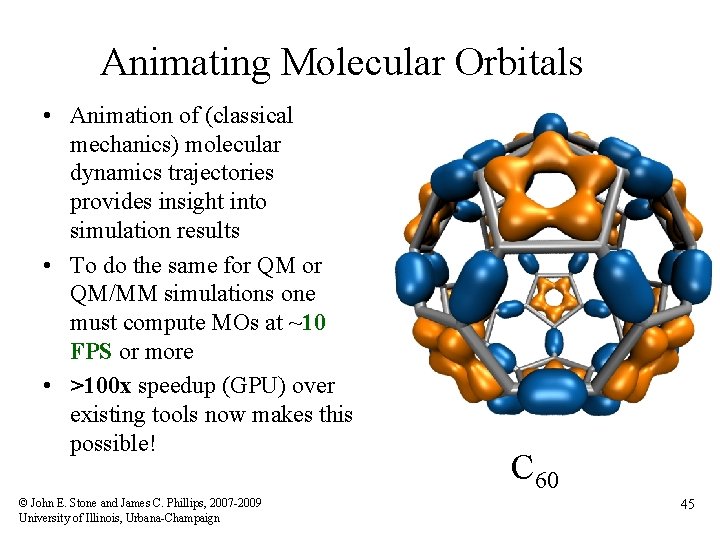
Animating Molecular Orbitals • Animation of (classical mechanics) molecular dynamics trajectories provides insight into simulation results • To do the same for QM/MM simulations one must compute MOs at ~10 FPS or more • >100 x speedup (GPU) over existing tools now makes this possible! © John E. Stone and James C. Phillips, 2007 -2009 University of Illinois, Urbana-Champaign C 60 45
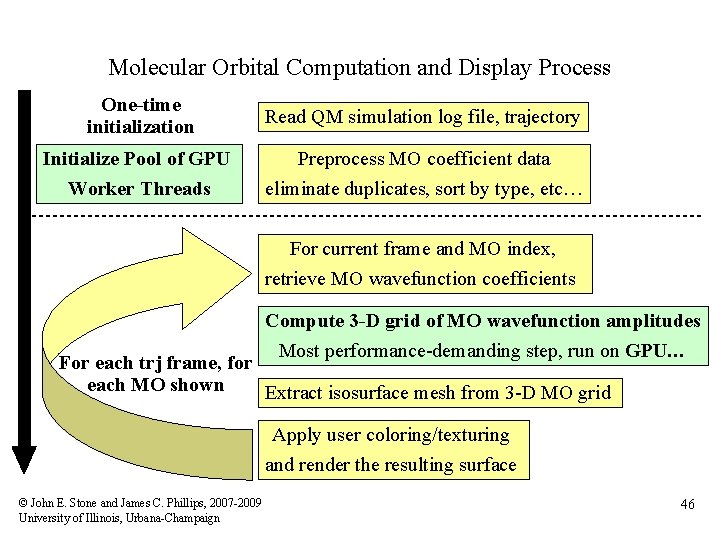
Molecular Orbital Computation and Display Process One-time initialization Read QM simulation log file, trajectory Initialize Pool of GPU Worker Threads Preprocess MO coefficient data eliminate duplicates, sort by type, etc… For current frame and MO index, retrieve MO wavefunction coefficients Compute 3 -D grid of MO wavefunction amplitudes Most performance-demanding step, run on GPU… For each trj frame, for each MO shown Extract isosurface mesh from 3 -D MO grid Apply user coloring/texturing and render the resulting surface © John E. Stone and James C. Phillips, 2007 -2009 University of Illinois, Urbana-Champaign 46
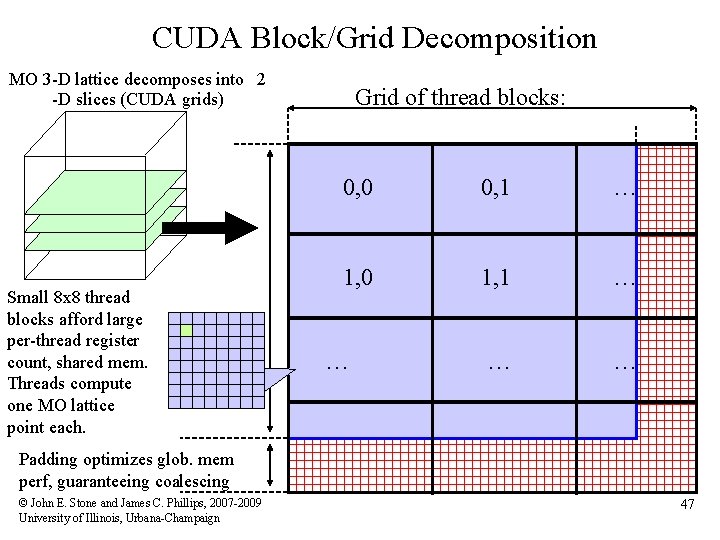
CUDA Block/Grid Decomposition MO 3 -D lattice decomposes into 2 -D slices (CUDA grids) Small 8 x 8 thread blocks afford large per-thread register count, shared mem. Threads compute one MO lattice point each. Grid of thread blocks: 0, 0 0, 1 … 1, 0 1, 1 … … Padding optimizes glob. mem perf, guaranteeing coalescing © John E. Stone and James C. Phillips, 2007 -2009 University of Illinois, Urbana-Champaign 47
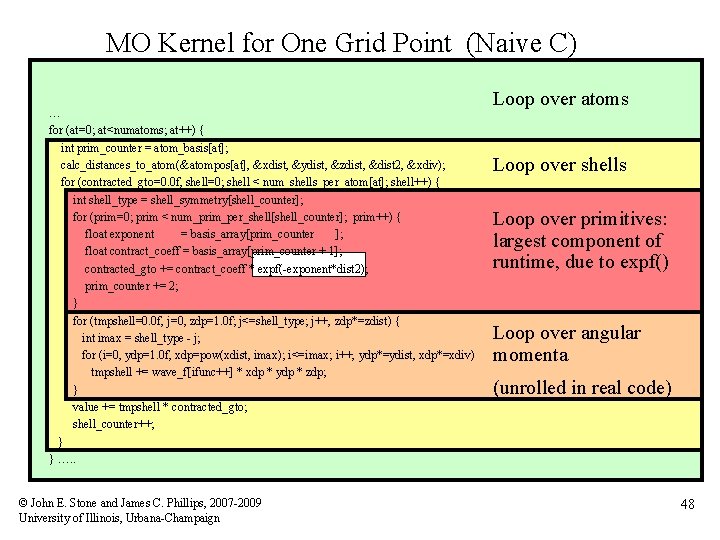
MO Kernel for One Grid Point (Naive C) … for (at=0; at<numatoms; at++) { int prim_counter = atom_basis[at]; calc_distances_to_atom(&atompos[at], &xdist, &ydist, &zdist, &dist 2, &xdiv); for (contracted_gto=0. 0 f, shell=0; shell < num_shells_per_atom[at]; shell++) { int shell_type = shell_symmetry[shell_counter]; for (prim=0; prim < num_prim_per_shell[shell_counter]; prim++) { float exponent = basis_array[prim_counter ]; float contract_coeff = basis_array[prim_counter + 1]; contracted_gto += contract_coeff * expf(-exponent*dist 2); prim_counter += 2; } for (tmpshell=0. 0 f, j=0, zdp=1. 0 f; j<=shell_type; j++, zdp*=zdist) { int imax = shell_type - j; for (i=0, ydp=1. 0 f, xdp=pow(xdist, imax); i<=imax; i++, ydp*=ydist, xdp*=xdiv) tmpshell += wave_f[ifunc++] * xdp * ydp * zdp; } value += tmpshell * contracted_gto; shell_counter++; } } …. . © John E. Stone and James C. Phillips, 2007 -2009 University of Illinois, Urbana-Champaign Loop over atoms Loop over shells Loop over primitives: largest component of runtime, due to expf() Loop over angular momenta (unrolled in real code) 48
Preprocessing of Atoms, Basis Set, and Wavefunction Coefficients • Must make effective use of high bandwidth, lowlatency GPU on-chip memory, or CPU cache: – Overall storage requirement reduced by eliminating duplicate basis set coefficients – Sorting atoms by element type allows re-use of basis set coefficients for subsequent atoms of identical type • Padding, alignment of arrays guarantees coalesced GPU global memory accesses, CPU SSE loads © John E. Stone and James C. Phillips, 2007 -2009 University of Illinois, Urbana-Champaign 49
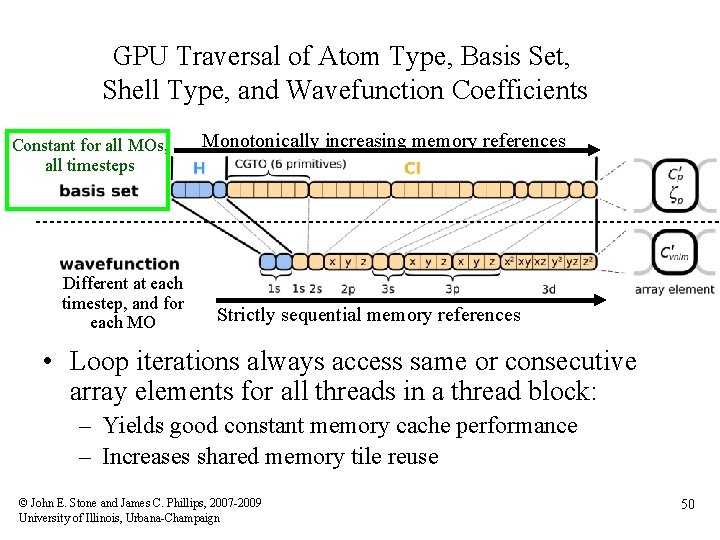
GPU Traversal of Atom Type, Basis Set, Shell Type, and Wavefunction Coefficients Constant for all MOs, all timesteps Different at each timestep, and for each MO Monotonically increasing memory references Strictly sequential memory references • Loop iterations always access same or consecutive array elements for all threads in a thread block: – Yields good constant memory cache performance – Increases shared memory tile reuse © John E. Stone and James C. Phillips, 2007 -2009 University of Illinois, Urbana-Champaign 50
Use of GPU On-chip Memory • If total data less than 64 k. B, use only const mem: – Broadcasts data to all threads, no global memory accesses! • For large data, shared memory used as a programmanaged cache, coefficients loaded on-demand: – Tile data in shared mem is broadcast to 64 threads in a block – Nested loops traverse multiple coefficient arrays of varying length, complicates things significantly… – Key to performance is to locate tile loading checks outside of the two performance-critical inner loops – Tiles sized large enough to service entire inner loop runs – Only 27% slower than hardware caching provided by constant memory (GT 200) © John E. Stone and James C. Phillips, 2007 -2009 University of Illinois, Urbana-Champaign 51
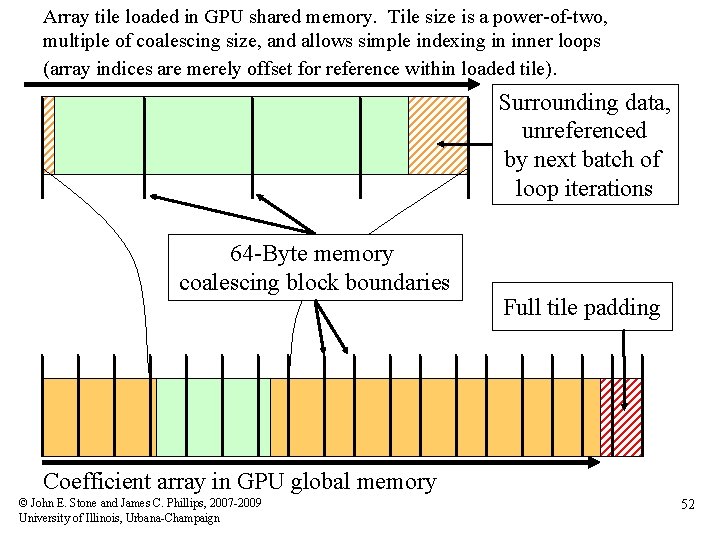
Array tile loaded in GPU shared memory. Tile size is a power-of-two, multiple of coalescing size, and allows simple indexing in inner loops (array indices are merely offset for reference within loaded tile). Surrounding data, unreferenced by next batch of loop iterations 64 -Byte memory coalescing block boundaries Full tile padding Coefficient array in GPU global memory © John E. Stone and James C. Phillips, 2007 -2009 University of Illinois, Urbana-Champaign 52
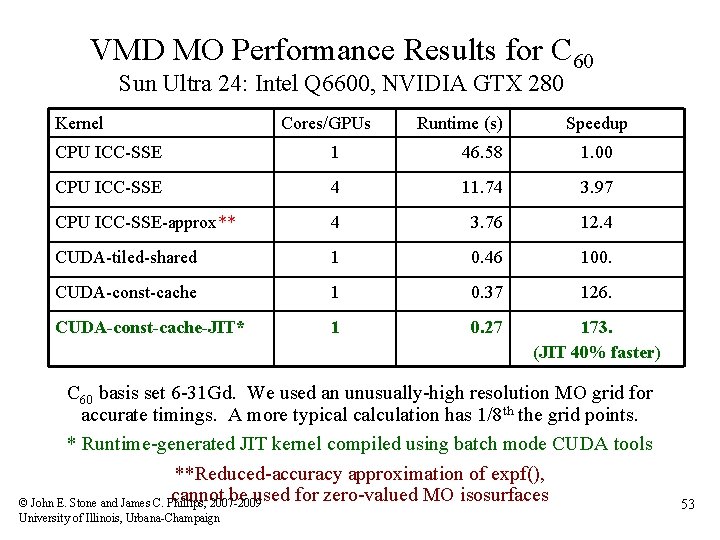
VMD MO Performance Results for C 60 Sun Ultra 24: Intel Q 6600, NVIDIA GTX 280 Kernel Cores/GPUs Runtime (s) Speedup CPU ICC-SSE 1 46. 58 1. 00 CPU ICC-SSE 4 11. 74 3. 97 CPU ICC-SSE-approx** 4 3. 76 12. 4 CUDA-tiled-shared 1 0. 46 100. CUDA-const-cache 1 0. 37 126. CUDA-const-cache-JIT* 1 0. 27 173. (JIT 40% faster) C 60 basis set 6 -31 Gd. We used an unusually-high resolution MO grid for accurate timings. A more typical calculation has 1/8 th the grid points. * Runtime-generated JIT kernel compiled using batch mode CUDA tools **Reduced-accuracy approximation of expf(), cannot be used for zero-valued MO isosurfaces © John E. Stone and James C. Phillips, 2007 -2009 University of Illinois, Urbana-Champaign 53
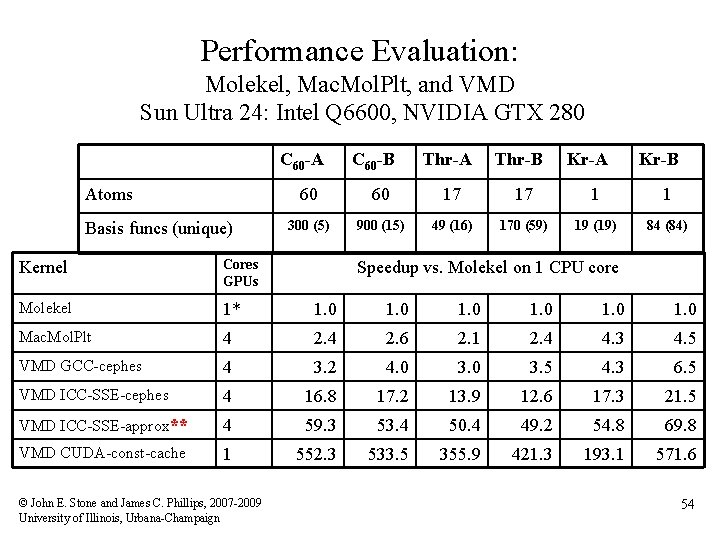
Performance Evaluation: Molekel, Mac. Mol. Plt, and VMD Sun Ultra 24: Intel Q 6600, NVIDIA GTX 280 C 60 -A Atoms Basis funcs (unique) C 60 -B Thr-A Thr-B Kr-A Kr-B 60 60 17 17 1 1 300 (5) 900 (15) 49 (16) 170 (59) 19 (19) 84 (84) Kernel Cores GPUs Molekel 1* 1. 0 1. 0 Mac. Mol. Plt 4 2. 6 2. 1 2. 4 4. 3 4. 5 VMD GCC-cephes 4 3. 2 4. 0 3. 5 4. 3 6. 5 VMD ICC-SSE-cephes 4 16. 8 17. 2 13. 9 12. 6 17. 3 21. 5 VMD ICC-SSE-approx** 4 59. 3 53. 4 50. 4 49. 2 54. 8 69. 8 VMD CUDA-const-cache 1 552. 3 533. 5 355. 9 421. 3 193. 1 571. 6 © John E. Stone and James C. Phillips, 2007 -2009 University of Illinois, Urbana-Champaign Speedup vs. Molekel on 1 CPU core 54
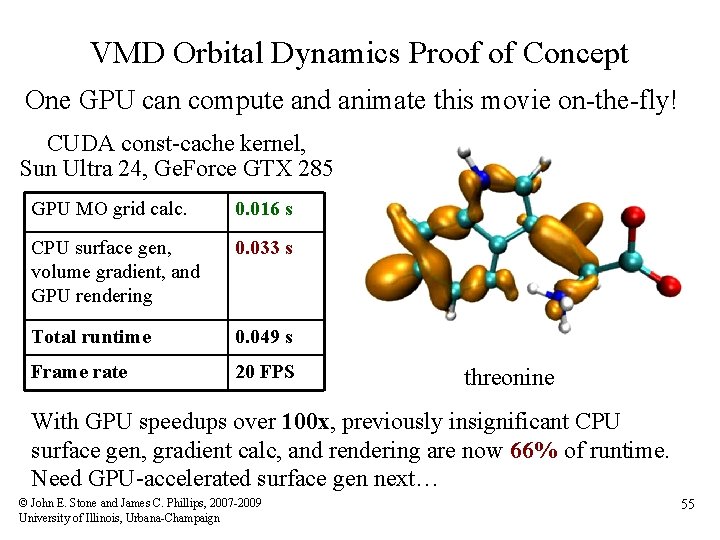
VMD Orbital Dynamics Proof of Concept One GPU can compute and animate this movie on-the-fly! CUDA const-cache kernel, Sun Ultra 24, Ge. Force GTX 285 GPU MO grid calc. 0. 016 s CPU surface gen, volume gradient, and GPU rendering 0. 033 s Total runtime 0. 049 s Frame rate 20 FPS threonine With GPU speedups over 100 x, previously insignificant CPU surface gen, gradient calc, and rendering are now 66% of runtime. Need GPU-accelerated surface gen next… © John E. Stone and James C. Phillips, 2007 -2009 University of Illinois, Urbana-Champaign 55
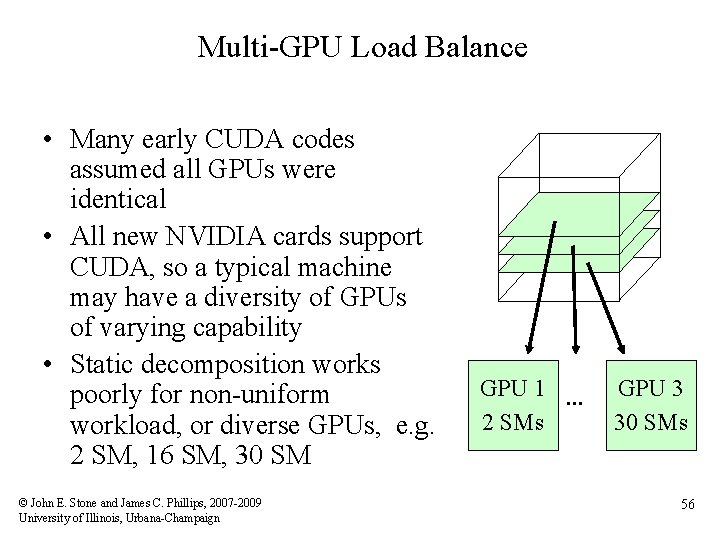
Multi-GPU Load Balance • Many early CUDA codes assumed all GPUs were identical • All new NVIDIA cards support CUDA, so a typical machine may have a diversity of GPUs of varying capability • Static decomposition works poorly for non-uniform workload, or diverse GPUs, e. g. 2 SM, 16 SM, 30 SM © John E. Stone and James C. Phillips, 2007 -2009 University of Illinois, Urbana-Champaign GPU 1 … 2 SMs GPU 3 30 SMs 56
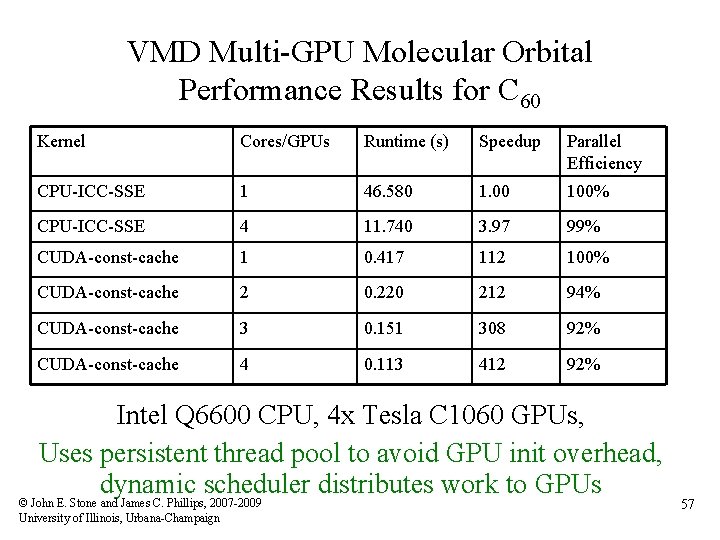
VMD Multi-GPU Molecular Orbital Performance Results for C 60 Kernel Cores/GPUs Runtime (s) Speedup Parallel Efficiency CPU-ICC-SSE 1 46. 580 1. 00 100% CPU-ICC-SSE 4 11. 740 3. 97 99% CUDA-const-cache 1 0. 417 112 100% CUDA-const-cache 2 0. 220 212 94% CUDA-const-cache 3 0. 151 308 92% CUDA-const-cache 4 0. 113 412 92% Intel Q 6600 CPU, 4 x Tesla C 1060 GPUs, Uses persistent thread pool to avoid GPU init overhead, dynamic scheduler distributes work to GPUs © John E. Stone and James C. Phillips, 2007 -2009 University of Illinois, Urbana-Champaign 57
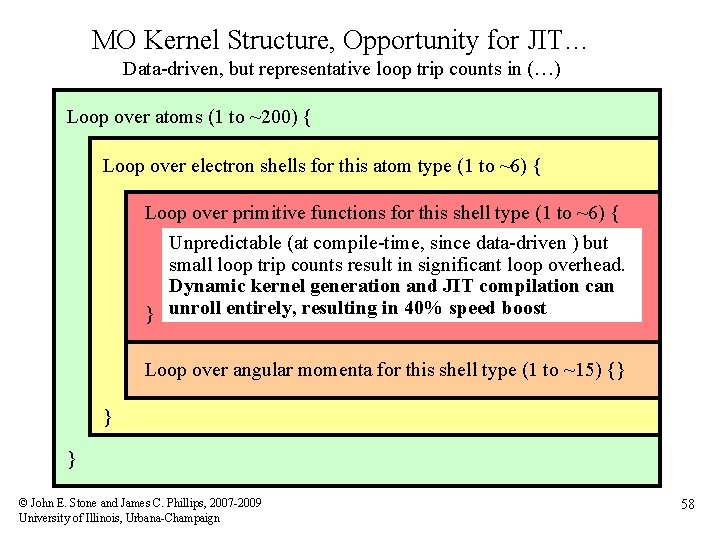
MO Kernel Structure, Opportunity for JIT… Data-driven, but representative loop trip counts in (…) Loop over atoms (1 to ~200) { Loop over electron shells for this atom type (1 to ~6) { Loop over primitive functions for this shell type (1 to ~6) { Unpredictable (at compile-time, since data-driven ) but small loop trip counts result in significant loop overhead. Dynamic kernel generation and JIT compilation can } unroll entirely, resulting in 40% speed boost Loop over angular momenta for this shell type (1 to ~15) {} } } © John E. Stone and James C. Phillips, 2007 -2009 University of Illinois, Urbana-Champaign 58
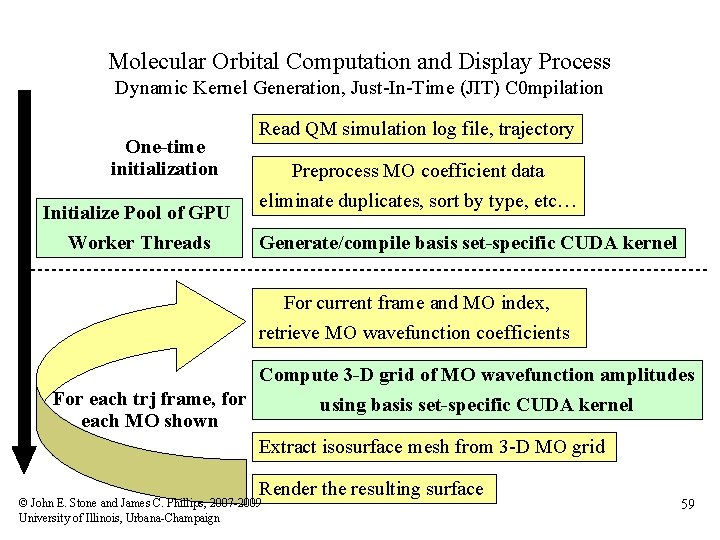
Molecular Orbital Computation and Display Process Dynamic Kernel Generation, Just-In-Time (JIT) C 0 mpilation One-time initialization Initialize Pool of GPU Worker Threads Read QM simulation log file, trajectory Preprocess MO coefficient data eliminate duplicates, sort by type, etc… Generate/compile basis set-specific CUDA kernel For current frame and MO index, retrieve MO wavefunction coefficients Compute 3 -D grid of MO wavefunction amplitudes For each trj frame, for using basis set-specific CUDA kernel each MO shown Extract isosurface mesh from 3 -D MO grid Render the resulting surface © John E. Stone and James C. Phillips, 2007 -2009 University of Illinois, Urbana-Champaign 59
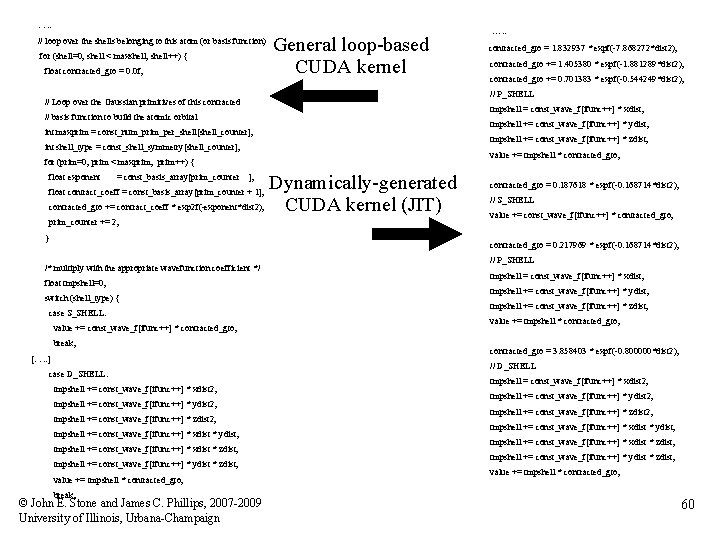
…. . // loop over the shells belonging to this atom (or basis function) for (shell=0; shell < maxshell; shell++) { float contracted_gto = 0. 0 f; General loop-based CUDA kernel contracted_gto += 1. 405380 * expf(-1. 881289*dist 2); contracted_gto += 0. 701383 * expf(-0. 544249*dist 2); tmpshell = const_wave_f[ifunc++] * xdist; // basis function to build the atomic orbital int maxprim = const_num_prim_per_shell[shell_counter]; int shell_type = const_shell_symmetry[shell_counter]; tmpshell += const_wave_f[ifunc++] * ydist; tmpshell += const_wave_f[ifunc++] * zdist; value += tmpshell * contracted_gto; for (prim=0; prim < maxprim; prim++) { Dynamically-generated contracted_gto += contract_coeff * exp 2 f(-exponent*dist 2); CUDA kernel (JIT) = const_basis_array[prim_counter contracted_gto = 1. 832937 * expf(-7. 868272*dist 2); // P_SHELL // Loop over the Gaussian primitives of this contracted float exponent …. . ]; float contract_coeff = const_basis_array[prim_counter + 1]; prim_counter += 2; } contracted_gto = 0. 187618 * expf(-0. 168714*dist 2); // S_SHELL value += const_wave_f[ifunc++] * contracted_gto; contracted_gto = 0. 217969 * expf(-0. 168714*dist 2); /* multiply with the appropriate wavefunction coefficient */ float tmpshell=0; switch (shell_type) { case S_SHELL: value += const_wave_f[ifunc++] * contracted_gto; break; […. . ] case D_SHELL: tmpshell += const_wave_f[ifunc++] * xdist 2; tmpshell += const_wave_f[ifunc++] * ydist 2; tmpshell += const_wave_f[ifunc++] * zdist 2; tmpshell += const_wave_f[ifunc++] * xdist * ydist; tmpshell += const_wave_f[ifunc++] * xdist * zdist; tmpshell += const_wave_f[ifunc++] * ydist * zdist; value += tmpshell * contracted_gto; break; © John E. Stone and James C. Phillips, 2007 -2009 University of Illinois, Urbana-Champaign // P_SHELL tmpshell = const_wave_f[ifunc++] * xdist; tmpshell += const_wave_f[ifunc++] * ydist; tmpshell += const_wave_f[ifunc++] * zdist; value += tmpshell * contracted_gto; contracted_gto = 3. 858403 * expf(-0. 800000*dist 2); // D_SHELL tmpshell = const_wave_f[ifunc++] * xdist 2; tmpshell += const_wave_f[ifunc++] * ydist 2; tmpshell += const_wave_f[ifunc++] * zdist 2; tmpshell += const_wave_f[ifunc++] * xdist * ydist; tmpshell += const_wave_f[ifunc++] * xdist * zdist; tmpshell += const_wave_f[ifunc++] * ydist * zdist; value += tmpshell * contracted_gto; 60
Lessons Learned • GPU algorithms need fine-grained parallelism and sufficient work to fully utilize the hardware • Much of per-thread GPU algorithm optimization revolves around efficient use of multiple memory systems and latency hiding • Concurrency can often be traded for per-thread performance, in combination with increased use of registers or shared memory • Fine-grained GPU work decompositions often compose well with the comparatively coarse-grained decompositions used for multicore or distributed memory programing © John E. Stone and James C. Phillips, 2007 -2009 University of Illinois, Urbana-Champaign 61
Lessons Learned (2) • The host CPU can potentially be used to “regularize” the computation for the GPU, yielding better overall performance • Overlapping CPU work with GPU can hide some communication and unaccelerated computation • Targeted use of double-precision floating point arithmetic, or compensated summation can reduce the effects of floating point truncation at low cost to performance © John E. Stone and James C. Phillips, 2007 -2009 University of Illinois, Urbana-Champaign 62
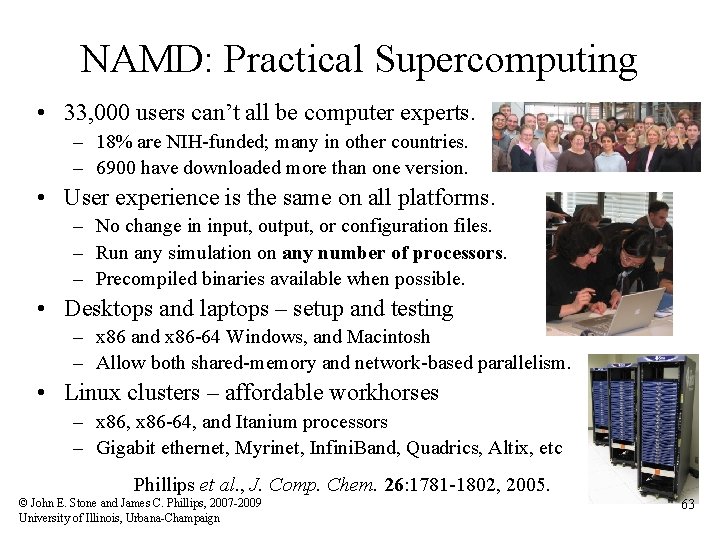
NAMD: Practical Supercomputing • 33, 000 users can’t all be computer experts. – 18% are NIH-funded; many in other countries. – 6900 have downloaded more than one version. • User experience is the same on all platforms. – No change in input, output, or configuration files. – Run any simulation on any number of processors. – Precompiled binaries available when possible. • Desktops and laptops – setup and testing – x 86 and x 86 -64 Windows, and Macintosh – Allow both shared-memory and network-based parallelism. • Linux clusters – affordable workhorses – x 86, x 86 -64, and Itanium processors – Gigabit ethernet, Myrinet, Infini. Band, Quadrics, Altix, etc Phillips et al. , J. Comp. Chem. 26: 1781 -1802, 2005. © John E. Stone and James C. Phillips, 2007 -2009 University of Illinois, Urbana-Champaign 63
Our Goal: Practical Acceleration • Broadly applicable to scientific computing – Programmable by domain scientists – Scalable from small to large machines • Broadly available to researchers – Price driven by commodity market – Low burden on system administration • Sustainable performance advantage – Performance driven by Moore’s law – Stable market and supply chain © John E. Stone and James C. Phillips, 2007 -2009 University of Illinois, Urbana-Champaign 64
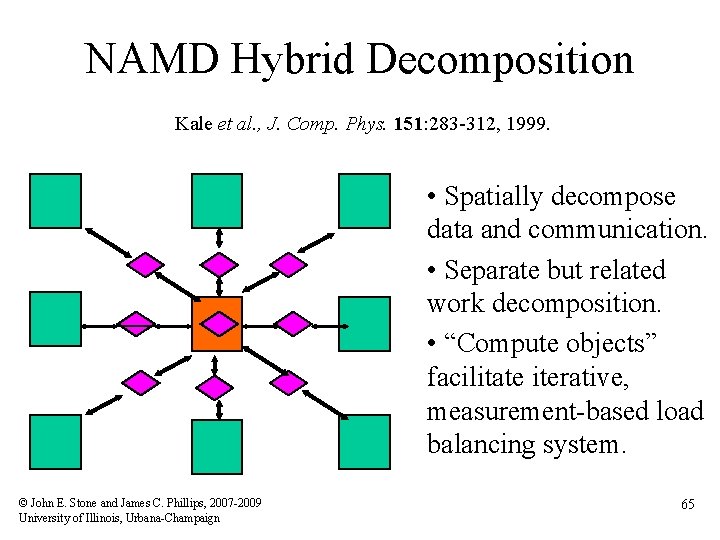
NAMD Hybrid Decomposition Kale et al. , J. Comp. Phys. 151: 283 -312, 1999. • Spatially decompose data and communication. • Separate but related work decomposition. • “Compute objects” facilitate iterative, measurement-based load balancing system. © John E. Stone and James C. Phillips, 2007 -2009 University of Illinois, Urbana-Champaign 65
Message-Driven Programming • No receive calls as in “message passing” • Messages sent to object “entry points” • Incoming messages placed in queue – Priorities are necessary for performance • Execution generates new messages • Implemented in Charm++ on top of MPI – Can be emulated in MPI alone – Charm++ provides tools and idioms – Parallel Programming Lab: http: //charm. cs. uiuc. edu/ © John E. Stone and James C. Phillips, 2007 -2009 University of Illinois, Urbana-Champaign 66
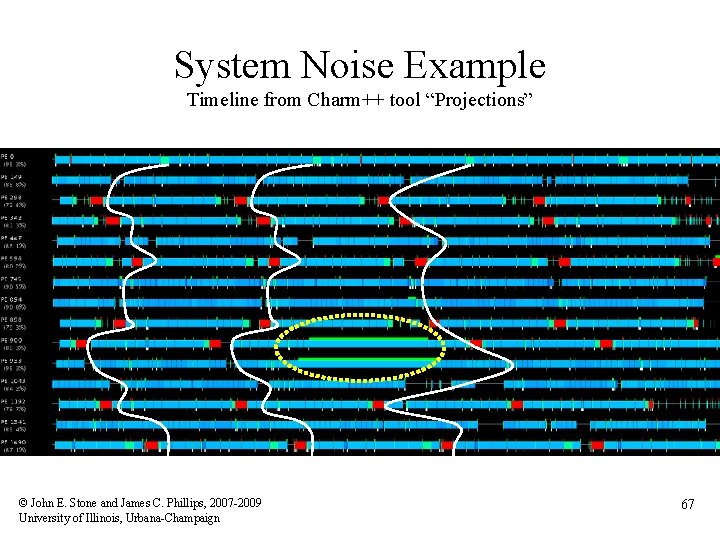
System Noise Example Timeline from Charm++ tool “Projections” © John E. Stone and James C. Phillips, 2007 -2009 University of Illinois, Urbana-Champaign 67
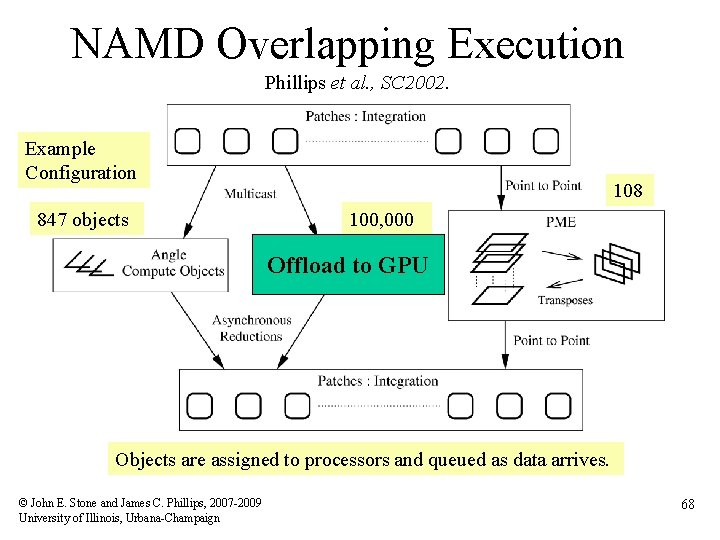
NAMD Overlapping Execution Phillips et al. , SC 2002. Example Configuration 847 objects 108 100, 000 Offload to GPU Objects are assigned to processors and queued as data arrives. © John E. Stone and James C. Phillips, 2007 -2009 University of Illinois, Urbana-Champaign 68
Message-Driven CUDA? • No, CUDA is too coarse-grained. – CPU needs fine-grained work to interleave and pipeline. – GPU needs large numbers of tasks submitted all at once. • No, CUDA lacks priorities. – FIFO isn’t enough. • Perhaps in a future interface: – Stream data to GPU. – Append blocks to a running kernel invocation. – Stream data out as blocks complete. © John E. Stone and James C. Phillips, 2007 -2009 University of Illinois, Urbana-Champaign 69
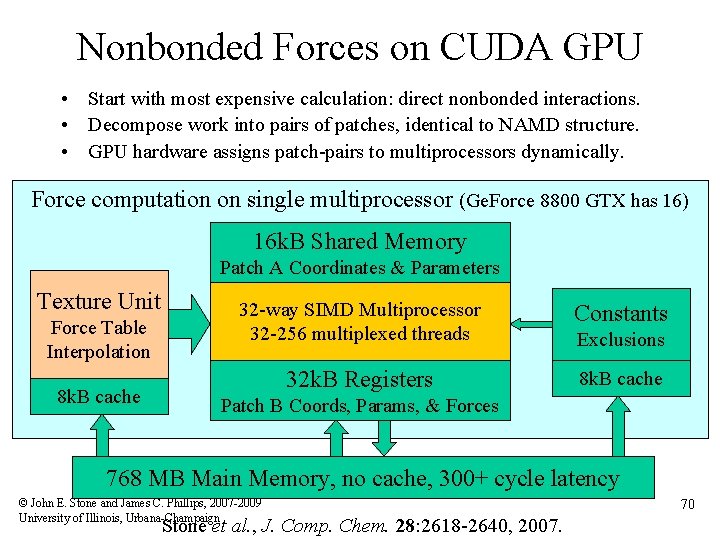
Nonbonded Forces on CUDA GPU • Start with most expensive calculation: direct nonbonded interactions. • Decompose work into pairs of patches, identical to NAMD structure. • GPU hardware assigns patch-pairs to multiprocessors dynamically. Force computation on single multiprocessor (Ge. Force 8800 GTX has 16) 16 k. B Shared Memory Patch A Coordinates & Parameters Texture Unit Force Table Interpolation 8 k. B cache 32 -way SIMD Multiprocessor 32 -256 multiplexed threads Constants 32 k. B Registers 8 k. B cache Exclusions Patch B Coords, Params, & Forces 768 MB Main Memory, no cache, 300+ cycle latency © John E. Stone and James C. Phillips, 2007 -2009 University of Illinois, Urbana-Champaign Stone et al. , J. Comp. Chem. 28: 2618 -2640, 2007. 70
![texture<float 4> force_table; __constant__ unsigned int exclusions[]; __shared__ atom jatom[]; atom iatom; // per-thread](http://slidetodoc.com/presentation_image_h/1ce1f8526feaa5286247abbd09a6ca01/image-71.jpg "texture<float 4> force_table; __constant__ unsigned int exclusions[]; __shared__ atom jatom[]; atom iatom; // per-thread")
texture<float 4> force_table; __constant__ unsigned int exclusions[]; __shared__ atom jatom[]; atom iatom; // per-thread atom, stored in registers float 4 iforce; // per-thread force, stored in registers for ( int j = 0; j < jatom_count; ++j ) { float dx = jatom[j]. x - iatom. x; float dy = jatom[j]. y - iatom. y; float dz = jatom[j]. z - iatom. z; float r 2 = dx*dx + dy*dy + dz*dz; if ( r 2 < cutoff 2 ) { float 4 ft = texfetch(force_table, 1. f/sqrt(r 2)); Force Interpolation bool excluded = false; int indexdiff = iatom. index - jatom[j]. index; Exclusions if ( abs(indexdiff) <= (int) jatom[j]. excl_maxdiff ) { indexdiff += jatom[j]. excl_index; excluded = ((exclusions[indexdiff>>5] & (1<<(indexdiff&31))) != 0); } float f = iatom. half_sigma + jatom[j]. half_sigma; // sigma f *= f*f; // sigma^3 Parameters f *= f; // sigma^6 f *= ( f * ft. x + ft. y ); // sigma^12 * fi. x - sigma^6 * fi. y f *= iatom. sqrt_epsilon * jatom[j]. sqrt_epsilon; float qq = iatom. charge * jatom[j]. charge; if ( excluded ) { f = qq * ft. w; } // PME correction else { f += qq * ft. z; } // Coulomb iforce. x += dx * f; iforce. y += dy * f; iforce. z += dz * f; Accumulation iforce. w += 1. f; // interaction count or energy © John E. Stone and James C. Phillips, 2007 -2009 71 } of Illinois, Urbana-Champaign University Stone et al. , J. Comp. Chem. 28: 2618 -2640, 2007. } Nonbonded Forces CUDA Code
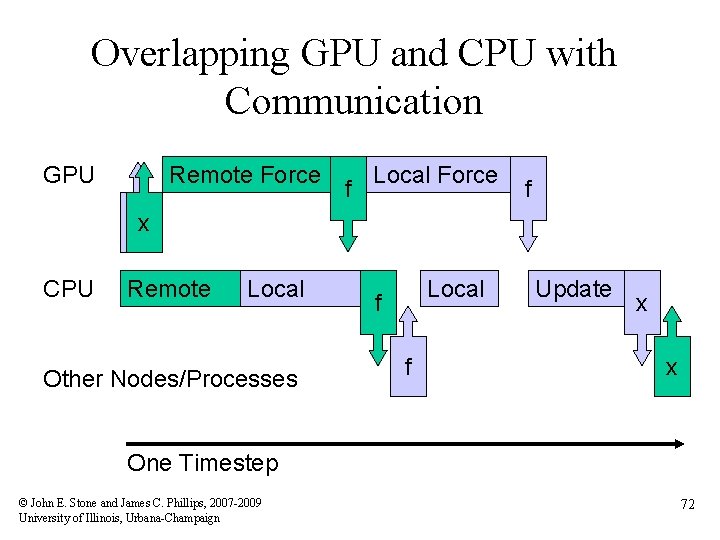
Overlapping GPU and CPU with Communication GPU Remote Force f Local Force f xx CPU Remote Local Other Nodes/Processes Local f f Update x x One Timestep © John E. Stone and James C. Phillips, 2007 -2009 University of Illinois, Urbana-Champaign 72
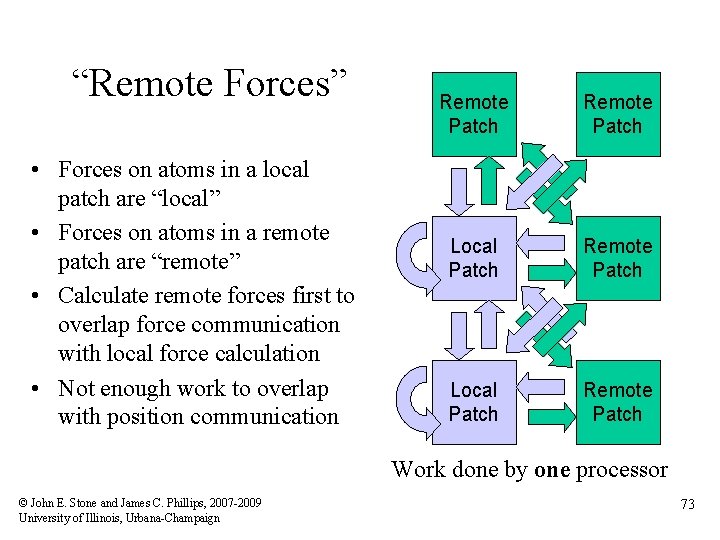
“Remote Forces” • Forces on atoms in a local patch are “local” • Forces on atoms in a remote patch are “remote” • Calculate remote forces first to overlap force communication with local force calculation • Not enough work to overlap with position communication Remote Patch Local Patch Remote Patch Work done by one processor © John E. Stone and James C. Phillips, 2007 -2009 University of Illinois, Urbana-Champaign 73
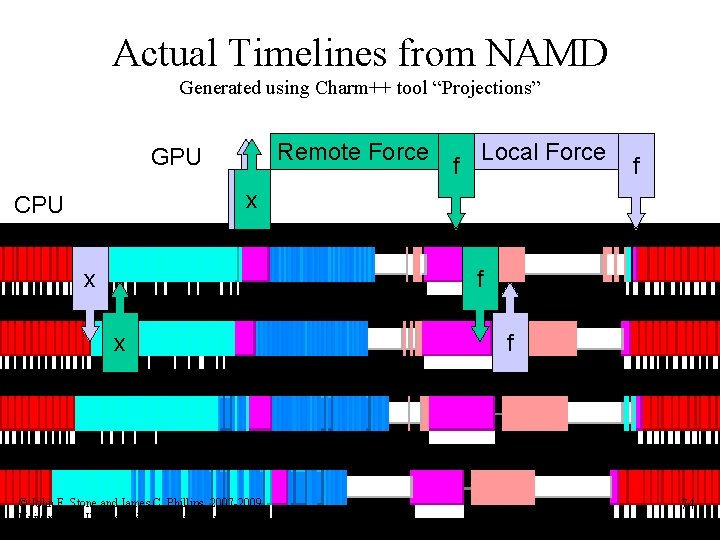
Actual Timelines from NAMD Generated using Charm++ tool “Projections” Remote Force GPU f Local Force f xx CPU x f x © John E. Stone and James C. Phillips, 2007 -2009 University of Illinois, Urbana-Champaign f 74
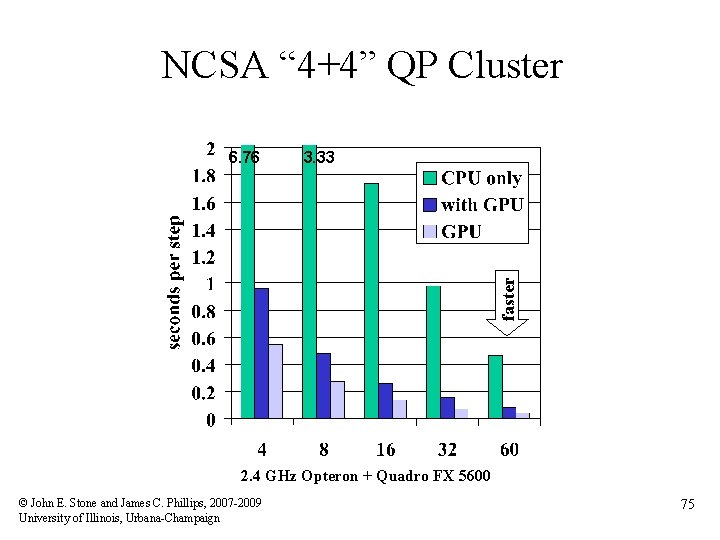
NCSA “ 4+4” QP Cluster 3. 33 faster 6. 76 2. 4 GHz Opteron + Quadro FX 5600 © John E. Stone and James C. Phillips, 2007 -2009 University of Illinois, Urbana-Champaign 75
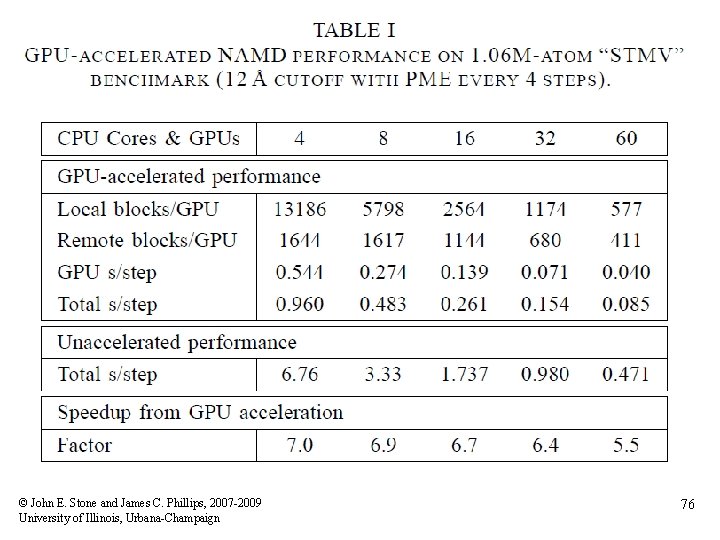
© John E. Stone and James C. Phillips, 2007 -2009 University of Illinois, Urbana-Champaign 76
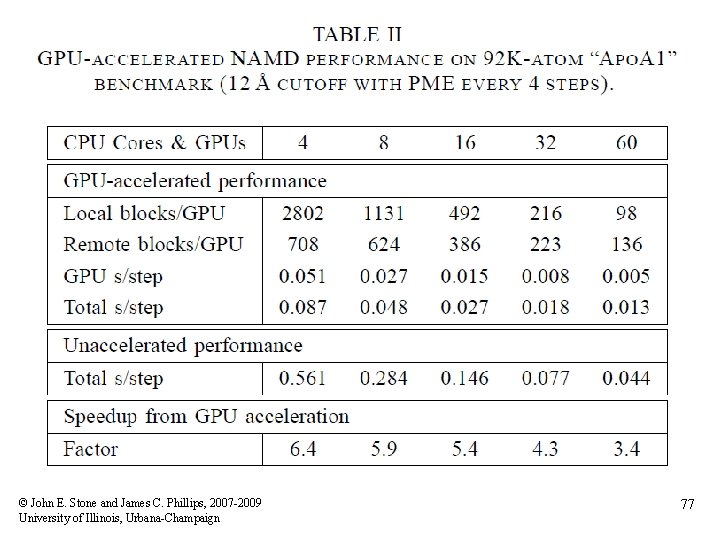
© John E. Stone and James C. Phillips, 2007 -2009 University of Illinois, Urbana-Champaign 77
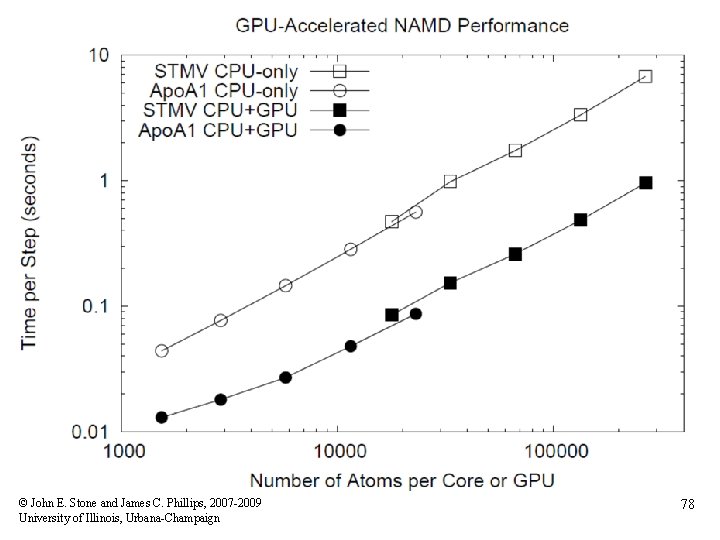
© John E. Stone and James C. Phillips, 2007 -2009 University of Illinois, Urbana-Champaign 78
GPU Cluster Observations • Tools needed to control GPU allocation – Simplest solution is rank % devices. Per. Node – Doesn’t work with multiple independent jobs • CUDA and MPI can’t share pinned memory – Either user copies data or disable MPI RDMA – Need interoperable user-mode DMA standard • Speaking of extra copies… – Why not DMA GPU to GPU? – Even better, why not RDMA over Infini. Band? © John E. Stone and James C. Phillips, 2007 -2009 University of Illinois, Urbana-Champaign 79
NCSA “ 8+2” Lincoln Cluster • CPU: 2 Intel E 5410 Quad-Core 2. 33 GHz • GPU: 2 NVIDIA C 1060 – Actually S 1070 shared by two nodes • How to share a GPU among 4 CPU cores? – Send all GPU work to one process? – Coordinate via messages to avoid conflict? – Or just hope for the best? © John E. Stone and James C. Phillips, 2007 -2009 University of Illinois, Urbana-Champaign 80
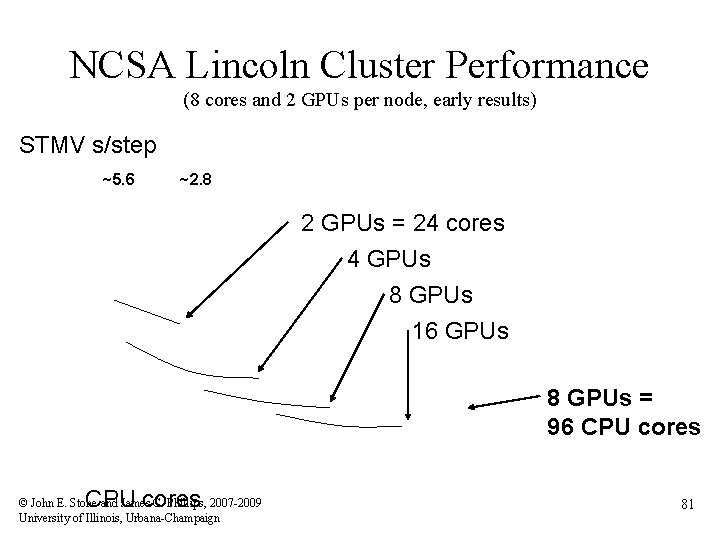
NCSA Lincoln Cluster Performance (8 cores and 2 GPUs per node, early results) STMV s/step ~5. 6 ~2. 8 2 GPUs = 24 cores 4 GPUs 8 GPUs 16 GPUs 8 GPUs = 96 CPU cores © John E. Stone and James C. Phillips, 2007 -2009 University of Illinois, Urbana-Champaign 81
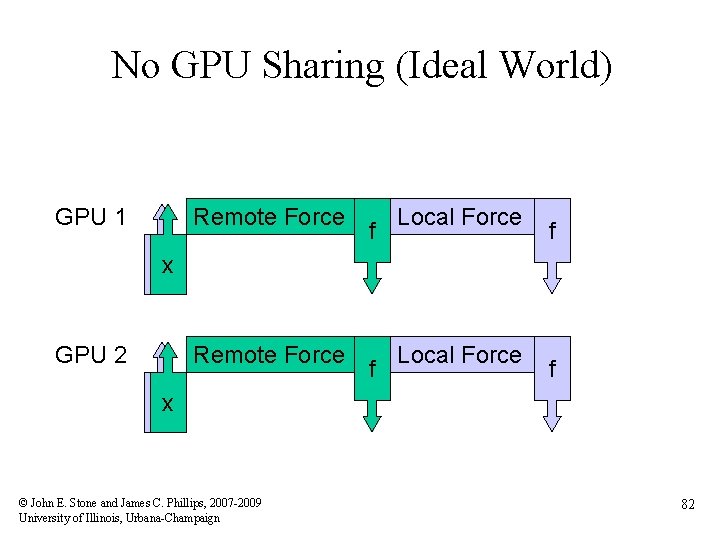
No GPU Sharing (Ideal World) GPU 1 Remote Force f Local Force f xx GPU 2 Remote Force f Local Force f xx © John E. Stone and James C. Phillips, 2007 -2009 University of Illinois, Urbana-Champaign 82
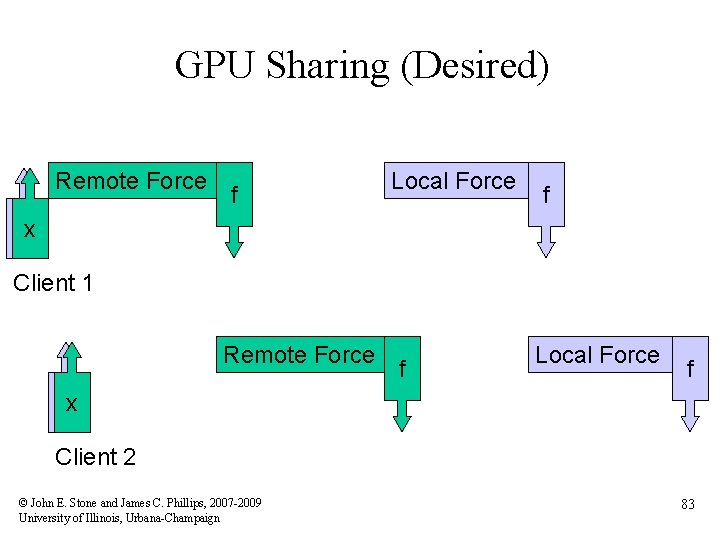
GPU Sharing (Desired) Remote Force f Local Force f xx Client 1 Remote Force f Local Force f xx Client 2 © John E. Stone and James C. Phillips, 2007 -2009 University of Illinois, Urbana-Champaign 83
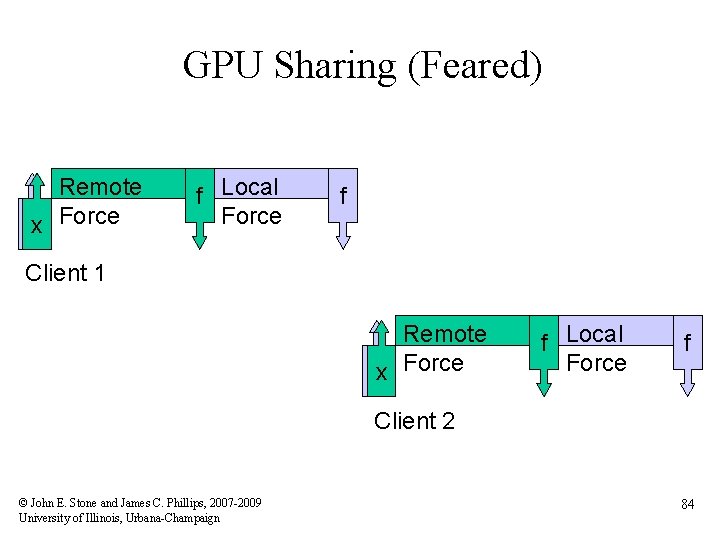
GPU Sharing (Feared) Remote xx Force f Local Force f Client 1 Remote xx Force f Local Force f Client 2 © John E. Stone and James C. Phillips, 2007 -2009 University of Illinois, Urbana-Champaign 84
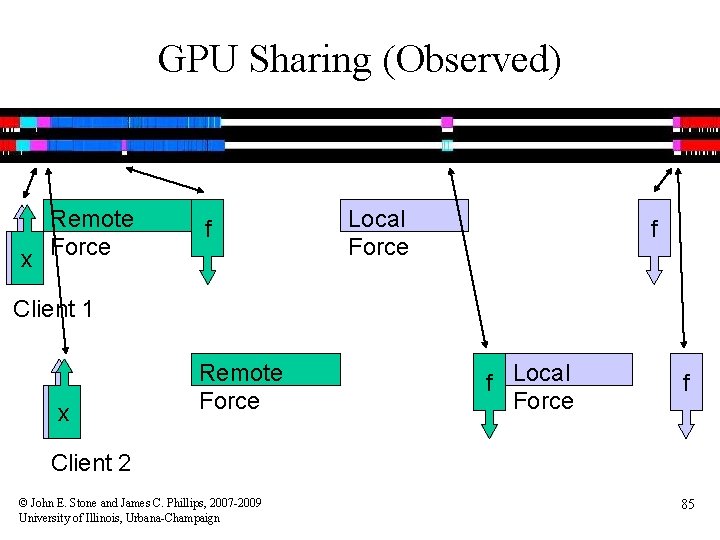
GPU Sharing (Observed) Remote xx Force f Local Force f Client 1 xx Remote Force f Local Force f Client 2 © John E. Stone and James C. Phillips, 2007 -2009 University of Illinois, Urbana-Champaign 85
GPU Sharing (Explained) • CUDA is behaving reasonably, but • Force calculation is actually two kernels – Longer kernel writes to multiple arrays – Shorter kernel combines output • Possible solutions: – Modify CUDA to be less “fair” (please!) – Use locks (atomics) to merge kernels (not G 80) – Explicit inter-client coordination © John E. Stone and James C. Phillips, 2007 -2009 University of Illinois, Urbana-Champaign 86
Inter-client Communication • First identify which processes share a GPU – – Need to know physical node for each process GPU-assignment must reveal real device ID Threads don’t eliminate the problem Production code can’t make assumptions • Token-passing is simple and predictable – Rotate clients in fixed order – High-priority, yield, low-priority, yield, … © John E. Stone and James C. Phillips, 2007 -2009 University of Illinois, Urbana-Champaign 87
Conclusions and Outlook • CUDA today is sufficient for – Single-GPU acceleration (the mass market) – Coarse-grained multi-GPU parallelism • Enough work per call to spin up all multiprocessors • Improvements in CUDA are needed for – Assigning GPUs to processes – Sharing GPUs between processes – Fine-grained multi-GPU parallelism • Fewer blocks per call than chip has multiprocessors – Moving data between GPUs (same or different node) • Faster processors will need a faster network! © John E. Stone and James C. Phillips, 2007 -2009 University of Illinois, Urbana-Champaign 88
Acknowledgements • Additional Information and References: – http: //www. ks. uiuc. edu/Research/gpu/ – http: //www. ks. uiuc. edu/Research/vmd/ – http: //www. ks. uiuc. edu/Research/namd/ • Acknowledgements: – D. Hardy, J. Saam, P. Freddolino, L. Trabuco, J. Cohen, K. Schulten (UIUC TCB Group) – Prof. Wen-mei Hwu, Christopher Rodrigues (UIUC IMPACT Group) – David Kirk and the CUDA team at NVIDIA – NIH support: P 41 -RR 05969 – UIUC NVIDIA Center of Excellence © John E. Stone and James C. Phillips, 2007 -2009 University of Illinois, Urbana-Champaign 89
Publications http: //www. ks. uiuc. edu/Research/gpu/ • • Long time-scale simulations of in vivo diffusion using GPU hardware. E. Roberts, J. Stone, L. Sepulveda, W. Hwu, Z. Luthey-Schulten. In Eighth IEEE International Workshop on High Performance Computational Biology, 2009. In press. High Performance Computation and Interactive Display of Molecular Orbitals on GPUs and Multi-core CPUs. J. Stone, J. Saam, D. Hardy, K. Vandivort, W. Hwu, K. Schulten, 2 nd Workshop on General-Purpose Computation on Graphics Pricessing Units (GPGPU-2), ACM International Conference Proceeding Series, volume 383, pp. 9 -18, 2009. Multilevel summation of electrostatic potentials using graphics processing units. D. Hardy, J. Stone, K. Schulten. J. Parallel Computing, 35: 164 -177, 2009. Adapting a message-driven parallel application to GPU-accelerated clusters. J. Phillips, J. Stone, K. Schulten. Proceedings of the 2008 ACM/IEEE Conference on Supercomputing, IEEE Press, 2008. GPU acceleration of cutoff pair potentials for molecular modeling applications. C. Rodrigues, D. Hardy, J. Stone, K. Schulten, and W. Hwu. Proceedings of the 2008 Conference On Computing Frontiers, pp. 273 -282, 2008. GPU computing. J. Owens, M. Houston, D. Luebke, S. Green, J. Stone, J. Phillips. Proceedings of the IEEE, 96: 879 -899, 2008. Accelerating molecular modeling applications with graphics processors. J. Stone, J. Phillips, P. Freddolino, D. Hardy, L. Trabuco, K. Schulten. J. Comp. Chem. , 28: 2618 -2640, 2007. Continuous fluorescence microphotolysis and correlation spectroscopy. A. Arkhipov, J. Hüve, M. Kahms, R. Peters, K. Schulten. Biophysical Journal, 93: 4006 -4017, 2007. © John E. Stone and James C. Phillips, 2007 -2009 University of Illinois, Urbana-Champaign 90
- Slides: 90