
Biometrics What does it mean to us Overview
Biometrics What does it mean to us?
Overview � History � Biometrics Defined � Modern Day Applications � Spoofing � Future of Biometrics

History 1858 First use of hand images for identification 1903 NY State Prisons begin using fingerprints 1936 Concept of using the iris for identification is proposed 1960 Face recognition becomes semi automated 1969 FBI pushes to make fingerprint recognition an automated process 1970 Automated biometrics, in general, starts to become more than just a concept (because of computers)
History (continued) � 1988 First semi-automated facial recognition system is deployed � 1994 First iris recognition algorithm is patented � 1996 Hand geometry is implemented at the Olympic games � 1998 FBI launces CODIS (DNA forensic database)

Defined: �“Bio” = life �“Metrics” = to measure
Access Control �What someone has? �What someone knows? �What someone is? �Two �Physiological �Behavioral Main Categories
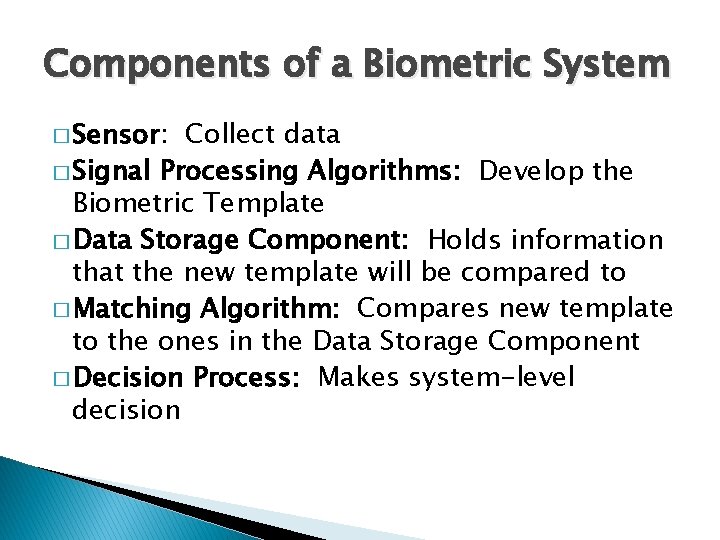
Components of a Biometric System � Sensor: Collect data � Signal Processing Algorithms: Develop the Biometric Template � Data Storage Component: Holds information that the new template will be compared to � Matching Algorithm: Compares new template to the ones in the Data Storage Component � Decision Process: Makes system-level decision
Fingerprints � Advantages: ◦ Easy to Use ◦ Large amount of data to check against ◦ Proven effective in large scale systems � Disadvantages: ◦ ◦ Privacy perceptions by the public Requires physical contact
Iris � Advantages: ◦ Most accurate ◦ No physical contact required � Disadvantages: ◦ Most costly
Iris � Advantages: ◦ Most accurate ◦ No physical contact required � Disadvantages: ◦ ◦ ◦ Most costly Can be difficult to capture Lack of existing data to check against
Face � Advantages: ◦ No physical contact required ◦ Commonly available sensors (cameras) ◦ Large amount of data to check against � Disadvantages: ◦ ◦ ◦ Face can be easily obstructed Faces change over time Frontal pose is usually necessary
Hand Geometry � Advantages: ◦ Easy to capture ◦ Believed to be highly stable pattern � Disadvantages: ◦ ◦ Not sufficiently distinctive for identification over large databases System requires a large amount of physical space
Speech � Advantages: ◦ Most publically accepted ◦ No physical contact required ◦ Commonly available sensors (telephones/microphones) � Disadvantages: ◦ Not sufficiently distinctive for identification over large databases
Modern Day Uses � Controlling Access to a physical location ◦ Labs / Buildings / etc. � Controlling Access to logical information ◦ Computer Accounts / Secure Electronic Docs / etc. � Determining if a person is already in a database
United States Visitor and Immigrant Status Indicator Technology �“US VISIT” program: ◦ Automated entry / exit control system ◦ Currently, inkless fingerprints and digital photos are required
Spoofing � Fingerprints are the most commonly spoofed ◦ Fake gummy fingers ◦ Breathing onto sensor ◦ Cutting off someone’s finger How to deal with spoofing?
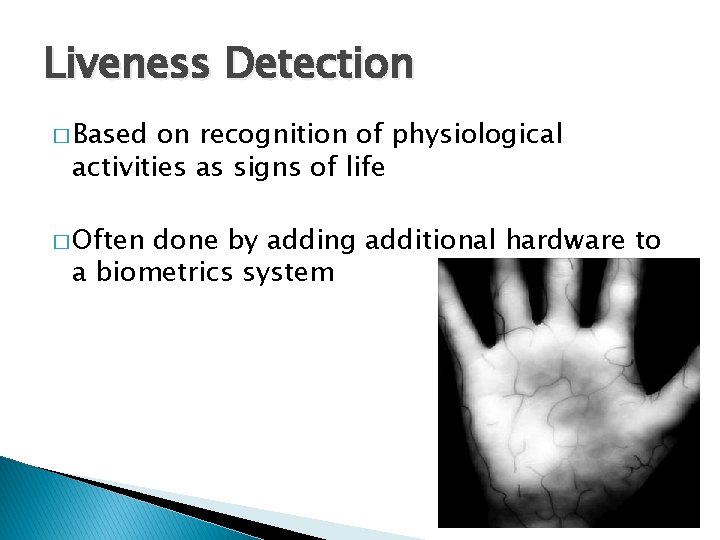
Liveness Detection � Based on recognition of physiological activities as signs of life � Often done by adding additional hardware to a biometrics system
Liveness Detection �Fingerprints: ◦ Hardware addition: �Detects temperature �Detects pulse ◦ Software Addition: �Detects perspiration
Other types of Liveness Detection �Face: Head movements �Iris: Pupil movement / eye movement �Voice: Matching lip movement (video) to the audio
Additional techniques to limit spoofing �Randomizing Verification Data �Multiple Biometrics �Multi-Factor Authentication
Future of Biometrics �Liveness Detection ◦ Palm Scanning � Distinctive as fingerprints � No physical contact required � Hand must be attached in order for live veins to be present
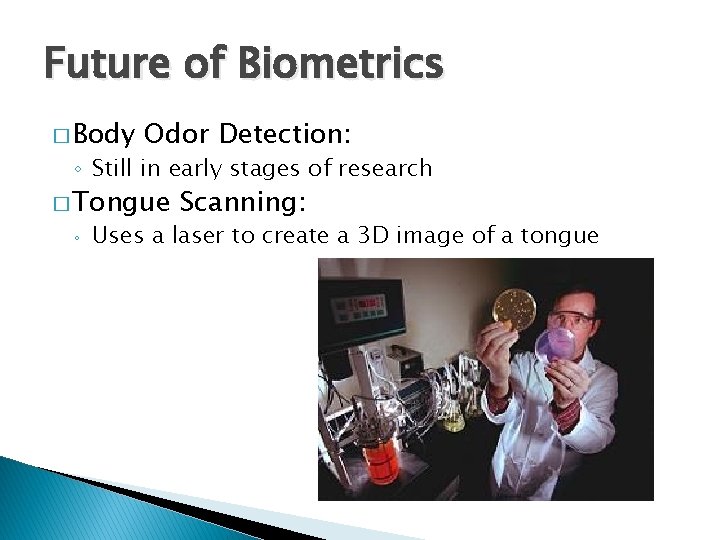
Future of Biometrics � Body Odor Detection: ◦ Still in early stages of research � Tongue ◦ Scanning: Uses a laser to create a 3 D image of a tongue
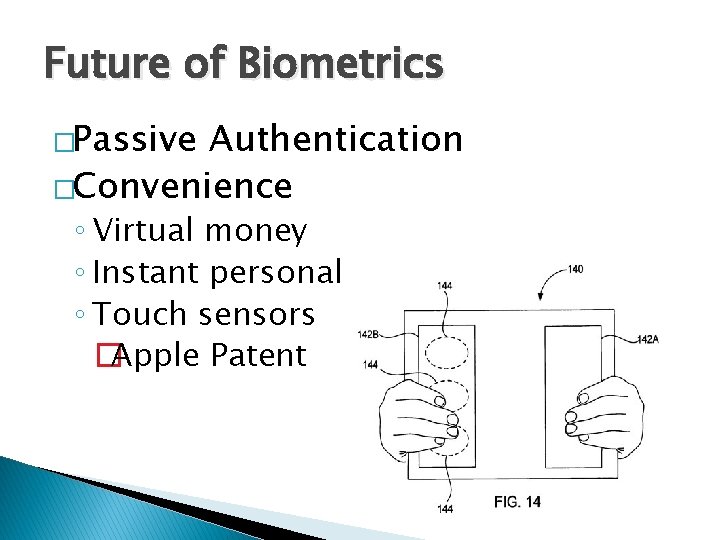
Future of Biometrics �Passive Authentication �Convenience ◦ Virtual money ◦ Instant personalization ◦ Touch sensors �Apple Patent
�Thank You
- Slides: 24