
Biometrics Harj Singh CLAS CISSP Security Architect BS
“Biometrics” Harj Singh CLAS CISSP Security Architect & BS 7799 Lead Auditor harj. singh@synetrix. co. uk 10/3/2020 Security Seminar 1
What does Biometrics mean? • • 10/3/2020 Comes from the Greek words “Bios – life” and “Metron – to measure”. Automated methods of verifying or recognising the identity of a living person based on physiological or behavioural characteristics Security Seminar 2
Identification or Verification? • • There are two ways of determining if you are you… Identification – Establishing a persons identity – Who are you ? – One to many comparison – Biometric sample presented to a system which compares it against a database of samples in the hope of finding a match • Verification – Involves confirming or denying a person’s claimed identity - Are you who you claim to be? – One to one comparison – Biometric sample captured and compared with the previously stored template for that user (Reference template) 10/3/2020 Security Seminar 3

Which Biometric? 10/3/2020 Fingerprint Hand Geometry Iris / Retina Scan Facial Scan Signature Voice Recognition Security Seminar 4
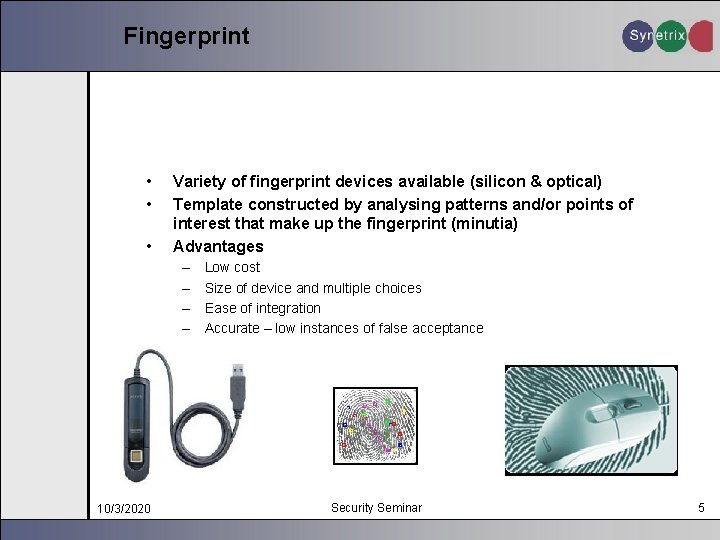
Fingerprint • • • Variety of fingerprint devices available (silicon & optical) Template constructed by analysing patterns and/or points of interest that make up the fingerprint (minutia) Advantages – – 10/3/2020 Low cost Size of device and multiple choices Ease of integration Accurate – low instances of false acceptance Security Seminar 5
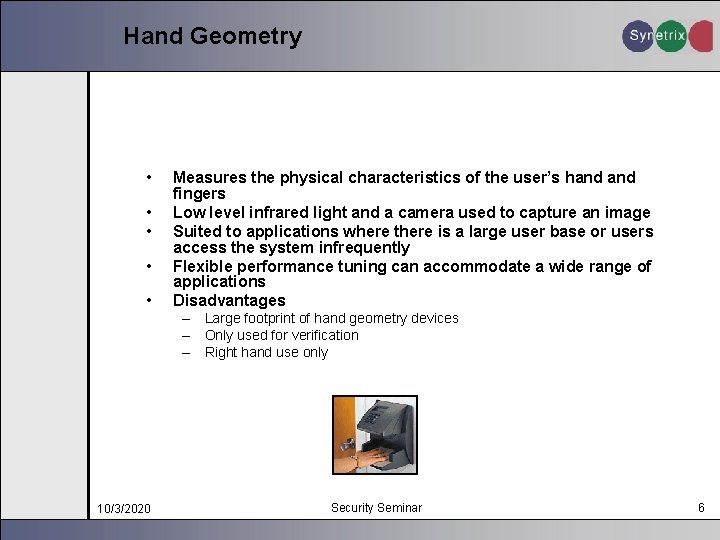
Hand Geometry • • • Measures the physical characteristics of the user’s hand fingers Low level infrared light and a camera used to capture an image Suited to applications where there is a large user base or users access the system infrequently Flexible performance tuning can accommodate a wide range of applications Disadvantages – Large footprint of hand geometry devices – Only used for verification – Right hand use only 10/3/2020 Security Seminar 6
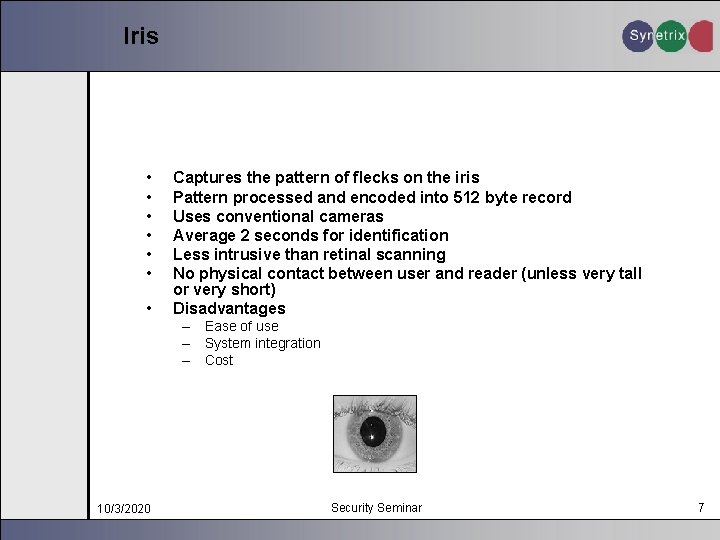
Iris • • Captures the pattern of flecks on the iris Pattern processed and encoded into 512 byte record Uses conventional cameras Average 2 seconds for identification Less intrusive than retinal scanning No physical contact between user and reader (unless very tall or very short) Disadvantages – Ease of use – System integration – Cost 10/3/2020 Security Seminar 7
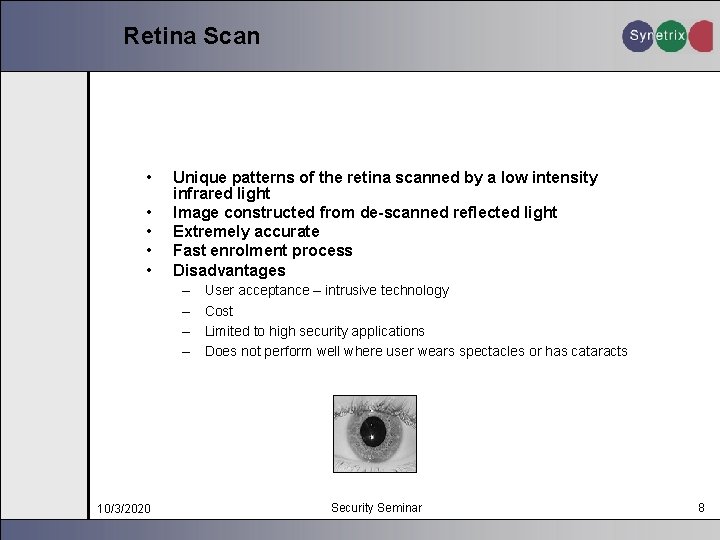
Retina Scan • • • Unique patterns of the retina scanned by a low intensity infrared light Image constructed from de-scanned reflected light Extremely accurate Fast enrolment process Disadvantages – – 10/3/2020 User acceptance – intrusive technology Cost Limited to high security applications Does not perform well where user wears spectacles or has cataracts Security Seminar 8
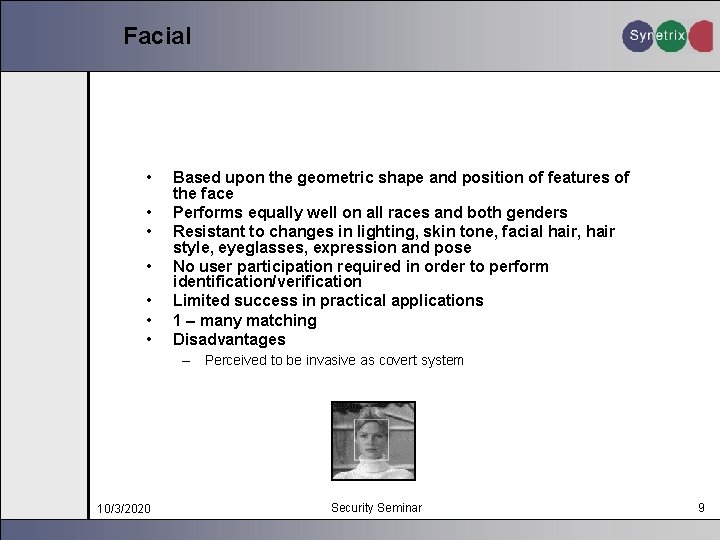
Facial • • Based upon the geometric shape and position of features of the face Performs equally well on all races and both genders Resistant to changes in lighting, skin tone, facial hair, hair style, eyeglasses, expression and pose No user participation required in order to perform identification/verification Limited success in practical applications 1 – many matching Disadvantages – Perceived to be invasive as covert system 10/3/2020 Security Seminar 9
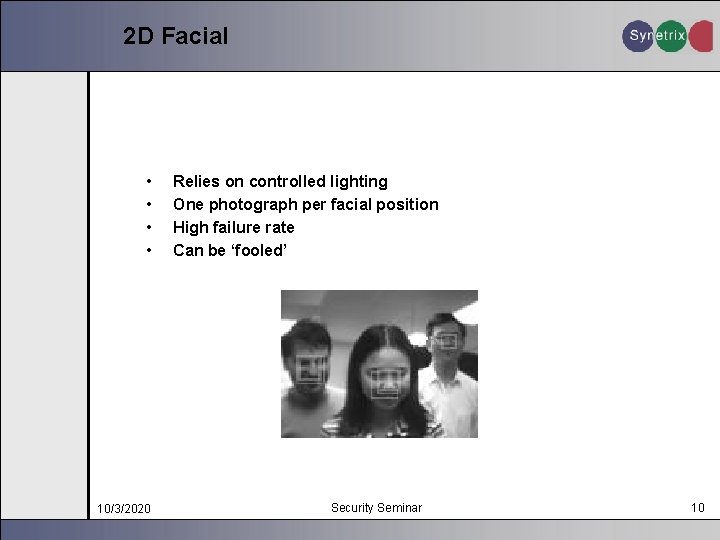
2 D Facial • • 10/3/2020 Relies on controlled lighting One photograph per facial position High failure rate Can be ‘fooled’ Security Seminar 10
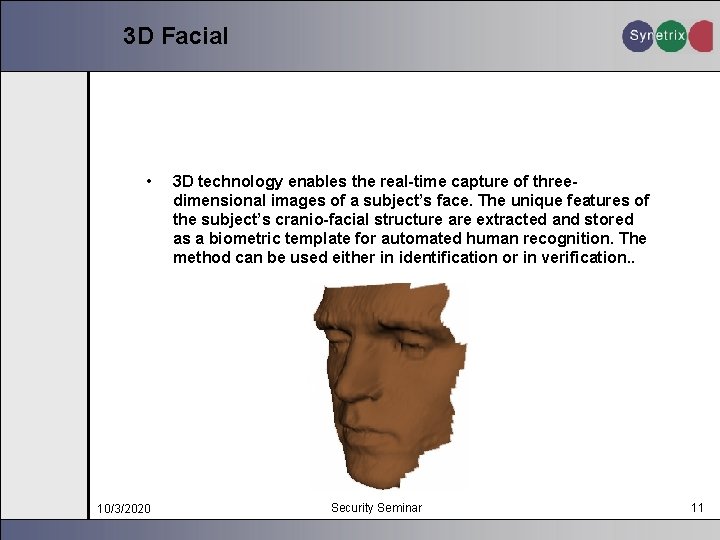
3 D Facial • 10/3/2020 3 D technology enables the real-time capture of threedimensional images of a subject’s face. The unique features of the subject’s cranio-facial structure are extracted and stored as a biometric template for automated human recognition. The method can be used either in identification or in verification. . Security Seminar 11
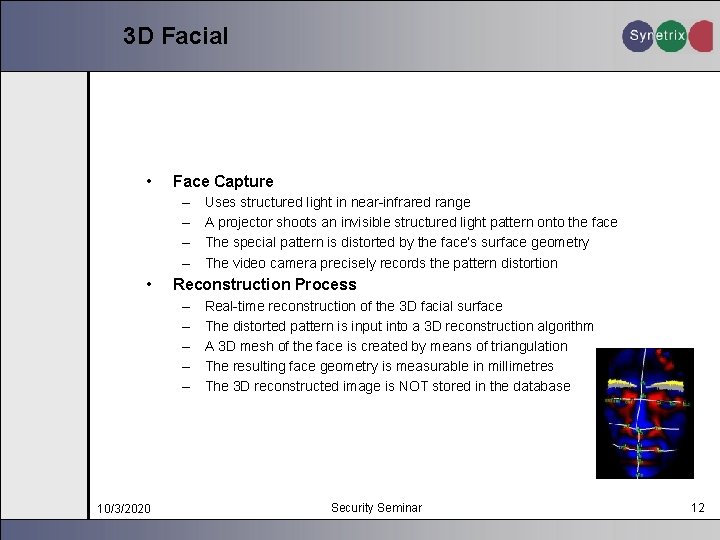
3 D Facial • Face Capture – – • Reconstruction Process – – – 10/3/2020 Uses structured light in near-infrared range A projector shoots an invisible structured light pattern onto the face The special pattern is distorted by the face’s surface geometry The video camera precisely records the pattern distortion Real-time reconstruction of the 3 D facial surface The distorted pattern is input into a 3 D reconstruction algorithm A 3 D mesh of the face is created by means of triangulation The resulting face geometry is measurable in millimetres The 3 D reconstructed image is NOT stored in the database Security Seminar 12
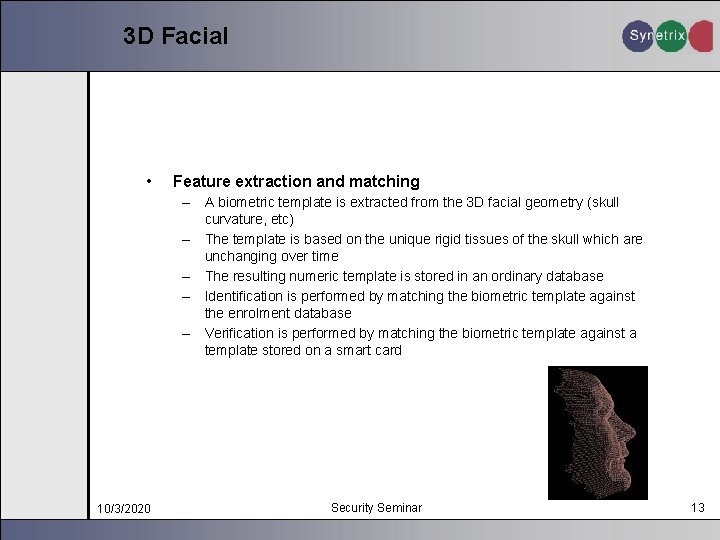
3 D Facial • Feature extraction and matching – A biometric template is extracted from the 3 D facial geometry (skull curvature, etc) – The template is based on the unique rigid tissues of the skull which are unchanging over time – The resulting numeric template is stored in an ordinary database – Identification is performed by matching the biometric template against the enrolment database – Verification is performed by matching the biometric template against a template stored on a smart card 10/3/2020 Security Seminar 13
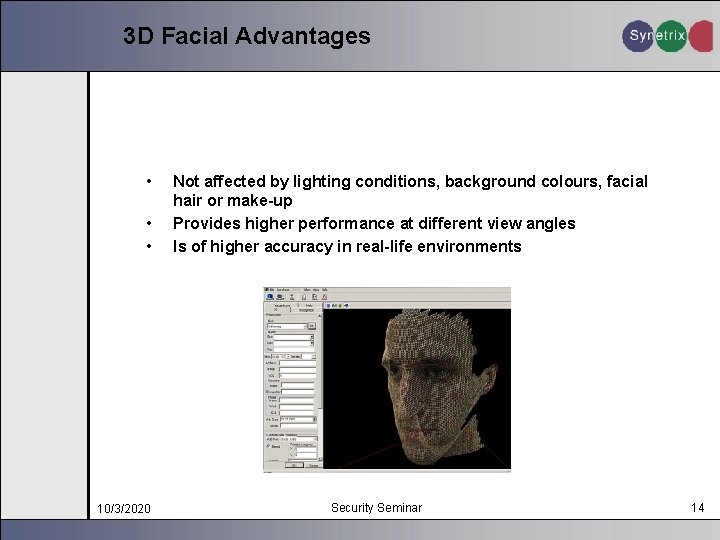
3 D Facial Advantages • • • 10/3/2020 Not affected by lighting conditions, background colours, facial hair or make-up Provides higher performance at different view angles Is of higher accuracy in real-life environments Security Seminar 14
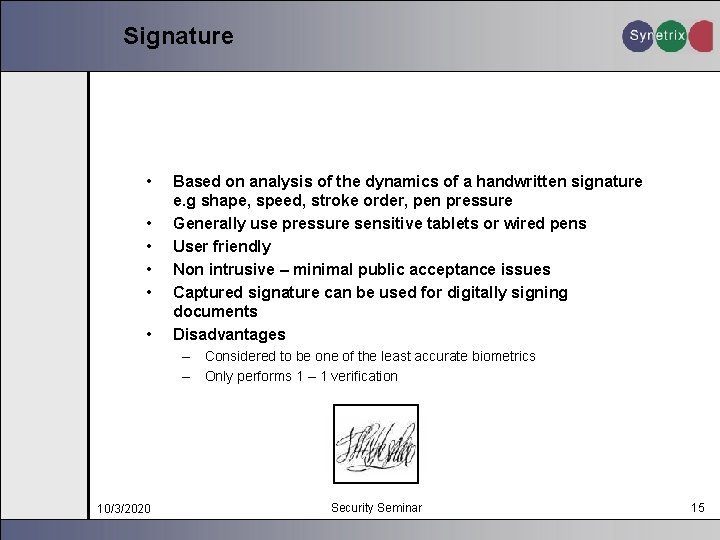
Signature • • • Based on analysis of the dynamics of a handwritten signature e. g shape, speed, stroke order, pen pressure Generally use pressure sensitive tablets or wired pens User friendly Non intrusive – minimal public acceptance issues Captured signature can be used for digitally signing documents Disadvantages – Considered to be one of the least accurate biometrics – Only performs 1 – 1 verification 10/3/2020 Security Seminar 15
Voice Recognition • • • Analyses voice patterns and characteristics of speech e. g. pitch, tone High user acceptance - perceived as least intrusive biometric technology Easy for end users to implement BUT the least secure biometric Ideal for telephone systems/ mobile environments Disadvantages: – Affected by environmental factors – background noise greatly affects system performance – Problems if enrolment undertaken using mobile device then request verification from fixed land line. 10/3/2020 Security Seminar 16
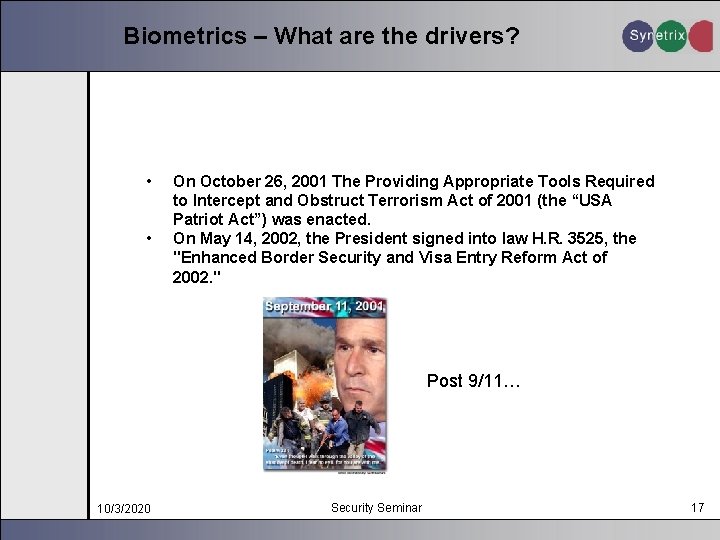
Biometrics – What are the drivers? • • On October 26, 2001 The Providing Appropriate Tools Required to Intercept and Obstruct Terrorism Act of 2001 (the “USA Patriot Act”) was enacted. On May 14, 2002, the President signed into law H. R. 3525, the "Enhanced Border Security and Visa Entry Reform Act of 2002. " Post 9/11… 10/3/2020 Security Seminar 17
H. R. 3525 • “The border security bill makes reforms to our immigration system in response to the increased awareness of America’s vulnerability to terrorism after 9/11. It provides for calls for vital improvements in technology to provide more timely information to help with the battle against terrorism. Among the key features: —Funds for increased border and State Department personnel and training, including 1, 000 new INS inspections personnel, and $150 million for INS border technology; —A report, a plan, and protections for an interoperable information-sharing system; —An interoperable information-sharing system with name-matching capacity; —Machine-readable, tamper-resistant biometric travel documents and passports; —Restriction on nonimmigrant visas for aliens from countries that sponsor terrorism; —Reform of the visa waiver program; —Requirement of passenger manifest information for commercial flights and vessels; —Repeal of the 45 -minute time limit on INS inspections of arriving passengers; and —Enhanced foreign student monitoring program” 10/3/2020 Security Seminar 18
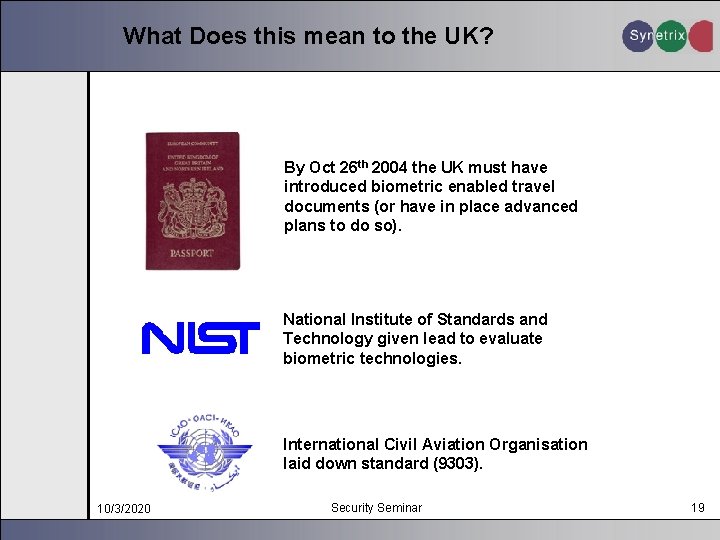
What Does this mean to the UK? By Oct 26 th 2004 the UK must have introduced biometric enabled travel documents (or have in place advanced plans to do so). National Institute of Standards and Technology given lead to evaluate biometric technologies. International Civil Aviation Organisation laid down standard (9303). 10/3/2020 Security Seminar 19
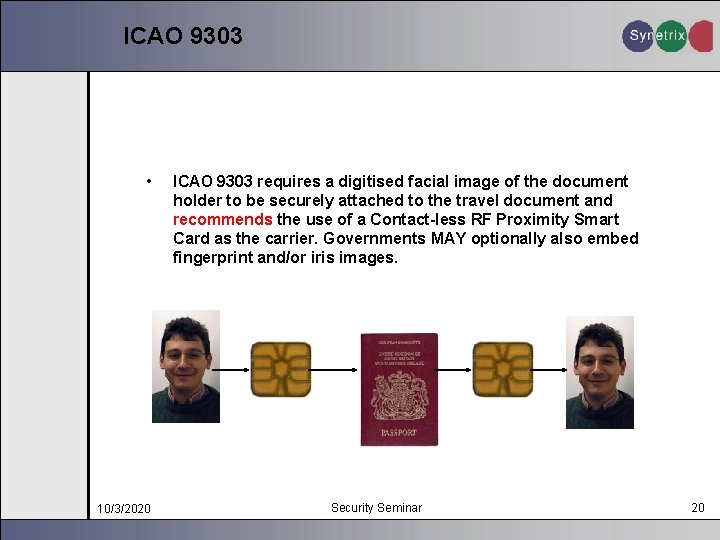
ICAO 9303 • 10/3/2020 ICAO 9303 requires a digitised facial image of the document holder to be securely attached to the travel document and recommends the use of a Contact-less RF Proximity Smart Card as the carrier. Governments MAY optionally also embed fingerprint and/or iris images. Security Seminar 20
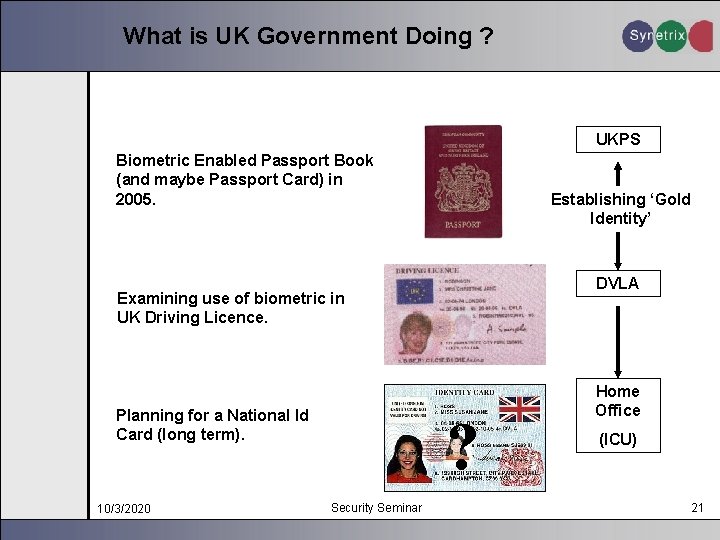
What is UK Government Doing ? UKPS Biometric Enabled Passport Book (and maybe Passport Card) in 2005. Establishing ‘Gold Identity’ DVLA Examining use of biometric in UK Driving Licence. Planning for a National Id Card (long term). 10/3/2020 ? Security Seminar Home Office (ICU) 21
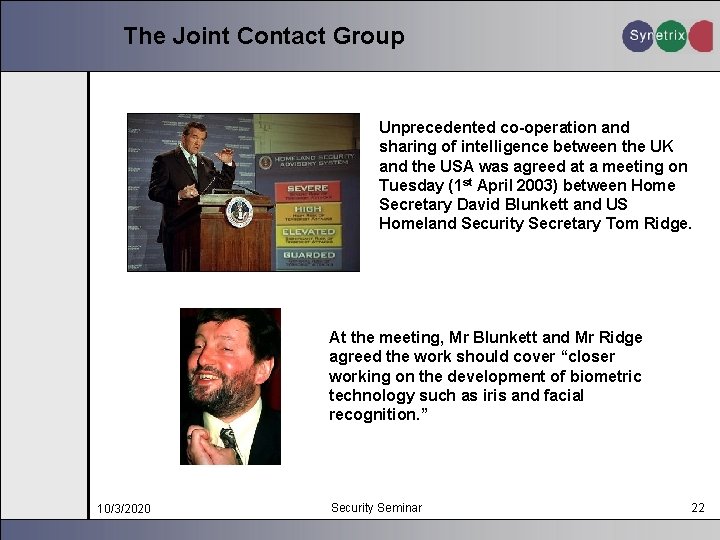
The Joint Contact Group Unprecedented co-operation and sharing of intelligence between the UK and the USA was agreed at a meeting on Tuesday (1 st April 2003) between Home Secretary David Blunkett and US Homeland Security Secretary Tom Ridge. At the meeting, Mr Blunkett and Mr Ridge agreed the work should cover “closer working on the development of biometric technology such as iris and facial recognition. ” 10/3/2020 Security Seminar 22
UK Law Enforcement Human identification is a key element in the reduction and investigation of crime and thus a key element in the provision of effective capabilities to assist the Police Service in meeting strategic objectives. Dr Fred Preston, Director of Identification, PITO 10/3/2020 Security Seminar 23
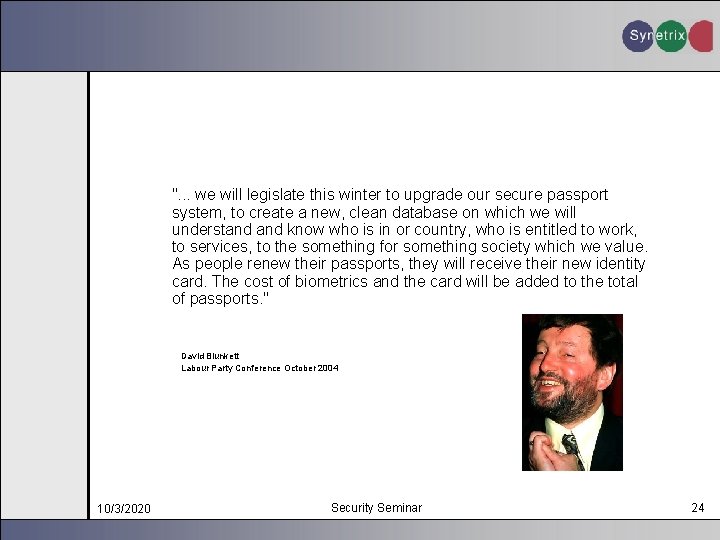
". . . we will legislate this winter to upgrade our secure passport system, to create a new, clean database on which we will understand know who is in or country, who is entitled to work, to services, to the something for something society which we value. As people renew their passports, they will receive their new identity card. The cost of biometrics and the card will be added to the total of passports. " David Blunkett Labour Party Conference October 2004 10/3/2020 Security Seminar 24
The Future • • 10/3/2020 Chip and Finger ? Facial recognition in cars ? Security Seminar 25
Questions 10/3/2020 Security Seminar 26
- Slides: 26