
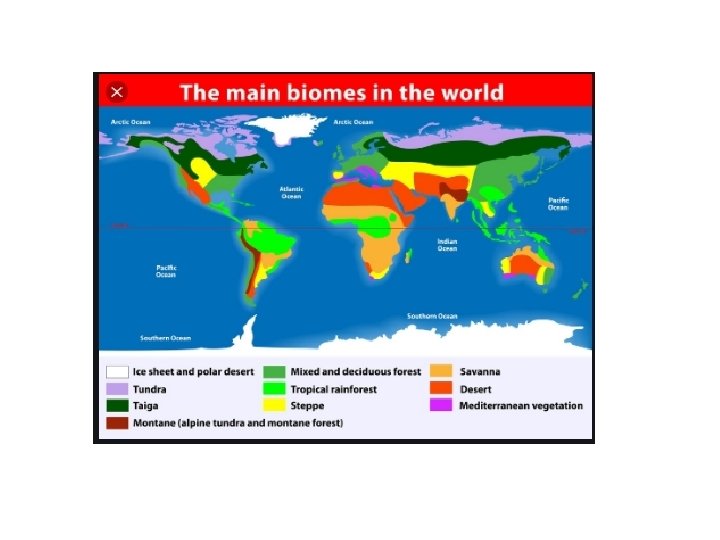
BIOMES Specific locations on the Earth that Support
BIOMES Specific locations on the Earth that Support various organisms Determined by the climate.
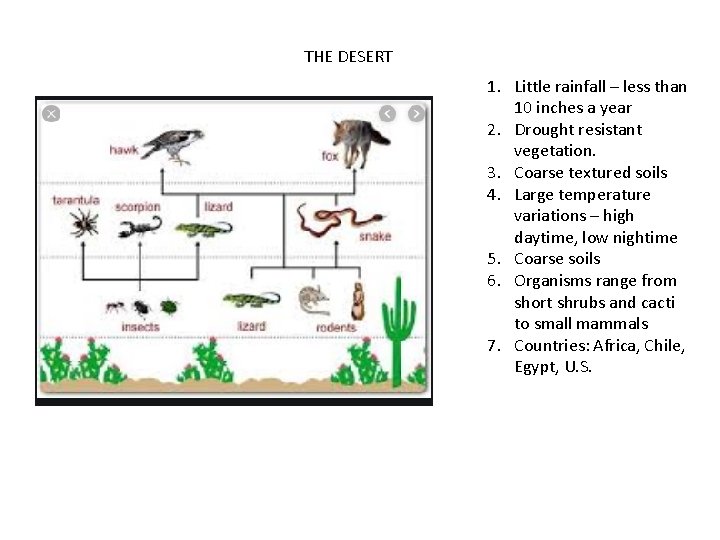
THE DESERT 1. Little rainfall – less than 10 inches a year 2. Drought resistant vegetation. 3. Coarse textured soils 4. Large temperature variations – high daytime, low nightime 5. Coarse soils 6. Organisms range from short shrubs and cacti to small mammals 7. Countries: Africa, Chile, Egypt, U. S.
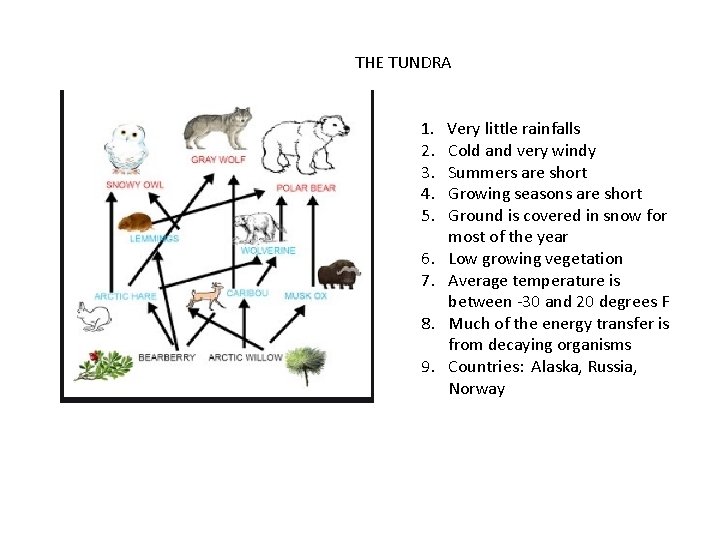
THE TUNDRA 1. 2. 3. 4. 5. 6. 7. 8. 9. Very little rainfalls Cold and very windy Summers are short Growing seasons are short Ground is covered in snow for most of the year Low growing vegetation Average temperature is between -30 and 20 degrees F Much of the energy transfer is from decaying organisms Countries: Alaska, Russia, Norway
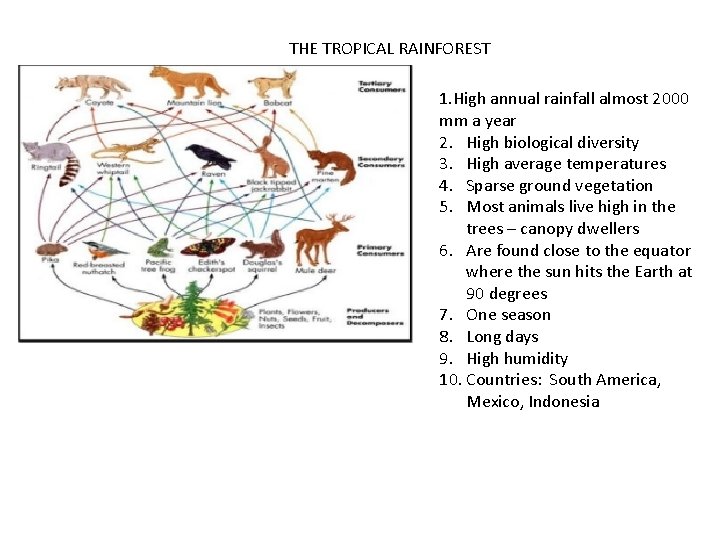
THE TROPICAL RAINFOREST 1. High annual rainfall almost 2000 mm a year 2. High biological diversity 3. High average temperatures 4. Sparse ground vegetation 5. Most animals live high in the trees – canopy dwellers 6. Are found close to the equator where the sun hits the Earth at 90 degrees 7. One season 8. Long days 9. High humidity 10. Countries: South America, Mexico, Indonesia
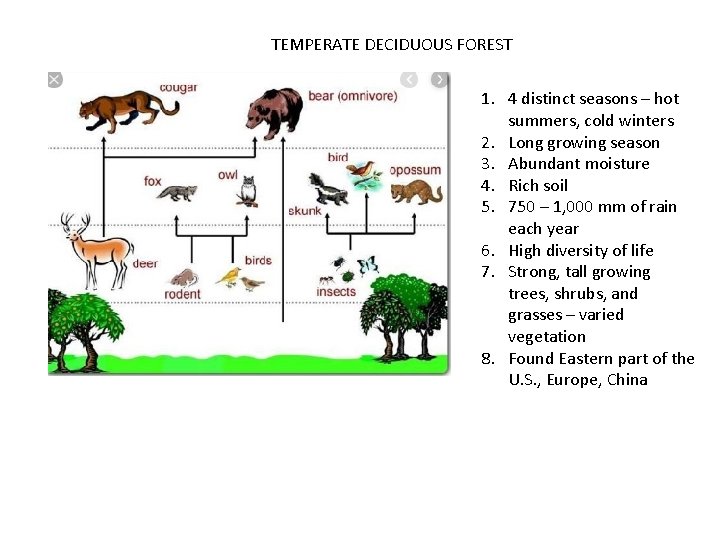
TEMPERATE DECIDUOUS FOREST 1. 4 distinct seasons – hot summers, cold winters 2. Long growing season 3. Abundant moisture 4. Rich soil 5. 750 – 1, 000 mm of rain each year 6. High diversity of life 7. Strong, tall growing trees, shrubs, and grasses – varied vegetation 8. Found Eastern part of the U. S. , Europe, China
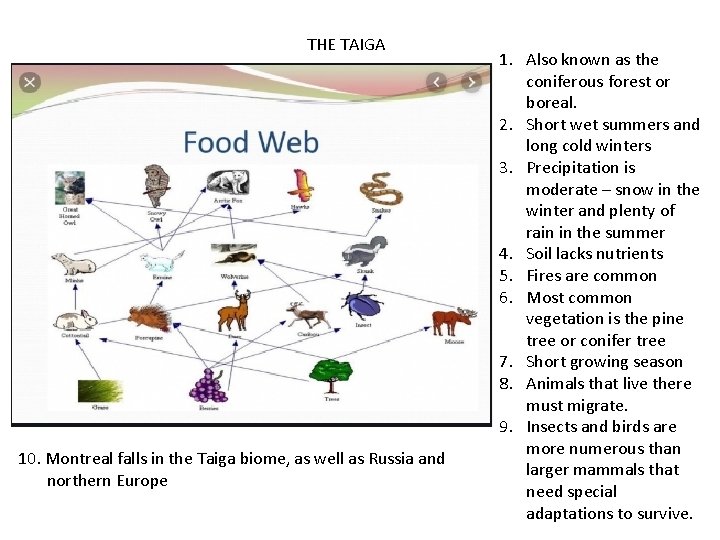
THE TAIGA 10. Montreal falls in the Taiga biome, as well as Russia and northern Europe 1. Also known as the coniferous forest or boreal. 2. Short wet summers and long cold winters 3. Precipitation is moderate – snow in the winter and plenty of rain in the summer 4. Soil lacks nutrients 5. Fires are common 6. Most common vegetation is the pine tree or conifer tree 7. Short growing season 8. Animals that live there must migrate. 9. Insects and birds are more numerous than larger mammals that need special adaptations to survive.

THE SHRUBLAND OR CHAPPARAL 1. Short grasses and small trees. 2. Limited rainfall 3. Large mammals 4. Hot summers 100 degrees 5. Cool winters 30 degrees 6. Rain falls mostly in the winter – 10 -17 inches 7. 4 seasons 8. Countries: South Africa and Australia
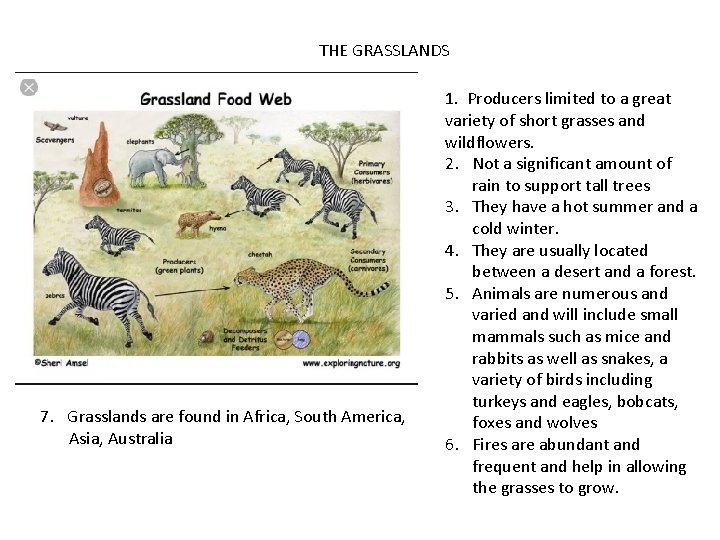
THE GRASSLANDS 7. Grasslands are found in Africa, South America, Asia, Australia 1. Producers limited to a great variety of short grasses and wildflowers. 2. Not a significant amount of rain to support tall trees 3. They have a hot summer and a cold winter. 4. They are usually located between a desert and a forest. 5. Animals are numerous and varied and will include small mammals such as mice and rabbits as well as snakes, a variety of birds including turkeys and eagles, bobcats, foxes and wolves 6. Fires are abundant and frequent and help in allowing the grasses to grow.
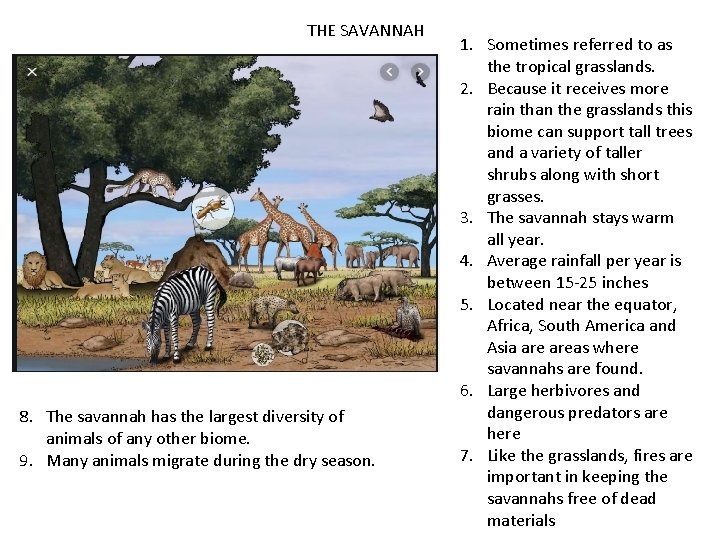
THE SAVANNAH 8. The savannah has the largest diversity of animals of any other biome. 9. Many animals migrate during the dry season. 1. Sometimes referred to as the tropical grasslands. 2. Because it receives more rain than the grasslands this biome can support tall trees and a variety of taller shrubs along with short grasses. 3. The savannah stays warm all year. 4. Average rainfall per year is between 15 -25 inches 5. Located near the equator, Africa, South America and Asia areas where savannahs are found. 6. Large herbivores and dangerous predators are here 7. Like the grasslands, fires are important in keeping the savannahs free of dead materials
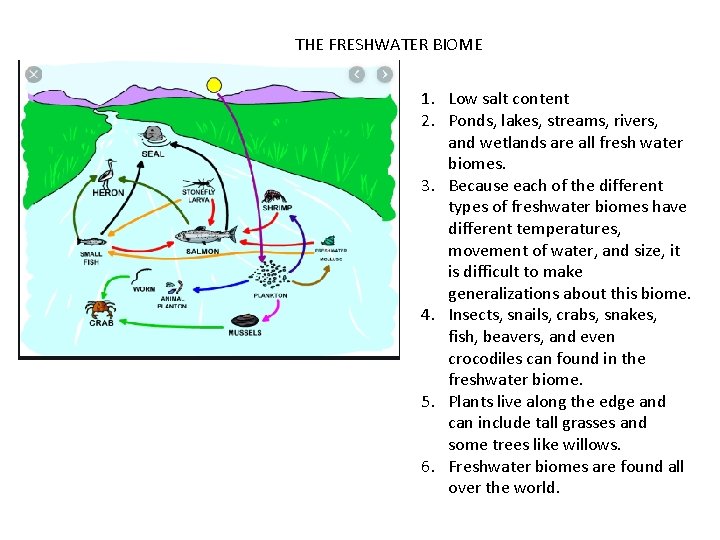
THE FRESHWATER BIOME 1. Low salt content 2. Ponds, lakes, streams, rivers, and wetlands are all fresh water biomes. 3. Because each of the different types of freshwater biomes have different temperatures, movement of water, and size, it is difficult to make generalizations about this biome. 4. Insects, snails, crabs, snakes, fish, beavers, and even crocodiles can found in the freshwater biome. 5. Plants live along the edge and can include tall grasses and some trees like willows. 6. Freshwater biomes are found all over the world.
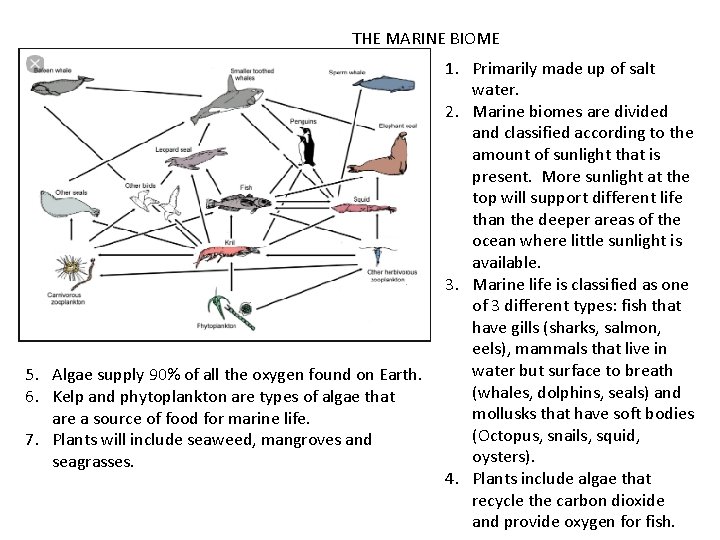
THE MARINE BIOME 5. Algae supply 90% of all the oxygen found on Earth. 6. Kelp and phytoplankton are types of algae that are a source of food for marine life. 7. Plants will include seaweed, mangroves and seagrasses. 1. Primarily made up of salt water. 2. Marine biomes are divided and classified according to the amount of sunlight that is present. More sunlight at the top will support different life than the deeper areas of the ocean where little sunlight is available. 3. Marine life is classified as one of 3 different types: fish that have gills (sharks, salmon, eels), mammals that live in water but surface to breath (whales, dolphins, seals) and mollusks that have soft bodies (Octopus, snails, squid, oysters). 4. Plants include algae that recycle the carbon dioxide and provide oxygen for fish.
- Slides: 12