
Biomes climate and plants What is an Ecosystem
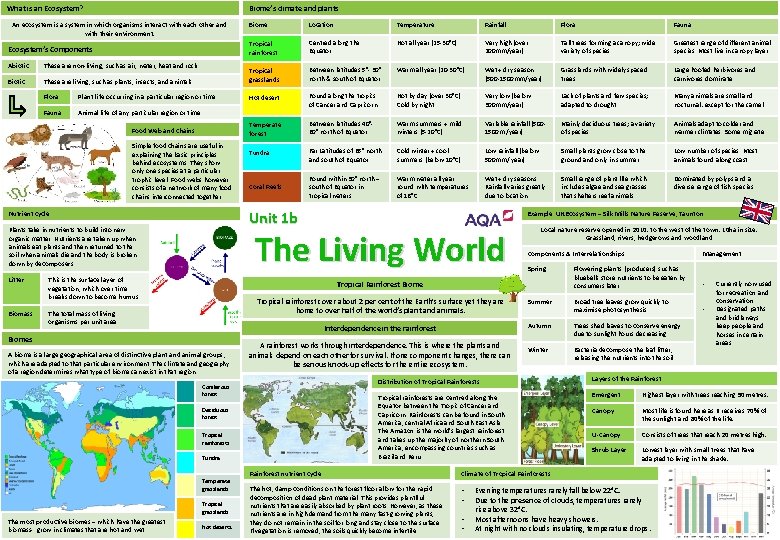
Biome’s climate and plants What is an Ecosystem? An ecosystem is a system in which organisms interact with each other and with their environment. Ecosystem’s Components Biome Location Temperature Rainfall Flora Fauna Tropical rainforest Centred along the Equator. Hot all year (25 -30°C) Very high (over 200 mm/year) Tall trees forming a canopy; wide variety of species. Greatest range of different animal species. Most live in canopy layer Abiotic These are non-living, such as air, water, heat and rock. These are living, such as plants, insects, and animals. Tropical grasslands Between latitudes 5°- 30° north & south of Equator. Warm all year (20 -30°C) Biotic Wet + dry season (500 -1500 mm/year) Grasslands with widely spaced trees. Large hoofed herbivores and carnivores dominate. Flora Plant life occurring in a particular region or time. Hot desert Fauna Animal life of any particular region or time. Found along the tropics of Cancer and Capricorn. Hot by day (over 30°C) Cold by night Very low (below 300 mm/year) Lack of plants and few species; adapted to drought. Many animals are small and nocturnal: except for the camel. Temperate forest Between latitudes 40° 60° north of Equator. Warm summers + mild winters (5 -20°C) Variable rainfall (5001500 m /year) Mainly deciduous trees; a variety of species. Animals adapt to colder and warmer climates. Some migrate. Tundra Far Latitudes of 65° north and south of Equator Cold winter + cool summers (below 10°C) Low rainfall (below 500 mm/ year) Small plants grow close to the ground and only in summer. Low number of species. Most animals found along coast. Coral Reefs Found within 30° north – south of Equator in tropical waters. Warm water all year round with temperatures of 18°C Wet + dry seasons. Rainfall varies greatly due to location. Small range of plant life which includes algae and sea grasses that shelters reef animals. Dominated by polyps and a diverse range of fish species. Food Web and Chains Simple food chains are useful in explaining the basic principles behind ecosystems. They show only one species at a particular trophic level. Food webs however consists of a network of many food chains interconnected together. Unit 1 b Nutrient cycle Plants take in nutrients to build into new organic matter. Nutrients are taken up when animals eat plants and then returned to the soil when animals die and the body is broken down by decomposers. Litter This is the surface layer of vegetation, which over time breaks down to become humus. Biomass The total mass of living organisms per unit area. The Living World Local nature reserve opened in 2010. to the west of the town. 10 ha in size. Grassland, rivers, hedgerows and woodland Components & Interrelationships Spring Tropical Rainforest Biomes A biome is a large geographical area of distinctive plant and animal groups , which are adapted to that particular environment. The climate and geography of a region determines what type of biome can exist in that region. - Interdependence in the rainforest Autumn Trees shed leaves to conserve energy due to sunlight hours decreasing. Winter Bacteria decompose the leaf litter, releasing the nutrients into the soil. A rainforest works through interdependence. This is where the plants and animals depend on each other for survival. If one component changes, there can be serious knock-up effects for the entire ecosystem. Tundra Hot deserts. - Broad tree leaves grow quickly to maximise photosynthesis. Tropical rainforests Tropical grasslands Flowering plants (producers) such as bluebells store nutrients to be eaten by consumers later. Summer Deciduous forest Temperate grasslands Management Tropical rainforest cover about 2 per cent of the Earth’s surface yet they are home to over half of the world’s plant and animals. Coniferous forest The most productive biomes – which have the greatest biomass- grow in climates that are hot and wet. Example: UK Ecosystem – Silk Mills Nature Reserve, Taunton Currently now used for recreation and conservation. Designated paths and bridleways keep people and horses in certain areas Distribution of Tropical Rainforests Layers of the Rainforest Tropical rainforests are centred along the Equator between the Tropic of Cancer and Capricorn. Rainforests can be found in South America, central Africa and South-East Asia. The Amazon is the world’s largest rainforest and takes up the majority of northern South America, encompassing countries such as Brazil and Peru. Emergent Highest layer with trees reaching 50 metres. Canopy Most life is found here as It receives 70% of the sunlight and 80% of the life. U-Canopy Consists of trees that reach 20 metres high. Shrub Layer Lowest layer with small trees that have adapted to living in the shade. Rainforest nutrient cycle Climate of Tropical Rainforests The hot, damp conditions on the forest floor allow for the rapid decomposition of dead plant material. This provides plentiful nutrients that are easily absorbed by plant roots. However, as these nutrients are in high demand from the many fast-growing plants, they do not remain in the soil for long and stay close to the surface. If vegetation is removed, the soils quickly become infertile. • • Evening temperatures rarely fall below 22°C. Due to the presence of clouds, temperatures rarely rise above 32°C. Most afternoons have heavy showers. At night with no clouds insulating, temperature drops.
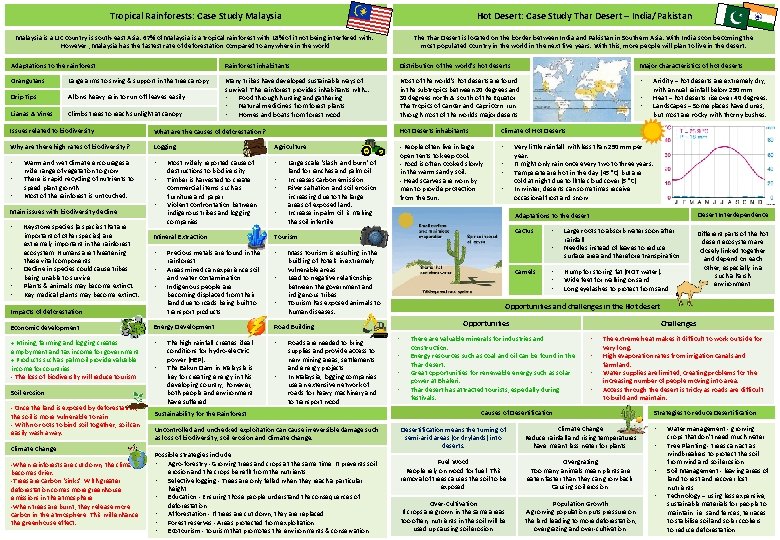
Tropical Rainforests: Case Study Malaysia Hot Desert: Case Study Thar Desert – India/Pakistan Malaysia is a LIC country is south-east Asia. 67% of Malaysia is a tropical rainforest with 18% of it not being interfered with. However , Malaysia has the fastest rate of deforestation compared to anywhere in the world The Thar Desert is located on the border between India and Pakistan in Southern Asia. With India soon becoming the most populated country in the world in the next five years. With this, more people will plan to live in the desert. Adaptations to the rainforest Rainforest inhabitants Distribution of the world’s hot deserts Major characteristics of hot deserts Orangutans Large arms to swing & support in the tree canopy. Allows heavy rain to run off leaves easily. Lianas & Vines Climbs trees to reach sunlight at canopy. Most of the world’s hot deserts are found in the subtropics between 20 degrees and 30 degrees north & south of the Equator. The Tropics of Cancer and Capricorn run through most of the worlds major deserts. • Drip Tips Many tribes have developed sustainable ways of survival. The rainforest provides inhabitants with… • Food through hunting and gathering. • Natural medicines from forest plants. • Homes and boats from forest wood. Issues related to biodiversity What are the causes of deforestation? Why are there high rates of biodiversity? Logging Agriculture • • • Warm and wet climate encourages a wide range of vegetation to grow. There is rapid recycling of nutrients to speed plant growth. Most of the rainforest is untouched. Main issues with biodiversity decline • • Keystone species (a species that are important of other species) are extremely important in the rainforest ecosystem. Humans are threatening these vital components. Decline in species could cause tribes being unable to survive. Plants & animals may become extinct. Key medical plants may become extinct. • • Most widely reported cause of destructions to biodiversity. Timber is harvested to create commercial items such as furniture and paper. Violent confrontation between indigenous tribes and logging companies. • • • Large scale ‘slash and burn’ of land for ranches and palm oil. Increases carbon emission. River saltation and soil erosion increasing due to the large areas of exposed land. Increase in palm oil is making the soil infertile. Mineral Extraction Tourism • • Impacts of deforestation Precious metals are found in the rainforest. Areas mined can experience soil and water contamination. Indigenous people are becoming displaced from their land due to roads being built to transport products. • • Energy Development Road Building + Mining, farming and logging creates employment and tax income for government. + Products such as palm oil provide valuable income for countries. - The loss of biodiversity will reduce tourism. • • Soil erosion - Once the land is exposed by deforestation, the soil is more vulnerable to rain. - With no roots to bind soil together, soil can easily wash away. Climate Change -When rainforests are cut down, the climate becomes drier. -Trees are carbon ‘sinks’. With greater deforestation comes more greenhouse emissions in the atmosphere. -When trees are burnt, they release more carbon in the atmosphere. This will enhance the greenhouse effect. • The high rainfall creates ideal conditions for hydro-electric power (HEP). The Bakun Dam in Malaysia is key for creating energy in this developing country, however, both people and environment have suffered. • Roads are needed to bring supplies and provide access to new mining areas, settlements and energy projects. In Malaysia, logging companies use an extensive network of roads for heavy machinery and to transport wood. Sustainability for the Rainforest Uncontrolled and unchecked exploitation cause irreversible damage such as loss of biodiversity, soil erosion and climate change. Possible strategies include: • Agro-forestry - Growing trees and crops at the same time. It prevents soil erosion and the crops benefit from the nutrients. • Selective logging - Trees are only felled when they reach a particular height. • Education - Ensuring those people understand the consequences of deforestation • Afforestation - If trees are cut down, they are replaced. • Forest reserves - Areas protected from exploitation. • Ecotourism - tourism that promotes the environments & conservation Hot Deserts inhabitants Climate of Hot Deserts - People often live in large open tents to keep cool. - Food is often cooked slowly in the warm sandy soil. - Head scarves are worn by men to provide protection from the Sun. • Very little rainfall with less than 250 mm per year. It might only rain once every two to three years. Temperate are hot in the day (45 °C) but are cold at night due to little cloud cover (5 °C). In winter, deserts can sometimes receive occasional frost and snow. • • • Adaptations to the desert Desert Interdependence • Different parts of the hot desert ecosystem are closely linked together and depend on each other, especially in a such a harsh environment. Cactus • Mass tourism is resulting in the building of hotels in extremely vulnerable areas. Lead to negative relationship between the government and indigenous tribes Tourism has exposed animals to human diseases. Economic development • • Aridity – hot deserts are extremely dry, with annual rainfall below 250 mm. Heat – hot deserts rise over 40 degrees. Landscapes – Some places have dunes, but most are rocky with thorny bushes. Camels • • • Large roots to absorb water soon after rainfall. Needles instead of leaves to reduce surface area and therefore transpiration. Hump for storing fat (NOT water). Wide feet for walking on sand. Long eyelashes to protect from sand. Opportunities and challenges in the Hot desert Opportunities • • Challenges There are valuable minerals for industries and construction. Energy resources such as coal and oil can be found in the Thar desert. Great opportunities for renewable energy such as solar power at Bhaleri. Thar desert has attracted tourists, especially during festivals. • • The extreme heat makes it difficult to work outside for very long. High evaporation rates from irrigation canals and farmland. Water supplies are limited, creating problems for the increasing number of people moving into area. Access through the desert is tricky as roads are difficult to build and maintain. Causes of Desertification means the turning of semi-arid areas (or drylands) into deserts. Climate Change Reduce rainfall and rising temperatures have meant less water for plants. Fuel Wood People rely on wood for fuel. This removal of trees causes the soil to be exposed. Overgrazing Too many animals mean plants are eaten faster than they can grow back. Causing soil erosion. Over-Cultivation If crops are grown in the same areas too often, nutrients in the soil will be used up causing soil erosion. Population Growth A growing population puts pressure on the land leading to more deforestation, overgrazing and over-cultivation. Strategies to reduce Desertification • • Water management - growing crops that don’t need much water. Tree Planting - trees can act as windbreakers to protect the soil from wind and soil erosion. Soil Management - leaving areas of land to rest and recover lost nutrients. Technology – using less expensive, sustainable materials for people to maintain. i. e. sand fences, terraces to stabilise soil and solar cookers to reduce deforestation.
- Slides: 2