
Biomedical Engineering for Global Health Lecture Fourteen Prostate
Biomedical Engineering for Global Health Lecture Fourteen
Prostate Cancer Early Detection
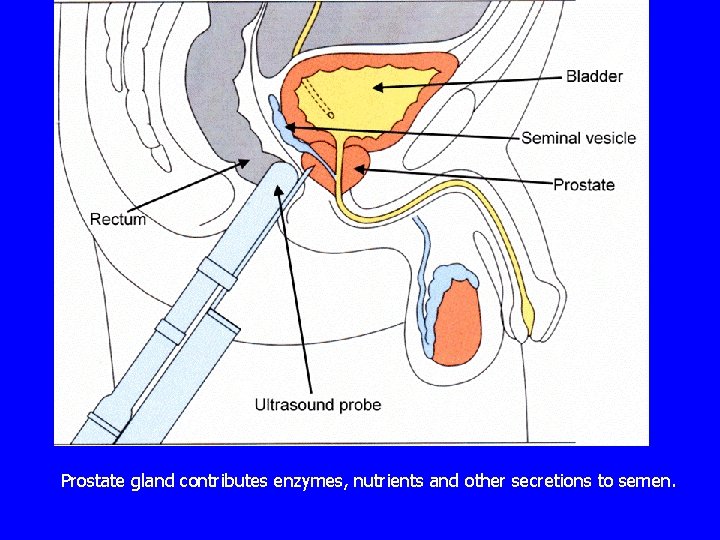
Prostate gland contributes enzymes, nutrients and other secretions to semen.
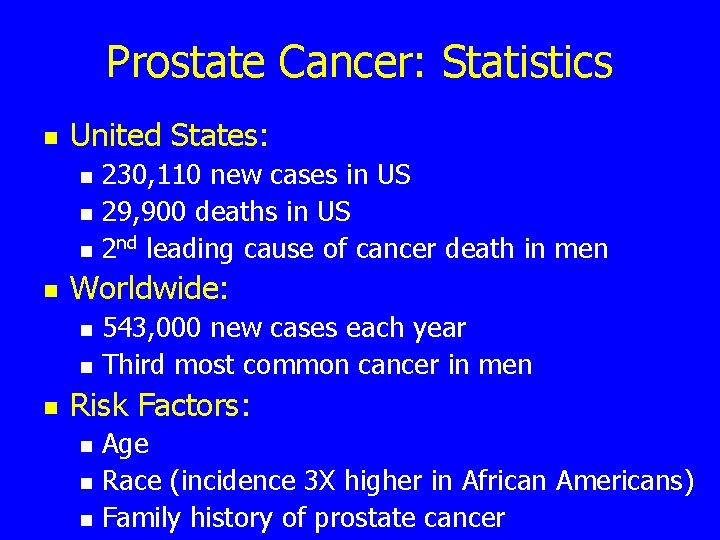
Prostate Cancer: Statistics n United States: n n Worldwide: n n n 230, 110 new cases in US 29, 900 deaths in US 2 nd leading cause of cancer death in men 543, 000 new cases each year Third most common cancer in men Risk Factors: n n n Age Race (incidence 3 X higher in African Americans) Family history of prostate cancer

Risk of Prostate Cancer in Next 5 Yrs BC Cancer Agency. PSA Screening information for patients, May 2009

Development of Prostate Cancer n Prostate Cancer: n n n Slow, but continuously growing neoplasia Preclinical form develops at age 30 Remains latent for up to 20 years Can progress to aggressive, malignant cancer Peak incidence: 7 th decade of life Signs and symptoms: n n Often asymptomatic in early stages Weak or interrupted urine flow Inability to urinate These are symptoms of prostate enlargement
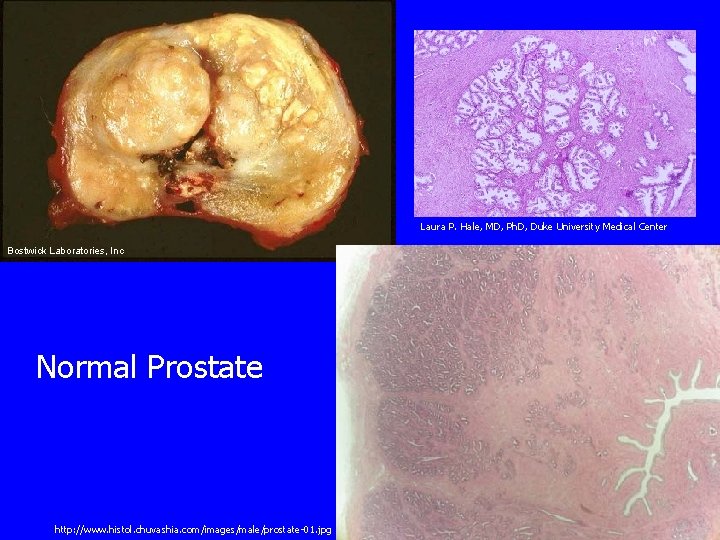
Laura P. Hale, MD, Ph. D, Duke University Medical Center Bostwick Laboratories, Inc Normal Prostate http: //www. histol. chuvashia. com/images/male/prostate-01. jpg
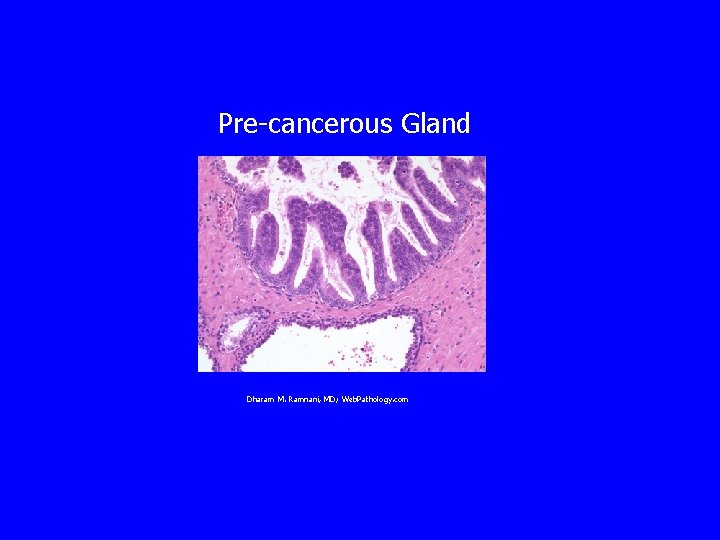
Pre-cancerous Gland Dharam M. Ramnani, MD; Web. Pathology. com
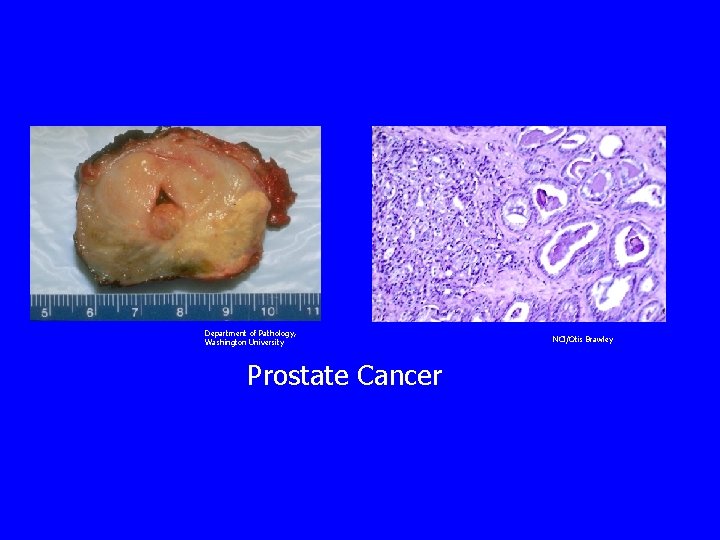
Department of Pathology, Washington University Prostate Cancer NCI/Otis Brawley
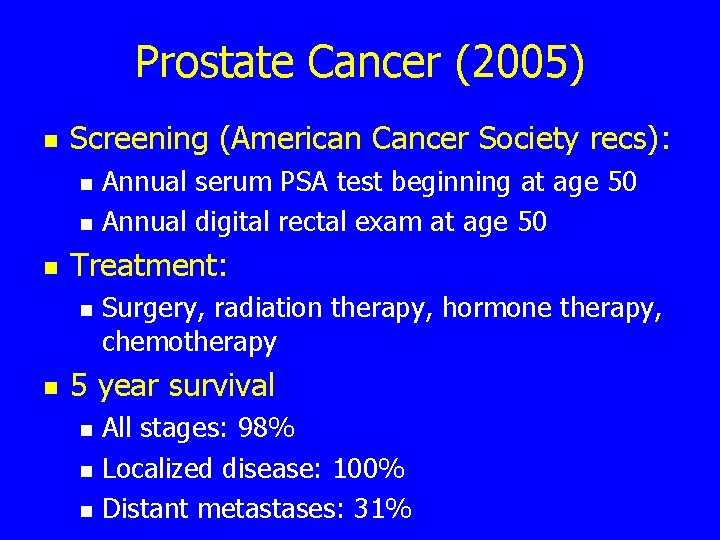
Prostate Cancer (2005) n Screening (American Cancer Society recs): n n n Treatment: n n Annual serum PSA test beginning at age 50 Annual digital rectal exam at age 50 Surgery, radiation therapy, hormone therapy, chemotherapy 5 year survival n n n All stages: 98% Localized disease: 100% Distant metastases: 31%
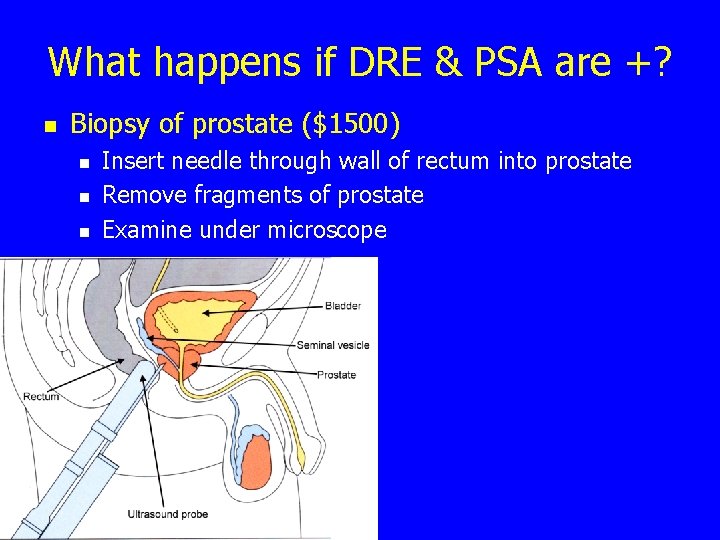
What happens if DRE & PSA are +? n Biopsy of prostate ($1500) n n n Insert needle through wall of rectum into prostate Remove fragments of prostate Examine under microscope
Rx for Localized Prostate Cancer n Radical prostatectomy (remove prostate) n n Usually curative Serious side effects: Incontinence (2 -30%) n Impotence (30 -90%) n Infertility n n Conservative management n Just watch until symptoms develop
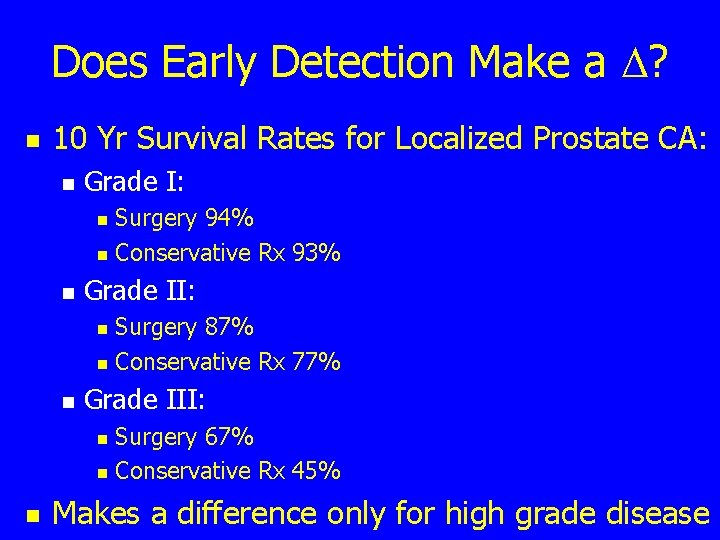
Does Early Detection Make a D? n 10 Yr Survival Rates for Localized Prostate CA: n Grade I: Surgery 94% n Conservative Rx 93% n n Grade II: Surgery 87% n Conservative Rx 77% n n Grade III: Surgery 67% n Conservative Rx 45% n n Makes a difference only for high grade disease
Challenges of Screening n Prostate cancer is a slow-growing cancer n n Not symptomatic for an average of 10 years Most men with prostate cancer die of other causes Treatment has significant side effects 50 year old man: n n n 40% chance of developing microscopic prostate cancer 10% chance of having this cancer diagnosed 3% chance of dying of it
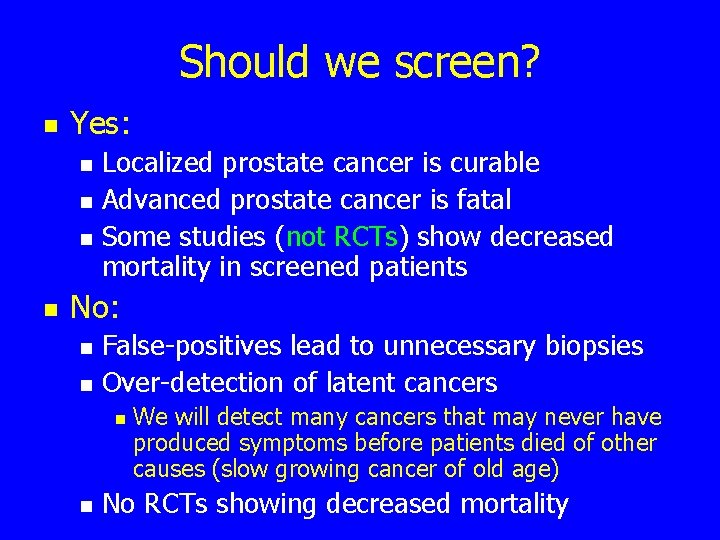
Should we screen? n Yes: n n Localized prostate cancer is curable Advanced prostate cancer is fatal Some studies (not RCTs) show decreased mortality in screened patients No: n n False-positives lead to unnecessary biopsies Over-detection of latent cancers n n We will detect many cancers that may never have produced symptoms before patients died of other causes (slow growing cancer of old age) No RCTs showing decreased mortality
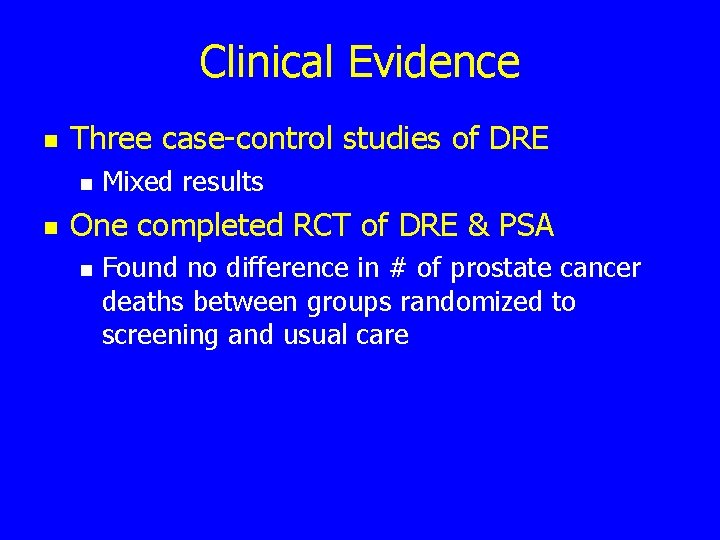
Clinical Evidence n Three case-control studies of DRE n n Mixed results One completed RCT of DRE & PSA n Found no difference in # of prostate cancer deaths between groups randomized to screening and usual care
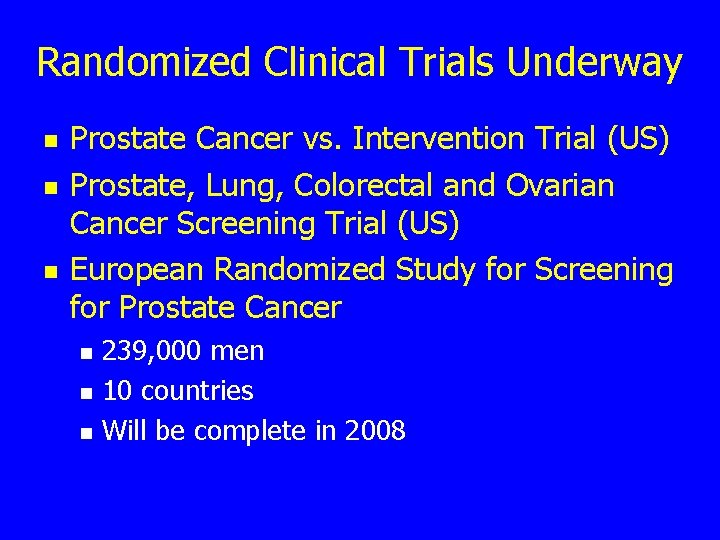
Randomized Clinical Trials Underway n n n Prostate Cancer vs. Intervention Trial (US) Prostate, Lung, Colorectal and Ovarian Cancer Screening Trial (US) European Randomized Study for Screening for Prostate Cancer n n n 239, 000 men 10 countries Will be complete in 2008
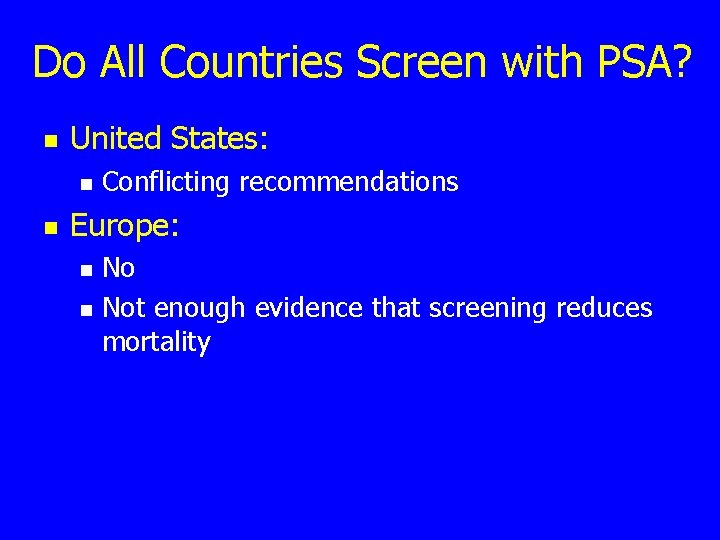
Do All Countries Screen with PSA? n United States: n n Conflicting recommendations Europe: n n No Not enough evidence that screening reduces mortality
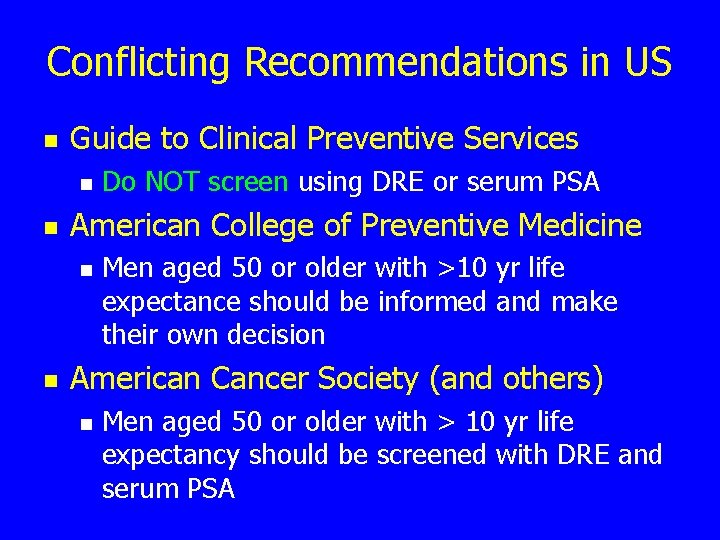
Conflicting Recommendations in US n Guide to Clinical Preventive Services n n American College of Preventive Medicine n n Do NOT screen using DRE or serum PSA Men aged 50 or older with >10 yr life expectance should be informed and make their own decision American Cancer Society (and others) n Men aged 50 or older with > 10 yr life expectancy should be screened with DRE and serum PSA
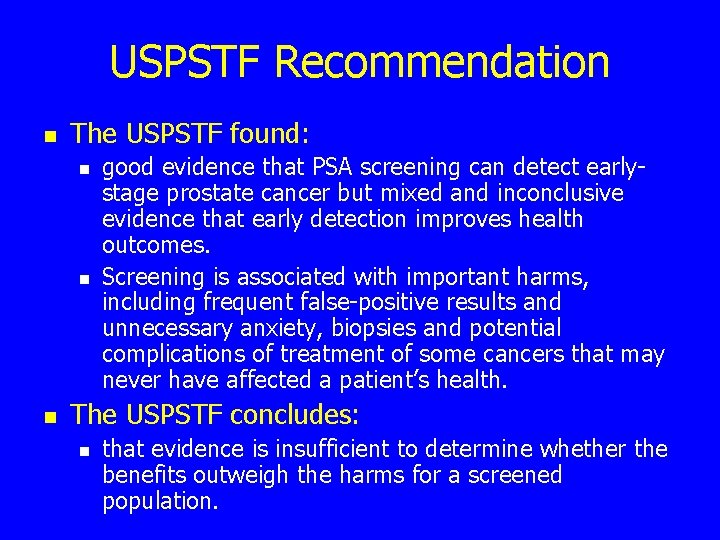
USPSTF Recommendation n The USPSTF found: n n n good evidence that PSA screening can detect earlystage prostate cancer but mixed and inconclusive evidence that early detection improves health outcomes. Screening is associated with important harms, including frequent false-positive results and unnecessary anxiety, biopsies and potential complications of treatment of some cancers that may never have affected a patient’s health. The USPSTF concludes: n that evidence is insufficient to determine whether the benefits outweigh the harms for a screened population.
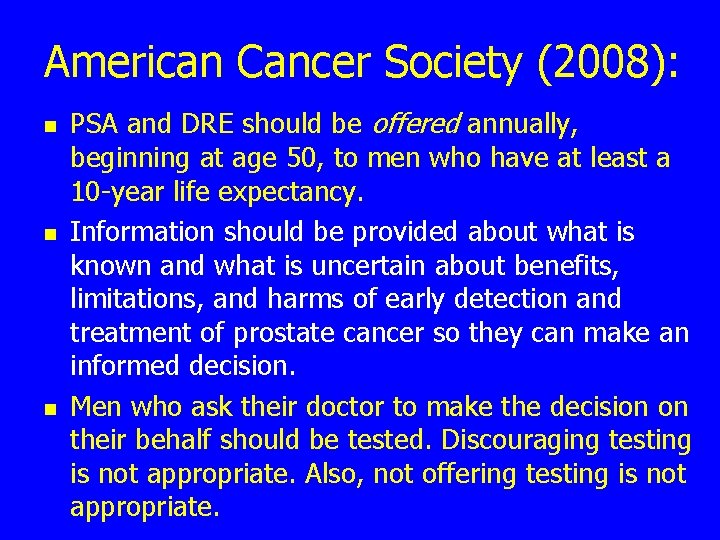
American Cancer Society (2008): n n n PSA and DRE should be offered annually, beginning at age 50, to men who have at least a 10 -year life expectancy. Information should be provided about what is known and what is uncertain about benefits, limitations, and harms of early detection and treatment of prostate cancer so they can make an informed decision. Men who ask their doctor to make the decision on their behalf should be tested. Discouraging testing is not appropriate. Also, not offering testing is not appropriate.

PSA Test Details
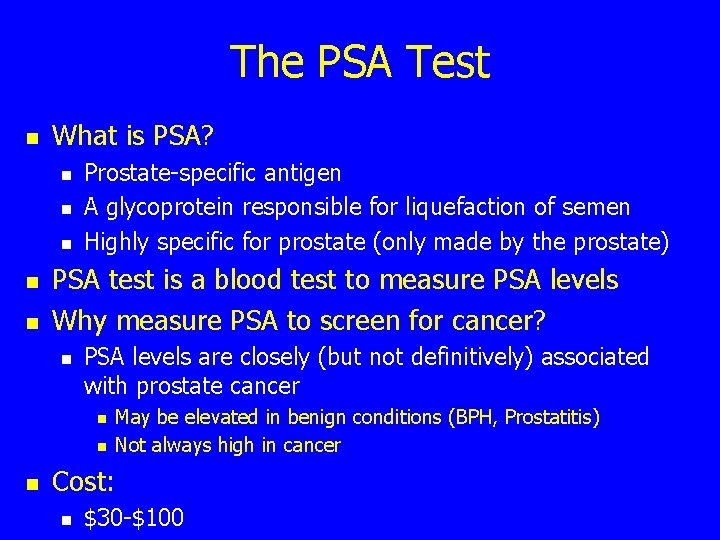
The PSA Test n What is PSA? n n n Prostate-specific antigen A glycoprotein responsible for liquefaction of semen Highly specific for prostate (only made by the prostate) PSA test is a blood test to measure PSA levels Why measure PSA to screen for cancer? n PSA levels are closely (but not definitively) associated with prostate cancer n n n May be elevated in benign conditions (BPH, Prostatitis) Not always high in cancer Cost: n $30 -$100
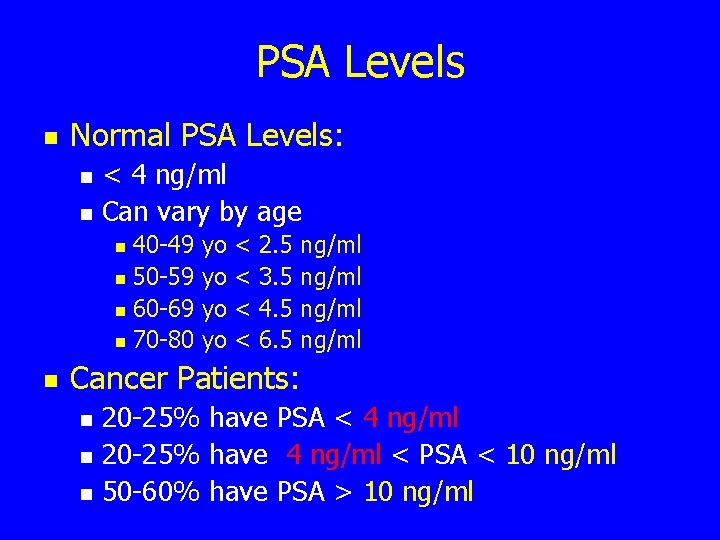
PSA Levels n Normal PSA Levels: n n < 4 ng/ml Can vary by age 40 -49 n 50 -59 n 60 -69 n 70 -80 n n yo yo < < 2. 5 3. 5 4. 5 6. 5 ng/ml Cancer Patients: n n n 20 -25% have PSA < 4 ng/ml 20 -25% have 4 ng/ml < PSA < 10 ng/ml 50 -60% have PSA > 10 ng/ml
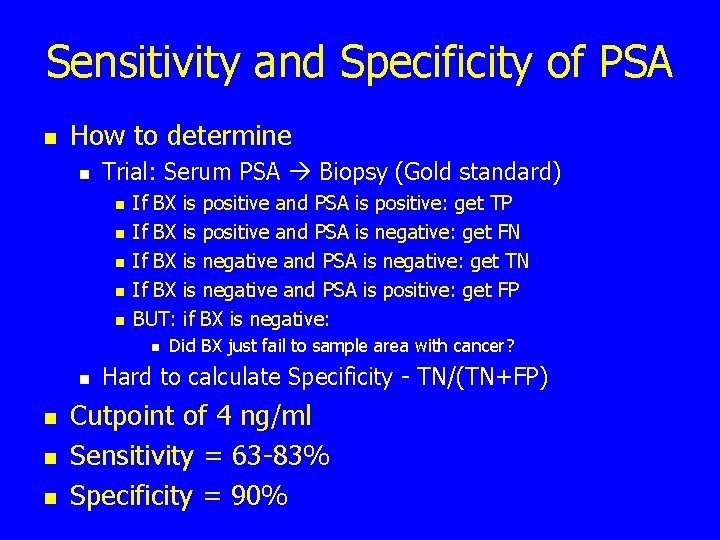
Sensitivity and Specificity of PSA n How to determine n Trial: Serum PSA Biopsy (Gold standard) n n n If BX BUT: n n n is positive and PSA is positive: get TP is positive and PSA is negative: get FN is negative and PSA is negative: get TN is negative and PSA is positive: get FP if BX is negative: Did BX just fail to sample area with cancer? Hard to calculate Specificity - TN/(TN+FP) Cutpoint of 4 ng/ml Sensitivity = 63 -83% Specificity = 90%
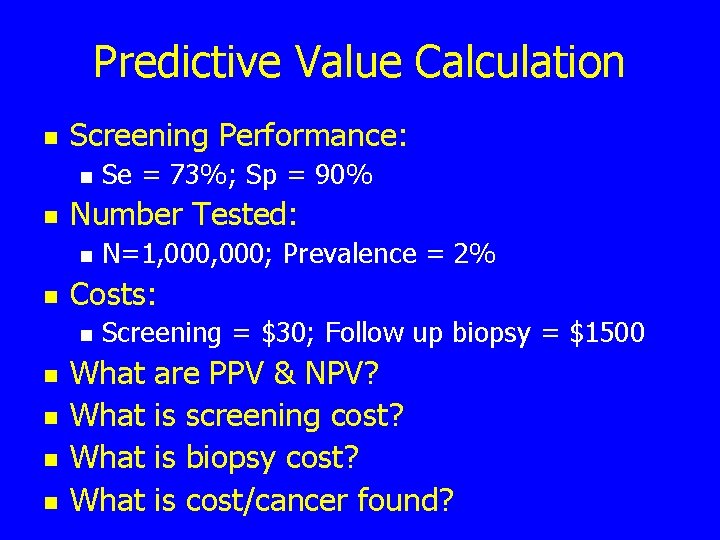
Predictive Value Calculation n Screening Performance: n n Number Tested: n n n N=1, 000; Prevalence = 2% Costs: n n Se = 73%; Sp = 90% Screening = $30; Follow up biopsy = $1500 What are PPV & NPV? is screening cost? is biopsy cost? is cost/cancer found?
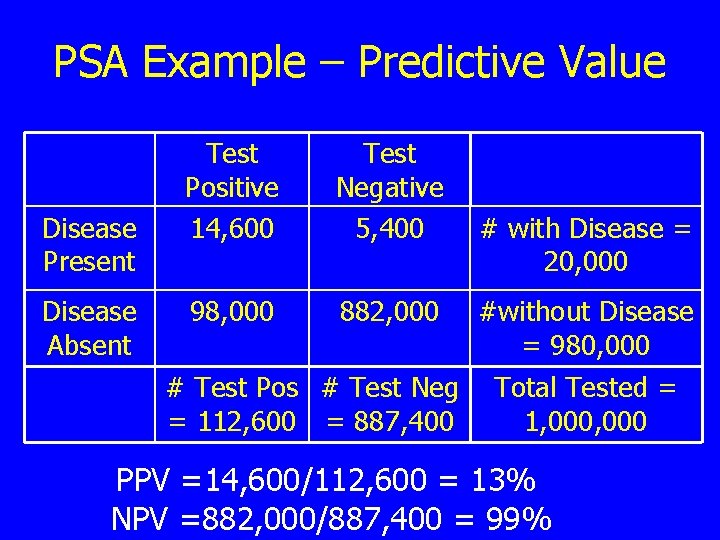
PSA Example – Predictive Value Disease Present Disease Absent Test Positive 14, 600 Test Negative 5, 400 98, 000 882, 000 # Test Pos # Test Neg = 112, 600 = 887, 400 # with Disease = 20, 000 #without Disease = 980, 000 Total Tested = 1, 000 PPV =14, 600/112, 600 = 13% NPV =882, 000/887, 400 = 99%

PSA Example – Cost Disease Present Disease Absent Test Positive 14, 600 Test Negative 5, 400 98, 000 882, 000 # Test Pos # Test Neg = 112, 600 = 887, 400 # with Disease = 20, 000 #without Disease = 980, 000 Total Tested = 1, 000 Cost to Screen =$30*1, 000+$1500*112, 600 =$168, 900, 000 Cost/Cancer = $168, 900, 000/14, 600=$13, 623
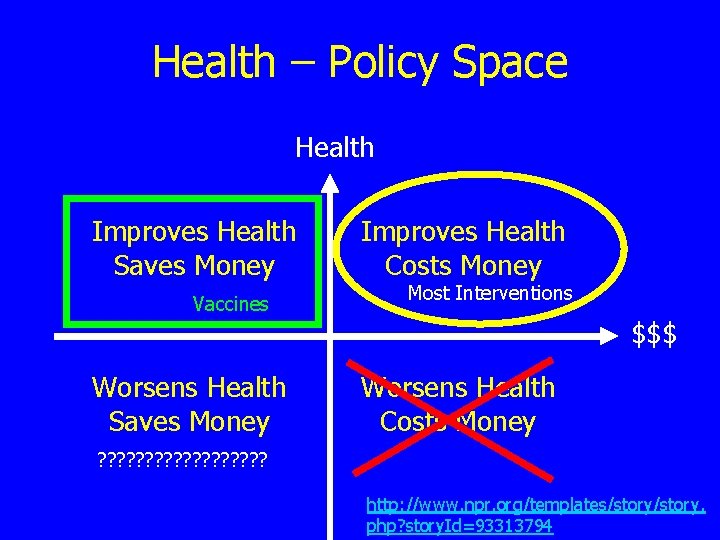
Health – Policy Space Health Improves Health Saves Money Vaccines Worsens Health Saves Money Improves Health Costs Money Most Interventions $$$ Worsens Health Costs Money ? ? ? ? ? http: //www. npr. org/templates/story. php? story. Id=93313794
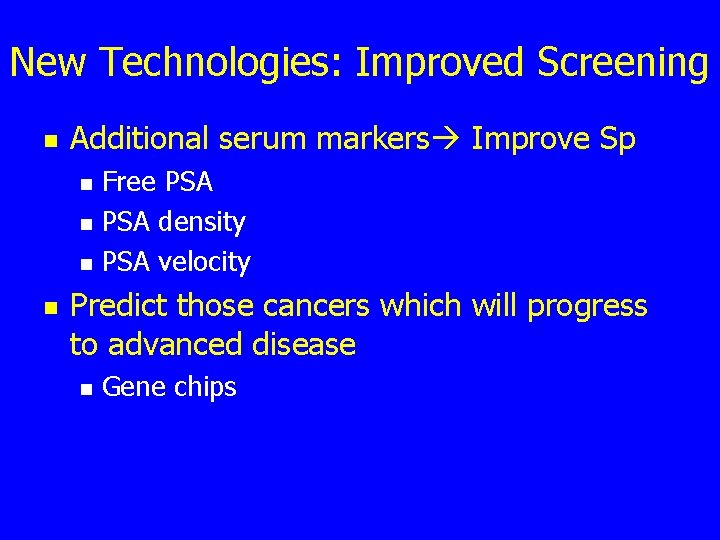
New Technologies: Improved Screening n Additional serum markers Improve Sp n n Free PSA density PSA velocity Predict those cancers which will progress to advanced disease n Gene chips
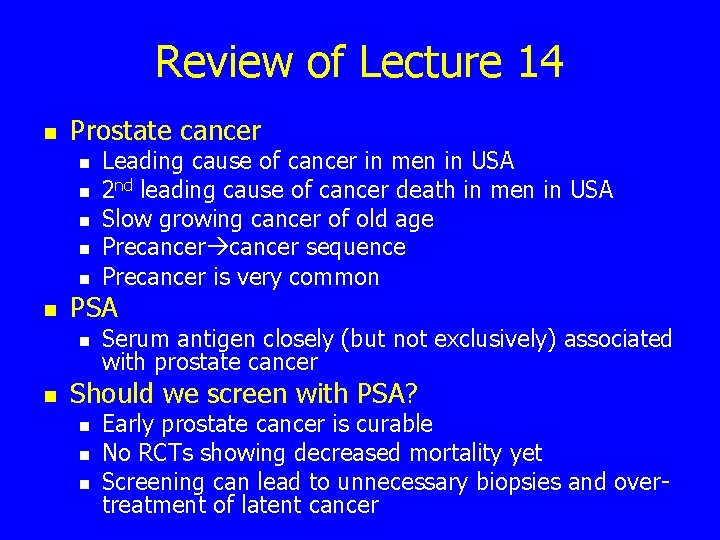
Review of Lecture 14 n Prostate cancer n n n PSA n n Leading cause of cancer in men in USA 2 nd leading cause of cancer death in men in USA Slow growing cancer of old age Precancer sequence Precancer is very common Serum antigen closely (but not exclusively) associated with prostate cancer Should we screen with PSA? n n n Early prostate cancer is curable No RCTs showing decreased mortality yet Screening can lead to unnecessary biopsies and overtreatment of latent cancer
- Slides: 31