
Biomedical Electronics Bioinstrumentation Introduction to Amplifiers Contents Introduction
Biomedical Electronics & Bioinstrumentation Introduction to Amplifiers
Contents Introduction to Biopotential Amplifier Principles of Differential Amplifier Fundamental of Instrumentation Amplifier
Biopotential Amplifiers Biopotential amplifier is a term given to amplifiers used to process biopotential signals. The designation applies to a large number of different types of amplifier. Gain can be low, medium or high (x 10, x 1000, x 10000). Some are ac-coupled, while some are dccoupled.
Biopotential Amplifiers DC-coupling required where input signals are clearly DC or changes very slowly. At frequencies as low as 0. 05 Hz, ac-coupling should be used instead of dc-coupling. This is to overcome the electrode offset potential. Also, the skin-electrode interface generates DC offsets.
Biopotential Amplifiers Low-Gain i. ii. Amplifiers Gain factors x 1 and x 10. The unity-gain amplifier is mainly for isolation, buffering and possibly impedance transformation between signal source and readout device. iii. Used for measurement of action potentials and other relatively high-amplitude bioelectric events.
Biopotential Amplifiers Medium-Gain i. ii. Gain factors x 100 and x 1000. Used for recording of ECG, EMG, etc. High-Gain i. ii. Amplifiers Gain factors over x 1000. Used in very sensitive measurement such as EEG.
Amplifier’s Desired Properties Single-ended High output, often differential input. CMRR. Variable gain adequate for intended functions. Frequency response suitable for applications. Zero suppression.
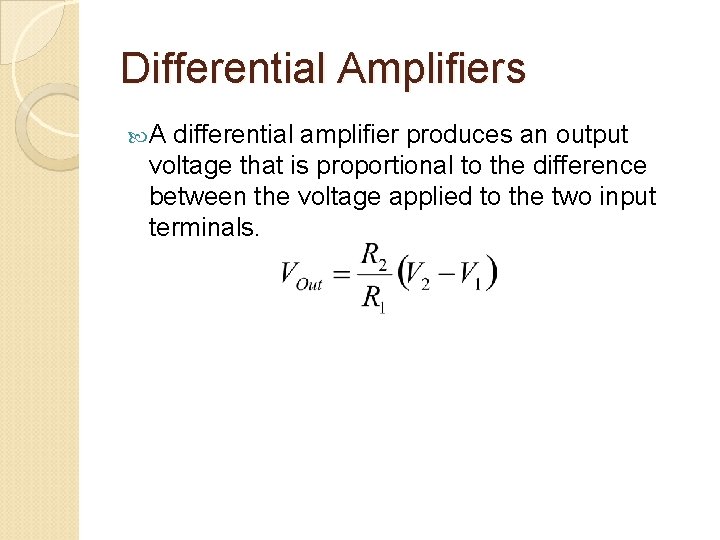
Differential Amplifiers A differential amplifier produces an output voltage that is proportional to the difference between the voltage applied to the two input terminals.
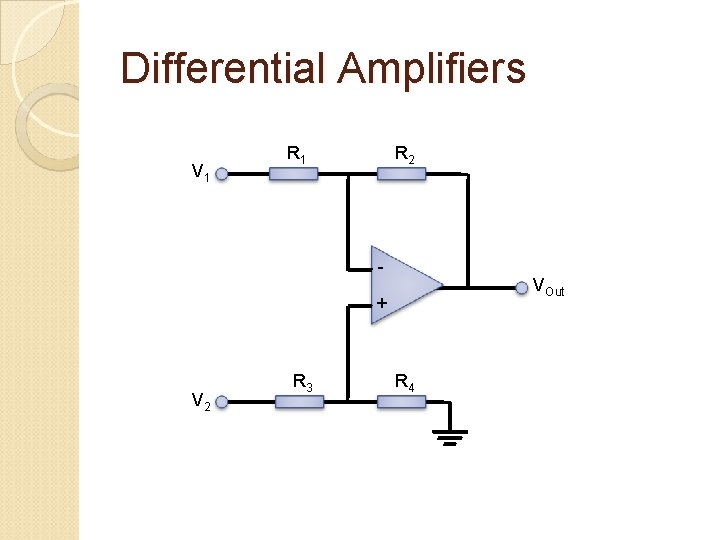
Differential Amplifiers V 1 R 2 - VOut + V 2 R 3 R 4
Differential Amplifiers The voltage gain for the differential signals is the same as for the inverting followers, provided the ratio equality of R 2/R 1 = R 4/R 3 is maintained. Differential amplifiers are useful because it rejects common voltages while amplifying the differential signal of interest. Example: Suppose equal 50 Hz noise is present on each input, and one input is at 5 Vdc while the other is at 2 Vdc. The circuit removes the noise and amplifies the 3 Vdc differential signal.
Instrumentation Amplifiers A solution to both high-gain and high-input impedance problem. Uses 3 operational amplifiers. Two input amplifier is connected in the noninverting follower configuration. 3 rd amplifier is connected as a simple dc amplifier circuit.
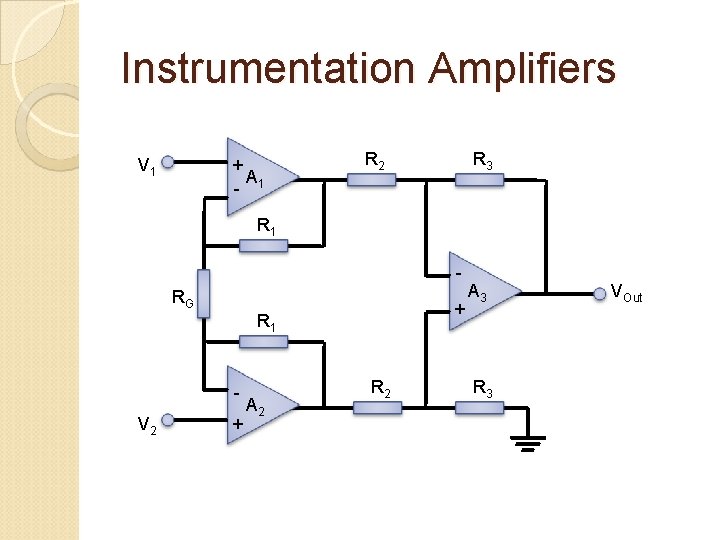
Instrumentation Amplifiers V 1 + A - 1 R 2 R 3 R 1 RG + R 1 V 2 + A 2 R 2 A 3 R 3 VOut
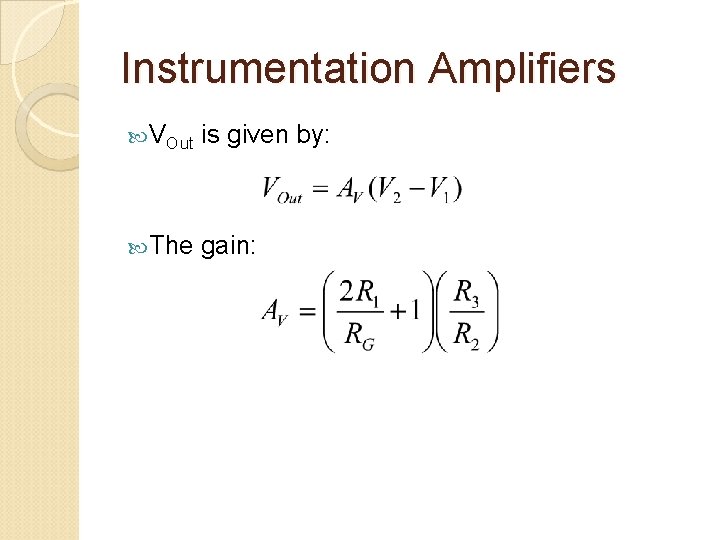
Instrumentation Amplifiers VOut is given by: The gain:
Instrumentation Amplifiers Advantages i. of using instrumentation amplifiers. Ability to obtain high gain with low resistor values. ii. Extremely high input impedance. iii. Superior rejection of common-mode signals.

Further Reading… Carr, J. J. (2000). Introduction to Biomedical Equipment Technology. 4 th Ed. Prentice Hall. ü Chapter 7 2. Floyd, T. L. (2008). Electronic Devices. 8 th Ed. , Prentice Hall. ü Chapter 14 & 15 1.
- Slides: 15