
Biomedical Databases Stefan Schulz Institute for Medical Informatics
Biomedical Databases Stefan Schulz Institute for Medical Informatics, Statistics and Documentation January 2019 Download this presentation from https: //goo. gl/y. CKbt. Y

Educational goals Biomedical Databases • Understand basic concepts of databases – – – Database management systems Database access Database curation Database semantics Controlled vocabularies and databases • Explore important databases for biomedical research – Literature databases: Pubmed / Medline / Web of Science / Google Scholar – Databases to support health care: Up. To. Date – Databases to support clinical research: Clinical. Trials. gov – Databases to support omics research: Uniprot, Gene. Bank, NCBI databases
Biomedical Databases Organization of Lecture • Thursday Database Basics – General & Medical databases • Friday OMICS databases • Interactive • Use you own device • Ask your questions – I‘ll try to answer them • My first lecture on this topic – I‘m learning too • Give me feedback • Language: Austrians ENGLISH Germans Others
What are databases? Biomedical Databases • Represent real world objects and their dependencies in a data model • A DBMS (Database Management System) is the “container” of a database. It provides a syntax for working with the database. Typical DBMSs: Oracle, MS SQL Server, my. SQL, MS Access • Databases can be found in most IT systems that manage data • Databases constitute the core of hospital information systems, bank account management system • Interfaces: – Database client application – Web interface – APIs (application program interfaces)
Biomedical Databases Your experiences with databases?
Typical database operations Biomedical Databases • Insert new data • Change existing data • Delete data • Data search / display – Projection – Selection – Join
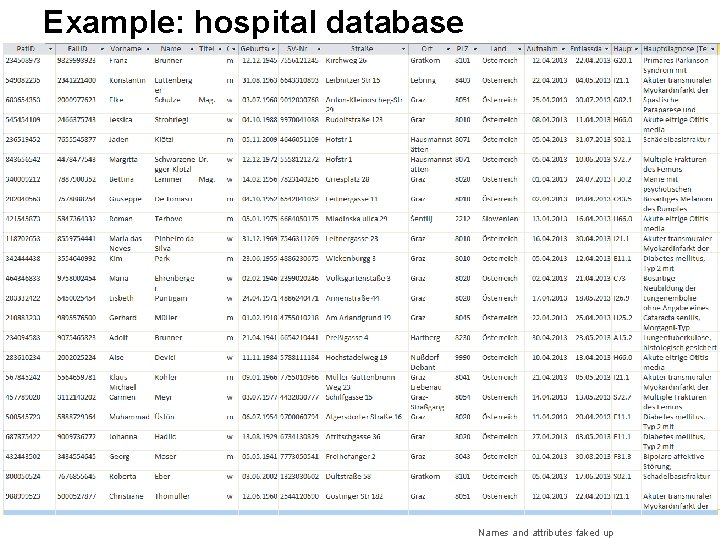
Biomedical Databases Example: hospital database Names and attributes faked up
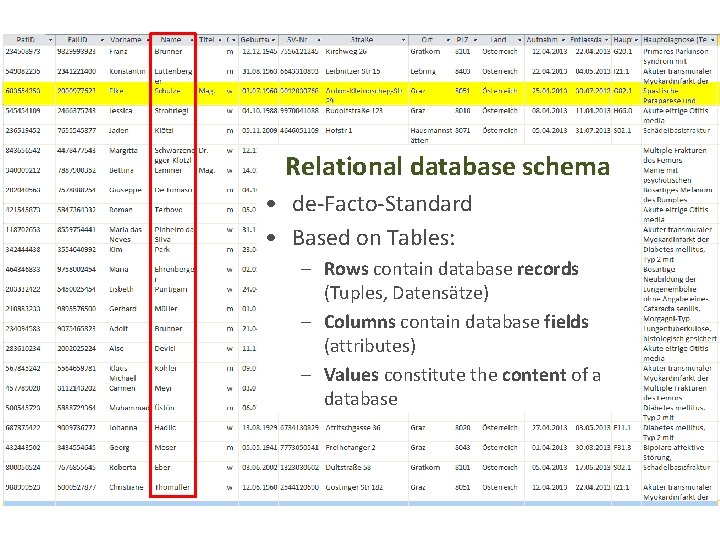
Biomedical Databases Relational database schema • de-Facto-Standard • Based on Tables: – Rows contain database records (Tuples, Datensätze) – Columns contain database fields (attributes) – Values constitute the content of a database
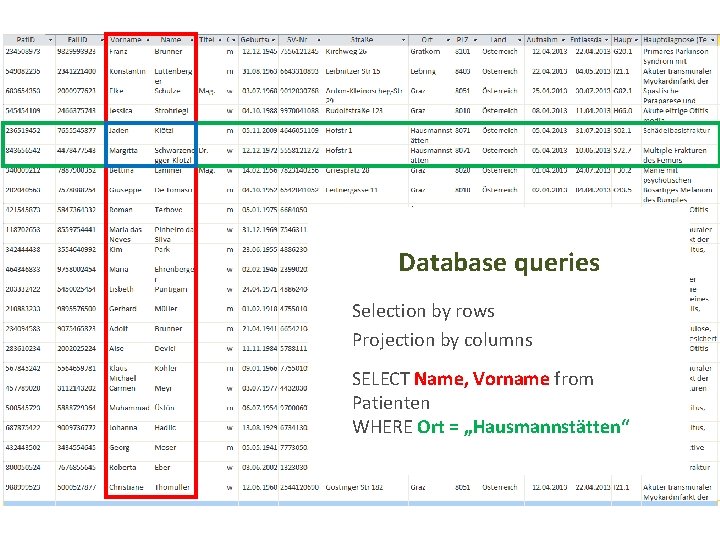
Biomedical Databases Database queries Selection by rows Projection by columns SELECT Name, Vorname from Patienten WHERE Ort = „Hausmannstätten“
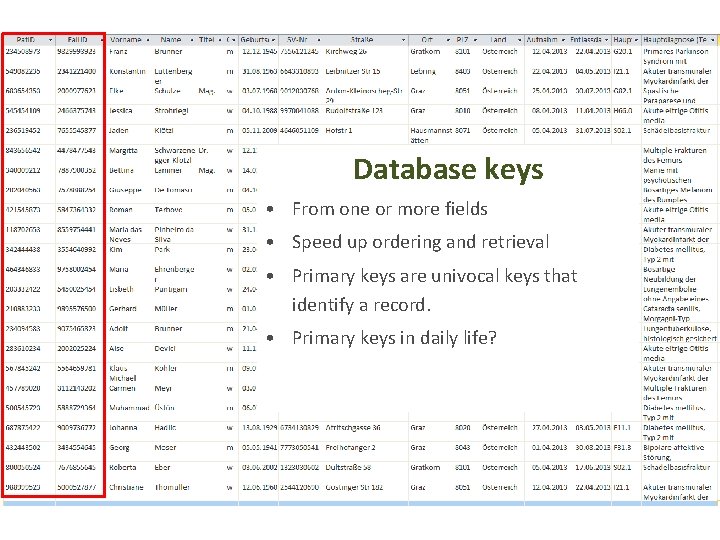
Biomedical Databases Database keys • From one or more fields • Speed up ordering and retrieval • Primary keys are univocal keys that identify a record. • Primary keys in daily life?
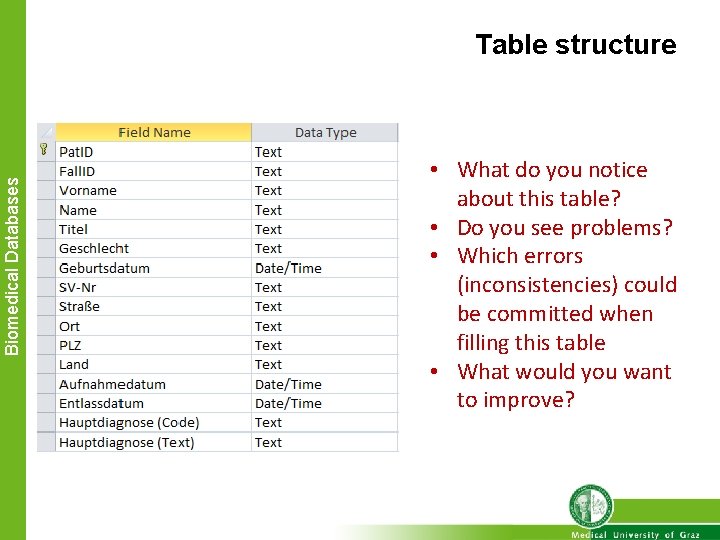
Biomedical Databases Table structure • What do you notice about this table? • Do you see problems? • Which errors (inconsistencies) could be committed when filling this table • What would you want to improve?
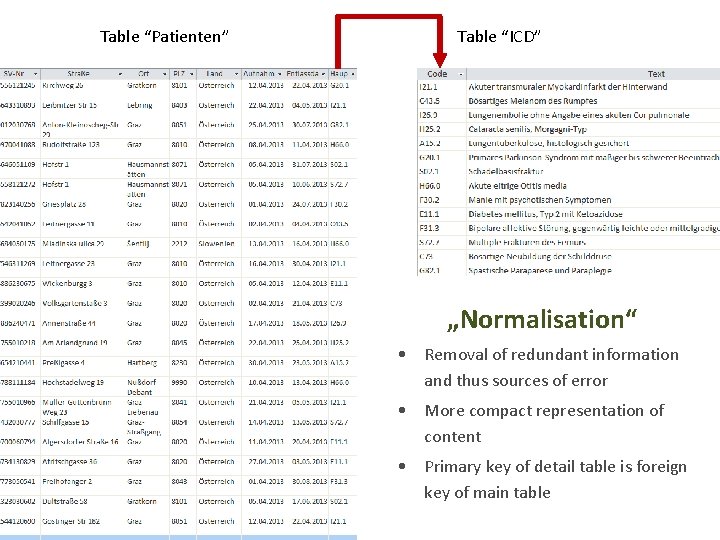
Biomedical Databases Table “Patienten” Table “ICD” „Normalisation“ • Removal of redundant information and thus sources of error • More compact representation of content • Primary key of detail table is foreign key of main table
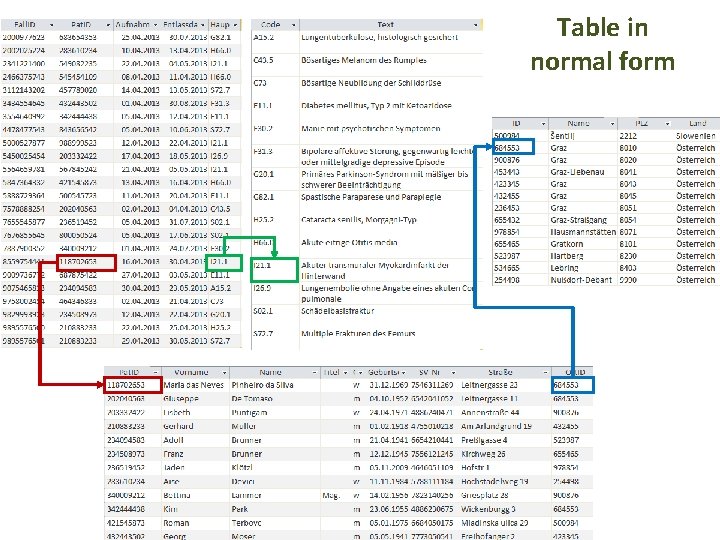
Biomedical Databases Table in normal form
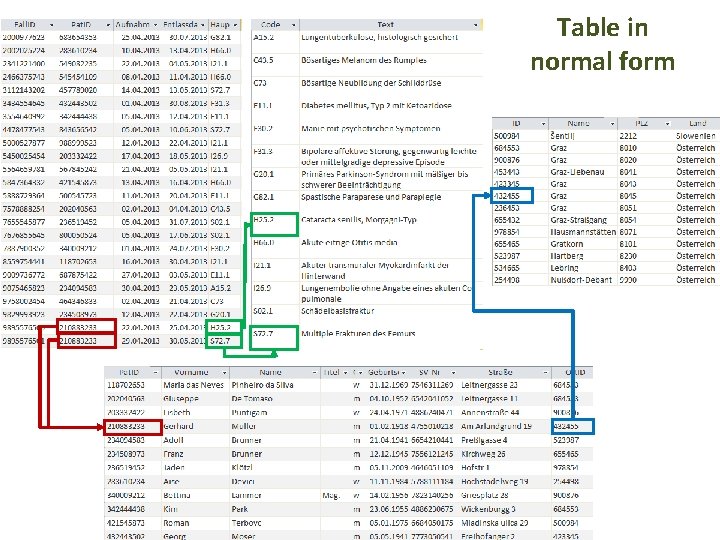
Biomedical Databases Table in normal form
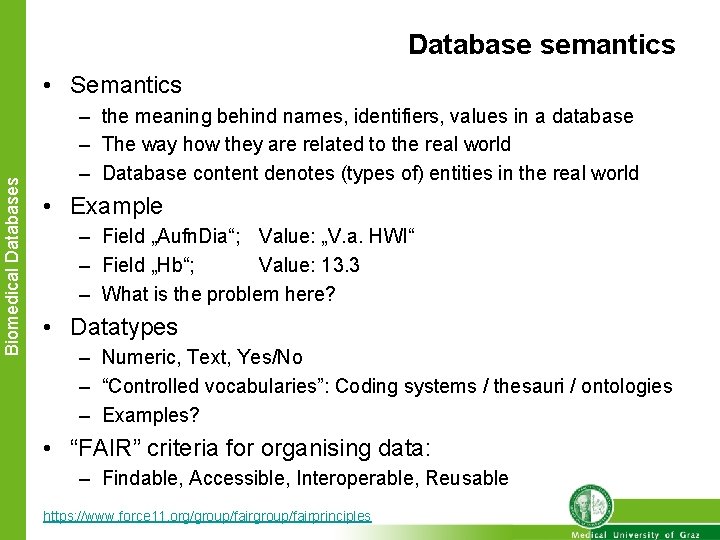
Database semantics Biomedical Databases • Semantics – the meaning behind names, identifiers, values in a database – The way how they are related to the real world – Database content denotes (types of) entities in the real world • Example – Field „Aufn. Dia“; Value: „V. a. HWI“ – Field „Hb“; Value: 13. 3 – What is the problem here? • Datatypes – Numeric, Text, Yes/No – “Controlled vocabularies”: Coding systems / thesauri / ontologies – Examples? • “FAIR” criteria for organising data: – Findable, Accessible, Interoperable, Reusable https: //www. force 11. org/group/fairprinciples
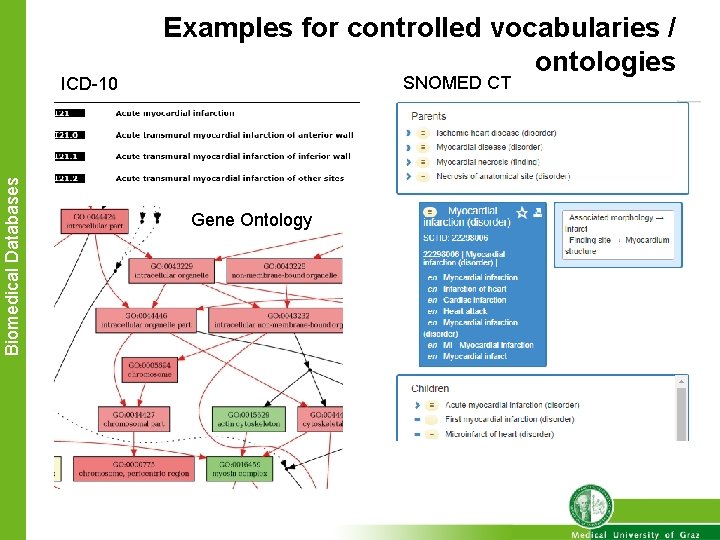
Biomedical Databases ICD-10 Examples for controlled vocabularies / ontologies SNOMED CT Gene Ontology
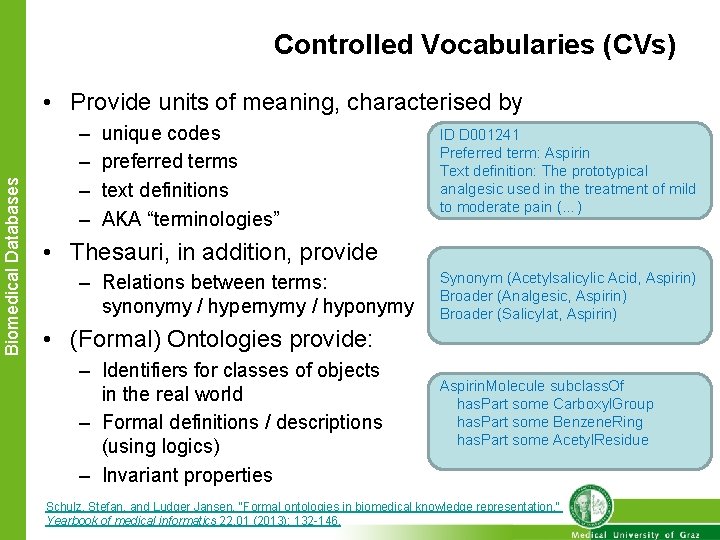
Controlled Vocabularies (CVs) Biomedical Databases • Provide units of meaning, characterised by – – unique codes preferred terms text definitions AKA “terminologies” ID D 001241 Preferred term: Aspirin Text definition: The prototypical analgesic used in the treatment of mild to moderate pain (…) • Thesauri, in addition, provide – Relations between terms: synonymy / hypernymy / hyponymy Synonym (Acetylsalicylic Acid, Aspirin) Broader (Analgesic, Aspirin) Broader (Salicylat, Aspirin) • (Formal) Ontologies provide: – Identifiers for classes of objects in the real world – Formal definitions / descriptions (using logics) – Invariant properties Aspirin. Molecule subclass. Of has. Part some Carboxyl. Group has. Part some Benzene. Ring has. Part some Acetyl. Residue Schulz, Stefan, and Ludger Jansen. "Formal ontologies in biomedical knowledge representation. " Yearbook of medical informatics 22. 01 (2013): 132 -146.
Biomedical Databases CVs and Databases • CVs provide standardised semantic identifiers • Ontologies are limited to express context-independent truths about types of entities • Databases express context-dependent assertions • Ontologies ideally constitute the semantic building blocks for databases – Providing meaning to database tables – Providing meaning to database fields – Providing meaning • The more databases are grounded in ontologies the more they fulfil the FAIR principles Wilkinson, Mark D. , et al. "The FAIR Guiding Principles for scientific data management and stewardship. " Scientific data 3 (2016).
Biomedical Databases Database annotations • The addition of IDs from CVs or ontologies is known as Annotation • Annotations are normally done by domain experts, AKA curators • Tools that do automated processing of natural language can assist curators and accelerate their work • Fully automated annotations (without human review) raise quality issues, but are increasingly reliable once enough training data are available (big data / machine learning, “artificial intelligence”) • Database content that only consists of CV IDs and numbers is known as “structured data” • “Unstructured data” (text, images) nevertheless indispensable in most cases
Biomedical Databases Criteria to describe biomedical databases • • Access (free or subscription-based) Availability of database content (downloadable) Kind of interfaces (User, API) Transparency of used algorithms Human annotation effort Connection with other databases Structuredness Use of standards (terminologies, information models)
Biomedical Databases Literature databases
28288747 Biomedical Databases Medline & Pub. Med https: //www. ncbi. nlm. nih. gov/pubmed/
Medline & Pub. Med Biomedical Databases • MEDLINE is the database, Pub. Med the search interface – 2018: approx. 27 million – 90% English-language articles • 6, 000 Publication organs (Journals, Proceedings) • Beyond MEDLINE – IN-PROCESS (not yet tagged publications in "waiting position") – Me. SH (Medical Subject Headings) : Keyword Thesaurus • Indexing by NLM (manual) – Me. SH headings / subheadings – Publication type – Substances, enzymes, organisms
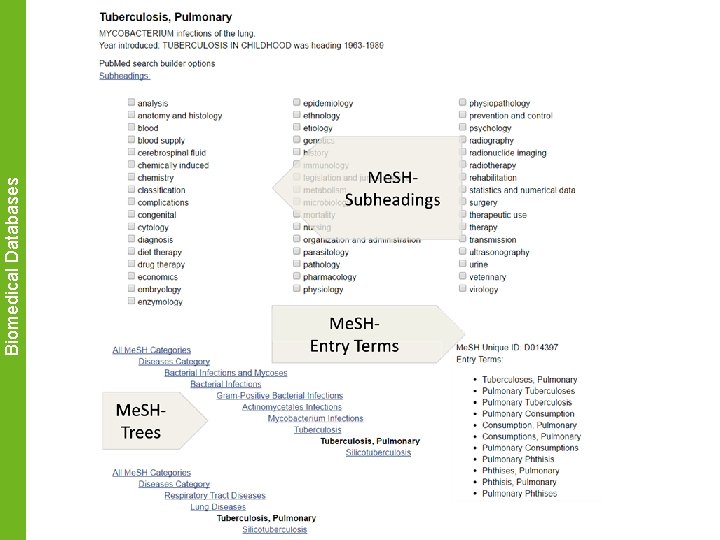
Medical Subject Headings (Me. SH) Biomedical Databases • “Key” to MEDLINE • 20, 000 keywords, hierarchically structured: – Documents annotated with more specific keywords will also be found using more general keywords. • Every Me. SH term – Has a preferred term ("tuberculosis, pulmonary") – Has synonyms and hyponyms ("Entry Terms"): "Pulmonary Consumption". – Is in one or more "trees": "Tuberculosis, Pulmonary" both under "Lung Diseases" and "Bacterial Infections" – Can be further specified by "subheadings", e. g. Tuberculosis, Pulmonary / * drug therapy. https: //www. ncbi. nlm. nih. gov/mesh/
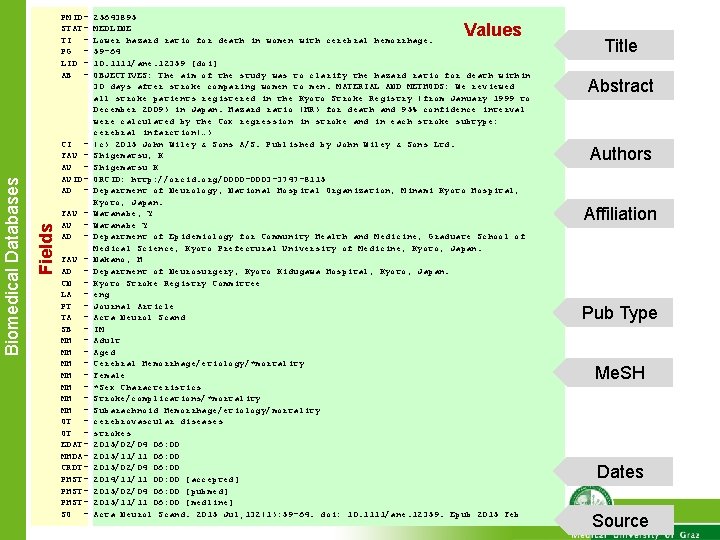
CI FAU AU AUIDAD - Fields Biomedical Databases PMIDSTATTI PG LID AB - FAU AU AD FAU AD CN LA PT TA SB MH MH OT OT EDATMHDACRDTPHSTPHSTSO - 25643895 MEDLINE Lower hazard ratio for death in women with cerebral hemorrhage. 59 -64 10. 1111/ane. 12359 [doi] OBJECTIVES: The aim of the study was to clarify the hazard ratio for death within 30 days after stroke comparing women to men. MATERIAL AND METHODS: We reviewed all stroke patients registered in the Kyoto Stroke Registry (from January 1999 to December 2009) in Japan. Hazard ratio (HR) for death and 95% confidence interval were calculated by the Cox regression in stroke and in each stroke subtype: cerebral infarction(…) (c) 2015 John Wiley & Sons A/S. Published by John Wiley & Sons Ltd. Shigematsu, K Shigematsu K ORCID: http: //orcid. org/0000 -0003 -3747 -8115 Department of Neurology, National Hospital Organization, Minami Kyoto Hospital, Kyoto, Japan. Watanabe, Y Watanabe Y Department of Epidemiology for Community Health and Medicine, Graduate School of Medical Science, Kyoto Prefectural University of Medicine, Kyoto, Japan. Nakano, H Department of Neurosurgery, Kyoto Kidugawa Hospital, Kyoto, Japan. Kyoto Stroke Registry Committee eng Journal Article Acta Neurol Scand IM Adult Aged Cerebral Hemorrhage/etiology/*mortality Female *Sex Characteristics Stroke/complications/*mortality Subarachnoid Hemorrhage/etiology/mortality cerebrovascular diseases strokes 2015/02/04 06: 00 2015/11/11 06: 00 2015/02/04 06: 00 2014/11/11 00: 00 [accepted] 2015/02/04 06: 00 [pubmed] 2015/11/11 06: 00 [medline] Acta Neurol Scand. 2015 Jul; 132(1): 59 -64. doi: 10. 1111/ane. 12359. Epub 2015 Feb Values Title Abstract Authors Affiliation Pub Type Me. SH Dates Source
Biomedical Databases
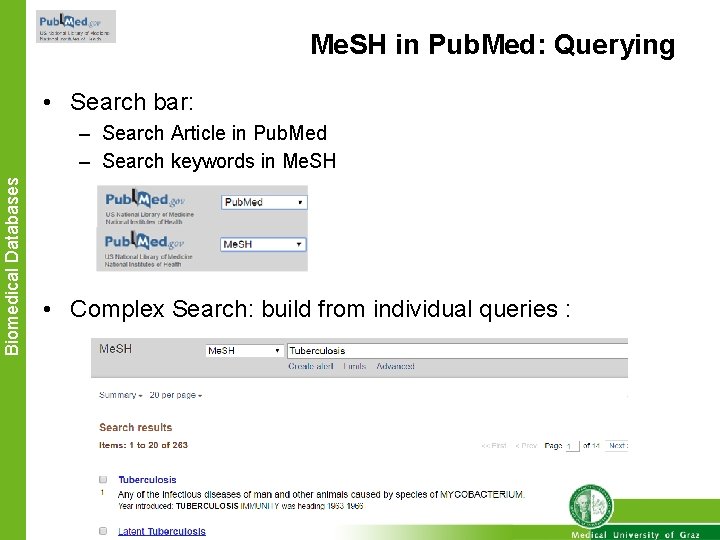
Me. SH in Pub. Med: Querying • Search bar: Biomedical Databases – Search Article in Pub. Med – Search keywords in Me. SH • Complex Search: build from individual queries :
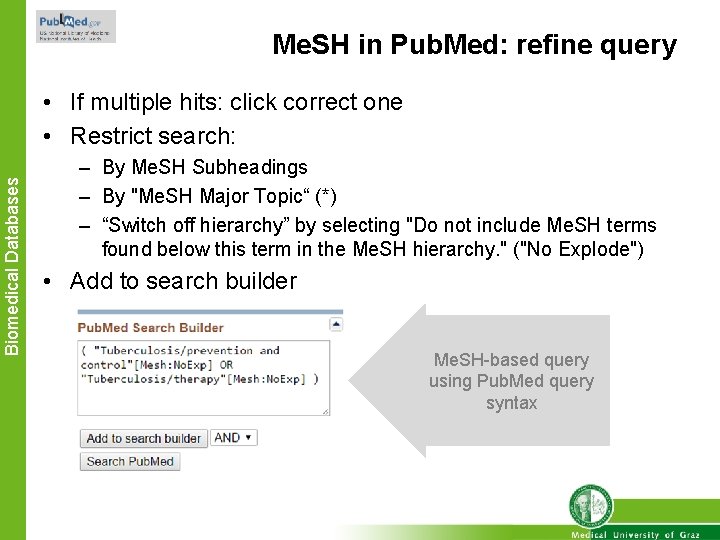
Me. SH in Pub. Med: refine query Biomedical Databases • If multiple hits: click correct one • Restrict search: – By Me. SH Subheadings – By "Me. SH Major Topic“ (*) – “Switch off hierarchy” by selecting "Do not include Me. SH terms found below this term in the Me. SH hierarchy. " ("No Explode") • Add to search builder Me. SH-based query using Pub. Med query syntax
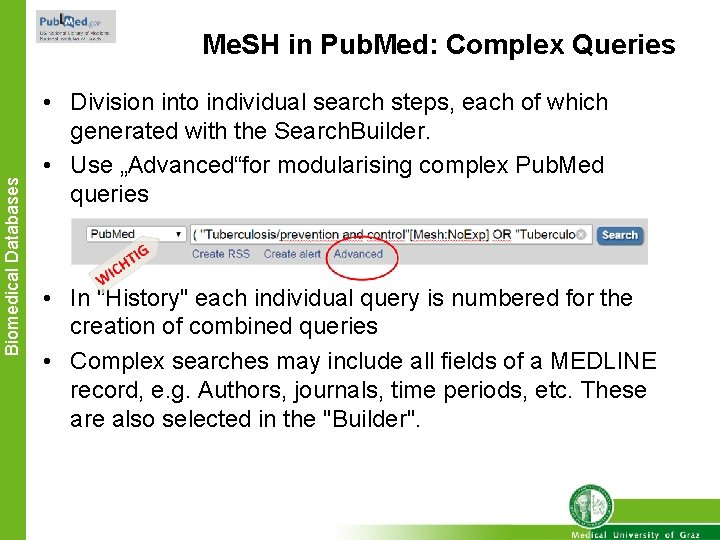
Biomedical Databases Me. SH in Pub. Med: Complex Queries • Division into individual search steps, each of which generated with the Search. Builder. • Use „Advanced“for modularising complex Pub. Med queries • In "History" each individual query is numbered for the creation of combined queries • Complex searches may include all fields of a MEDLINE record, e. g. Authors, journals, time periods, etc. These are also selected in the "Builder".
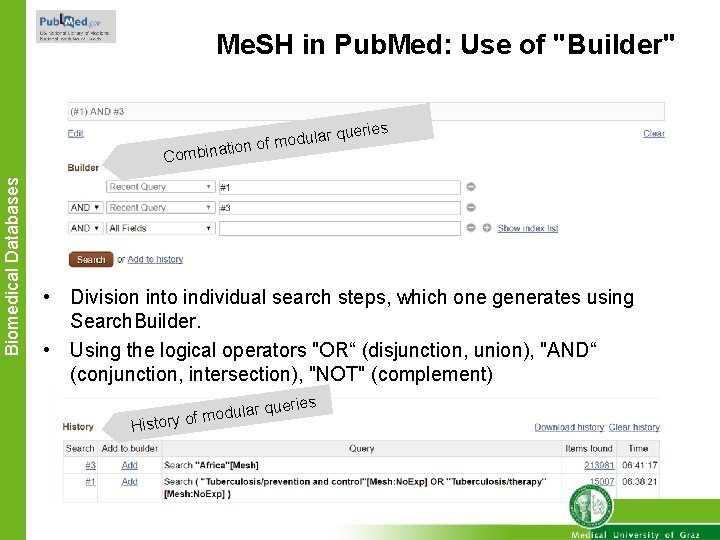
Me. SH in Pub. Med: Use of "Builder" odular ation of m Biomedical Databases Combin queries • Division into individual search steps, which one generates using Search. Builder. • Using the logical operators "OR“ (disjunction, union), "AND“ (conjunction, intersection), "NOT" (complement) r queries la u d o m f History o
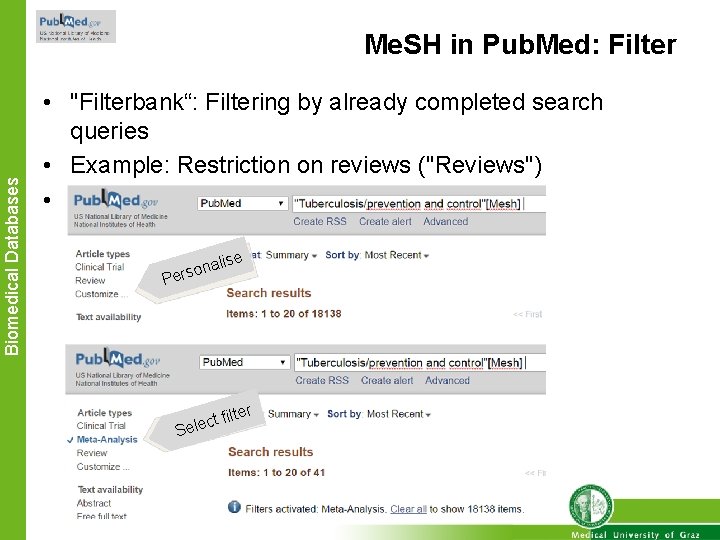
Biomedical Databases Me. SH in Pub. Med: Filter • "Filterbank“: Filtering by already completed search queries • Example: Restriction on reviews ("Reviews") • Personalize via "Customize", then click onal s r e P ise ter ct fil e S
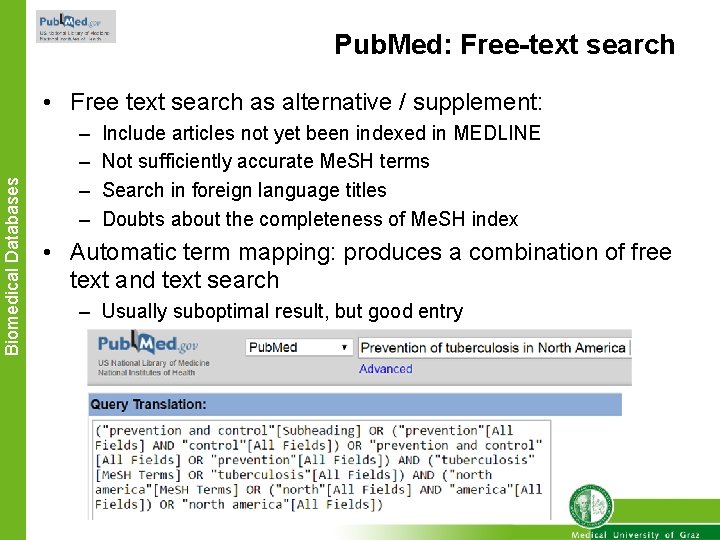
Pub. Med: Free-text search Biomedical Databases • Free text search as alternative / supplement: – – Include articles not yet been indexed in MEDLINE Not sufficiently accurate Me. SH terms Search in foreign language titles Doubts about the completeness of Me. SH index • Automatic term mapping: produces a combination of free text and text search – Usually suboptimal result, but good entry
Biomedical Databases Pub. Med: Free text search principles • Specifiy using "Field tags" Title [ti]; Title + Abstract [tiab]; Text Word [tw] • Synonyms und hypernyms have to be added manually! • Truncation operator (wildcard) "*": – cholangio* retrieves cholangiohepatography, cholangiovenous, … • Phrase search (“…”) – CD 8 T cell memory more but less specific hits compared to "CD 8 T cell memory". • Disadvantage of free text search – Synonyms have to be considered and entered (OR-operator). – Spelling variants must be considered: esophagus (American) and oesophagus (British) – Ambiguous phrases: low precision. – Search only in the title leads: low recall.
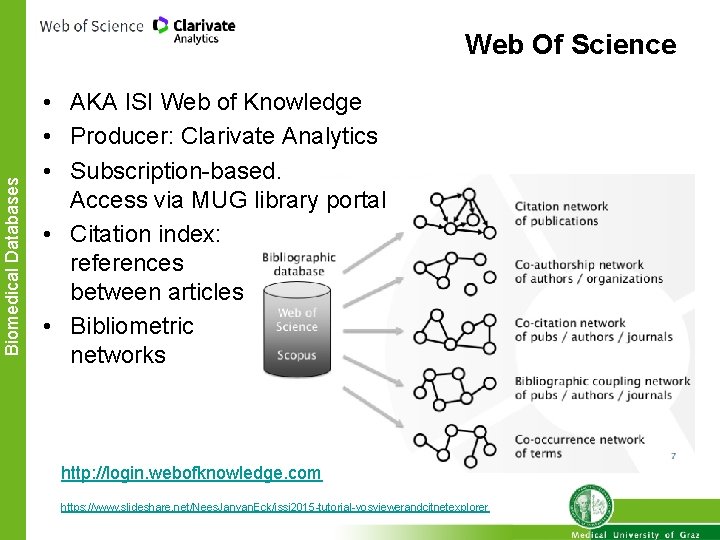
Biomedical Databases Web Of Science • AKA ISI Web of Knowledge • Producer: Clarivate Analytics • Subscription-based. Access via MUG library portal • Citation index: references between articles • Bibliometric networks http: //login. webofknowledge. com https: //www. slideshare. net/Nees. Janvan. Eck/issi 2015 -tutorial-vosviewerandcitnetexplorer
Biomedical Databases Web Of Science • 50, 000 books; 12, 000 journals; 160, 000 Conference proceedings • Citation databases – Core collections (by discipline) & regional – Link publications by citations – Manually curated
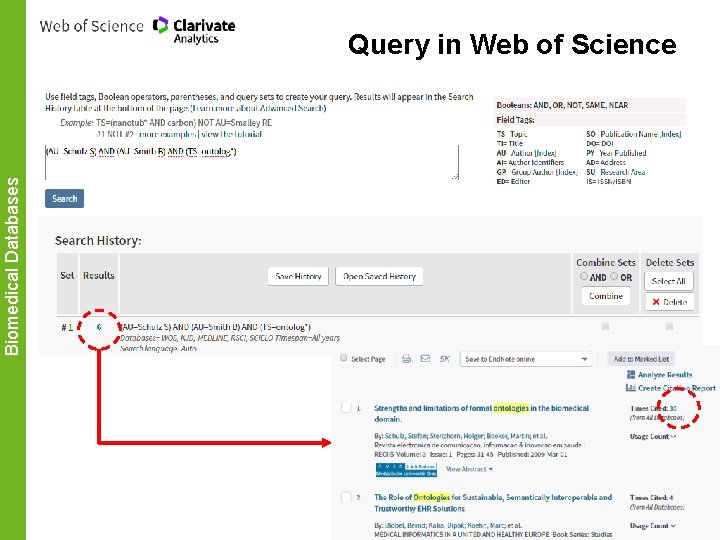
Biomedical Databases Query in Web of Science
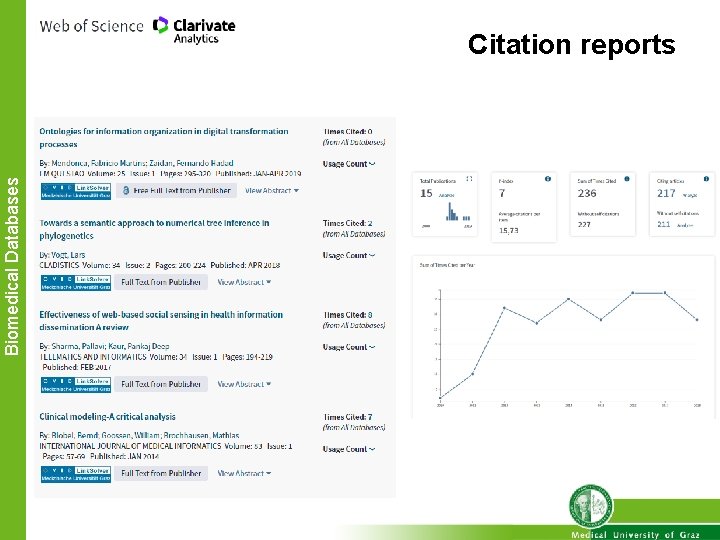
Biomedical Databases Citation reports
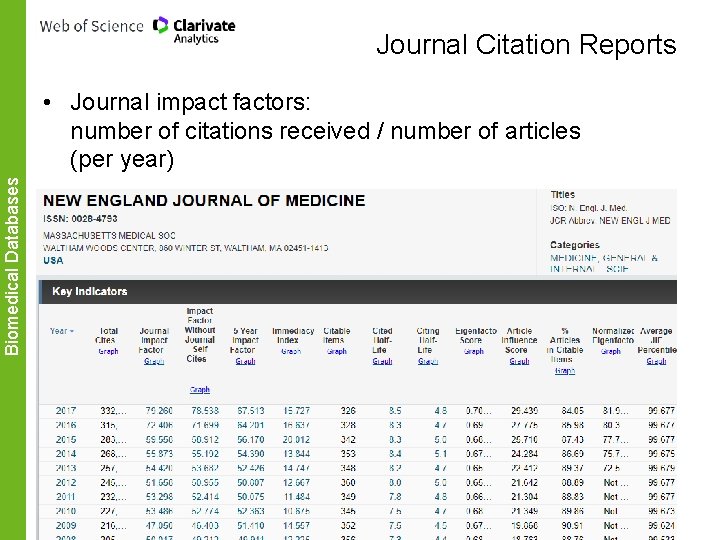
Journal Citation Reports Biomedical Databases • Journal impact factors: number of citations received / number of articles (per year)
Google Scholar Biomedical Databases • Rather Search engine than database – – Look & feel of Web search engines Content not downloadable “Black box” No manual annotation / curation • Coverage: all kinds of scientific publications – That are available online – Of which bibliographic records are available online – Estimation: 400 Million documents https: //scholar. google. at/
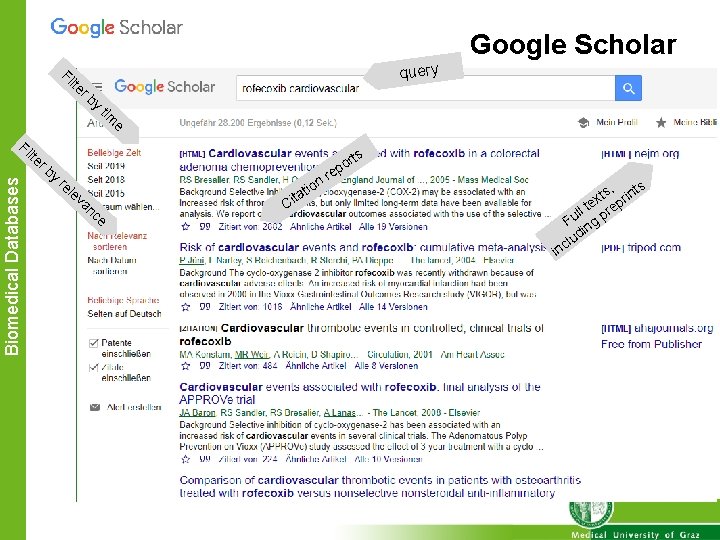
Google Scholar Fi query lte rb y tim e Fi Biomedical Databases lte rb y rts re l ev an on ce C ti ita o rep s ts, rint x p e ll t pre u F ng di u l inc
Google Scholar pros and cons Biomedical Databases • Pro – – Highest coverage Ordering by relevance (complex calculations) „Cited by“ competes with subscription-based databases (WOS) Access to free texts (40 – 60%) • Con – – Not transparent No fields Detection errors Sorting by relevance penalises new articles („Matthew effect“)
Biomedical Databases Medical databases • Up. To. Date as one example for database support at the doctor’s workplace • Clinical. Trials. gov as one example for clinical trials • Just to mention: also clinical or epidemiological registries are databases
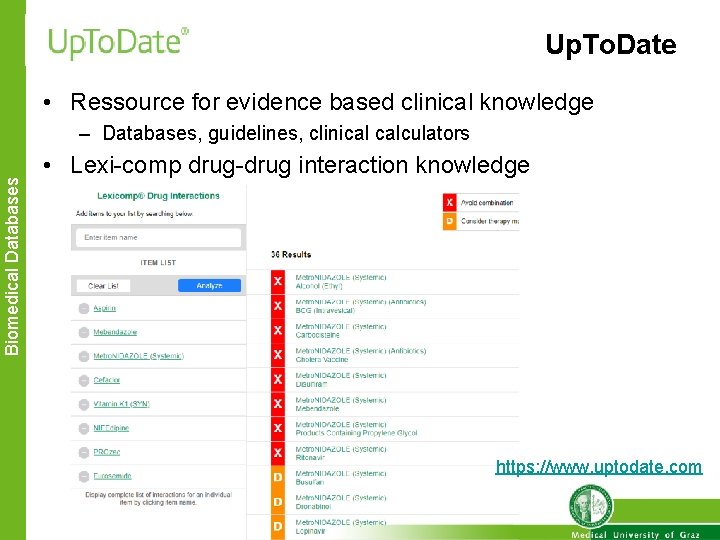
Up. To. Date • Ressource for evidence based clinical knowledge Biomedical Databases – Databases, guidelines, clinical calculators • Lexi-comp drug-drug interaction knowledge https: //www. uptodate. com
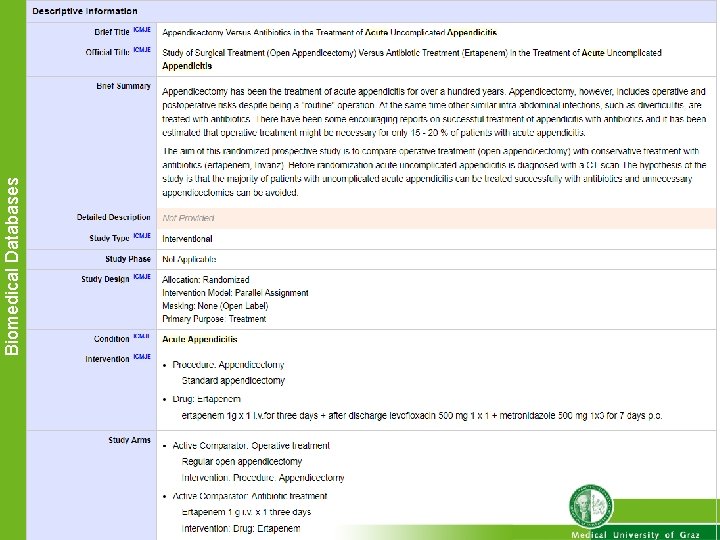
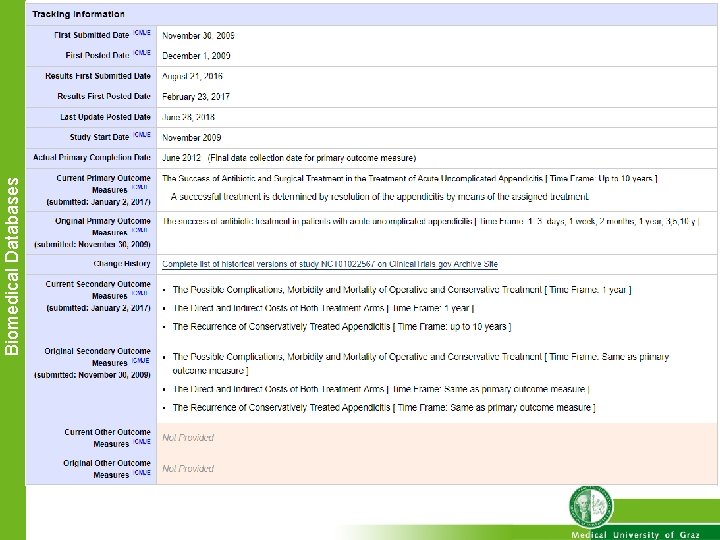
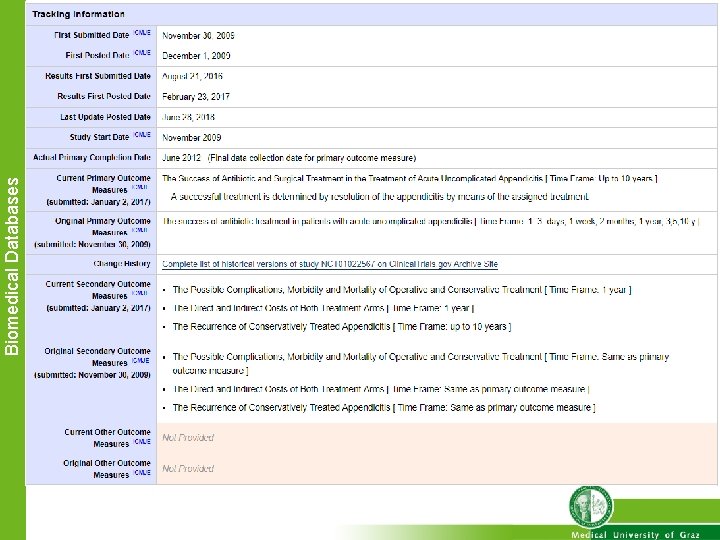
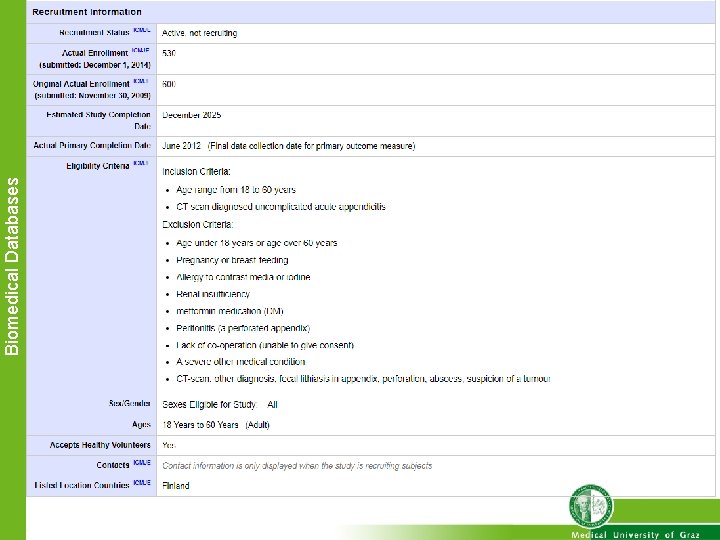
Biomedical Databases Clinical. Trials. gov • • Database of clinical studies Maintained by the U. S. National Library of Medicine Nearly 300, 000 records in 2019 Important fields: – – – – – Dates, locations Primary outcome (e. g. success of treatment) Secondary outcome (e. g. costs, complication, morbidity) Text description Study type and design (e. g. RCT) Population, inclusion, exclusion criteria Intervention (drug, surgery, …) Publication Recruitment information Sponsor https: //clinicaltrials. gov/
Biomedical Databases
Biomedical Databases
Biomedical Databases
Biomedical Databases
Biomedical Databases Exercise on Clinicl. Trials. gov • Search studies on ethanol abuse in Germany • If you are successful, refine your search by adding „arrythmia“ and „München“ • Which are the limitations of the search compared to MEDLINE search?
Biological Databases Biomedical Databases • Increasing amount of partly overlapping Databases • Huge amount of data – Sequences – Annotations (Gene ontology, organisms, …) • • • In-built visualization tools In-built sequence alignment tools Heavy curation effort Heavily interlinked Linked with original sources (PMID) Due to public funding (EU, US) Wheeler, David L. , et al. "Database resources of the national center for biotechnology information. " Nucleic acids research 35. suppl_1 (2006): D 5 -D 12. Toomula, Nishant, et al. "Biological databases-integration of life science data. " J. Comput. Sci. Syst. Biol 4 (2012): 87 -92.
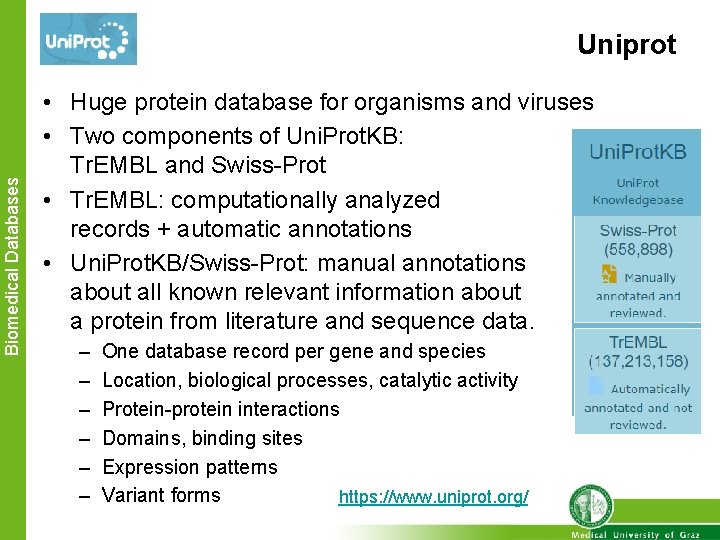
Biomedical Databases Uniprot • Huge protein database for organisms and viruses • Two components of Uni. Prot. KB: Tr. EMBL and Swiss-Prot • Tr. EMBL: computationally analyzed records + automatic annotations • Uni. Prot. KB/Swiss-Prot: manual annotations about all known relevant information about a protein from literature and sequence data. – – – One database record per gene and species Location, biological processes, catalytic activity Protein-protein interactions Domains, binding sites Expression patterns Variant forms https: //www. uniprot. org/
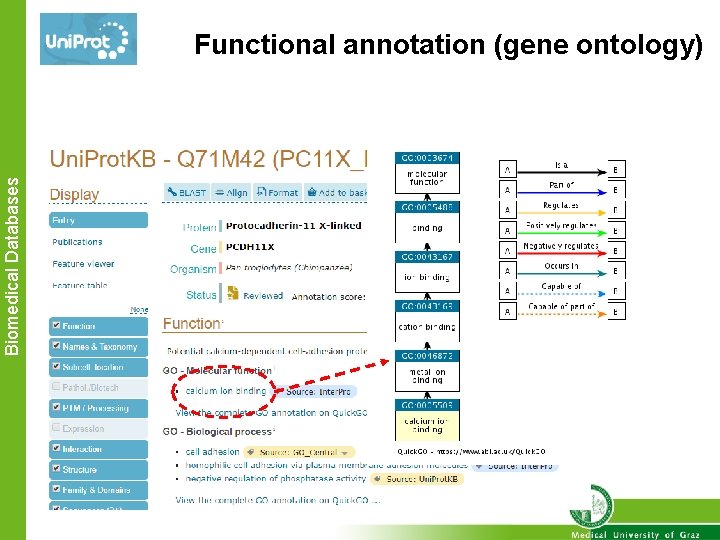
Biomedical Databases Functional annotation (gene ontology)
Biomedical Databases Ensembl • Genome database for selected species (Homo sapiens and key model organisms) • Important features – – Graphical views Gene Tree Orthologues Gene Variants • Annotations – Gene Ontology: Biological Process, Molecular Function, Cellular Component – Phenotypes – Sources (PMIDs) https: //www. ensembl. org
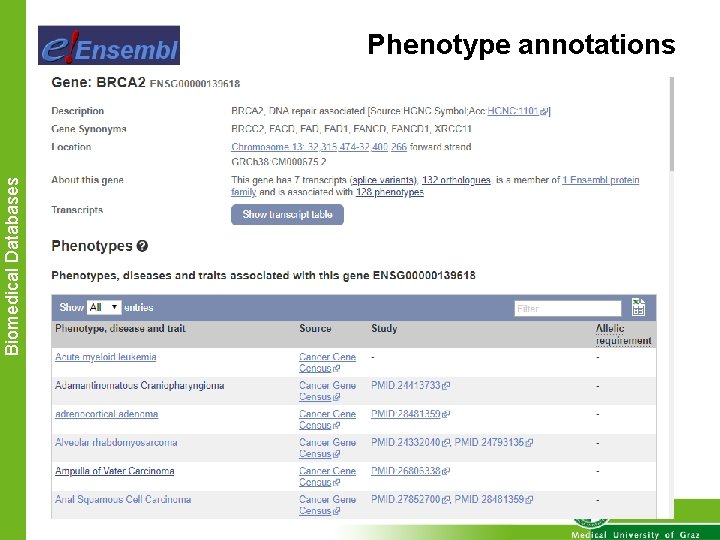
Biomedical Databases Phenotype annotations
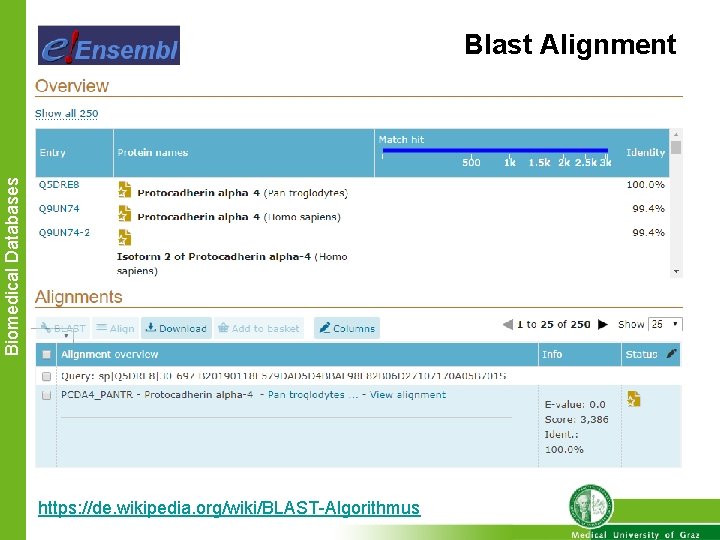
Biomedical Databases Blast Alignment https: //de. wikipedia. org/wiki/BLAST-Algorithmus
NCBI Databases • NCBI databases (“Entrez”) Biomedical Databases – Using platform known from Pubmed – Interlinked • Important domains – – – Protein sequences Gene expression maps Complete genomes Human genetic disorders (OMIM) Chemicals (substance, Compound, Bio. Assay) https: //www. ncbi. nlm. nih. gov/search/
Biomedical Databases Nucleotide / Gene bank • Open-access repository at NCBI (National Center for Biotechnology Information), U. S. • Nucleotide sequences + protein translations • > 100, 000 organisms 286 billion bases, 211 million sequences (Dec 2018) • Submission from individual labs
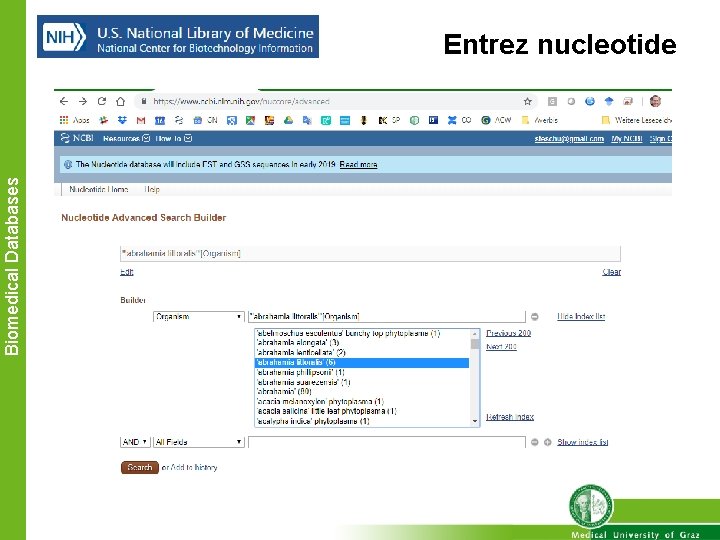
Biomedical Databases Entrez nucleotide
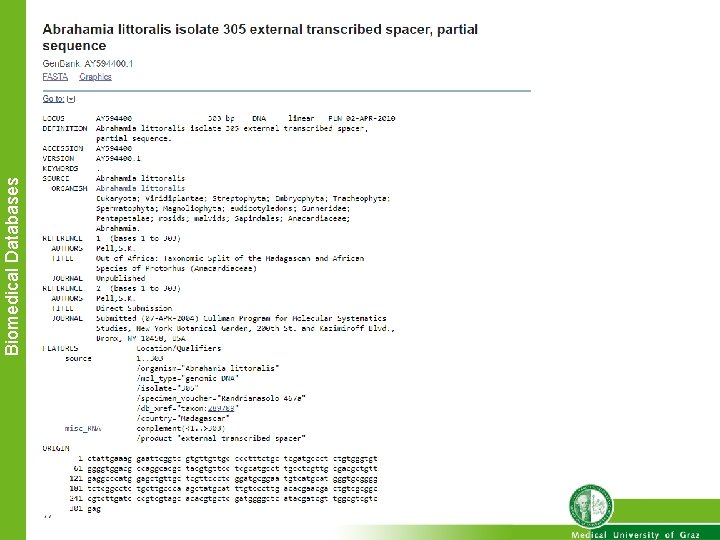
Biomedical Databases
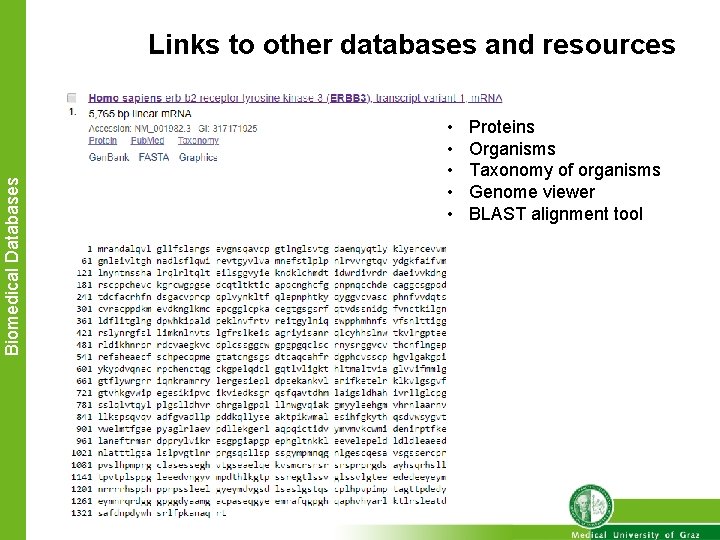
Biomedical Databases Links to other databases and resources • • • Proteins Organisms Taxonomy of organisms Genome viewer BLAST alignment tool
- Slides: 60