
Biomechanics of Jumprope Yoonsun Sunny Jang Professor Rome
Biomechanics of Jump-rope Yoonsun (Sunny) Jang Professor Rome BIOL 438 Spring 2012
What is Jump-rope? • Very efficient cardiovascular workout and muscle toning • Good calorie burner • Excellent footwork, coordination, agility, and balance • Great stamina, endurance, and strength required • Total body workout without leaving home • Low price & Portable

History of Jump-rope • 1600 B. C Egyptians and Aborigines of Australia • The first Jump-rope: bamboo and vines found in jungles • The first evidence: medieval paintings • 1940 s, 1950 s: game of choice for city or town children • 1970 s: increased interest for physical fitness
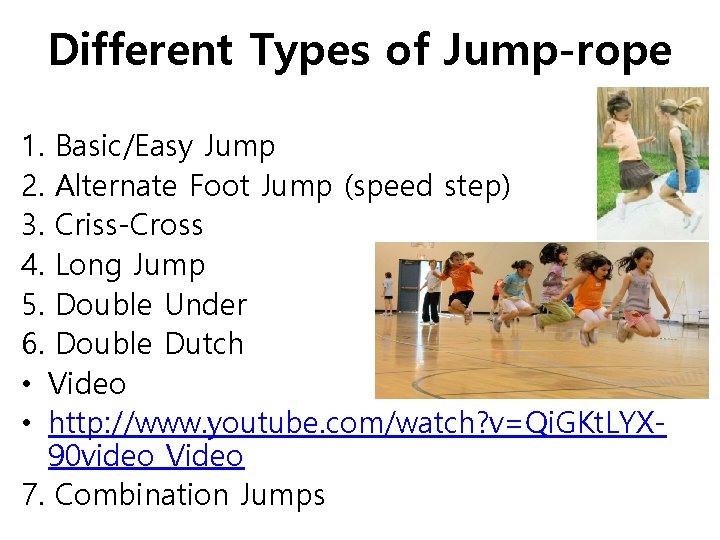
Different Types of Jump-rope 1. Basic/Easy Jump 2. Alternate Foot Jump (speed step) 3. Criss-Cross 4. Long Jump 5. Double Under 6. Double Dutch • Video • http: //www. youtube. com/watch? v=Qi. GKt. LYX 90 video Video 7. Combination Jumps
Research Questions 1. The relationship between Potential Energy, and Kinetic Energy during doing jump-rope 2. Comparison of Normal jump-rope and High jump-rope 3. Clinical use of jump-rope
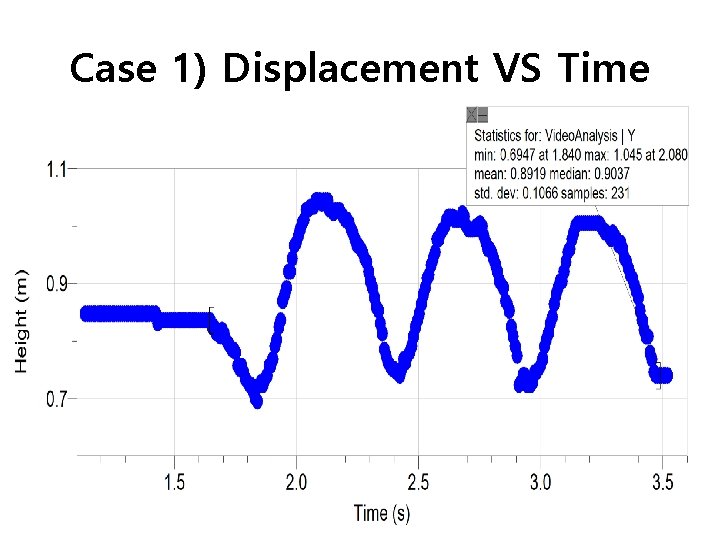
Definitions • Center of Mass: middle of my hips (m: 51 kg) • Upper points: when COM is at the highest • Lower points: when COM is at the lowest • One cycle of jump-rope: one full turn of jumprope
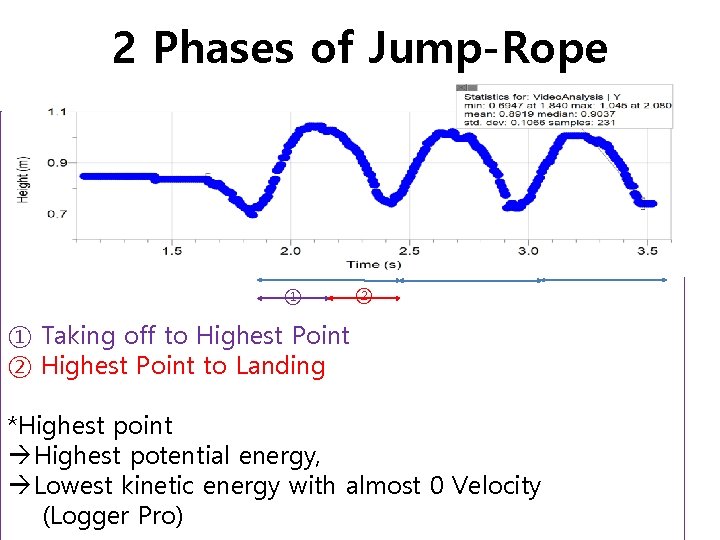
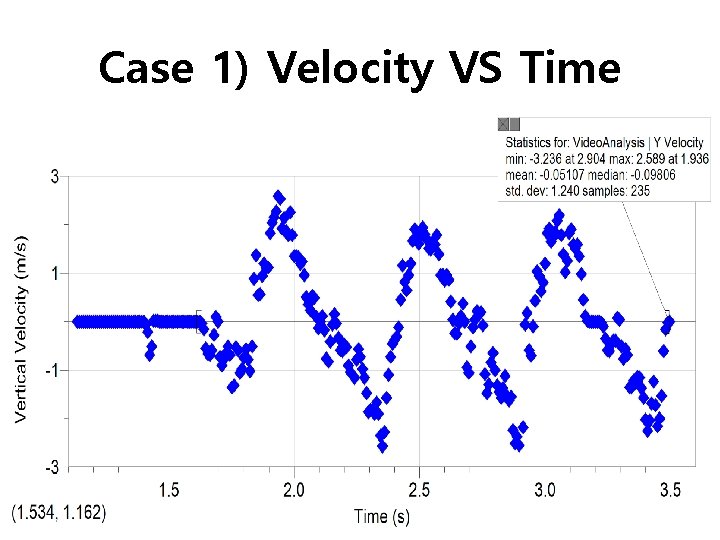
2 Phases of Jump-Rope ① ② ① Taking off to Highest Point ② Highest Point to Landing *Highest point Highest potential energy, Lowest kinetic energy with almost 0 Velocity (Logger Pro)
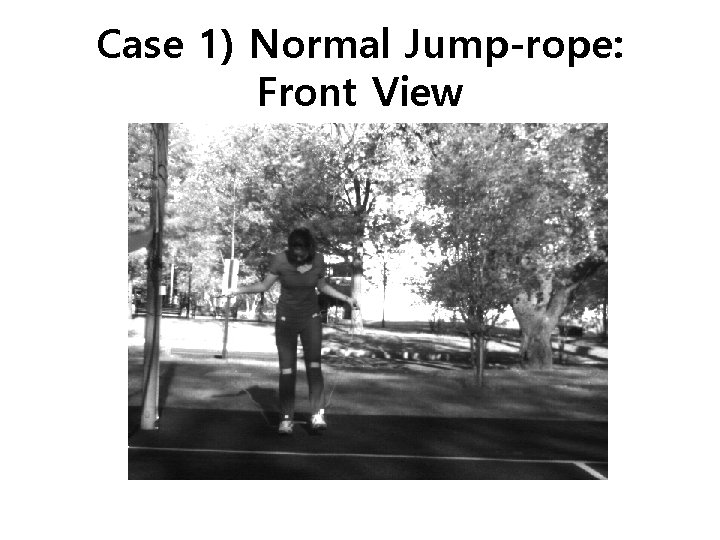
Case 1) Normal Jump-rope: Front View
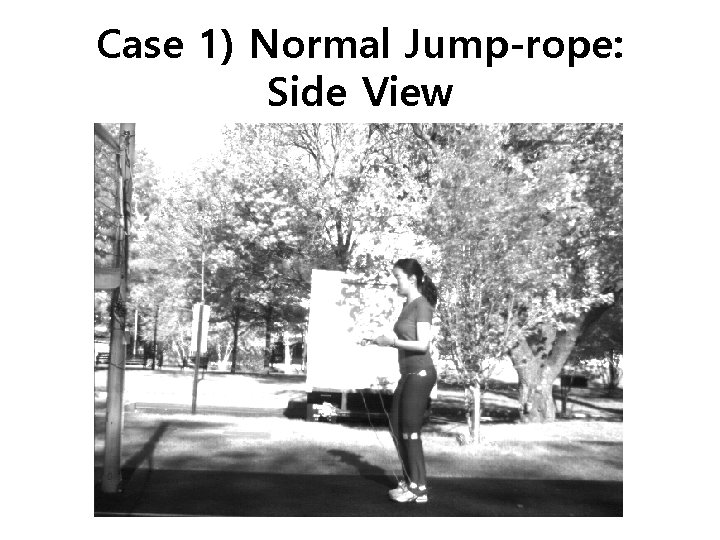
Case 1) Normal Jump-rope: Side View
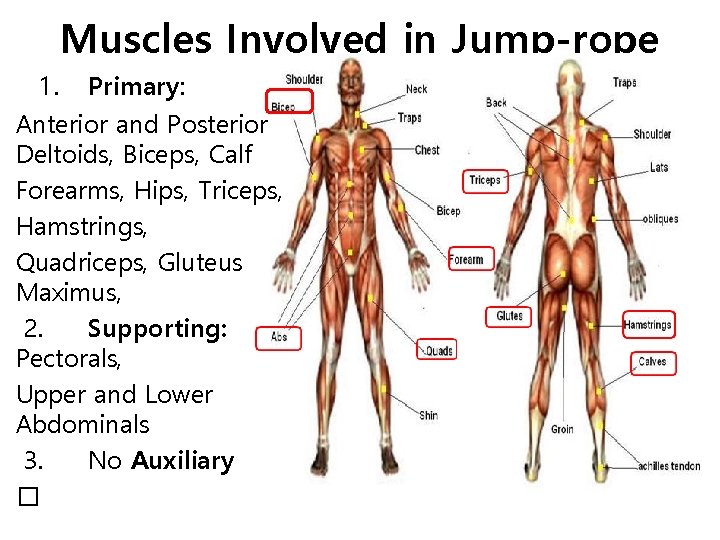
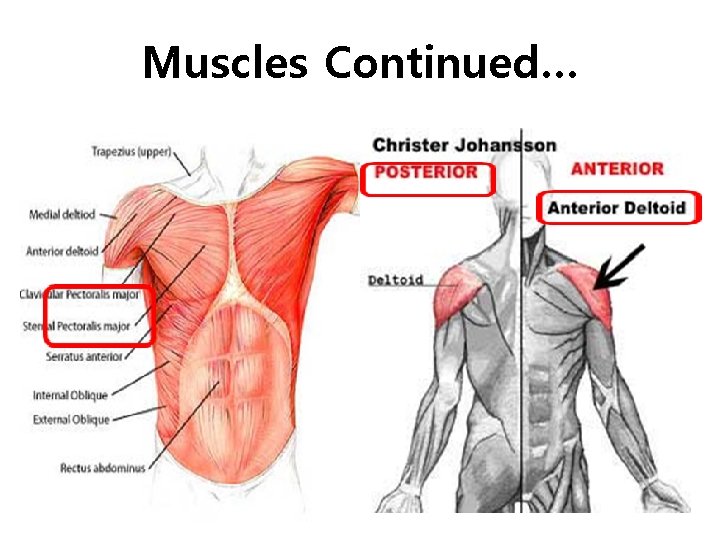
Muscles Involved in Jump-rope 1. Primary: Anterior and Posterior Deltoids, Biceps, Calf Forearms, Hips, Triceps, Hamstrings, Quadriceps, Gluteus Maximus, 2. Supporting: Pectorals, Upper and Lower Abdominals 3. No Auxiliary �
Muscles Continued…
Case 1) Displacement VS Time
Case 1) Velocity VS Time
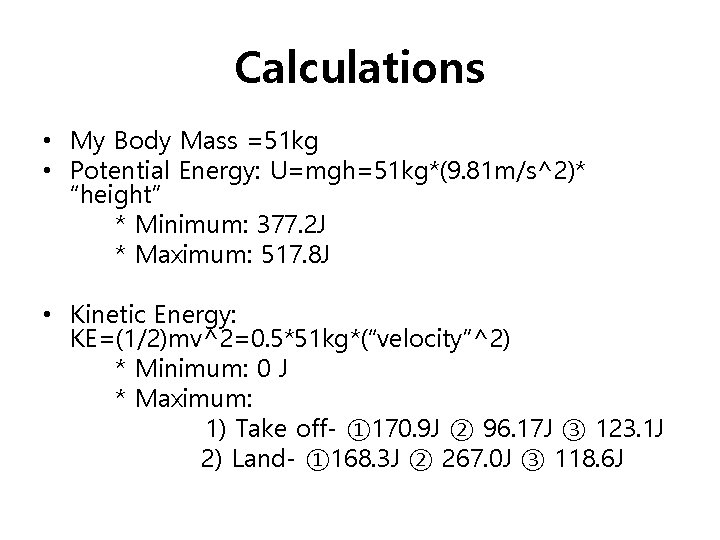
Calculations • My Body Mass =51 kg • Potential Energy: U=mgh=51 kg*(9. 81 m/s^2)* “height” * Minimum: 377. 2 J * Maximum: 517. 8 J • Kinetic Energy: KE=(1/2)mv^2=0. 5*51 kg*(“velocity”^2) * Minimum: 0 J * Maximum: 1) Take off- ① 170. 9 J ② 96. 17 J ③ 123. 1 J 2) Land- ① 168. 3 J ② 267. 0 J ③ 118. 6 J
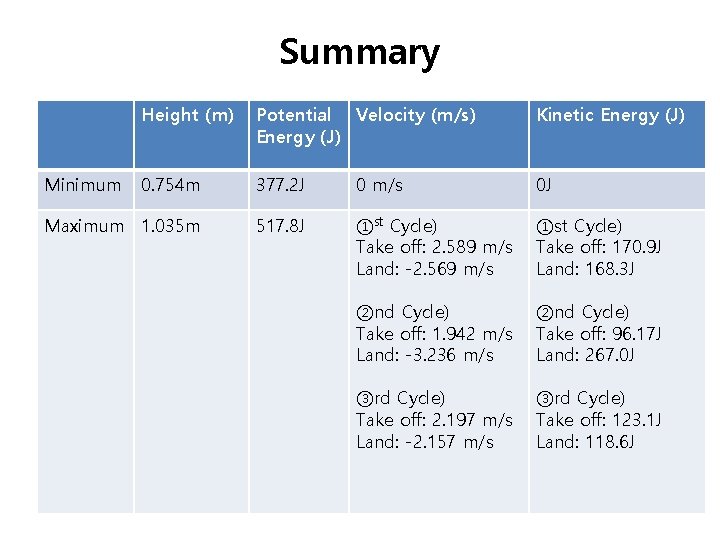
Summary Height (m) Potential Velocity (m/s) Energy (J) Kinetic Energy (J) 0. 754 m 377. 2 J 0 m/s 0 J Maximum 1. 035 m 517. 8 J ①st Cycle) Take off: 2. 589 m/s Land: -2. 569 m/s ①st Cycle) Take off: 170. 9 J Land: 168. 3 J ②nd Cycle) Take off: 1. 942 m/s Land: -3. 236 m/s ②nd Cycle) Take off: 96. 17 J Land: 267. 0 J ③rd Cycle) Take off: 2. 197 m/s Land: -2. 157 m/s ③rd Cycle) Take off: 123. 1 J Land: 118. 6 J Minimum
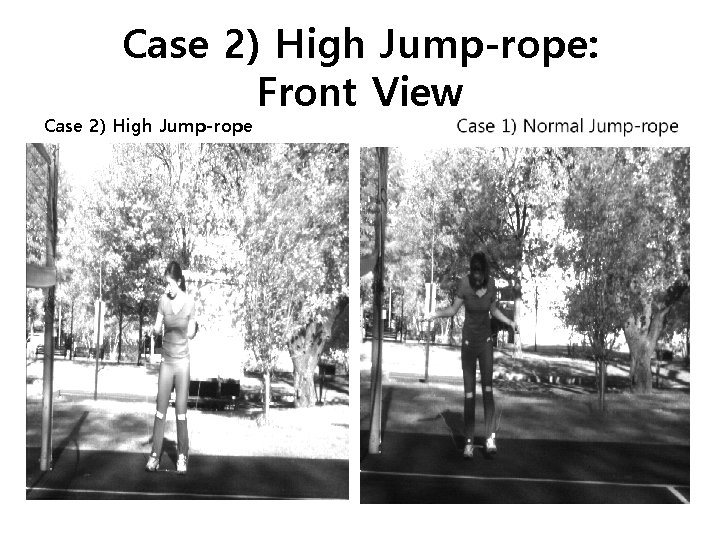
Case 2) High Jump-rope: Front View Case 2) High Jump-rope
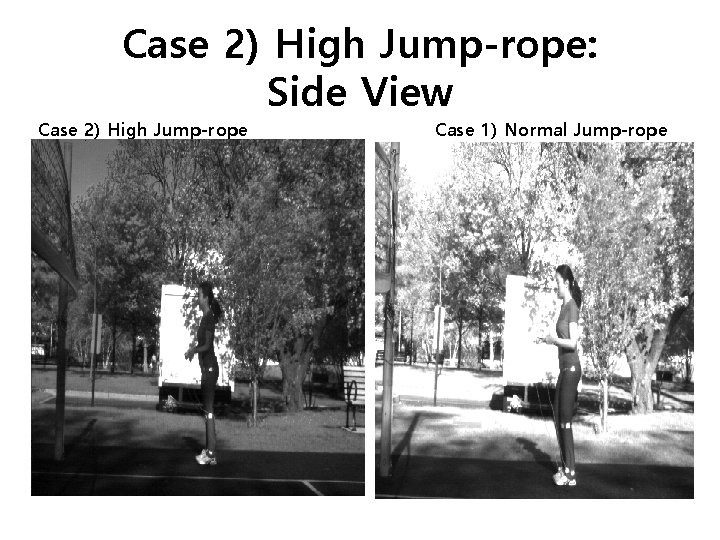
Case 2) High Jump-rope: Side View Case 2) High Jump-rope Case 1) Normal Jump-rope

Additional Background Information • Howard Stone, a professor of mechanical and aerospace engineering at Princeton university found out interesting fact about aerodynamics of a moving jump rope. He devised a mathematical model that captures the rope’s bending action. Then, he discovered that the middle of the rope, which moves faster than the ends, bent away from the direction of motion.
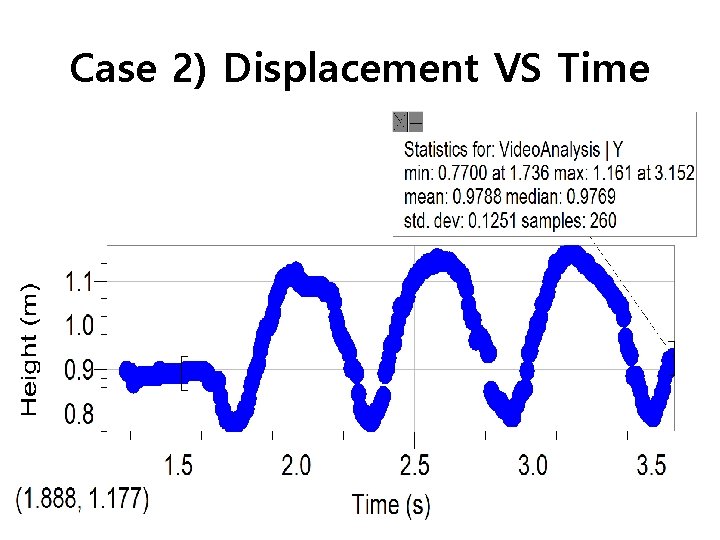
Case 2) Displacement VS Time
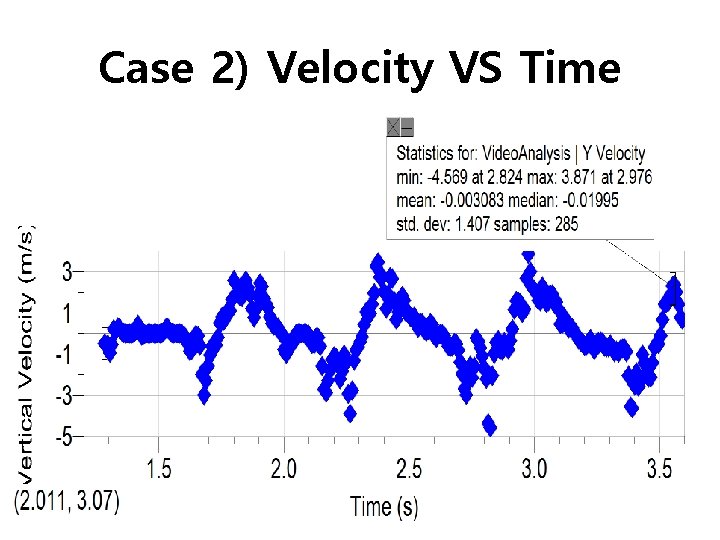
Case 2) Velocity VS Time
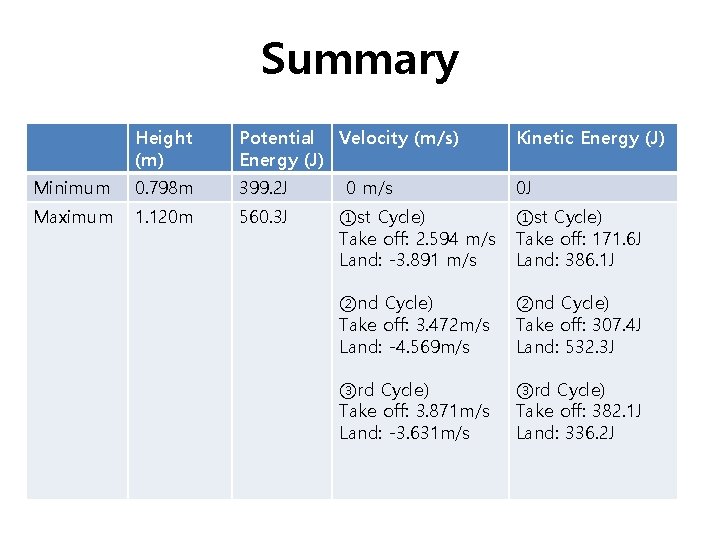
Summary Height (m) Potential Velocity (m/s) Energy (J) Kinetic Energy (J) Minimum 0. 798 m 399. 2 J 0 J Maximum 1. 120 m 560. 3 J 0 m/s ①st Cycle) Take off: 2. 594 m/s Land: -3. 891 m/s ①st Cycle) Take off: 171. 6 J Land: 386. 1 J ②nd Cycle) Take off: 3. 472 m/s Land: -4. 569 m/s ②nd Cycle) Take off: 307. 4 J Land: 532. 3 J ③rd Cycle) Take off: 3. 871 m/s Land: -3. 631 m/s ③rd Cycle) Take off: 382. 1 J Land: 336. 2 J
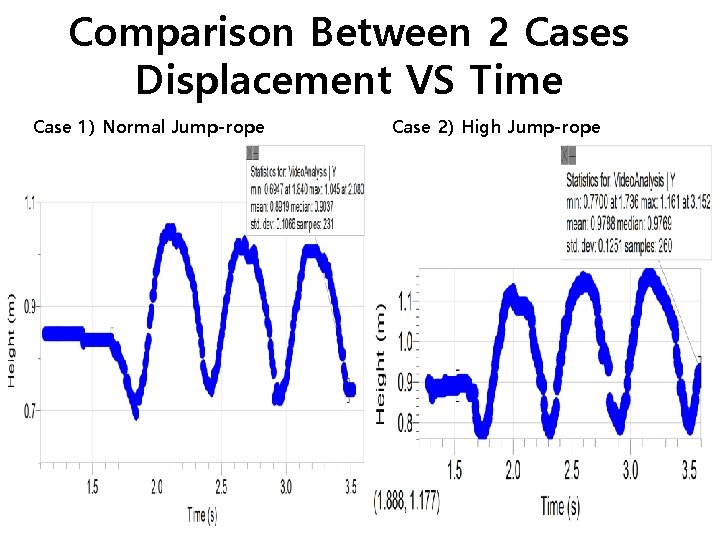
Comparison Between 2 Cases Displacement VS Time Case 1) Normal Jump-rope Case 2) High Jump-rope
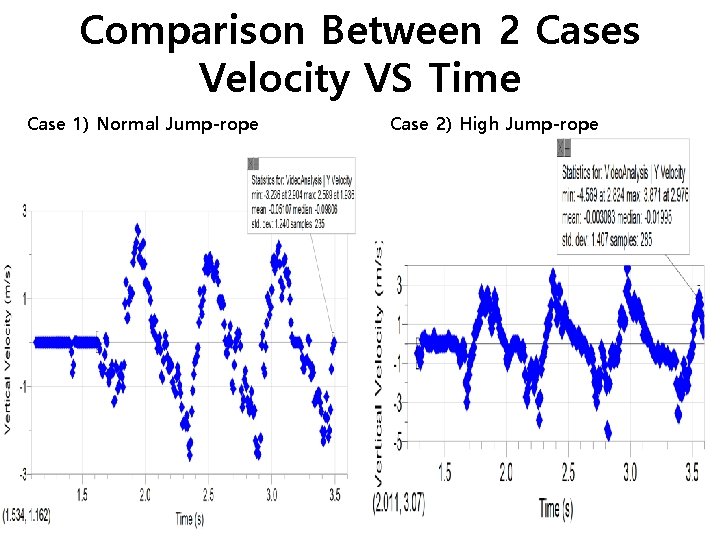
Comparison Between 2 Cases Velocity VS Time Case 1) Normal Jump-rope Case 2) High Jump-rope
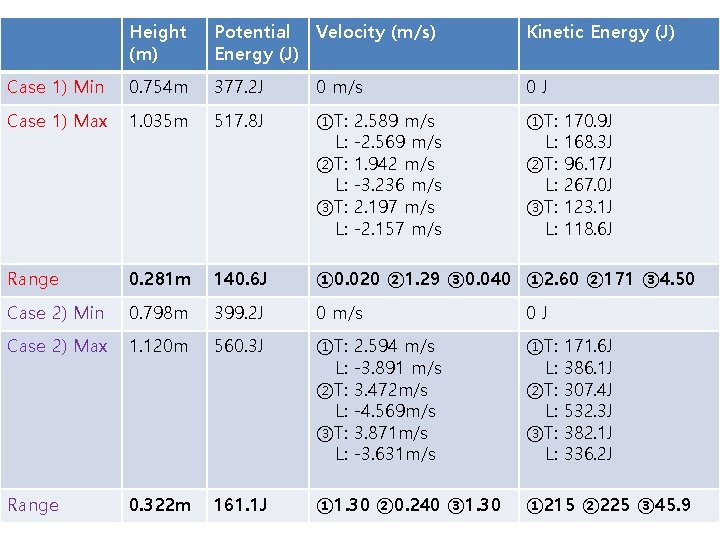
Height (m) Potential Velocity (m/s) Energy (J) Kinetic Energy (J) Case 1) Min 0. 754 m 377. 2 J 0 m/s 0 J Case 1) Max 1. 035 m 517. 8 J ①T: L: ②T: L: ③T: L: Range 0. 281 m 140. 6 J ① 0. 020 ② 1. 29 ③ 0. 040 ① 2. 60 ② 171 ③ 4. 50 Case 2) Min 0. 798 m 399. 2 J 0 m/s 0 J Case 2) Max 1. 120 m 560. 3 J ①T: L: ②T: L: ③T: L: Range 0. 322 m 161. 1 J ① 1. 30 ② 0. 240 ③ 1. 30 2. 589 m/s -2. 569 m/s 1. 942 m/s -3. 236 m/s 2. 197 m/s -2. 157 m/s 2. 594 m/s -3. 891 m/s 3. 472 m/s -4. 569 m/s 3. 871 m/s -3. 631 m/s 170. 9 J 168. 3 J 96. 17 J 267. 0 J 123. 1 J 118. 6 J 171. 6 J 386. 1 J 307. 4 J 532. 3 J 382. 1 J 336. 2 J ① 215 ② 225 ③ 45. 9
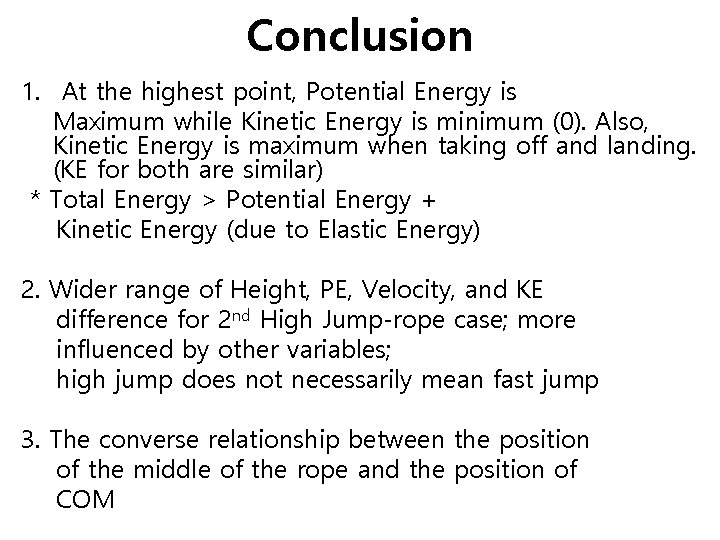
Conclusion 1. At the highest point, Potential Energy is Maximum while Kinetic Energy is minimum (0). Also, Kinetic Energy is maximum when taking off and landing. (KE for both are similar) * Total Energy > Potential Energy + Kinetic Energy (due to Elastic Energy) 2. Wider range of Height, PE, Velocity, and KE difference for 2 nd High Jump-rope case; more influenced by other variables; high jump does not necessarily mean fast jump 3. The converse relationship between the position of the middle of the rope and the position of COM

Clinical Significance JUMPING IS KINDER ON • Cardiovascular Endurance YOUR JOINTS THAN RUNNING (Arrhythmia; Jump Rope for Heart) & Muscular Endurance • Run: each foot absorbs up to 5 • Spatial Awareness, Reading Skills, times body weight from the force Memory, and Mental Alertness of impact as they hit the ground. (hemispheres of the brain) (heel) • Improves Dynamic Balance and injury to your feet, ankles, hips, Coordination, Reflexes, Bone and knees if you overdo it. density Jump roping: the impact is (balls of the feet absorbed by both feet (balls of make neural muscular adjustments feet), letting calf muscles help to imbalances created from control the impact. continuous jumping ) • American College of Sports Medicine: to improve heart health, people should skip rope at least 3~5 times a week for 12 to 20 minutes. • 10 minutes non-stop Jump-roping = 1 mile run =18 holes of golf = 2 sets of tennis singles =720 yards of swimming
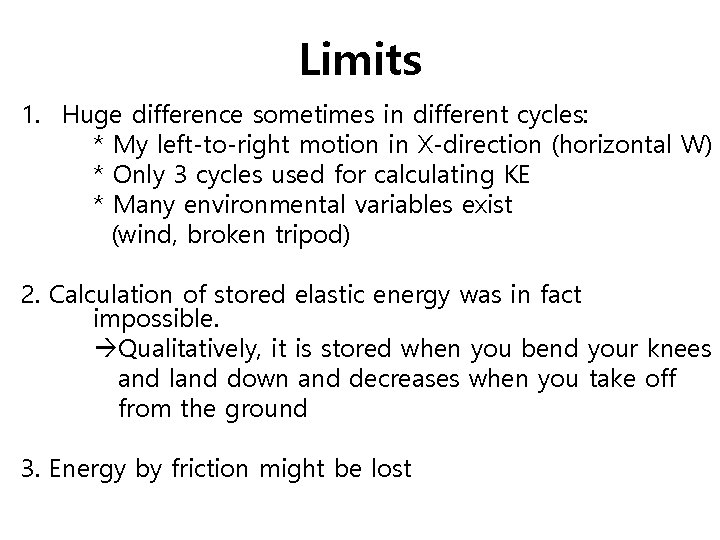
Limits 1. Huge difference sometimes in different cycles: * My left-to-right motion in X-direction (horizontal W) * Only 3 cycles used for calculating KE * Many environmental variables exist (wind, broken tripod) 2. Calculation of stored elastic energy was in fact impossible. Qualitatively, it is stored when you bend your knees and land down and decreases when you take off from the ground 3. Energy by friction might be lost
Future Study Questions 1. Measuring the value of stored elastic energy 2. Comparison in impact between running and jump-rope 3. Making other variables constant (ex: wind-experimenting inside with a lot of light) 4. Designing objects moving through the air by engineers 5. Angular momentum of Jump-rope

For those who are interested in • USA Jump Rope (USAJR): hundreds of teams and jumpers all over the country • Athletes of all ages, but mostly graduate school to high school-aged people • Compete against each other every June

Reference * Content: • Campus Note Book, FYI: Findings. March 7. Princeton Alumni Weekly, 2012. 21. Print. (http: //paw. princeton. edu/issues/2012/03/07/pages/0811/index. xml) • Rudd, Johnny. "Exercise Jump Rope. ". United States Patent, 19061990. Web. 18 Apr 2012. <http: //www. google. com/patents? hl=ko&lr=&vid=USPAT 4934691&id=_f 8 g. AAAAEBAJ &oi=fnd&dq=jump-rope muscle&printsec=abstract> • Jump Rope Institute: http: //www. jumpropeinstitute. com/benefits. htm • Jump Rope for Heart: http: //www. aahperd. org/jump/aboutjump/ • Muscles Involved in Jump-rope: http: //www. youtube. com/watch? v=io. A 1 wfq 7 vcg • Logger Pro 3. 8. 3 * Images: • http: //www. livestrong. com/article/25493 -muscles-used-jump-rope/ • http: //www. wikihow. com/Jump-Rope • http: //www. foothillforce. com/images/photos/class. May 2010. jpg • http: //www. jumpropeinstitute. com/kids. htm • http: //www. divavillage. com/article/id/43668/section_name/Food+%26+Fitness/title/Ju mp+Rope+for+Fitness/pg/1 • http: //www. stretchingworld. com/anterior_deltiod_stretches. html
- Slides: 30