
BIOMECHANICS FLUID MECHANICS STUDENTS LEARN ABOUT Flotation centre
BIOMECHANICS – FLUID MECHANICS STUDENTS LEARN ABOUT: • Flotation, centre of buoyancy • Fluid resistance • • STUDENTS LEARN TO: Apply principles of fluid mechanics to enhance performance through participation in practical workshops Explore how principles of fluid mechanics have influenced changes in movement and performance, eg technique, modification, clothing/suits, equipment/apparatus
What is Fluid Mechanics �Fluid mechanics is concerned with properties of gases and liquids. �An understanding of fluid mechanics is important for performance improvement because physical activities such as running, throwing and swimming all take place in fluid environments, be it air, water or a combination of both.
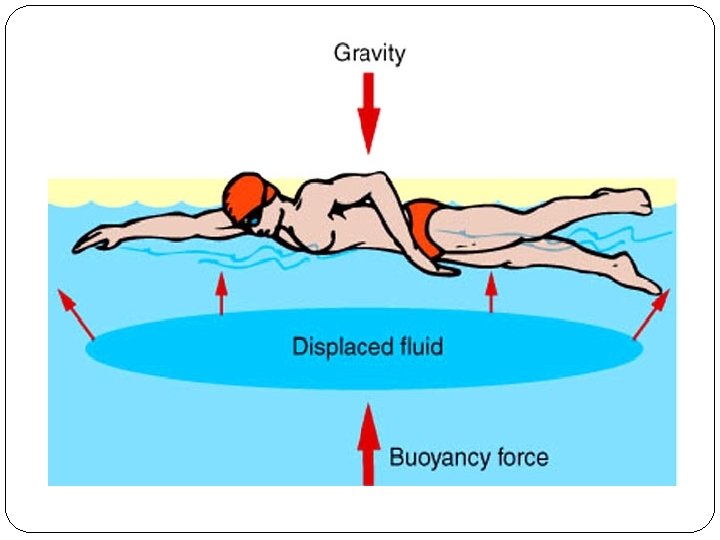
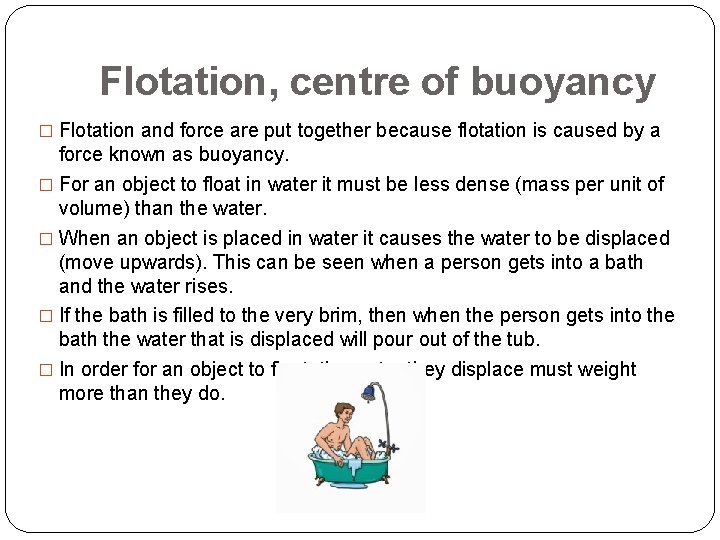
Flotation, centre of buoyancy � Flotation and force are put together because flotation is caused by a force known as buoyancy. � For an object to float in water it must be less dense (mass per unit of volume) than the water. � When an object is placed in water it causes the water to be displaced (move upwards). This can be seen when a person gets into a bath and the water rises. � If the bath is filled to the very brim, then when the person gets into the bath the water that is displaced will pour out of the tub. � In order for an object to float, the water they displace must weight more than they do.
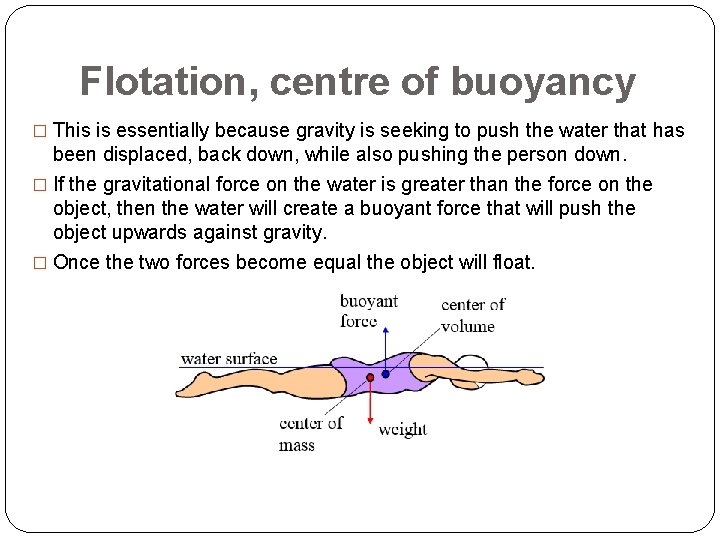
Flotation, centre of buoyancy � This is essentially because gravity is seeking to push the water that has been displaced, back down, while also pushing the person down. � If the gravitational force on the water is greater than the force on the object, then the water will create a buoyant force that will push the object upwards against gravity. � Once the two forces become equal the object will float.

Flotation, centre of buoyancy � The centre of buoyancy is the centre point of the mass below the water and is the point through which the buoyant force acts. � In order for the object to not rotate in the water this buoyant force must pass through the center of mass of the object, if they do not line up the object will rotate until they do, such that one end of the object will sink further while the other end raises.
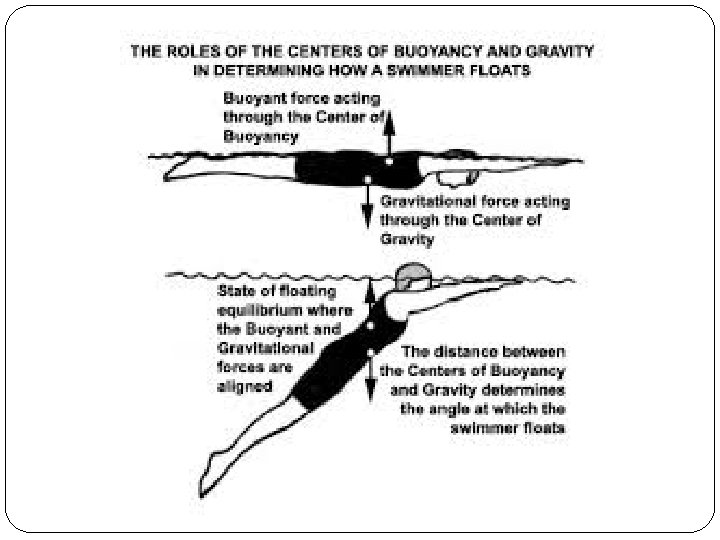

Flotation, centre of buoyancy �For an object to have less gravitational force than the water it displaces it must be less dense than the water. �Flotation and centre of buoyancy relate to performance because the higher an object floats in the water, the less resistance the water will create to its movement. �This applies to all water sports, including: surfing, kayaking, sailing, skiing, dragon boat racing, water polo, synchronised swimming, and swimming.
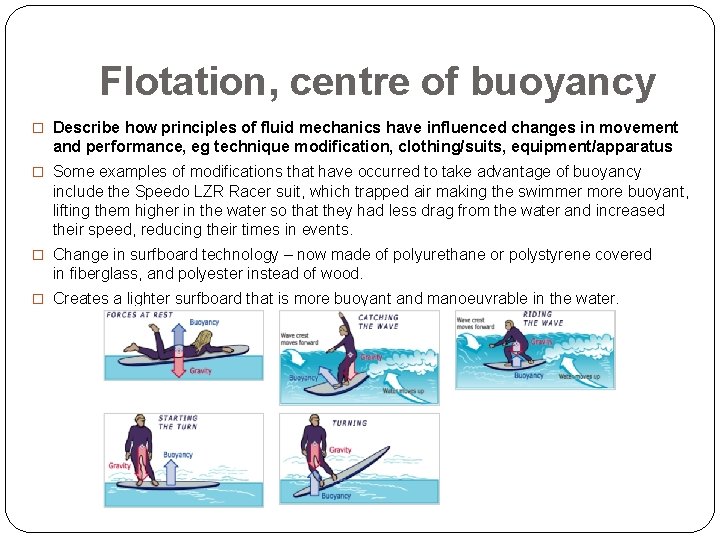
Flotation, centre of buoyancy � Describe how principles of fluid mechanics have influenced changes in movement and performance, eg technique modification, clothing/suits, equipment/apparatus � Some examples of modifications that have occurred to take advantage of buoyancy include the Speedo LZR Racer suit, which trapped air making the swimmer more buoyant, lifting them higher in the water so that they had less drag from the water and increased their speed, reducing their times in events. � Change in surfboard technology – now made of polyurethane or polystyrene covered in fiberglass, and polyester instead of wood. � Creates a lighter surfboard that is more buoyant and manoeuvrable in the water.
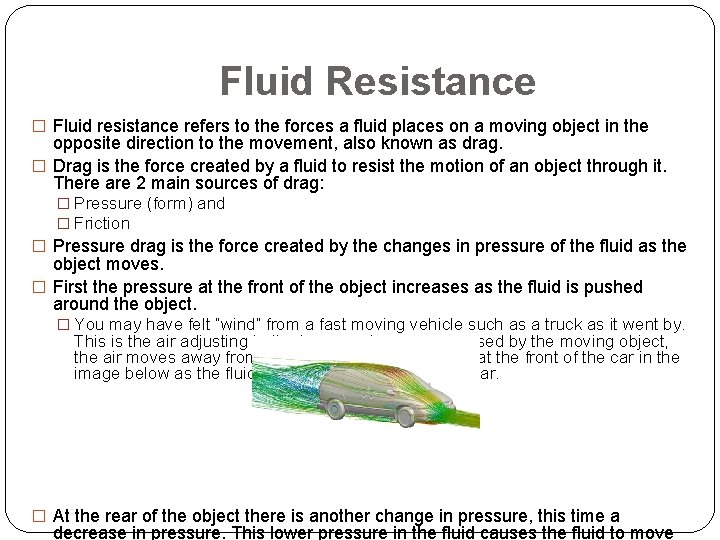
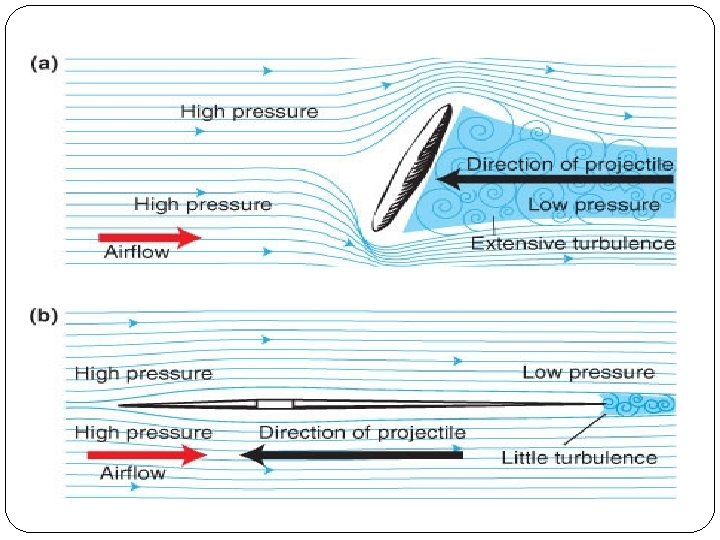
Fluid Resistance � Fluid resistance refers to the forces a fluid places on a moving object in the opposite direction to the movement, also known as drag. � Drag is the force created by a fluid to resist the motion of an object through it. There are 2 main sources of drag: � Pressure (form) and � Friction � Pressure drag is the force created by the changes in pressure of the fluid as the object moves. � First the pressure at the front of the object increases as the fluid is pushed around the object. � You may have felt “wind” from a fast moving vehicle such as a truck as it went by. This is the air adjusting to the increased pressure caused by the moving object, the air moves away from the object. You can see this at the front of the car in the image below as the fluid separates to move over the car. � At the rear of the object there is another change in pressure, this time a decrease in pressure. This lower pressure in the fluid causes the fluid to move
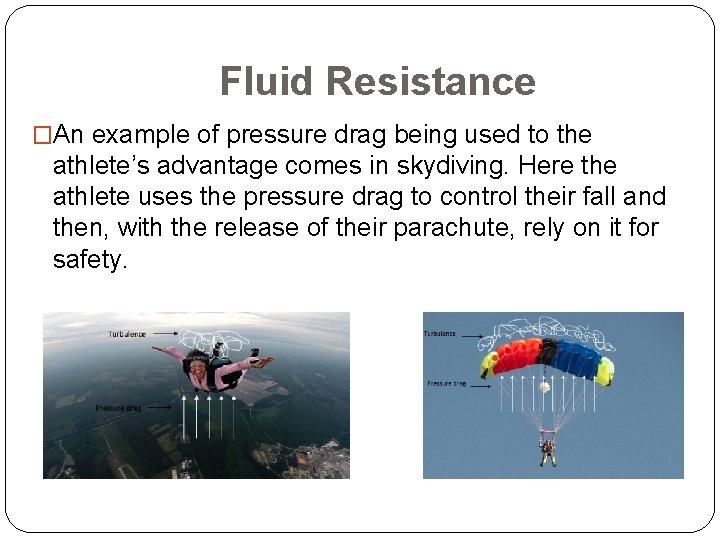
Fluid Resistance �An example of pressure drag being used to the athlete’s advantage comes in skydiving. Here the athlete uses the pressure drag to control their fall and then, with the release of their parachute, rely on it for safety.

Drag Forces
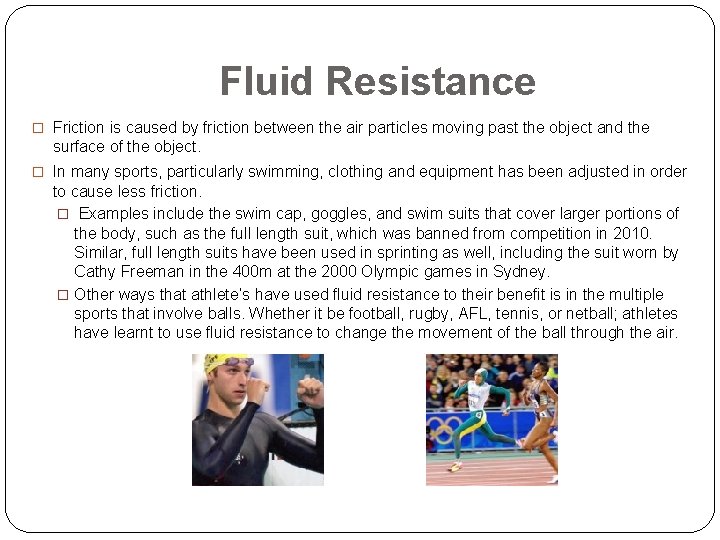
Fluid Resistance � Friction is caused by friction between the air particles moving past the object and the surface of the object. � In many sports, particularly swimming, clothing and equipment has been adjusted in order to cause less friction. � Examples include the swim cap, goggles, and swim suits that cover larger portions of the body, such as the full length suit, which was banned from competition in 2010. Similar, full length suits have been used in sprinting as well, including the suit worn by Cathy Freeman in the 400 m at the 2000 Olympic games in Sydney. � Other ways that athlete’s have used fluid resistance to their benefit is in the multiple sports that involve balls. Whether it be football, rugby, AFL, tennis, or netball; athletes have learnt to use fluid resistance to change the movement of the ball through the air.
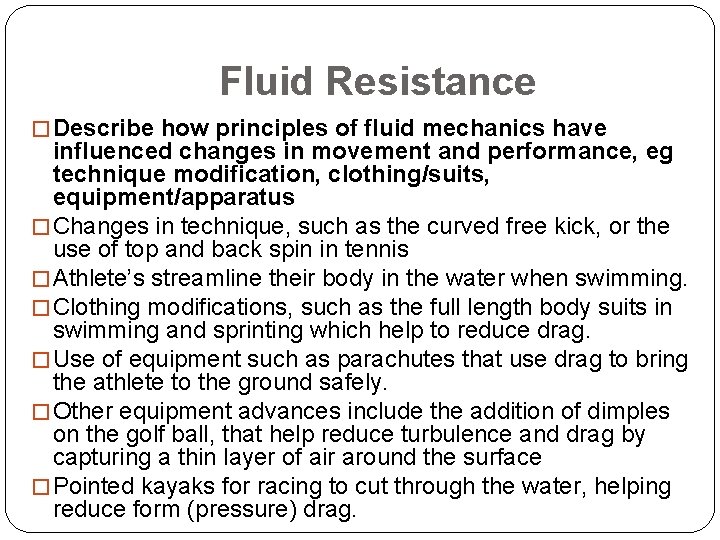
Fluid Resistance � Describe how principles of fluid mechanics have influenced changes in movement and performance, eg technique modification, clothing/suits, equipment/apparatus � Changes in technique, such as the curved free kick, or the use of top and back spin in tennis � Athlete’s streamline their body in the water when swimming. � Clothing modifications, such as the full length body suits in swimming and sprinting which help to reduce drag. � Use of equipment such as parachutes that use drag to bring the athlete to the ground safely. � Other equipment advances include the addition of dimples on the golf ball, that help reduce turbulence and drag by capturing a thin layer of air around the surface � Pointed kayaks for racing to cut through the water, helping reduce form (pressure) drag.
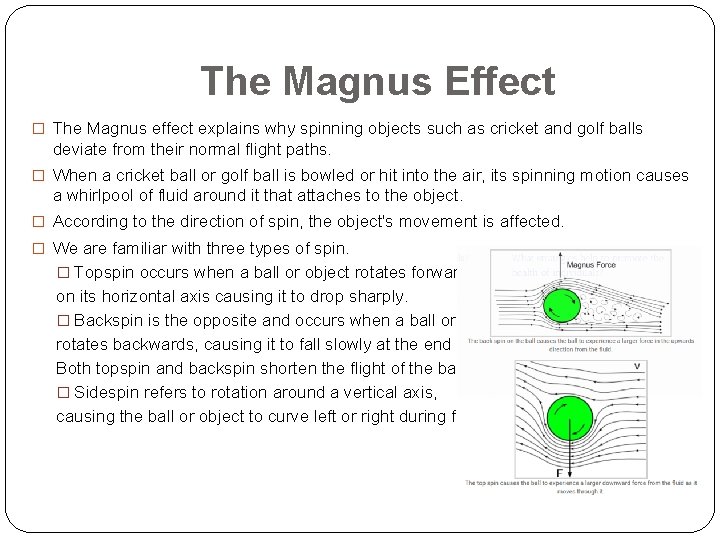
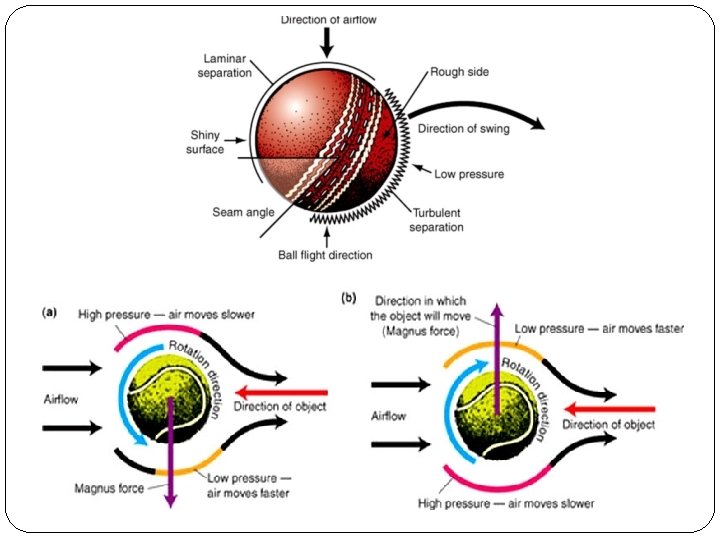
The Magnus Effect � The Magnus effect explains why spinning objects such as cricket and golf balls deviate from their normal flight paths. � When a cricket ball or golf ball is bowled or hit into the air, its spinning motion causes a whirlpool of fluid around it that attaches to the object. � According to the direction of spin, the object's movement is affected. � We are familiar with three types of spin. � Topspin occurs when a ball or object rotates forward on its horizontal axis causing it to drop sharply. � Backspin is the opposite and occurs when a ball or object rotates backwards, causing it to fall slowly at the end of flight. Both topspin and backspin shorten the flight of the ball. � Sidespin refers to rotation around a vertical axis, causing the ball or object to curve left or right during flight.
QUESTIONS �Explain how flotation can occur. 3 marks �What is fluid resistance and how does it affect performance in both land aquatic sport. 5 marks �Describe how a modification in technique, apparel, or equipment using the principles of fluid mechanics has allowed for increases in performance. 8 marks
- Slides: 18