
Biomechanics 4 Kinematics 1 Daniel Jandaka Ph D
Biomechanics 4 Kinematics 1 Daniel Jandačka, Ph. D. Projekt: Cizí jazyky v kinantropologii - CZ. 1. 07/2. 2. 00/15. 0199
Kinematics describes the motion of bodies • In sport and physical exercise we need to describe motor skills for the purposes of teaching, training and skills evaluation. • Moreover, the results in many sport disciplnes actually have the form of kinematic measures.

Motion is the process of changing position. Motion of a body can be described only if we know its position with respect to time. In order to study motion more easily, we classify motion as 1. linear 2. rotary 3. general.

Linear Motion In linear motion all particles of human body travel the same distance during the same time.
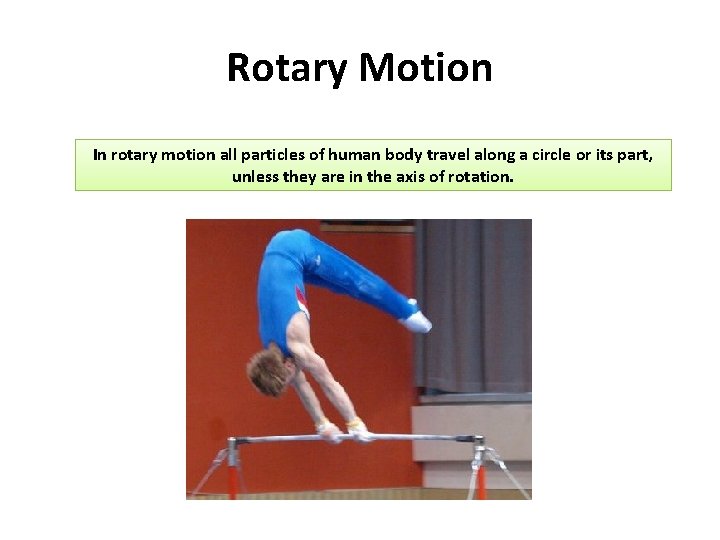
Rotary Motion In rotary motion all particles of human body travel along a circle or its part, unless they are in the axis of rotation.

General Motion General motion is a combination of linear and rotary motions. If we resolve general motion into linear and rotary motions, it is easier to analyze.
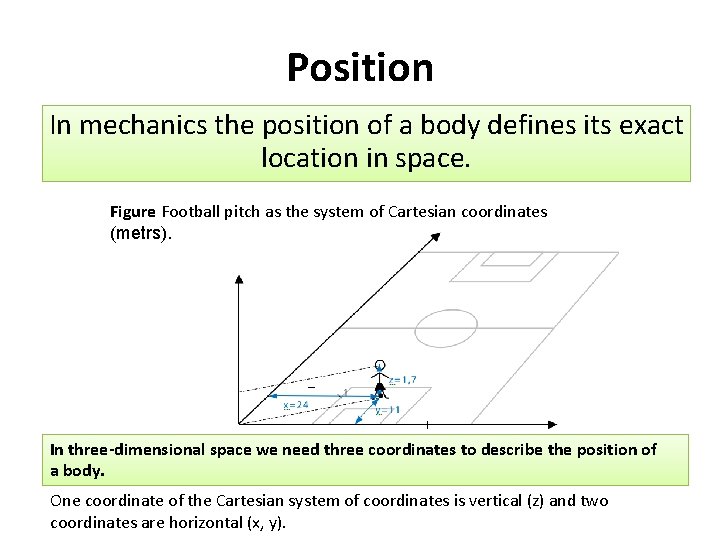
Position In mechanics the position of a body defines its exact location in space. Figure Football pitch as the system of Cartesian coordinates (metrs). In three-dimensional space we need three coordinates to describe the position of a body. One coordinate of the Cartesian system of coordinates is vertical (z) and two coordinates are horizontal (x, y).

Trajectory is the path that a moving object follows through space.
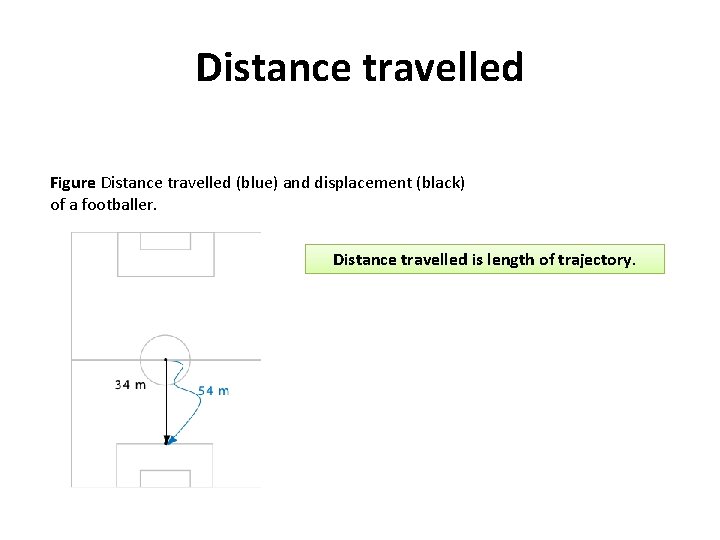
Distance travelled Figure Distance travelled (blue) and displacement (black) of a footballer. Distance travelled is length of trajectory.

Displacement is the shortest distance in the specific direction from the initial to the final position of a body’s motion. Displacement is a vector with both the length and direction. The unit of measure is metre (m) and the symbol used is d.

Thank you for your attention Projekt: Cizí jazyky v kinantropologii - CZ. 1. 07/2. 2. 00/15. 0199
- Slides: 11