
Biomechanical evaluation of Lifting Techniques Among Untrained Trained
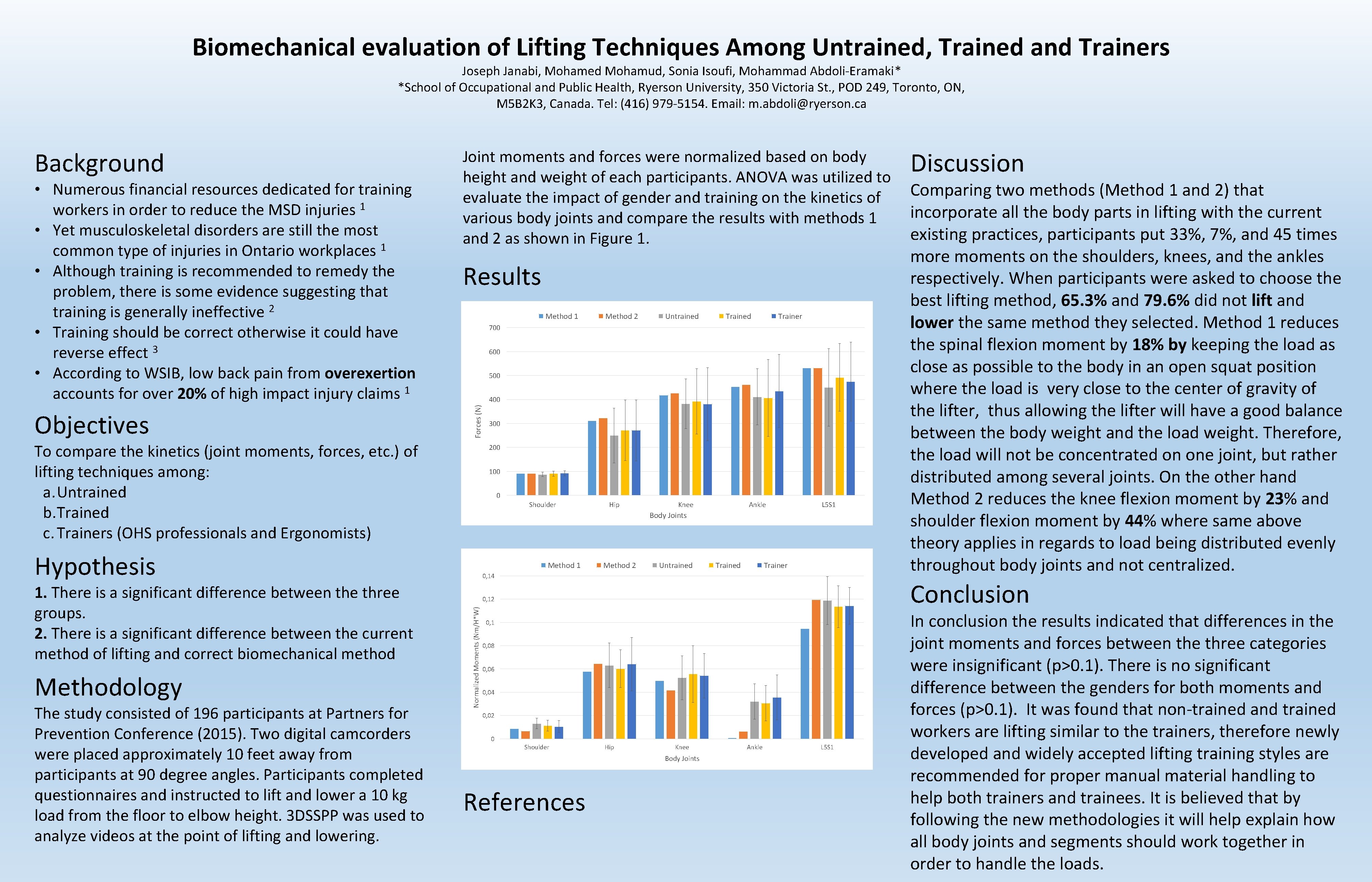
Biomechanical evaluation of Lifting Techniques Among Untrained, Trained and Trainers Joseph Janabi, Mohamed Mohamud, Sonia Isoufi, Mohammad Abdoli-Eramaki* *School of Occupational and Public Health, Ryerson University, 350 Victoria St. , POD 249, Toronto, ON, M 5 B 2 K 3, Canada. Tel: (416) 979 -5154. Email: m. abdoli@ryerson. ca • Numerous financial resources dedicated for training workers in order to reduce the MSD injuries 1 • Yet musculoskeletal disorders are still the most common type of injuries in Ontario workplaces 1 • Although training is recommended to remedy the problem, there is some evidence suggesting that training is generally ineffective 2 • Training should be correct otherwise it could have reverse effect 3 • According to WSIB, low back pain from overexertion accounts for over 20% of high impact injury claims 1 Objectives Results Method 1 Trainer 400 300 200 100 0 Shoulder Hip Knee Ankle L 5 S 1 Body Joints Method 1 Method 2 Untrained Trainer 0, 14 Discussion Comparing two methods (Method 1 and 2) that incorporate all the body parts in lifting with the current existing practices, participants put 33%, 7%, and 45 times more moments on the shoulders, knees, and the ankles respectively. When participants were asked to choose the best lifting method, 65. 3% and 79. 6% did not lift and lower the same method they selected. Method 1 reduces the spinal flexion moment by 18% by keeping the load as close as possible to the body in an open squat position where the load is very close to the center of gravity of the lifter, thus allowing the lifter will have a good balance between the body weight and the load weight. Therefore, the load will not be concentrated on one joint, but rather distributed among several joints. On the other hand Method 2 reduces the knee flexion moment by 23% and shoulder flexion moment by 44% where same above theory applies in regards to load being distributed evenly throughout body joints and not centralized. Conclusion 0, 12 Normalized Moments (Nm/H*W) The study consisted of 196 participants at Partners for Prevention Conference (2015). Two digital camcorders were placed approximately 10 feet away from participants at 90 degree angles. Participants completed questionnaires and instructed to lift and lower a 10 kg load from the floor to elbow height. 3 DSSPP was used to analyze videos at the point of lifting and lowering. Trained 500 Hypothesis Methodology Untrained 600 To compare the kinetics (joint moments, forces, etc. ) of lifting techniques among: a. Untrained b. Trained c. Trainers (OHS professionals and Ergonomists) 1. There is a significant difference between the three groups. 2. There is a significant difference between the current method of lifting and correct biomechanical method Method 2 700 Forces (N) Background Joint moments and forces were normalized based on body height and weight of each participants. ANOVA was utilized to evaluate the impact of gender and training on the kinetics of various body joints and compare the results with methods 1 and 2 as shown in Figure 1. 0, 1 0, 08 0, 06 0, 04 0, 02 0 Shoulder Hip Knee Body Joints References Ankle L 5 S 1 In conclusion the results indicated that differences in the joint moments and forces between the three categories were insignificant (p>0. 1). There is no significant difference between the genders for both moments and forces (p>0. 1). It was found that non-trained and trained workers are lifting similar to the trainers, therefore newly developed and widely accepted lifting training styles are recommended for proper manual material handling to help both trainers and trainees. It is believed that by following the new methodologies it will help explain how all body joints and segments should work together in order to handle the loads.
- Slides: 1